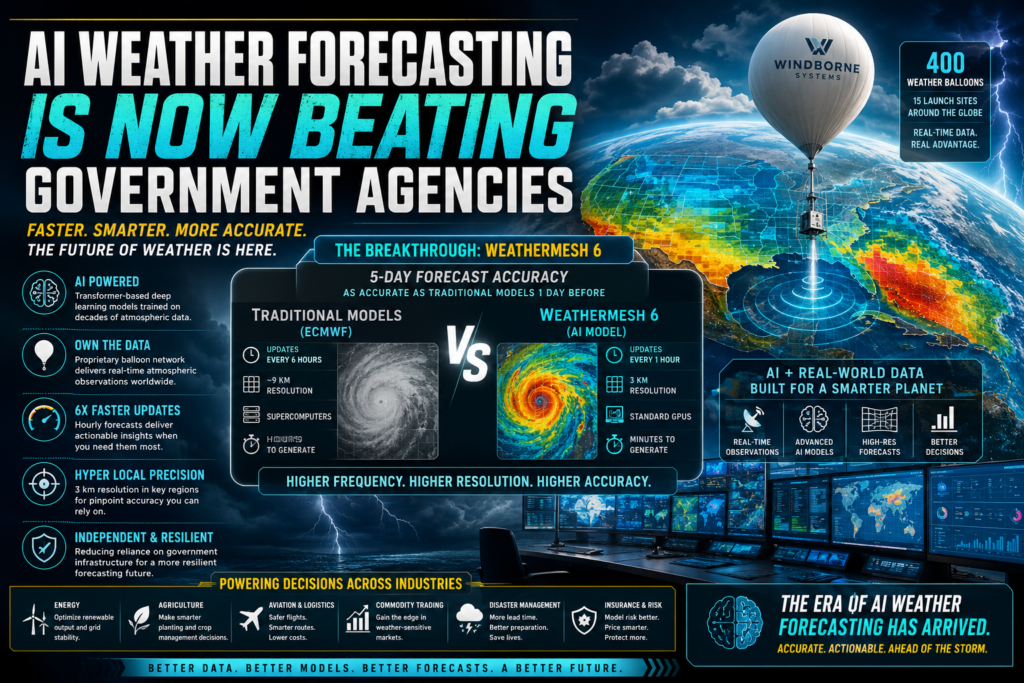
AI weather forecasting has crossed a critical threshold: a private startup can now predict the weather more accurately than the world’s top government meteorological organizations. WindBorne Systems, a Stanford-founded company, released WeatherMesh 6 on June 1, 2026 — a deep learning model that outperforms the European Centre for Medium-Range Weather Forecasting (ECMWF), the gold standard of global weather prediction, across multiple key variables.
This is not a minor improvement. It is a structural shift in how weather knowledge is produced, who controls it, and what it means for industries that live and die by forecast accuracy.
What Is AI Weather Forecasting?
AI weather forecasting is the application of machine learning — particularly deep learning models trained on large atmospheric datasets — to predict weather conditions more quickly, cheaply, and at higher frequency than traditional physics-based models.
Traditional forecasting relies on numerical weather prediction (NWP): complex systems of differential equations that simulate the atmosphere using supercomputers. These models are extraordinarily powerful but take hours to run, update only every six hours, and are expensive to operate. They are the domain of large intergovernmental agencies like the ECMWF or the U.S. National Oceanic and Atmospheric Administration (NOAA).
AI weather forecasting changes this equation. Where NWP models simulate the physics of the atmosphere from first principles, AI models learn patterns directly from decades of historical weather data. The result is a system that can generate forecasts in minutes rather than hours, run on comparatively modest hardware, and — as of 2026 — match or exceed the accuracy of traditional methods.
The key players in AI weather forecasting include Google DeepMind (GraphCast), Huawei (Pangu-Weather), and a growing field of startups, with WindBorne Systems now emerging as a compelling leader.
How WindBorne Systems Beat Government Forecasts
The WeatherMesh 6 Model
WeatherMesh 6 is WindBorne’s sixth-generation AI weather forecasting model and its most significant release to date. According to WindBorne’s chief product officer Kai Marshland, the model is “as accurate five days out as a traditional forecast is the day before” — specifically on surface temperature measurements.
To put that in concrete terms: when a traditional model tells you what tomorrow will look like, WeatherMesh 6 can tell you what next Tuesday will look like with equivalent reliability. That is a roughly five-day extension of actionable forecast accuracy.
Key capabilities of WeatherMesh 6 include:
- Hourly forecasts — WeatherMesh 6 updates predictions every hour, compared to the six-hour cycle of traditional models.
- 3 km resolution — In Europe and the continental United States, the model resolves atmospheric conditions at a 3-kilometer grid scale, enabling highly localized predictions.
- Multi-variable superiority — WindBorne claims WeatherMesh 6 outperforms both the ECMWF’s traditional numerical model and the ECMWF’s own AI system across several forecast variables.
- Transformer-based architecture — The model uses a transformer neural network, the same foundational architecture behind large language models like GPT and Claude, adapted for atmospheric science.
It took a year of tuning and re-architecting the model to deliver these results without losing stability — a challenge that WindBorne’s head of AI, Joan Creus-Costa, attributes to the complexity of directly ingesting raw observational data into the model.
The Data Advantage: 400 Balloons in Flight
The breakthrough behind WeatherMesh 6 is not just the model architecture — it is the data pipeline feeding it.
WindBorne operates a fleet of roughly 400 weather balloons in continuous flight, launched from 15 sites around the globe. These balloons collect real-time atmospheric sensor readings at multiple altitude levels and transmit them directly into the WeatherMesh modeling pipeline.
This matters enormously because of a process called data assimilation — the work of converting raw, disparate sensor readings from satellites, radiosondes, ships, aircraft, and ground stations into a clean, machine-readable “initial condition” of the atmosphere. The ECMWF’s legendary superiority in weather forecasting is largely attributed to its unmatched skill at data assimilation.
Historically, AI weather forecasting models — including early versions of WeatherMesh — depended on data assimilation outputs from the ECMWF and NOAA to start their predictions. They were, in effect, parasitic on government data infrastructure. WindBorne’s balloon network changes that dependency.
“When we started doing [data assimilation] we were still very heavily reliant on ECMWF,” WindBorne CEO John Dean said. “I predict today, if we removed ECMWF’s initial conditions, we would actually still do pretty good.”
This represents a strategic moat that WindBorne has deliberately cultivated. As Dean put it: “I don’t understand, personally, the business model of being [an] AI-based weather company without a data set advantage.”
AI vs. Traditional Weather Forecasting: A Direct Comparison
| Feature | Traditional NWP (e.g., ECMWF) | AI Weather Forecasting (e.g., WeatherMesh 6) |
|---|---|---|
| Update frequency | Every 6 hours | Every 1 hour |
| Compute required | Supercomputer clusters | Standard GPU infrastructure |
| Forecast speed | Hours to generate | Minutes to generate |
| Resolution (best) | ~9 km globally | 3 km (US/Europe) |
| Data dependency | Proprietary assimilation pipelines | Increasingly independent (balloon + satellite) |
| Long-range accuracy | High (established benchmark) | Matching/exceeding at 5+ day range |
| Variables covered | Comprehensive | Broad and expanding |
| Cost to operate | Very high | Comparatively low |
| Commercial licensing | Government-controlled | Startup / enterprise SaaS models |
The picture that emerges is not one of AI weather forecasting simply replacing traditional models — it is one of the two approaches converging, with AI systems rapidly closing the gaps that remained as of 2022 while opening new capabilities around frequency, cost, and independence.
Why Data Assimilation Is the Key Battleground in AI Weather Forecasting
Data assimilation is the process of merging real-world observations from many different sensors into a coherent, physically consistent model of the current state of the atmosphere. It is the foundation on which every weather forecast — AI or traditional — is built.
For decades, this process has been the exclusive domain of major government agencies. The ECMWF processes data from thousands of sensors — weather stations, weather balloons, commercial aircraft, ocean buoys, and weather satellites — using sophisticated mathematical techniques to produce its analysis fields. These fields are then used to initialize forecast models.
The reason this matters for AI weather forecasting is that a model is only as good as the state it starts from. A brilliantly trained neural network fed a poor initial atmospheric state will produce an inaccurate forecast. This is why early AI weather models, despite their architectural innovations, remained downstream of traditional infrastructure.
WindBorne’s approach is to solve this from the data side. By directly ingesting observations from its own balloon network — and working to assimilate data from other sources — the company is building toward a fully self-contained AI weather forecasting pipeline. This reduces dependence on government agencies, potentially enabling WindBorne to deliver forecasts even in scenarios where government data infrastructure is degraded or delayed.
The company has also addressed a notable operational risk: in 2025, a United Airlines jet made contact with one of its balloons, causing minor aircraft damage. WindBorne has since equipped its balloons with ADS-B transponders — the same system used by commercial aircraft for surveillance — so aviation systems can track balloon positions in real time and reduce the odds of future incidents.
Who Uses AI Weather Forecasting Today?
AI weather forecasting is no longer a research curiosity. It is being used operationally across a wide range of sectors, and its commercial and governmental adoption is accelerating.
Current users and use cases include:
- Government agencies — NOAA purchases balloon data from WindBorne for use in the American weather forecasting system. The U.S. Air Force and Navy are also WindBorne customers. Agencies around the world are actively working to integrate AI outputs into their operational forecast pipelines.
- Commodity traders and investors — Weather is among the largest drivers of commodity price volatility. WindBorne sells forecast access to traders seeking an information edge on agricultural, energy, and logistics markets.
- Aviation and logistics — High-frequency, high-resolution forecasts enable more precise flight planning, fuel optimization, and routing decisions.
- Energy grid operators — Wind and solar generation are highly weather-dependent. AI weather forecasting at 1-hour intervals and 3-km resolution gives grid operators dramatically better visibility into short-term generation capacity.
- Agriculture — Precision farming depends on localized weather knowledge; AI weather forecasting can deliver field-level predictions that traditional models cannot.
- Catastrophe risk modeling — Insurance and reinsurance industries use weather forecasting to price and manage extreme weather risk portfolios.
- Emergency management — Faster and more accurate AI weather forecasting gives emergency managers more lead time to issue warnings and deploy resources ahead of severe weather events.
The distribution of AI weather forecasting is also beginning to shift toward agent-based delivery. WindBorne CEO John Dean acknowledged this explicitly: “I’m not trying to invest a massive team into building a SaaS product, if the way people want consumer information two years from now is through an agent.”
What This Means for the Future of AI Weather Forecasting
The release of WeatherMesh 6 is a landmark in a broader transition, not an endpoint. Several important trends are likely to shape how AI weather forecasting evolves over the next three to five years.
The Death of the Six-Hour Cycle
Traditional weather models have long operated on six-hour analysis cycles — a constraint imposed by supercomputer scheduling and data processing time, not by the physical limits of the atmosphere. AI weather forecasting eliminates this constraint. Hourly forecasts are now possible; sub-hourly updates are likely as the technology matures. This matters most for fast-evolving weather events — thunderstorms, flash floods, and sudden wind shifts — where the difference between a two-hour and a six-hour warning can be the difference between safety and catastrophe.
The Convergence of AI and Physical Models
AI models and physics-based models are not necessarily in competition — they may be most powerful in combination. Researchers are exploring hybrid architectures that use AI to accelerate and extend NWP models rather than replace them. WindBorne’s approach of feeding raw observational data directly into the AI is one version of this convergence. AI weather forecasting’s future likely involves deeper integration with the physical sciences, not wholesale replacement of them.
The Privatization of Weather Infrastructure
The emergence of commercially viable AI weather forecasting carries genuine geopolitical implications. Weather has historically been treated as a public good — meteorological data is shared internationally through agreements that make global prediction possible. As private companies build independent data collection and modeling pipelines, questions arise about data sharing, access equity, and whether critical weather infrastructure should remain within the public sphere. WindBorne’s decision to sell forecast data to commodity traders is entirely rational from a business perspective, but it illustrates the tension between commercial weather intelligence and public weather safety.
Rapid Improvement Curves
AI weather forecasting in 2022 was impressive. In 2026, it is competitive with the world’s best government systems. The trajectory — driven by better training data, better architectures, and the compounding effect of real-world feedback — suggests continued rapid improvement. AI systems that lag behind today’s best models are likely to catch up within years, not decades.
Key Takeaways
The rise of AI weather forecasting — and WindBorne’s achievement with WeatherMesh 6 — can be summarized in five clear points:
- Accuracy milestone: AI weather forecasting has reached parity with — and in some variables surpassed — the ECMWF, the world’s most respected traditional forecasting agency.
- Frequency advantage: Hourly updates versus the traditional six-hour cycle represent a 6x improvement in forecast refresh rate.
- Data independence: The critical strategic move in AI weather forecasting is building proprietary data pipelines, not just better models.
- Commercial expansion: Government agencies, commodity traders, aviation, agriculture, and energy markets are all active adopters of AI weather forecasting.
- Future direction: AI weather forecasting will converge with traditional models, operate through agent-based interfaces, and gradually challenge the historical assumption that weather data is a pure public good.
The question for any organization or industry that depends on weather knowledge is no longer whether AI weather forecasting is good enough to rely on. It clearly is. The question is how quickly decision-makers will build systems and strategies to take advantage of it.