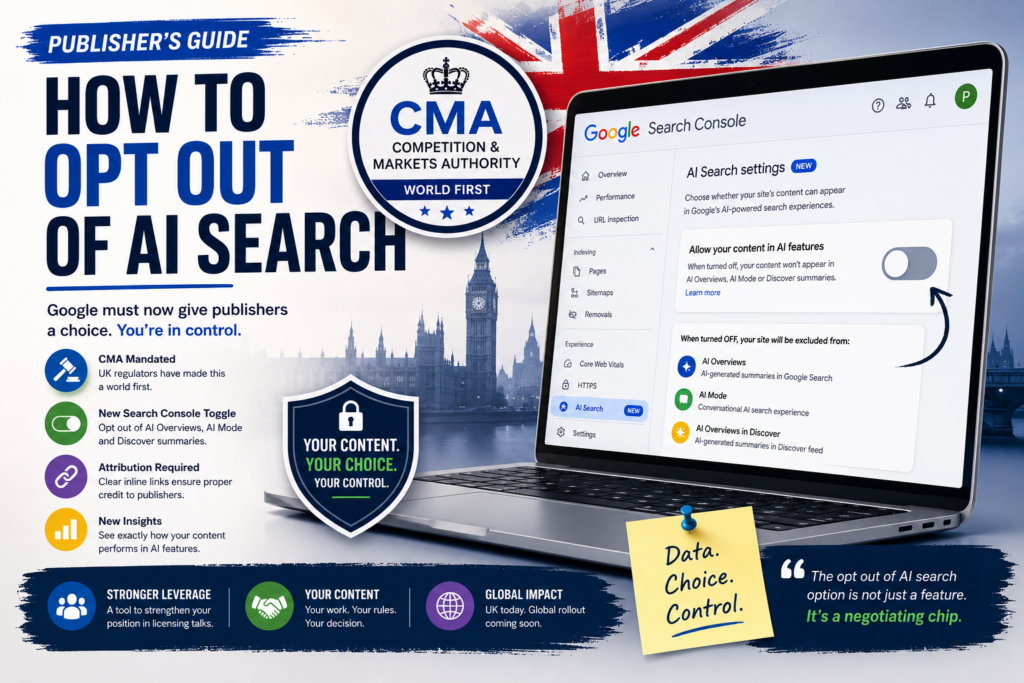
Publishers now have the legal right to opt out of AI search — and a concrete tool to do it. Thanks to a June 2026 ruling by the UK’s Competition and Markets Authority (CMA), Google must provide every website owner with a direct mechanism to exclude their content from AI-generated search features like AI Overviews and AI Mode.
This is not a minor policy tweak. It is the first regulation of its kind anywhere in the world, and it reshapes the relationship between content creators and the AI systems that profit from their work. Whether you run a major news outlet or a niche blog, understanding how this opt-out works — and whether you should use it — is now a core part of your digital strategy.
What Does “Opt Out of AI Search” Actually Mean?
Definition: To opt out of AI search means to formally instruct Google’s systems to exclude your website’s content from appearing within, or being used to generate, its generative AI-powered search features.
This is distinct from traditional SEO deindexing. When a publisher opts out of AI search, their pages can still appear in conventional blue-link Google results. The opt-out is scoped specifically to the AI layer — the generative layer that synthesizes and summarises web content to answer queries without requiring a click-through.
Before this regulation, publishers had no granular control over this. Robots.txt could block crawlers wholesale, but that was a blunt instrument — blocking all of Google or none of it. The new regime creates a middle path: remain in traditional search, exit the AI layer.
The Mechanism: The Google Search Console AI Toggle
The opt-out is delivered through a new toggle in Google Search Console, the free platform that website owners use to manage their presence in Google’s results.
Once a publisher activates the toggle, their site is removed from:
- AI Overviews — the AI-generated summaries that appear above traditional search results
- AI Mode — Google’s full conversational search interface, which has surpassed one billion monthly users
- AI Overviews in Discover — AI-generated summaries surfaced within the Google Discover feed
Google confirmed it will initially test the opt-out option with a subset of UK publishers before a global rollout. That means if you are a UK-based publisher, you may be among the first in the world to have access to this control.
What Gets Excluded — and What Doesn’t
A critical nuance: opting out of AI search does not affect your traditional search ranking. Google has explicitly stated that activating the opt-out toggle will not be used as a ranking signal for conventional web search. Your blue-link visibility is untouched.
What changes is your content’s participation in AI-synthesised answers — the feature set that has transformed how hundreds of millions of users interact with information online.
Why the UK’s CMA Forced Google’s Hand
The ability to opt out of AI search did not arrive voluntarily. It was the result of sustained regulatory pressure from the UK’s Competition and Markets Authority, one of the most aggressive antitrust bodies in the world when it comes to Big Tech.
Google’s “Strategic Market Status” Designation
In October 2025, the CMA formally designated Google as having “strategic market status” (SMS) in the UK — a legal classification that unlocks a new tier of regulatory obligations. SMS designation recognises that certain technology companies hold such structural dominance over a market that standard competition rules are insufficient; targeted, proactive interventions are required.
With SMS in place, the CMA moved quickly. In January 2026, it pushed Google to offer website publishers a genuine choice over whether their content is aggregated into AI search features or used to train standalone AI models. The opt-out toggle is the direct result of that push.
The CMA describes this as a “world first” — a landmark intervention that puts publishers, including news organisations and independent content creators, into a materially stronger position when negotiating content licensing deals with Google. For the first time, publishers can credibly say “no” to the AI layer — and that leverage is real.
A World First — The Attribution Requirement
Alongside the opt-out mechanism, the CMA has required Google to ensure that publisher content appearing in AI features is properly attributed, using clear, inline links. Google says it has already increased the number of direct links within AI responses and added website previews to encourage users to click through to source pages.
This attribution requirement matters enormously for publishers who decide to remain opted in. It addresses one of the core grievances of the media industry: that AI systems consume and repackage original journalism without directing readers back to the source. A robust link within an AI response is not a full substitute for a direct search click, but it is a meaningful improvement over invisible content harvesting.
Should Your Publication Opt Out of AI Search?
This is not a binary, one-size-fits-all decision. The right answer depends on your traffic model, your content type, your audience’s search behaviour, and your commercial priorities. Below is a structured framework for thinking through the trade-offs.
The Case For Opting Out of AI Search
Publishers with strong brand loyalty and direct audience relationships have the most to gain from opting out. If your readers actively seek out your brand rather than arriving via generic queries, AI synthesis is pure dilution — it surfaces your insights without your byline, your branding, or your monetisation layer.
News publishers face a particularly acute version of this problem. A breaking news story that appears as an AI Overview gives the reader the essential facts with zero reason to click. The publisher absorbs the cost of the reporting; Google captures the attention. Opting out of AI search is a way of refusing that arrangement.
Publishers operating subscription or paywalled models also have a strong case. If your value proposition is depth, exclusivity, or premium curation, you do not want your best paragraphs surfaced for free in an AI response.
The Case Against Opting Out of AI Search
For publishers whose growth depends on reaching new audiences at the top of the funnel, AI Overviews can still serve as a discovery mechanism. Being cited within an AI response — with a visible link — introduces your brand to users who may never have searched for you directly.
Google is also introducing new impression metrics inside Search Console to show publishers exactly which pages appear in AI responses and in which countries. Before making any decision, these metrics will allow publishers to model the actual traffic and brand-exposure value they currently derive from AI features.
Finally, there is the question of competitive dynamics. If you opt out of AI search while your competitors remain opted in, you may cede the AI-mediated answer space entirely to them — particularly on evergreen, informational queries where AI Overviews are most prevalent.
Opt Out vs. Stay In: A Decision Framework
| Factor | Lean Towards Opting Out | Lean Towards Staying In |
|---|---|---|
| Traffic model | Subscription / direct / brand-loyal | Discovery / SEO-dependent / top-of-funnel |
| Content type | Breaking news, investigations, opinion | Evergreen guides, product reviews, how-tos |
| Monetisation | Paywalls, membership, email list | Display advertising, affiliate, e-commerce |
| Brand recognition | Strong, established | Building or niche |
| Current AI visibility | Low — not being cited anyway | High — regularly appearing in AI Overviews |
| Negotiating position | Want leverage for licensing deals | Prefer reach over control |
What Publishers Need to Do Right Now
Regardless of which direction you ultimately choose, there are concrete steps every publisher should take immediately in response to this regulatory shift.
- Access Google Search Console and locate the new AI toggle. The feature is rolling out to UK publishers first. If you are based in the UK, check your Search Console dashboard now. If you are outside the UK, the global rollout is confirmed — monitor for its arrival.
- Audit your current AI search visibility. Before making any opt-out decision, use the new impression metrics Google is adding to Search Console to understand how often your content appears in AI responses, in which countries, and for which queries. You cannot make a sound decision without this data.
- Segment your content. The opt-out works at the domain level initially, but think about whether different content categories on your site have different strategic interests. Advocacy for page-level controls is a natural next step for publishers.
- Document your decision and its rationale. Whether you opt out or stay in, record the decision, the metrics at the time, and the reasoning. AI search is evolving rapidly; you will want a baseline to measure against.
- Engage in CMA and industry consultations. The CMA’s intervention is part of a longer regulatory process. Publisher associations and trade bodies are actively shaping how these rules evolve. Your participation matters.
- Review your robots.txt and llms.txt. The Search Console toggle is Google-specific. If you want broader protection across AI training pipelines and other AI search systems (Bing, Perplexity, OpenAI), you will need to use complementary technical controls.
- Monitor competitors’ choices. Your competitive landscape will shift as some publishers opt out and others double down on AI optimisation. Track how the AI answer space changes for your core topics over the next six to twelve months.
The Bigger Picture: What This Means for AI Search’s Future
The UK’s decision to mandate a publisher opt out of AI search is not an isolated regulatory quirk. It is the leading edge of a global reckoning with how AI systems consume, synthesise, and monetise human-created content.
Google’s AI Overviews now reach more than 2.5 billion monthly active users. AI Mode has already crossed one billion monthly users. These are not experimental features — they are core infrastructure for how a significant portion of the world accesses information. The question of who controls the terms of that access, and who is compensated for providing the raw material, is one of the defining policy debates of the 2020s.
The CMA’s framework — SMS designation, followed by targeted remedies like the opt-out toggle and the attribution requirement — is a model that other regulators are watching closely. The EU’s Digital Markets Act contains analogous gatekeeper provisions. US antitrust proceedings against Google are ongoing. Australia, Canada, and Japan have all signalled interest in publisher compensation frameworks.
For publishers, the strategic implication is this: the leverage to opt out of AI search exists today in the UK, and it will expand globally. The question is whether publishers use that leverage individually, through opt-out toggles, or collectively, through licensing negotiations that establish fair compensation for content use.
The CMA explicitly framed the opt-out as a tool to strengthen publishers’ negotiating position with Google. That framing is significant. A publisher who can credibly threaten to withdraw their content from the AI layer is a publisher with a seat at the table. One who cannot make that threat — because no mechanism exists, or because they have not activated it — has far less leverage.
The opt out of AI search option is not just a feature. It is a negotiating chip. The publishers who understand that first will be the ones who shape the terms of the AI content economy — not just adapt to them.
Summary: Key Takeaways for Publishers
The core facts every publisher should know about the new AI search opt-out:
- The UK’s CMA has mandated that Google give publishers a formal way to opt out of AI search features including AI Overviews and AI Mode.
- The opt-out is accessible via a new toggle in Google Search Console.
- Opting out does not affect conventional search rankings.
- Google must also ensure proper attribution (clear inline links) for content that remains in AI features.
- The opt-out will be tested with UK publishers first, then rolled out globally.
- Google is adding new impression metrics in Search Console so publishers can model the value of their AI search presence before deciding.
- The CMA describes this as a “world first,” and views the opt-out as a tool for strengthening publisher leverage in licensing negotiations with Google.
The decision to opt out of AI search is consequential, and it deserves careful analysis — not a reflexive response in either direction. Use the data now available to you, understand your specific commercial context, and make an active choice rather than a passive one.
Frequently Asked Questions About Opt Out of AI Search
1. What does it mean to opt out of AI search?
To opt out of AI search means telling Google not to use your website’s content in AI-powered experiences such as AI Overviews, AI Mode, and other generative search features. When you opt out of AI search, your pages can still appear in traditional Google Search results, but they will no longer be used to generate AI summaries or conversational responses.
2. How can publishers opt out of AI search?
Publishers can opt out of AI search through a dedicated setting in Google Search Console. The new AI toggle allows website owners to control whether their content can be included in AI-generated search experiences. This gives publishers a more granular option than traditional robots.txt controls.
3. Does opting out of AI search affect Google rankings?
No. According to Google, choosing to opt out of AI search will not impact your traditional search rankings. Your website can continue appearing in standard search results while being excluded from AI-generated summaries and answers.
4. Why are publishers considering opting out of AI search?
Many publishers want to opt out of AI search because AI-generated answers may reduce website traffic by providing users with information directly on Google’s search pages. News organizations, subscription-based publishers, and websites that depend on direct visits often view the ability to opt out as a way to protect audience engagement and revenue.
5. Who benefits most from opting out of AI search?
Publishers with strong brands, premium content, paywalls, memberships, or exclusive reporting may benefit the most when they opt out of AI search. These businesses often prioritize direct reader relationships over exposure through AI-generated search experiences.
6. Are there advantages to staying in AI search?
Yes. While some publishers choose to opt out of AI search, others may benefit from increased visibility and brand awareness. AI Overviews can introduce content to new audiences, generate citations, and create opportunities for users to discover trusted sources.
7. Can I reverse my decision after I opt out of AI search?
Google’s system is designed to give publishers flexibility. If you opt out of AI search and later decide that AI visibility aligns with your goals, you can typically update your settings through Search Console. Publishers should regularly review performance data before making long-term decisions.
8. Is the AI search opt-out available worldwide?
The rollout begins with UK publishers following the CMA ruling, with broader availability expected globally. Website owners should monitor Google Search Console for updates and new controls related to opt out of AI search options in their region.
9. Should every website opt out of AI search?
Not necessarily. The decision to opt out of AI search depends on your traffic sources, monetization strategy, content type, and business objectives. Before making a choice, review Google’s new AI visibility metrics and evaluate how much value AI search currently provides to your website.