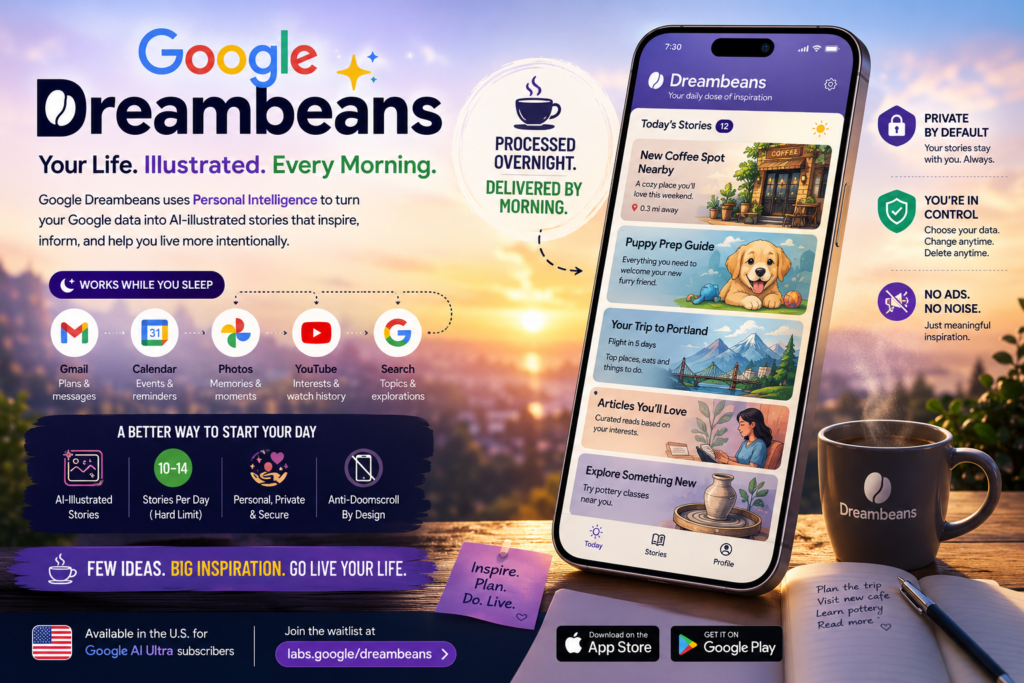
Google Dreambeans is a new AI-powered app from Google Labs that mines your personal Google data overnight and delivers a curated set of AI-illustrated lifestyle stories each morning. If you’ve ever wished your calendar, search history, and inbox could hand you a personalised daily briefing — animated and beautifully visualised — that’s exactly what Google Dreambeans is designed to do.
Launched in June 2026 for eligible Google AI Ultra subscribers in the United States, this Google Labs experiment sits at the intersection of personal intelligence, generative AI, and the growing backlash against endless social media feeds. Here’s everything you need to know.
What Is Google Dreambeans?
Definition: Google Dreambeans is a mobile application (available on iOS and Android) developed by Google Labs. It uses a form of AI the company calls “Personal Intelligence” to synthesise data across your connected Google services and generate a finite collection of AI-illustrated stories every day.
Think of it less like a news app and more like a personalised animated magazine that knows your calendar, your search habits, your travel plans, and your recent photos — and uses all of that context to surface genuinely relevant ideas, recommendations, and insights.
The name itself is intentional. As Gozde Oznur, the product lead, explained to TechCrunch: “The dream part is literal, because while you sleep, the app is working through everything across your connected apps.” The “beans” part nods to the morning ritual of a freshly brewed coffee — the app processes everything overnight and hands you a concentrated drop of inspiration by the time you wake up.
How Does Dreambeans Work?
Google Dreambeans operates on a nightly processing cycle. While you sleep, the app’s AI engine draws from whichever Google services you’ve authorised — Gmail, Calendar, Photos, YouTube, Search History — and distils patterns, upcoming events, and interests into a small set of illustrated narratives.
By morning, you open the app to find your daily collection: typically between 10 and 14 stories, each rendered as an AI-illustrated visual piece. Once you’ve scrolled through your daily batch, that’s it — there’s no infinite feed to fall into.
What Kind of Stories Does Google Dreambeans Generate?
The stories take several forms, all personalised to the user’s context:
- Geographical recommendations — nearby places to visit based on your location and past interests, such as a new coffee shop in your neighbourhood.
- Life-event guidance — if your Google Calendar shows you’re getting a new dog, Dreambeans might generate an illustrated guide to welcoming a puppy home.
- Curated news and articles — web content relevant to your established interests, surfaced from across the open web.
- Trip and event reminders — upcoming travel or events from your calendar, repackaged as visual story cards.
- Exploratory suggestions — topics, hobbies, or experiences the AI thinks you might want to explore next.
Oznur describes the stories as covering “places to visit, topics to explore, things to try, upcoming trips, events that you should be aware of.” The thread connecting all of them is that they’re action-oriented — designed to inspire, not just inform.
The Technology Behind Dreambeans: Personal Intelligence Explained
What is Personal Intelligence? In Google’s framing, Personal Intelligence is an AI capability that connects and reasons across data from multiple Google services simultaneously, rather than treating each app in isolation. It’s what allows Google Dreambeans to notice that your Calendar says you’re travelling to a new city next week, your Search History shows recent interest in food, and your Maps data suggests you haven’t visited that neighbourhood before — and combine all three signals into a single, coherent restaurant recommendation story.
This cross-app synthesis is meaningfully different from how most productivity AI works today. A standard AI assistant might answer a question about your next meeting. Personal Intelligence aims to proactively generate insight you didn’t know to ask for.
Which Google Apps Does Dreambeans Connect To?
Google Dreambeans can integrate with the following services, all subject to user permission:
| Google Service | How It Informs Stories |
|---|---|
| Gmail | Surfaces upcoming plans, RSVPs, bookings, and correspondence context |
| Google Calendar | Detects upcoming events, trips, and life milestones |
| Google Photos | May reference recent photo activity for memory-based stories |
| YouTube | Reads watch history to understand content interests |
| Google Search History | Identifies topics you’ve been actively researching |
Critically, users can choose which services to connect and can revoke access at any time. The integration is opt-in, not automatic.
Dreambeans as a Doomscrolling Antidote
One of the most distinctive design decisions behind Google Dreambeans is its deliberate scarcity. Rather than rewarding engagement with more content — the standard social media loop — the app is built around a hard daily limit.
Why does Dreambeans limit stories? Oznur said the app was specifically designed as a doomscrolling antidote. The intention is to give users a few genuinely inspirational ideas, then encourage them to put down the phone and act on them. “The idea is to get a few inspirational ideas and then go out and live your life,” she told TechCrunch.
This positions Google Dreambeans in a small but growing category of apps that are explicitly anti-infinite-scroll. Rather than competing for maximum attention, they compete for maximum relevance within a minimum footprint. Companion apps like Bond — a recently reviewed AI social platform — take a similar approach, using AI to auto-generate lifestyle suggestions rather than surfacing a bottomless stream of other people’s content.
How Does Dreambeans Compare to Other Anti-Doomscrolling AI Apps?
| Feature | Google Dreambeans | Typical Social Feed |
|---|---|---|
| Stories per day | 10–14 (hard limit) | Unlimited |
| Content source | Your personal Google data | Other users’ posts & ads |
| AI illustration | Yes — every story is AI-generated visual content | No |
| Personalisation engine | Cross-app Personal Intelligence | Interest graph + ads targeting |
| Offline processing | Overnight (while you sleep) | Real-time |
| Doomscroll risk | Low (finite daily batch) | High (infinite scroll design) |
| Data control | User-controlled, deletable | Platform-controlled |
The contrast is stark. Where most feeds are designed to maximise time-on-app, Google Dreambeans is designed to minimise it — and to send you into the world more inspired than when you woke up.
Privacy and Data Controls
For many users, the obvious question is: what happens to all that personal data?
Does Google Dreambeans share your data? According to the product lead, no. The stories generated by Google Dreambeans are only visible to the individual user. There is no social sharing layer, no friends feed, and no advertiser access to the content of your stories. Users also retain full control over their connected data and can delete it at any point.
Key privacy features include:
- User-only visibility — stories are private by default and not shared with other users or third parties.
- Selective service connection — users choose exactly which Google apps feed into the system.
- On-demand data deletion — all personal data can be deleted from the app at any time.
- No advertising layer — the current version of Google Dreambeans does not serve ads within the story feed.
That said, it’s worth noting that this is a Google Labs product — meaning it is experimental, subject to change, and currently in early access. Privacy policies and data practices for Google Labs experiments may evolve as the product matures.
Who Can Access Google Dreambeans Right Now?
Current availability: Google Dreambeans is currently available exclusively to U.S.-based subscribers to Google AI Ultra — Google’s premium AI subscription tier. It runs on both iOS and Android.
For those outside that tier, Google has opened a waitlist at labs.google/dreambeans for users with a standard personal Google account. Given that Google Labs products frequently expand availability based on early adoption and feedback, getting on the waitlist is the most direct path to early access.
Quick eligibility summary:
- Must be based in the United States
- Must have an active Google AI Ultra subscription
- Available on iOS and Android
- Waitlist open to standard Google account holders at labs.google/dreambeans
Why Is It Called “Dreambeans”? The Name Explained
It’s genuinely one of the odder product names in recent Google history — and the explanation is more thoughtful than you might expect.
Gozde Oznur broke it down for TechCrunch in two parts. The “dream” in Google Dreambeans refers to the app’s nocturnal processing: while the user sleeps, the AI engine is working through potentially enormous volumes of personal data across every connected service. It distils all of that activity quietly, in the background, like the subconscious processing of a dream.
The “beans” part is a morning metaphor. Just as coffee beans are processed overnight and brewed fresh each morning, the app hands you a concentrated, ready-to-consume drop of inspiration the moment you start your day. You don’t need to do any of the work — the beans have already been ground.
It’s a surprisingly elegant naming logic for a product that sounds, at first glance, like it was named by a chatbot.
What This Means for the Future of AI Personal Assistants
Google Dreambeans is a small app, but it points toward a significant shift in how AI is being positioned in everyday life.
For years, the dominant paradigm of the AI assistant has been reactive: you ask a question, it answers. What Dreambeans represents is a move toward proactive AI storytelling — where the system anticipates what you might find useful, synthesises it from sources you’ve already trusted with your data, and delivers it in a format designed for inspiration rather than productivity.
A few broader implications worth watching:
- Cross-app AI synthesis will become a standard expectation. As users become accustomed to AI that reasons across their entire digital life — not just one app at a time — the pressure on platform operators to provide deeper, permission-based integrations will intensify.
- Scarcity as a feature. The deliberate 10–14 story limit may be the most counterintuitive design choice in Google Dreambeans, and it may also be its most influential. Expect other apps to experiment with hard consumption limits as a trust signal.
- AI illustration as a UX layer. Most AI content tools generate text. Google Dreambeans generates illustrated visual stories. As AI image generation matures, the expectation that personalised content will also be visually distinctive is likely to spread.
- The doomscrolling backlash is becoming a product category. Bond, Dreambeans, and others are building entire business models around the premise that users are exhausted by infinite feeds. This is no longer a niche concern — it’s a positioning strategy.
Whether Google Dreambeans becomes a mainstream product or remains a Google Labs experiment, its design philosophy signals where the most thoughtful AI product teams are currently pointing: toward AI that works for your life, not against your time.
Frequently Asked Questions About Google Dreambeans
What is Google Dreambeans? Google Dreambeans is a Google Labs AI app that uses Personal Intelligence to draw from your Google services overnight and deliver a daily set of 10–14 AI-illustrated lifestyle stories by morning.
Is Google Dreambeans free? No. It currently requires a Google AI Ultra subscription and is only available in the United States. A waitlist exists for standard Google account holders.
Is Google Dreambeans safe for privacy? Google says stories are private to the user, data is user-deletable, and no advertising layer exists in the current version. As a Google Labs experiment, privacy terms may evolve.
Why is it called Dreambeans? “Dream” refers to the app processing your data while you sleep. “Beans” is a metaphor for freshly brewed morning coffee — concentrated inspiration delivered at the start of your day.
How is Dreambeans different from a regular news feed? It uses your personal Google data rather than public content, limits you to a finite daily batch (not an infinite scroll), and renders every story as an AI-illustrated visual rather than text or links.