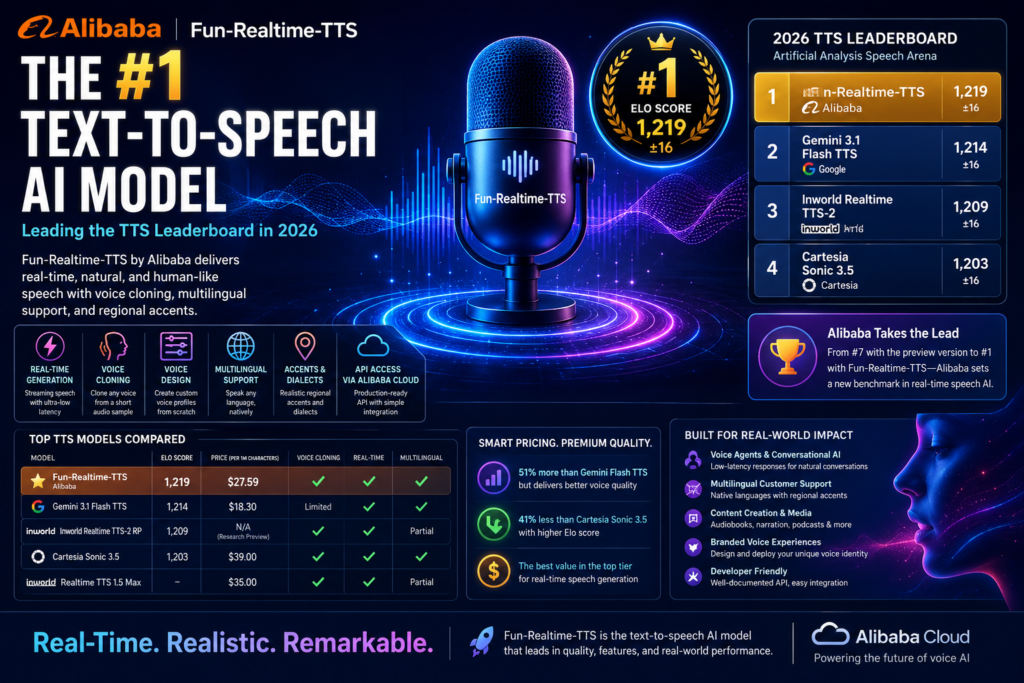
Alibaba’s Fun-Realtime-TTS just claimed the top spot on the Artificial Analysis Speech Arena Leaderboard, outperforming Google and Inworld. If you’re evaluating the best text-to-speech AI model for real-time voice applications, voice cloning, or multilingual output in 2026, this is the one to know.
What Is Fun-Realtime-TTS?
Fun-Realtime-TTS is a real-time text-to-speech AI model developed by Alibaba, available via Alibaba Cloud with full API access for developers. It supports streaming speech generation, meaning audio is delivered as it’s synthesized — without waiting for the full output to be ready.
The model builds directly on Alibaba’s earlier Fun-Realtime-TTS-Preview, which reached #7 on the Speech Arena Leaderboard. The updated release represents a significant leap in voice quality and places Alibaba at the forefront of the competitive TTS space for the first time.
Fun-Realtime-TTS is part of a broader category of real-time speech generation systems — models that don’t just convert text to audio, but do so at conversational speeds with natural-sounding output.
How Fun-Realtime-TTS Reached #1 on the TTS Leaderboard
What Is the Artificial Analysis Speech Arena?
The Artificial Analysis Speech Arena is an independent benchmarking platform where text-to-speech AI models are evaluated through head-to-head comparisons. Each model earns an Elo score — the same scoring system used in chess rankings — based on how often it wins in side-by-side human preference evaluations.
A higher Elo score means human listeners consistently prefer that model’s voice output. This makes it one of the most reliable, user-grounded rankings available for evaluating a text-to-speech AI model.
Fun-Realtime-TTS Elo Score Breakdown
As of June 3, 2026, Fun-Realtime-TTS holds an Elo score of 1,219 (±16), calculated from 962 arena appearances. That places it narrowly but clearly ahead of the next four competitors — with only 24 Elo points separating the entire top five.
| Rank | Model | Elo Score | Developer |
|---|---|---|---|
| #1 | Fun-Realtime-TTS | 1,219 | Alibaba |
| #2 | Gemini 3.1 Flash TTS | 1,214 | |
| #3 | Inworld Realtime TTS-2 Research Preview | 1,209 | Inworld AI |
| #4 | Cartesia Sonic 3.5 | 1,203 | Cartesia |
The margin at the top is tight — which reflects how competitive the current generation of real-time speech generation models has become.
How It Compares to Alibaba’s Previous TTS Model
Fun-Realtime-TTS-Preview, Alibaba’s prior entry, reached position #7 on the same leaderboard. The new release marks Alibaba’s first #1 ranking in the Speech Arena — a meaningful milestone that signals rapid iteration in voice quality. In terms of Elo progression, the jump from #7 to #1 represents both technical improvement and a clear commercial ambition to lead the text-to-speech AI model market.
Key Features of Fun-Realtime-TTS
What makes this text-to-speech AI model stand out isn’t just its Elo score. The feature set is designed for production use cases in voice agents, customer service bots, content creation pipelines, and multilingual platforms.
- Real-time speech generation: Audio output streams as it’s synthesized, enabling low-latency voice responses in live applications.
- Voice cloning: The model can replicate a target speaker’s voice from sample audio, useful for personalized assistants or branded voice experiences.
- Voice design: Users can define and configure custom voice profiles without needing a real speaker reference.
- Multilingual support: Fun-Realtime-TTS handles multiple languages natively, making it suitable for global deployments.
- Regional accents and dialects: Beyond language-level support, the model recognizes and reproduces regional speech patterns — a feature typically absent from lower-tier TTS models.
- API access via Alibaba Cloud: Developers can integrate the model directly into applications using standard API calls, with no proprietary SDK required.
These features collectively position Fun-Realtime-TTS as a full-stack text-to-speech AI model rather than a single-purpose audio converter.
Fun-Realtime-TTS vs. Top Competitors: Full Comparison
When choosing a text-to-speech AI model, quality, price, and feature set all matter. Here’s how the top models compare across all three dimensions.
| Model | Elo Score | Price (per 1M characters) | Voice Cloning | Real-Time | Multilingual |
|---|---|---|---|---|---|
| Fun-Realtime-TTS | 1,219 | $27.59 | Yes | Yes | Yes |
| Gemini 3.1 Flash TTS | 1,214 | $18.30 | Limited | Yes | Yes |
| Inworld Realtime TTS-2 RP | 1,209 | N/A (Research Preview) | Yes | Yes | Partial |
| Cartesia Sonic 3.5 | 1,203 | $39.00 | Yes | Yes | Yes |
| Inworld Realtime TTS 1.5 Max | — | $35.00 | Yes | Yes | Partial |
Key observation: Fun-Realtime-TTS delivers the highest voice quality score at a mid-range price point — more expensive than Gemini 3.1 Flash TTS, but significantly cheaper than Sonic 3.5 while outperforming it on quality. For teams prioritizing both output fidelity and cost efficiency, Fun-Realtime-TTS offers the most compelling value in the current TTS leaderboard.
Pricing Analysis: Is Fun-Realtime-TTS Worth It?
Fun-Realtime-TTS is priced at $27.59 per million characters. In context:
- It costs 51% more than Gemini 3.1 Flash TTS ($18.30/1M characters).
- It costs 41% less than Cartesia Sonic 3.5 ($39.00/1M characters).
- It sits 21% below Inworld Realtime TTS 1.5 Max ($35.00/1M characters).
For most production use cases, the price-to-quality ratio is strong. You’re paying a premium over Gemini’s Flash tier, but receiving better voice quality by Elo measure. Against Sonic 3.5, you’re paying less and getting more — which is unusual in competitive AI markets.
The question of whether any text-to-speech AI model is “worth it” always depends on volume and use case. At scale — say, 100 million characters per month — the difference between Gemini ($1,830) and Fun-Realtime-TTS ($2,759) is under $1,000 per month for measurably better voice output. For voice-first products, that tradeoff is likely acceptable.
Who Should Use Fun-Realtime-TTS?
Fun-Realtime-TTS is best suited for teams and developers who need high-quality real-time speech generation at a reasonable cost and don’t want to compromise on multilingual or accent fidelity.
Ideal use cases include:
- Voice agents and conversational AI: The low-latency, streaming output makes this text-to-speech AI model a strong fit for real-time dialogue systems.
- Multilingual customer service platforms: With native multilingual support and regional dialect handling, it outperforms most competitors on international deployments.
- Content creation pipelines: Audiobook production, narration workflows, and podcast automation benefit from the voice cloning and voice design features.
- Branded voice experiences: Companies building a consistent voice identity across products can use voice design to define and maintain a custom speaker profile.
- Developer integrations: The Alibaba Cloud API provides standard, well-documented access — making it easier to adopt than research-preview models.
Not the best fit if:
- Cost is the absolute top priority (Gemini 3.1 Flash TTS remains cheaper).
- You need a model that is already deeply integrated into the Google or OpenAI ecosystems.
- You require extensive tooling or SDKs beyond a raw API endpoint.
What This Means for the TTS AI Landscape in 2026
The rise of Fun-Realtime-TTS to the top of the TTS leaderboard signals several important shifts in how the text-to-speech AI model market is evolving.
Competition Is Now Measured in Fractions
With only 24 Elo points separating the top five models, differentiation is no longer about raw capability — it’s about price, features, and ecosystem integration. Any new text-to-speech AI model entering the market must close a very narrow quality gap while offering a distinct operational advantage.
Alibaba Is a Serious Contender in Voice AI
Fun-Realtime-TTS represents Alibaba’s first #1 ranking in an independent speech quality benchmark. Coming from a previous position of #7, the jump signals fast-moving internal development and a strategic commitment to winning in the real-time speech generation space — not just LLMs or image generation.
Voice Cloning and Dialect Support Are Becoming Table Stakes
All four top-ranked models now support some form of voice cloning. Regional accent and dialect handling — once a differentiator — is increasingly expected at the frontier tier. Future competition will likely center on emotional expressiveness, prosody control, and fine-grained customization.
Real-Time Generation Is the New Baseline
Batch TTS is no longer a frontier capability. The entire top of the leaderboard consists of real-time speech generation models. Developers evaluating a text-to-speech AI model for any interactive application should treat real-time output as a minimum requirement, not an optional feature.
Frequently Asked Questions
What is Fun-Realtime-TTS?
Fun-Realtime-TTS is a real-time text-to-speech AI model developed by Alibaba and available via Alibaba Cloud. It reached #1 on the Artificial Analysis Speech Arena Leaderboard in June 2026 with an Elo score of 1,219, surpassing Google Gemini 3.1 Flash TTS, Inworld Realtime TTS-2, and Cartesia Sonic 3.5.
How does Fun-Realtime-TTS compare to Gemini 3.1 Flash TTS?
Fun-Realtime-TTS scores 1,219 on the Elo leaderboard vs. Gemini 3.1 Flash TTS at 1,214 — a 5-point quality advantage. However, Gemini Flash TTS is cheaper at $18.30/1M characters vs. $27.59 for Fun-Realtime-TTS. Teams that prioritize voice quality over cost savings will likely prefer Fun-Realtime-TTS.
Does Fun-Realtime-TTS support voice cloning?
Yes. Fun-Realtime-TTS supports both voice cloning (from a reference audio sample) and voice design (creating a synthetic speaker profile from scratch). Both features are accessible via the Alibaba Cloud API.
Is Fun-Realtime-TTS available to developers right now?
Yes. Fun-Realtime-TTS is available via Alibaba Cloud with standard API access. As of June 2026, it is not a research preview — it is a production-ready text-to-speech AI model with documented pricing.
What languages does Fun-Realtime-TTS support?
Fun-Realtime-TTS supports multilingual output including regional accents and dialects, though Alibaba Cloud’s full supported language list should be consulted for specific language availability in production deployments.
Summary: Why Fun-Realtime-TTS Matters
Fun-Realtime-TTS is not just a leaderboard footnote. It is the current best-performing text-to-speech AI model available through public API access, combining the highest Elo score in the Speech Arena with a feature set that covers real-time output, voice cloning, voice design, multilingual support, and regional accent recognition.
At $27.59 per million characters, it occupies a strategic middle ground — below the most expensive competitors, above the cheapest, and ahead of both in voice quality. For developers and product teams building voice-first experiences in 2026, Fun-Realtime-TTS is the benchmark the entire TTS leaderboard is now measured against.
Conclusion
The race to build the most natural and responsive voice generation platform has accelerated dramatically over the past few years. What was once a niche technology primarily used for accessibility tools and automated phone systems has evolved into a foundational layer for modern digital experiences. From conversational assistants and customer support platforms to content creation workflows and enterprise automation, high-quality speech synthesis has become a critical component of how businesses interact with users.
The latest rankings and performance benchmarks demonstrate just how rapidly this field is progressing. The difference between the highest-performing systems is now remarkably small, indicating that the industry has entered a phase where incremental improvements can significantly influence user preference. Voice quality, responsiveness, language coverage, customization options, and deployment flexibility have become the primary differentiators rather than basic speech generation capabilities.
Alibaba’s latest release highlights this shift perfectly. Rather than focusing solely on generating understandable audio, the platform emphasizes real-time responsiveness, customizable voice experiences, multilingual communication, and production-ready deployment. These capabilities align closely with what organizations increasingly need as voice interfaces become more common across websites, applications, contact centers, and connected devices.
One of the most notable developments is the growing importance of streaming audio generation. Users now expect conversational systems to respond instantly, without the delays that were once considered acceptable. This expectation mirrors the evolution of chat-based AI, where response speed often influences perceived intelligence and overall satisfaction. As a result, platforms capable of delivering speech in real time have gained a significant advantage in both enterprise and consumer-facing applications.
Another trend shaping the industry is the increasing demand for personalization. Organizations no longer want generic synthetic voices that sound identical across every implementation. Instead, businesses are seeking unique voice identities that reinforce brand recognition and create stronger emotional connections with audiences. The ability to clone voices, design custom personas, and maintain consistency across channels is becoming a major competitive advantage for voice technology providers.
Multilingual support has also transitioned from being a premium feature to an expected standard. Global businesses require solutions that can communicate effectively across diverse markets while preserving natural pronunciation, regional accents, and cultural nuances. The strongest platforms are those that can provide consistent quality regardless of language, enabling organizations to scale internationally without sacrificing user experience.
Pricing remains an important consideration, but it is increasingly viewed in relation to quality and business outcomes rather than as an isolated metric. Companies deploying voice technology at scale often evaluate solutions based on overall value rather than simply selecting the lowest-cost option. When improved speech quality leads to better engagement, higher customer satisfaction, stronger brand perception, or more effective automation, the additional investment can be justified through measurable returns.
The competitive landscape also reveals a broader trend within artificial intelligence: leadership positions are becoming more fluid. New entrants and established technology companies alike are capable of making substantial advances within relatively short periods. A model that ranks near the top today may face intense competition from future releases, creating an environment where continuous innovation is essential for maintaining relevance.
For developers, this level of competition is ultimately beneficial. More options mean greater flexibility when selecting a solution that aligns with specific project requirements. Some teams may prioritize affordability, while others focus on customization capabilities, language support, integration simplicity, or audio fidelity. The availability of multiple high-performing platforms allows organizations to make decisions based on their actual business needs rather than being constrained by a limited set of viable choices.
Looking ahead, future advancements will likely focus on areas that extend beyond basic speech quality. Emotional expression, contextual awareness, adaptive speaking styles, dynamic prosody control, and personalized conversational behaviors are expected to become increasingly important. As these capabilities mature, synthetic voices will continue moving closer to human-level communication, opening new possibilities for digital interactions across industries.
Ultimately, the current state of voice generation technology demonstrates that the market has entered a highly competitive and innovation-driven phase. Organizations evaluating solutions today have access to capabilities that would have seemed extraordinary just a few years ago. Whether the goal is building conversational agents, enhancing customer experiences, automating content production, or creating distinctive voice-based products, the available technology is more capable than ever before.
The emergence of new leaders and the narrowing gap between top-performing systems suggest that the next wave of innovation will be defined not by who can generate speech, but by who can create the most engaging, natural, adaptable, and scalable voice experiences. For businesses and developers alike, that evolution represents a significant opportunity to rethink how users interact with digital products and services in an increasingly voice-driven world.
Bottom Line
Voice generation technology has reached a point where quality differences are measured in small margins, making features, customization, multilingual capabilities, latency, and ecosystem support just as important as benchmark rankings. The latest leaderboard results demonstrate that competition among leading providers is stronger than ever, giving organizations more choices and better value than at any previous stage of the market.
For teams building conversational applications, customer service solutions, content production pipelines, or branded voice experiences, the current generation of platforms offers enterprise-grade performance with real-time responsiveness and advanced customization options. The key decision is no longer whether voice technology is mature enough for production use—it clearly is. The real challenge lies in selecting the platform that best aligns with long-term business goals, technical requirements, and user expectations.
As voice interfaces continue to expand across industries, organizations that invest in high-quality speech experiences today will be better positioned to meet growing consumer expectations tomorrow. The leaders in this space are setting new standards for what users consider natural, engaging, and trustworthy digital communication, and those standards will only continue to rise in the years ahead.