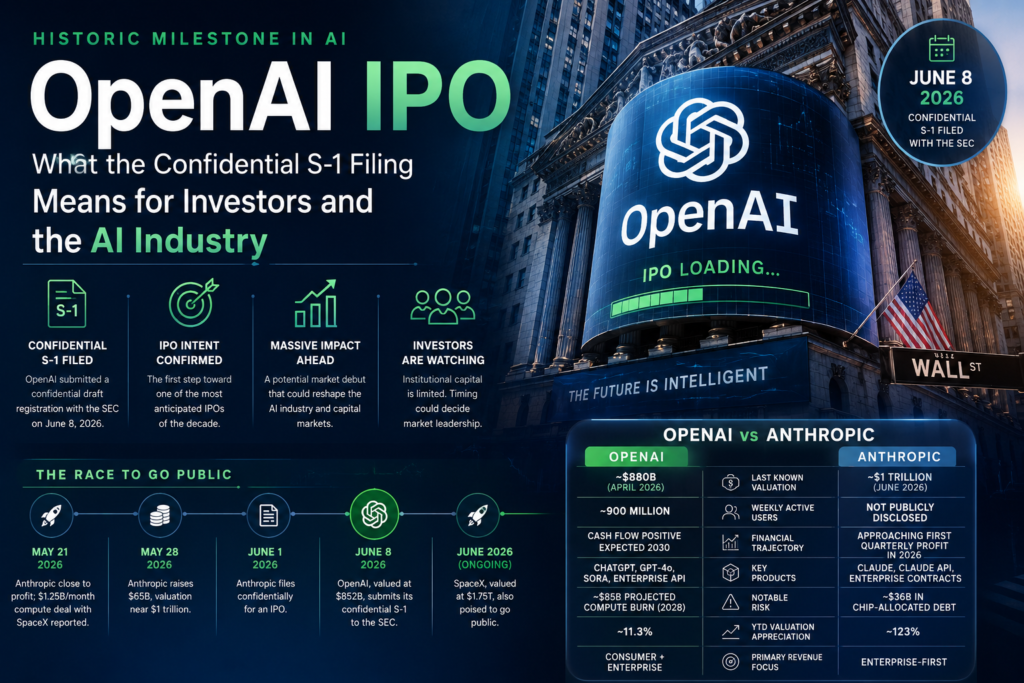
The OpenAI IPO is now official — at least in its earliest form. On June 8, 2026, OpenAI submitted a confidential draft registration statement to the U.S. Securities and Exchange Commission, setting the stage for what could become the most anticipated public market debut of the decade. Here is everything you need to know about what it means, how it stacks up against Anthropic’s competing filing, and what the road ahead looks like.
What Is the OpenAI IPO?
Definition: The OpenAI IPO refers to the company’s intention to offer shares to the public via an initial public offering — a process that begins with submitting an S-1 registration statement to the SEC. OpenAI’s filing is “confidential,” meaning the full financial details remain private until the company chooses to make them public ahead of an actual listing.
A confidential S-1 filing is a standard mechanism available to companies under the JOBS Act of 2012. It allows businesses to test investor appetite and refine their financial disclosures before entering the full glare of public scrutiny. Companies like Airbnb, DoorDash, and Spotify all used similar confidential filings before their public debuts.
For OpenAI, this means the company has not yet disclosed the number of shares it intends to offer, the target share price, or how much capital it hopes to raise. What is clear is the company’s intent: OpenAI is going public.
The Race to Go Public: OpenAI vs. Anthropic
The OpenAI IPO filing did not happen in a vacuum. It came just over a week after OpenAI’s primary rival, Anthropic, filed its own confidential S-1 with the SEC — making June 2026 a landmark month in AI market history. Two of the world’s most valuable AI companies are now in a sprint to the public markets, and the stakes could not be higher.
Timeline of Events
- May 21, 2026 — Reuters reports Anthropic is close to its first quarterly profit and has agreed to pay SpaceX $1.25 billion monthly for compute resources.
- May 28, 2026 — Anthropic raises a $65 billion funding round, pushing its valuation near $1 trillion.
- June 1, 2026 — Anthropic files confidentially for an IPO.
- June 8, 2026 — OpenAI, last valued at $852 billion, submits its own confidential S-1 to the SEC.
- June 2026 (ongoing) — SpaceX, valued at $1.75 trillion, is also poised to enter public markets, adding further competition for institutional capital.
OpenAI vs. Anthropic: A Side-by-Side Comparison
| Factor | OpenAI | Anthropic |
|---|---|---|
| Last Known Valuation | ~$880B (April 2026 secondary market) | ~$1T (June 2026 secondary market) |
| Confidential Filing Date | June 8, 2026 | June 1, 2026 |
| Weekly Active Users | ~900 million | Not publicly disclosed |
| Financial Trajectory | Revenue & user targets missed; cash-flow positive expected 2030 | Approaching first quarterly profit in 2026 |
| Key Products | ChatGPT, GPT-4o, Sora, enterprise API | Claude, Claude API, enterprise contracts |
| Notable Risk | Massive compute burn (~$85B projected for 2028) | Large debt position (~$36B in chip-allocated debt) |
| YTD Valuation Appreciation | ~11.3% | ~123% |
| Primary Revenue Focus | Consumer + enterprise | Enterprise-first |
The data tells a clear story: Anthropic has been appreciating faster and is in a stronger near-term financial position, while OpenAI holds a commanding lead in consumer reach and brand recognition.
OpenAI’s Financial Reality: Burn Rate, Revenue Misses, and the Road to Profitability
Any honest analysis of the OpenAI IPO must grapple with the company’s challenging financial profile. OpenAI has publicly acknowledged that it does not expect to reach positive cash flow until 2030 — a notable admission for a company seeking a public valuation in the hundreds of billions.
In late March 2026, OpenAI closed the largest funding round in Silicon Valley history: $122 billion, including $3 billion sourced directly from retail investors via bank channels. Yet the company is on track to spend the equivalent of that entire round on computing power for AI research by 2028 alone. Projected spending for that year stands at approximately $85 billion — even after doubling its year-prior sales.
Prior to the filing, The Wall Street Journal reported that OpenAI missed its own targets for new users and revenue. Chief Financial Officer Sarah Friar reportedly raised concerns about the company’s ability to sustain its massive data center expenditures. These are not minor footnotes; they are the central tension that IPO investors will need to price.
The core financial dynamics at play:
- OpenAI’s compute costs are expected to scale faster than its revenue in the near term.
- The company does not expect positive free cash flow until 2030.
- Its most recent funding valued the company at $852 billion post-money, setting a high bar for public market pricing.
- Secondary market activity pegged OpenAI at approximately $880 billion as of April 2026, slightly below Anthropic’s $1 trillion secondary market valuation.
None of this makes the OpenAI IPO unattractive — but it does mean investors are essentially being asked to bet on future monetization of a platform with 900 million weekly active users, rather than present-day profitability.
Why the OpenAI IPO Timing Matters
Timing in public markets is rarely accidental, and the OpenAI IPO announcement appears strategically calculated. Here is why the timing carries real weight.
The Capital Scarcity Problem
With SpaceX, OpenAI, and Anthropic all preparing to tap public markets in 2026, analysts warn that institutional capital for AI companies may become increasingly constrained. Experts cited by The Wall Street Journal suggest that whichever company debuts first will likely capture a disproportionate share of available capital — capital that will have already been partly absorbed by SpaceX, which is expected to list first with a $1.75 trillion valuation.
This creates a genuine first-mover advantage for whichever AI company successfully IPOs ahead of the other. Every week of delay is a week that investor enthusiasm, capital allocation, and analyst attention can shift.
How Anthropic’s Filing Constrains OpenAI’s Valuation
Here is a dynamic that has received less mainstream coverage but carries significant strategic weight: because Anthropic filed first, its IPO disclosures will establish a public valuation comparable for the AI sector. When Anthropic’s S-1 financials become public, they will create a benchmark against which OpenAI’s pricing will be judged.
If Anthropic’s disclosed financials come in stronger than expected, it could actually benefit OpenAI by validating the sector’s growth story. If they disappoint, OpenAI may find investor appetite has cooled before its own roadshow even begins. A recent PitchBook report suggested OpenAI was overvalued relative to its fundamental financial performance — a concern that Anthropic’s disclosures will either amplify or neutralize.
OpenAI’s Strengths: Scale, Brand, and 900 Million Users
No analysis of the OpenAI IPO would be complete without acknowledging what the company has genuinely built. Despite its financial challenges, OpenAI commands a consumer presence that no other AI company can match.
ChatGPT reached approximately 900 million weekly active users as of early 2026, a scale that puts it in the company of social media platforms that took decades to build comparable audiences. This is not a niche enterprise tool or a developer API — it is a mass-market consumer product with deep, habitual engagement.
OpenAI has also successfully expanded beyond its consumer roots:
- Enterprise contracts with major corporations and government agencies provide recurring revenue.
- API access has made OpenAI’s models the default foundation for thousands of third-party applications.
- Multimodal products like GPT-4o and Sora extend the company’s footprint into image, audio, and video AI.
- Global distribution partnerships continue to expand the company’s international user base.
From a secondary market perspective, OpenAI’s stock saw a modest rally immediately following the IPO filing announcement, with investors beginning to price both OpenAI and Anthropic as potential dual winners of the large language model era — rather than a zero-sum race.
Key Risks Investors Should Watch
The OpenAI IPO carries a risk profile unlike most technology IPOs in recent memory. Investors should be clear-eyed about the following:
Financial risks:
- Projected burn of ~$85 billion in 2028, even after significant revenue growth.
- No expected positive cash flow until 2030.
- Missed revenue and user acquisition targets ahead of the filing.
- High dependence on continued capital raises to fund operations.
Competitive risks:
- Anthropic’s faster valuation appreciation suggests the market may be shifting preference toward safety-focused, enterprise-first AI.
- Google, Microsoft, Meta, and Amazon are all deeply invested in competing models, with the ability to subsidize AI services at scale.
- Newer entrants continue to compress the technical moat on model performance.
Legal and reputational risks:
- The state of Florida filed a lawsuit against OpenAI and CEO Sam Altman in June 2026, alleging harm to minors through the ChatGPT platform.
- OpenAI faces a litany of other lawsuits related to user self-harm, copyright infringement, and data privacy.
- Political controversies involving executive donations to super PACs have created reputational headwinds.
Structural risks:
- OpenAI’s transition from a nonprofit research lab (founded in 2015) to a for-profit IPO candidate involves governance complexity that is still being resolved.
- The Elon Musk lawsuit, though ultimately dismissed by a jury in May 2026, drew sustained attention to the company’s original mission and whether public market incentives align with it.
What the OpenAI IPO Means for the Broader AI Industry
The OpenAI IPO, alongside Anthropic’s concurrent filing, represents an inflection point for the entire artificial intelligence sector. For years, the largest and most consequential AI companies operated as private entities — accountable primarily to venture investors and a handful of strategic partners. A successful public offering changes that dynamic fundamentally.
For the AI industry, this shift means:
- Public financial disclosure will, for the first time, give the market a verified picture of AI economics: revenue, margins, and the true cost of frontier model development.
- Valuation benchmarks established by these filings will ripple through startup valuations, hiring, and competitive dynamics for years.
- Public market accountability may accelerate pressure on AI companies to demonstrate near-term revenue rather than purely long-horizon capability building.
- Retail investor access to AI’s leading companies — previously the exclusive domain of institutional and venture capital — democratizes participation in one of the most consequential technology cycles in history.
The OpenAI IPO is not just a corporate event. It is a signal that the era of AI as an exclusively private, venture-backed experiment may be drawing to a close. The technology is now large enough, consequential enough, and revenue-generating enough to face the scrutiny — and the opportunity — of public ownership.
Frequently Asked Questions
What is the OpenAI IPO? The OpenAI IPO is OpenAI’s planned initial public offering, initiated via a confidential S-1 filing with the U.S. SEC on June 8, 2026. The company has not yet disclosed pricing, share count, or a specific listing date.
What is OpenAI’s current valuation? OpenAI was valued at approximately $852 billion post-money in its March 2026 funding round. Secondary market activity in April 2026 placed it at around $880 billion, just below Anthropic’s $1 trillion secondary market valuation.
Why did OpenAI file confidentially? A confidential S-1 allows OpenAI to begin the regulatory process without disclosing sensitive financial and business information publicly until closer to its actual listing. This is a standard process under the JOBS Act.
How does the OpenAI IPO compare to Anthropic’s? Anthropic filed approximately one week before OpenAI. Anthropic is closer to profitability and has seen faster secondary market valuation growth (123% YTD vs. OpenAI’s 11.3%). OpenAI has a much larger consumer user base (~900M weekly active users) and a stronger brand in the general public.
When will the OpenAI IPO actually happen? No public listing date has been set. Based on typical timelines, a public debut could happen anywhere from late 2026 to mid-2027, depending on SEC review timelines, market conditions, and the company’s readiness to disclose its financials publicly.
Conclusion
The OpenAI IPO is shaping up to be one of the most significant events in modern technology and financial markets. As artificial intelligence continues to transform industries worldwide, the OpenAI IPO represents much more than a traditional public offering. It symbolizes the transition of AI from a venture-capital-driven innovation sector into a mature industry that will be closely scrutinized by public investors, regulators, and global markets. For anyone following the future of artificial intelligence, the OpenAI IPO is a milestone that deserves careful attention.
What makes the OpenAI IPO particularly noteworthy is the company’s unmatched influence in the AI ecosystem. With hundreds of millions of users engaging with ChatGPT and an expanding portfolio of enterprise solutions, OpenAI has established itself as one of the most recognizable AI brands in the world. The OpenAI IPO gives investors a potential opportunity to participate in the growth of a company that has played a leading role in bringing generative AI into the mainstream. At the same time, it provides the broader market with a rare chance to evaluate the real economics behind large-scale AI development.
However, the OpenAI IPO is not without challenges. Investors considering the OpenAI IPO will need to weigh the company’s extraordinary growth potential against its substantial operating costs and long-term profitability timeline. OpenAI’s massive investment in computing infrastructure highlights the reality that building frontier AI systems requires unprecedented levels of capital. As a result, the success of the OpenAI IPO may depend not only on current revenue growth but also on the company’s ability to demonstrate a clear path toward sustainable profitability in the coming years.
Competition is another factor that could influence the performance of the OpenAI IPO. Rivals such as Anthropic, along with major technology companies like Google, Microsoft, Meta, and Amazon, continue to invest aggressively in artificial intelligence. The OpenAI IPO arrives during a period of intense competition, where innovation cycles are accelerating and technological advantages can shift quickly. Investors evaluating the OpenAI IPO will likely compare OpenAI’s market position, financial performance, and future strategy against both emerging AI startups and established technology giants.
Despite these risks, the OpenAI IPO remains a potentially transformative event for the AI sector. The public listing process will provide unprecedented transparency into OpenAI’s revenue, expenses, growth metrics, and business strategy. This level of disclosure could establish important benchmarks for the entire industry and help investors better understand the true value of AI-driven businesses. In many ways, the OpenAI IPO may become the reference point against which future AI companies are measured.
For retail investors, the OpenAI IPO also represents a unique opportunity. Until now, participation in the growth of leading AI companies has largely been limited to venture capital firms, institutional investors, and private market participants. The OpenAI IPO could democratize access to one of the most influential technology companies of the decade, allowing a broader audience to invest in the future of artificial intelligence. This increased accessibility is likely to generate substantial interest from both experienced investors and those new to technology-focused investing.
Ultimately, the OpenAI IPO is about far more than a stock market debut. It reflects the growing importance of artificial intelligence in business, society, and the global economy. Whether the OpenAI IPO exceeds expectations or faces challenges after listing, its impact on investor sentiment, AI innovation, and public market dynamics will be felt for years to come. As more details emerge through regulatory filings and financial disclosures, investors should closely monitor the OpenAI IPO and assess both its opportunities and risks. One thing is clear: the OpenAI IPO marks the beginning of a new chapter for OpenAI, the AI industry, and the future of technology investing.