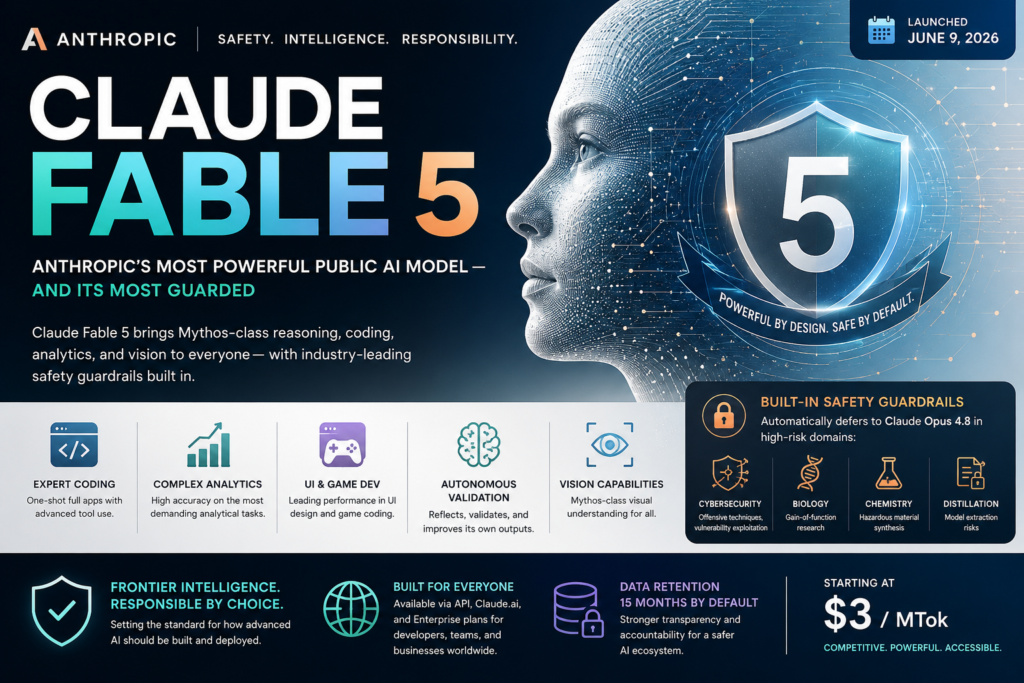
Anthropic just released Claude Fable 5, the first publicly accessible version of its frontier Mythos-class AI — and it comes wrapped in an unprecedented layer of safety infrastructure. If you’ve been watching the AI arms race and wondering when truly advanced reasoning models would reach everyday users and enterprises, the answer arrived on June 9, 2026.
This article breaks down everything you need to know: what Claude Fable 5 is, what it can and cannot do, how it was tested, how it’s priced, and what it signals about the future of responsible AI deployment.
What Is Claude Fable 5?
Definition: Claude Fable 5 is Anthropic’s first Mythos-class AI model made available to the general public. It is derived from the Mythos architecture — a family of frontier models previously restricted to a small group of vetted partners — and is designed to excel at software engineering, knowledge work, and vision tasks.
Expansion: Think of Claude Fable 5 as the “consumer-safe” edition of a research-grade superintelligent system. It delivers Mythos-level reasoning on the vast majority of tasks, while automatically deferring to the more conservative Claude Opus 4.8 when a query touches high-risk domains such as cybersecurity, biology, or chemistry. According to Anthropic’s early deployment data, at least 95% of Fable sessions run entirely on Fable’s own responses — meaning the guardrails are rarely triggered for typical users.
The name “Fable” is significant. It signals something powerful yet shaped — a story with intentional boundaries. Anthropic chose not to release raw Mythos capability publicly; instead, they engineered a version that retains most of the intelligence while hard-limiting the most dangerous outputs.
How Fable 5 Relates to the Mythos Lineage
Mythos is Anthropic’s most advanced model family, first previewed in April 2026 and initially limited to a handful of trusted organizations due to cybersecurity concerns. In early June 2026, access was expanded to hundreds of organizations across 15 countries — primarily those managing critical infrastructure. Claude Fable 5 is now the first iteration of this technology accessible to any developer, business, or individual through Anthropic’s API and Enterprise plans.
Alongside the public launch, Anthropic also released Mythos 5, an updated version deployed exclusively to organizations that had already been approved for advanced Mythos access. So there are now two active branches of the Mythos family: the gated Mythos 5 for verified critical-infrastructure operators, and the guardrailed Claude Fable 5 for general availability.
Why Anthropic Released Claude Fable 5 Now
Timing is everything in AI. Claude Fable 5 launched against a backdrop of extraordinary tension: Anthropic itself had, just days earlier, published a public plea urging major global AI labs to establish a coordinated “brake pedal” on frontier AI development.
The concern? Recursive self-improvement (RSI) — the theoretical point at which an AI system becomes capable of autonomously improving its own capabilities without human intervention. Anthropic warned that systems are advancing so rapidly that RSI may no longer be a distant hypothetical. And yet, here they are, releasing their most powerful model to the public.
The RSI Warning That Preceded the Launch
This apparent contradiction is, in fact, Anthropic’s strategic argument made manifest. The company’s position — articulated through its safety-first research culture — is that safety-capable labs should be the ones pushing the frontier, not ceding it to less cautious actors. By releasing Claude Fable 5 with hard-coded guardrails, extensive red-team testing, and mandatory data retention policies, Anthropic is demonstrating what responsible frontier deployment looks like, rather than simply preaching it.
The launch also comes as Anthropic prepares to enter the public markets, with OpenAI filing confidentially for its IPO just one day earlier. The competitive and commercial pressures are real — but Anthropic appears to be betting that safety credibility is itself a differentiator.
What Claude Fable 5 Can — and Cannot — Do
What Can Claude Fable 5 Do?
Claude Fable 5 is optimized for high-complexity tasks where prior models showed limitations:
- Software engineering: Early adopters report that Fable 5 is significantly better at “one-shotting” full applications — generating complete, deployable code from a single prompt — with notably improved tool-calling capabilities.
- Complex analytics: Analytics platform Hex reported that Claude Fable 5 was the first model to score 90% on its core analytics benchmark of complex, long-running analytical tasks. Hex noted particular strength in nuance and judgment on the hardest questions.
- UI and game development: AI-powered workspace platform Genspark found that Fable outperformed every other model in its internal evaluations, with especially strong results on UI design and game coding tasks.
- Autonomous validation: At the highest effort settings, Claude Fable 5 reflects on and validates its own outputs — a capability that Rakuten, the shopping rewards platform, called the enabler of “highly autonomous operations.”
- Vision tasks: The model brings Mythos-class visual understanding to general availability for the first time.
High-Risk Domains Where Fable Defers to Opus 4.8
Claude Fable 5 will not generate responses in several domains where the potential for harm is judged to be unacceptably high. In these cases, it transparently falls back to Claude Opus 4.8:
- Cybersecurity (offensive techniques, vulnerability exploitation)
- Biology (gain-of-function research, pathogen enhancement)
- Chemistry (synthesis of hazardous materials)
- Distillation (model knowledge extraction for competitive misuse)
This is not a soft filter — it is a hard block enforced at the classifier level, stress-tested against over 1,000 hours of adversarial jailbreak attempts before public release.
How Claude Fable 5 Was Safety-Tested Before Release
Anthropic ran a multi-stage red-teaming process before making Claude Fable 5 available to the public. The methodology included:
- An internal bug bounty program in which no universal jailbreaks were found across more than 1,000 hours of testing.
- External red-teaming organizations were subsequently engaged; they also failed to produce universal jailbreaks.
- Despite these results, Anthropic acknowledges that novel attacks remain possible, which is why they have implemented a new data retention policy.
The mandatory 30-day data retention policy is one of the most consequential policy decisions bundled with this release. Historically, enterprise customers could negotiate zero-retention agreements — meaning their queries were never logged. With Claude Fable 5 (and the parallel Mythos 5 rollout), Anthropic has made 30-day retention non-negotiable, even for previously zero-retention customers.
Anthropic states it will not use this data for model training. The retention serves two explicit purposes: defending against complex and novel attacks (including new jailbreaks discovered post-launch), and identifying and reducing false positives in the safety classifiers. This policy could set an industry-wide precedent: access to increasingly powerful AI comes with mandatory oversight infrastructure.
Claude Fable 5 vs. Competing Frontier Models
How does Claude Fable 5 stack up against the current generation of high-performance AI models? Here is a summary based on available benchmark data and reported enterprise evaluations:
| Feature | Claude Fable 5 | Claude Opus 4.8 | GPT-class Frontier Models |
|---|---|---|---|
| Model family | Mythos (public tier) | Opus | GPT-5 class |
| Public availability | Yes (API + Enterprise) | Yes | Yes |
| Safety guardrails | Hard-coded, domain-specific blocks | Standard RLHF safety | Moderate filtering |
| Complex analytics benchmark | 90% (Hex benchmark) | Not reported at this level | Competitive but lower |
| One-shot app generation | Excellent (Base44 evaluation) | Good | Competitive |
| UI/game coding | Best-in-class (Genspark eval) | Strong | Competitive |
| Self-validation / reflection | Yes, at highest effort settings | Partial | Limited |
| Input token price | $10 / million | $5 / million (approx.) | Comparable range |
| Output token price | $50 / million | $25 / million (approx.) | Comparable range |
| Data retention requirement | Mandatory 30 days | Standard enterprise options | Varies by provider |
| High-risk domain fallback | Defers to Opus 4.8 | Responds within guidelines | Model-dependent |
Note: Pricing and benchmark data reflect public announcements as of June 9, 2026. Enterprise agreements may vary.
Pricing, Access, and Availability
Claude Fable 5 is priced at $10 per million input tokens and $50 per million output tokens — exactly double the cost of Claude Opus 4.8. This positions it firmly in the premium tier and will likely limit casual or exploratory use in favor of high-value, high-return enterprise applications.
Anthropic acknowledges this pricing acts as a natural demand filter. Many enterprises have already begun scrutinizing AI costs after receiving unexpected bills or exhausting annual AI budgets early. At twice the Opus 4.8 rate, Claude Fable 5 is clearly designed for use cases where model quality directly drives measurable business outcomes — not general-purpose productivity.
Subscription Rollout Timeline
Access to Claude Fable 5 is being staged carefully:
- June 9 – June 22, 2026: Claude Fable 5 is included at no extra cost in Pro, Max, Team, and seat-based Enterprise plans.
- June 23, 2026 onward: Fable 5 will be removed from standard subscription tiers and will require usage credits.
- Future date (TBD): Anthropic plans to restore Claude Fable 5 as a standard subscription feature as soon as operationally feasible.
For API access and consumption-based Enterprise plans, Claude Fable 5 is available immediately at the published per-token rates.
What Enterprises Are Saying About Fable 5
Early enterprise adopters have shared evaluations that paint a consistent picture: Claude Fable 5 represents a step-change in AI capability for high-complexity workflows.
Hex (analytics platform): Claude Fable 5 was the first model to achieve 90% on their core analytics benchmark, with evaluators specifically noting its judgment and attention to nuance on the hardest questions — areas where previous models plateaued.
Base44 (vibe-coding platform): Reported that Fable is notably better at one-shotting full applications, and highlighted significantly improved tool-calling as a key workflow differentiator.
Genspark (AI workspace and agent platform): Found that Claude Fable 5 outperformed every other model in its comprehensive evaluations, with the largest gains on tasks involving UI design and game coding.
Rakuten (shopping rewards platform): Pointed to Fable’s self-reflection and self-validation capability as the feature that makes “highly autonomous operations possible,” framing the premium cost as an investment that pays for itself through quality outputs.
The Bigger Picture: AI Power and Accountability
The launch of Claude Fable 5 is more than a product announcement. It represents a live experiment in what responsible scaling looks like.
Anthropic is simultaneously arguing that frontier AI is becoming dangerously powerful (via its RSI warning and calls for a coordinated global brake) and demonstrating that powerful AI can be released responsibly (via hard guardrails, extensive red-teaming, and novel data retention policies). These positions are not in contradiction — they are two sides of the same safety-first philosophy.
The mandatory data retention policy is the most legally and commercially significant element of this launch. Enterprises that previously operated under zero-retention agreements — a feature they paid premiums for — are now subject to a non-negotiable 30-day logging requirement. Anthropic is, in effect, asserting that at a certain level of model capability, the social contract between AI provider and enterprise customer must include a layer of oversight that cannot be waived. Whether competitors follow suit will be one of the most important industry dynamics to watch in the second half of 2026.
Claude Fable 5 is also launching as Anthropic prepares for an IPO, creating an unusual alignment between safety credibility and investor story. The company’s bet is that in a world increasingly anxious about AI risk, being the lab that ships powerful models responsibly is not just ethically correct — it is commercially advantageous.
Frequently Asked Questions
What is the difference between Claude Fable 5 and Mythos 5? Claude Fable 5 is the publicly accessible, guardrailed version available to any API user or Enterprise customer. Mythos 5 is the updated full-capability model deployed exclusively to organizations that have already been vetted and approved for advanced Mythos access, primarily critical infrastructure operators.
Can Claude Fable 5 be jailbroken? Anthropic ran over 1,000 hours of adversarial testing prior to launch with no universal jailbreaks found. However, the company acknowledges novel attacks remain possible, which is why the mandatory 30-day data retention policy exists — to detect and patch new vulnerabilities post-launch.
When does Claude Fable 5 fall back to Opus 4.8? When a query involves high-risk domains including cybersecurity (offensive), biology, chemistry, and model distillation. Early data shows this affects fewer than 5% of sessions.
Is Claude Fable 5 worth the price premium? For high-value workflows — complex analytics, autonomous coding, UI generation, and agentic operations — enterprise evaluations suggest the quality delta justifies the 2x cost over Opus 4.8. For general productivity use cases, Opus 4.8 likely remains more cost-effective.
Does the 30-day data retention policy apply to existing zero-retention customers? Yes. Anthropic has made the 30-day retention non-negotiable for all Claude Fable 5 and Mythos 5 users, including those who previously held zero-retention agreements. Anthropic states the retained data will not be used for model training.