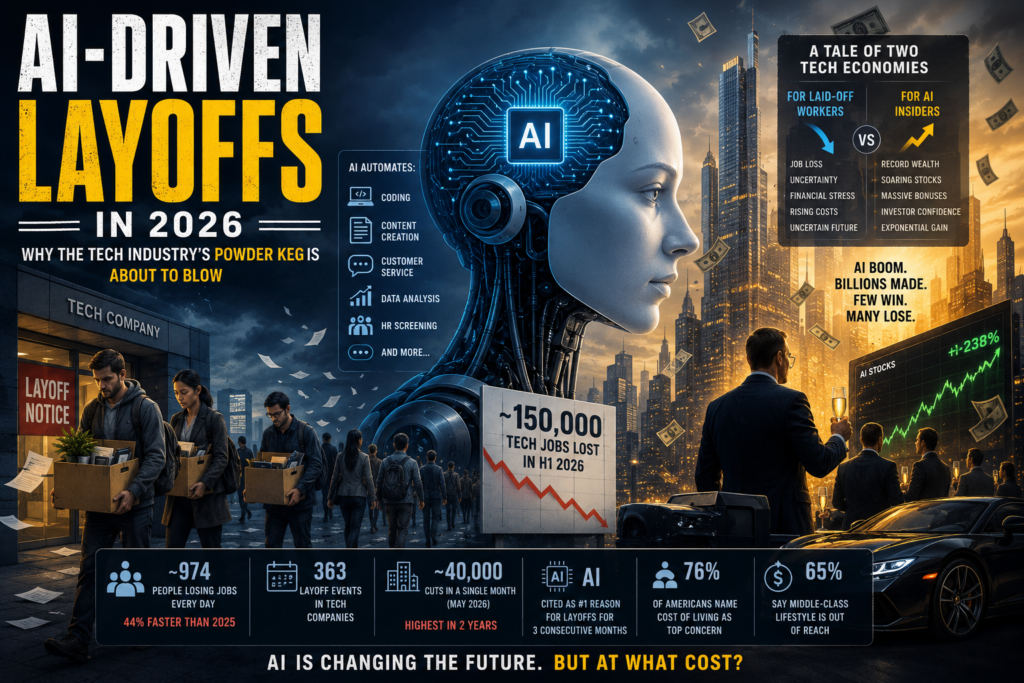
The tech industry is cutting jobs at the fastest pace in years — and blaming artificial intelligence. AI-driven layoffs have become the defining economic story of 2026, affecting nearly 150,000 workers in the first half of the year alone, while a small cohort of AI insiders accumulates unprecedented wealth. Understanding what is really driving this wave, and what it means for workers, companies, and the broader economy, has never been more urgent.
What Are AI-Driven Layoffs?
Definition: AI-driven layoffs refer to workforce reductions that companies attribute — fully or partially — to the adoption of artificial intelligence tools that automate tasks previously performed by human employees.
In theory, this means roles become redundant as AI handles coding, content generation, customer service, data analysis, HR screening, and other functions more cheaply and quickly than people can. In practice, the picture is far more complicated.
The term has become something of a corporate catch-all in 2026. Firms announcing AI-driven layoffs range from those that are genuinely restructuring workflows around automation to those that appear to be using AI as a socially acceptable explanation for cuts driven primarily by pandemic-era overhiring, cost-cutting pressure, or a desire to boost stock prices.
What makes the label so powerful — and so contested — is that it arrives with built-in justification. “We’re not failing; we’re evolving” is a far easier story to tell investors and press than “we hired too many people between 2020 and 2022.”
The Scale of the 2026 Tech Layoff Wave
The raw numbers are striking. According to TrueUp, a tech recruiting platform that maintains one of the most widely cited layoff trackers, roughly 363 separate layoff events at tech companies have been recorded so far in 2026, affecting close to 150,000 workers. That works out to approximately 974 people losing their jobs every single day — a pace around 44% faster than 2025.
The peak came last month: outplacement firm Challenger, Grey & Christmas recorded nearly 40,000 tech cuts in a single month, the highest figure in two years. Crucially, AI was cited as the primary reason for layoffs across all industries for the third consecutive month, making AI-driven layoffs the dominant narrative of the current economic moment.
Key Statistics at a Glance
- ~150,000 tech workers laid off in H1 2026
- 363 distinct layoff events at tech companies
- 974 people per day losing jobs — 44% faster than 2025
- ~40,000 cuts in a single month (May 2026) — highest in 2 years
- AI cited as the #1 reason for layoffs industry-wide for 3 consecutive months
- 76% of Americans now name cost of living as their top economic concern (CNN/SSRS, May 2026)
These numbers do not exist in a vacuum. They land against a backdrop where median home prices have climbed 28% since early 2020, health insurance premiums are rising at double the rate of inflation, and 65% of voters — in a January 2026 New York Times/Siena poll — said a middle-class lifestyle now feels out of reach.
Is AI Really to Blame, or Is It a Convenient Cover Story?
This is the central question of the moment, and the honest answer is: often both.
The Pandemic Overhiring Problem
Between 2020 and 2022, tech companies hired aggressively in response to a surge in digital demand. Zoom calls replaced offices, e-commerce replaced retail, and cloud computing scaled at extraordinary speed. Investors rewarded growth at any cost, and payrolls ballooned accordingly.
When that demand normalized — and interest rates rose dramatically — companies were left with headcounts that no longer matched their business needs. The math of over-hiring eventually catches up with every company.
Prominent venture capitalist Marc Andreessen put it bluntly in a widely shared conversation with investor Harry Stebbings, describing AI as “the silver bullet excuse” for layoffs that were really a correction of pandemic-era bloat. His estimate: most large companies are overstaffed by at least 25%, with many bloated by 50% or more, and AI is providing a convenient rationale to make cuts that were coming regardless.
When Companies Admit the Real Reason
The most illustrative example is Block, the payments company led by Jack Dorsey. After cutting nearly half its workforce earlier in 2026, Dorsey initially pointed to AI tools “enabling a new way of working” as the driver. Then, when pressed on social media about the company’s rapid hiring during the pandemic, he acknowledged that Block had, in fact, over-hired.
Uber’s situation captures the ambiguity even more sharply. The company cut roughly 23% of its people division — the HR and recruiting unit — while explicitly stating the cuts had nothing to do with AI. But the announcement followed by just one month a public disclosure that Uber had burned through its entire 2026 AI coding budget in just four months, forcing it to cap individual engineers’ spending on tools like Cursor and Claude Code. Whether AI caused the cuts or merely enabled a headcount reduction that was always coming remains genuinely unclear.
What is clear is that companies face a real incentive to frame restructuring as AI transformation. Firms including Block, Atlassian, and Cloudflare have watched their stock prices surge when they make that pivot. The financial logic of calling it an AI-driven layoff is powerful, regardless of whether it is entirely accurate.
The Wealth Divide Making This a Powder Keg
Here is what separates the 2026 tech layoff wave from prior downturns: it is happening simultaneously with the creation of extraordinary wealth for a tiny slice of the technology industry.
A Tale of Two Tech Economies
| What’s Happening for Laid-Off Workers | What’s Happening for AI Insiders |
|---|---|
| ~974 job losses per day in tech | Cerebras Systems IPO minted two new billionaires on day one |
| Health insurance premiums rising 6–7% this year | SpaceX IPO created an estimated 400 centimillionaires |
| Median home prices up 28% since 2020 | OpenAI and Anthropic approaching $1 trillion+ valuations |
| 65% of voters say middle-class lifestyle is out of reach | Mark Zuckerberg purchased a $170M Miami mansion (new county record) |
| Cost of living is top economic concern for 76% of Americans | Meta announced 8,000 layoffs (~10% of workforce) two months later |
The Cerebras Systems IPO in May 2026 illustrates the divide with unusual clarity. The AI chipmaker debuted on the Nasdaq up 68% from its $185 IPO price, giving it a market cap near $67 billion — the largest US tech IPO since Snowflake in 2020 — and instantly minting its co-founders as billionaires. SpaceX, which went public shortly after, achieved a $2.1 trillion market cap and is estimated to have created roughly 4,400 new millionaires and around 400 centimillionaires among employees.
Meanwhile, Meta announced 8,000 layoffs — roughly 10% of its global workforce — just two months after its CEO set the all-time record for the most expensive home sale in Miami-Dade County history, at $170 million.
This is the combustible element of the current moment. It is not simply that jobs are being cut. It is that jobs are being cut, ostensibly because of AI, at the exact same time AI is generating once-in-a-generation wealth for a small group of insiders — and workers are experiencing this against a cost-of-living backdrop that leaves almost no margin for error.
How AI-Driven Layoffs Compare to Past Tech Disruptions
Is This 2008 All Over Again?
The Occupy Wall Street protests of 2011 are the closest historical parallel that observers are beginning to reach for. That movement emerged after the 2008 financial crisis, in which risky behavior by financial institutions led to a government bailout of banks while millions of ordinary Americans lost jobs and homes in the resulting recession.
The structure of anger in 2026 is different — and potentially more combustible. In 2008, there was a crash to point to: a clear moment of failure, a visible villain, a crisis everyone agreed had happened. The public fury was about who paid for the cleanup.
In 2026, there is no crash. Companies are posting record profits. AI is simultaneously the stated reason workers are losing jobs and the engine generating historic wealth for those who own a piece of it. The message workers are receiving — whether companies intend it or not — is closer to: “We are getting richer than ever, using the very technology we’re deploying to replace you.”
That is a significantly harder narrative to defuse than the one that preceded Occupy Wall Street.
Key Differences Between 2008 and 2026
- 2008: Crisis-driven layoffs; banks required rescuing; public anger was reactive
- 2026: Profit-driven AI-driven layoffs; companies are thriving; public anger is building pre-emptively
- 2008: The disruption was financial; it felt temporary and correctable
- 2026: The disruption is structural; AI adoption is accelerating, not reversing
- 2008: Workers could see a path back as the economy recovered
- 2026: Workers in automated roles face potential permanent displacement
What AI-Driven Layoffs Mean for Workers Right Now
Which Roles Are Most Vulnerable?
AI-driven layoffs are not uniformly distributed across the workforce. The current wave is concentrating most heavily in roles where AI tools have demonstrated clear capability to replicate the work, at lower cost and higher speed.
Roles facing the highest near-term risk include:
- Recruiting and HR operations — Uber’s cuts to its people division are emblematic of a wider trend. AI screening, scheduling, and onboarding tools are replacing large portions of HR headcount.
- Junior software engineers — AI coding assistants now handle significant portions of routine development work, reducing demand for entry-level programmers.
- Content writers and copywriters — Generative AI has automated much of the output previously produced by marketing and content teams.
- Customer support agents — AI chatbots and voice tools handle first- and second-line support at scale.
- Data entry and back-office operations — Automation has made large segments of this work redundant.
- Junior analysts — Routine data summarization, report generation, and research synthesis are increasingly AI-native tasks.
Roles that remain more insulated tend to require physical presence, high emotional intelligence, novel judgment, or complex stakeholder management — characteristics that AI tools still struggle to replicate reliably.
What the Evidence Says About “Reskilling”
Corporate messaging around AI-driven layoffs frequently includes reassurances that workers will be retrained or transitioned into new roles. The evidence for this at scale remains thin. Most companies cutting headcount are not simultaneously building retraining pipelines — they are reducing overall labor costs, not reallocating labor.
This does not mean individual workers cannot navigate the transition. It does mean the burden of adaptation falls overwhelmingly on workers themselves, often against a financial timeline that a 6-7% increase in health insurance premiums and a 28% rise in home prices makes very unforgiving.
What Should Workers and Companies Do Next?
For Workers Navigating AI-Driven Layoffs
The most durable response to AI-driven job displacement is to move toward the skills and capabilities that remain distinctly human — while also becoming genuinely fluent in the AI tools reshaping your industry.
Practical steps that career experts and researchers consistently recommend:
- Develop AI literacy in your field. Understanding how to use tools like LLMs, coding assistants, or automation platforms makes you a force-multiplier rather than a target.
- Shift toward judgment-intensive work. Roles that require contextual decision-making, ethical reasoning, stakeholder negotiation, and novel problem-solving are harder to automate.
- Build portable expertise. Domain expertise that travels across companies and industries provides resilience that company-specific roles do not.
- Treat credentials as signals. Certifications and coursework in AI-adjacent skills (prompt engineering, AI ethics, data interpretation) signal adaptability to hiring managers.
- Build financial buffers proactively. Given the speed of the current layoff wave, an emergency fund covering 6+ months of expenses is more important than it has been in years.
For Companies Communicating AI-Driven Layoffs
The strategic case for transparency is stronger than most companies appear to realize. Workers who feel misled — who are told their role was eliminated because of AI when the real driver was pandemic overhiring or margin pressure — do not simply move on. They talk. They post. They shape the talent brand that a company will need to recruit from in three years.
Companies that acknowledge the genuine complexity — “AI is changing what we need; we also over-hired during COVID; both things are true” — tend to fare better in the court of public opinion than those who over-index on the AI narrative to avoid accountability.
There is also a regulatory dimension emerging. Policymakers are beginning to take a closer look at whether AI displacement claims should trigger different obligations under existing labor laws — a development that companies treating “AI made us do it” as a liability shield may find uncomfortable.
The Bigger Picture: A Structural Shift, Not a Correction
The 2026 tech layoff wave is not a blip. AI-driven layoffs represent a structural transformation in how companies think about labor, and the wave is still early in its progression. As AI tools become more capable and less expensive, the range of tasks they can perform will expand beyond the white-collar roles currently being displaced.
What makes the current moment genuinely different from every previous wave of technological disruption — from the mechanization of agriculture to the automation of manufacturing — is the speed and breadth of AI’s reach. Previous disruptions moved through economies over decades, leaving time for workers, educational systems, and labor markets to adapt. The current transition is moving in years, and in some cases months.
The political and social temperature around AI-driven layoffs will continue to rise in proportion to the wealth concentration happening at the other end of the AI economy. Anthropic and OpenAI, both approaching trillion-dollar valuations, are still private. When they eventually go public, the wealth creation event that follows will make the Cerebras and SpaceX IPOs look modest by comparison. That will happen against whatever employment backdrop exists at that moment.
If the trajectory of AI-driven layoffs continues — and there is no credible economic argument that it will not — the question is not whether a social and political reckoning arrives. It is what form that reckoning takes, and whether companies, policymakers, and workers will have built the frameworks to channel it constructively before it arrives.
Frequently Asked Questions About AI-Driven Layoffs
Q: Are AI-driven layoffs real, or is AI just an excuse?
Both are true simultaneously. Some companies are genuinely restructuring their workflows around AI tools and legitimately need fewer people as a result. Others are using AI as a more palatable explanation for cuts driven by pandemic over-hiring or margin pressure. Identifying which is which requires looking at whether a company is investing in AI products and tools, not just making cuts.
Q: Which industries are seeing the most AI-driven layoffs in 2026?
Technology companies are leading the wave, but AI-attributed cuts are appearing across financial services, media, professional services, and healthcare administration. The common thread is roles where AI tools have demonstrably automated meaningful portions of the work.
Q: What jobs are safe from AI-driven layoffs?
No role is completely immune, but work requiring physical presence, high emotional intelligence, real-time judgment in novel situations, and complex human relationship management remains more insulated. Skilled trades, healthcare delivery, senior leadership, and roles requiring contextual ethical judgment are among those most resistant to near-term AI displacement.
Q: How should I talk about being laid off due to AI in a job interview?
Frame it as an industry-wide structural shift rather than a personal failing — because that is what it is. Emphasize what you learned during the transition, any AI tools or skills you have developed, and your forward-looking adaptability. Hiring managers in 2026 understand the landscape.
Conclusion
AI-driven layoffs are the defining workforce story of 2026 — and the powder keg metaphor is apt. Nearly 150,000 tech workers have lost jobs this year at a pace 44% faster than 2025, with AI cited as the primary cause across all industries for three consecutive months. At the same time, a small group of AI insiders is accumulating wealth on a scale that has few historical precedents.
Whether AI is the true cause or a convenient cover story varies by company. What does not vary is the reality facing displaced workers: a cost-of-living environment offering very little margin for error, a reskilling promise that most companies are not actually fulfilling, and a wealth divide that grows more visible by the quarter.
The companies that navigate this best will be the ones that communicate with more transparency than the moment seems to demand, invest genuinely in the transitions of the workers they displace, and resist the temptation to let AI-driven layoffs serve as a one-size-fits-all explanation for decisions that deserve a more honest accounting.
The ones that don’t may find that the powder keg has a shorter fuse than they realized.