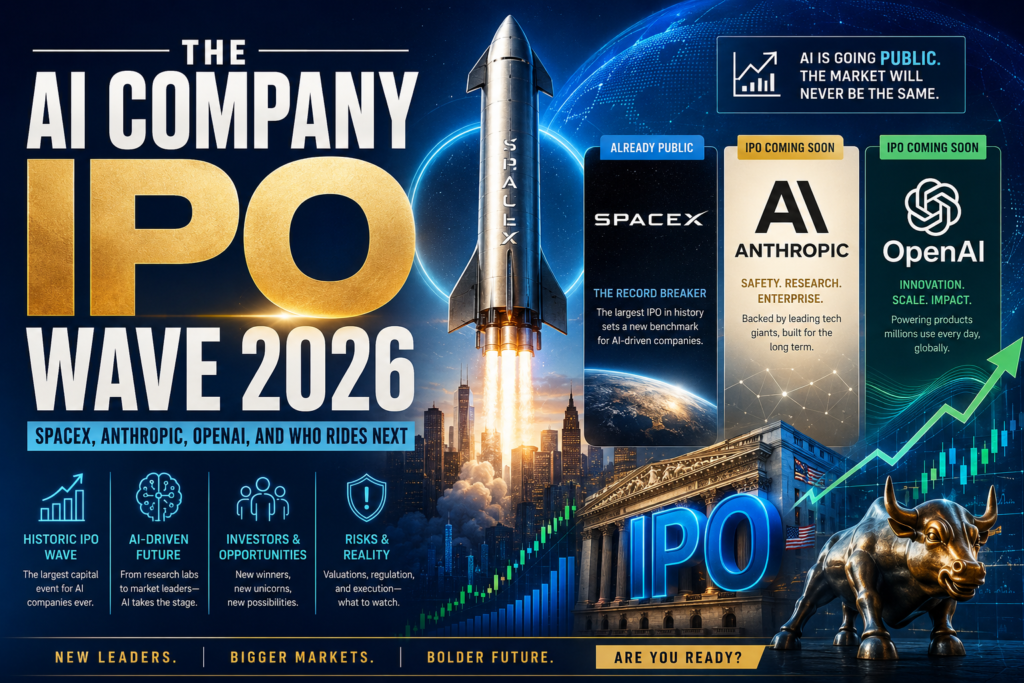
The summer of 2026 is shaping up to be the most consequential IPO season in a generation — and the AI company IPO is at the center of it. SpaceX already made history with the largest public offering ever, and both Anthropic and OpenAI have confidentially filed to follow. Here is everything you need to know about why this wave matters, who benefits, and what the risks are.
What Is the 2026 AI Company IPO Wave?
Definition: An AI company IPO (Initial Public Offering) is the process by which an artificial-intelligence-focused private company sells shares to public investors for the first time, listing on a stock exchange such as NASDAQ or NYSE.
Why 2026 is different: Previous tech IPO cycles were driven by consumer platforms — social networks, streaming services, e-commerce. The current wave is led by deep-technology AI labs and infrastructure plays. Analysts now describe the dominant public-market acronym as MANGOS — Meta, Anthropic, NVIDIA, Google, OpenAI, SpaceX — a significant departure from the old FAANG framework. Netflix gets replaced by two AI labs that were barely founded a decade ago.
This structural shift means that for the first time, the companies commanding the largest pools of public capital are primarily research-and-infrastructure businesses, not consumer-facing platforms. That has profound implications for how startup funding, valuations, and public-market expectations work across the entire technology sector.
Why SpaceX’s IPO Changed the Game
The Largest IPO Ever — and What It Signals
SpaceX officially priced its shares at $135 in June 2026, completing what analysts confirmed was the largest IPO in history. The offering made CEO Elon Musk the world’s first trillionaire and sent Robinhood traffic to record-breaking levels on the debut trading day.
Despite its name, SpaceX’s IPO filing leaned heavily into its AI business, describing costly bets on AI infrastructure alongside its Starship ambitions. That positioning was a deliberate signal to public markets: this is not merely an aerospace company. It is a technology conglomerate anchored in AI — and it wanted to be valued accordingly.
The SpaceX AI company IPO set three precedents that every subsequent filing will be measured against:
- Scale: It demonstrated that markets have appetite for massive, pre-profitability raises when AI is the growth story.
- Control concentration: SpaceX pushed the limits of single-founder control, echoing the dual-class share structures of early Google and Meta. Observers are now watching to see how much Anthropic and OpenAI will replicate this.
- Loss-tolerance: Like Amazon in its formative years, SpaceX signaled that “we will lose money for a long time” is acceptable if the long-term vision is compelling enough.
The Ripple Effect: Who Else Benefits From the SpaceX Wave
The effects of the SpaceX IPO extended well beyond the company itself. Within days, a company called Quantum Space announced a SPAC transaction explicitly designed to ride SpaceX’s momentum. Startups building orbital data centers — a concept SpaceX helped popularize — began raising fresh capital on the strength of SpaceX’s narrative, even though none of them were anywhere close to going public themselves.
Even legacy industrial companies pivoted. Ford announced a battery storage business to supply power to AI data centers, and its stock jumped noticeably on the news. General Motors made a parallel pivot into energy storage infrastructure targeting the same data center market. Both moves were criticized by veteran observers who noted that trying to mimic an Elon Musk-style business has historically not worked out well for traditional automakers.
The pattern is clear: each major AI company IPO generates a gravitational field that pulls adjacent startups, incumbents, and investors into its orbit.
Anthropic IPO vs. OpenAI IPO: A Head-to-Head Race
Anthropic filed confidentially to go public in early June 2026. OpenAI followed within days. Both companies are AI labs racing to the same pool of public-market capital — and both know there is a finite supply of investor appetite at any given valuation level.
Side-by-Side Comparison
| Factor | Anthropic | OpenAI |
|---|---|---|
| IPO Filing Status | Confidential filing confirmed (June 2026) | Confidential filing confirmed (June 2026) |
| Primary Revenue Model | API access, enterprise Claude subscriptions | ChatGPT subscriptions, API, enterprise |
| Investor Base | Amazon, Google (strategic backers) | Microsoft (strategic backer), broad VC |
| Corporate Structure | Public Benefit Corporation | Transitioning from capped-profit to for-profit |
| Competitive Pricing Move | N/A disclosed pre-IPO | Announced price cuts ahead of filing |
| Positioning | Safety-focused, research-led | Consumer-facing + enterprise hybrid |
| Go-Public Motivation | Capital for compute + long-term R&D | Capital for compute + competitive moat |
| Key Risk | Regulatory uncertainty around AI safety | Organizational complexity of restructuring |
Why the Race Timing Matters
Public markets do not have unlimited bandwidth. When two comparable AI labs are both preparing for an IPO in the same calendar window, they are effectively competing for the same dollars, the same analyst coverage, and the same retail investor attention.
The company that goes first gets to set the pricing benchmark. The company that goes second is implicitly measured against it. If the first AI company IPO in this pair prices well and performs on its debut, the second benefits from warm sentiment. If the first stumbles, the second faces a significantly harder road.
This dynamic — described by analysts covering both filings — means Anthropic and OpenAI are not simply racing each other for market leadership. They are racing each other for IPO timing advantage.
The MANGOS Era: How the Tech Power Map Is Shifting
Definition: MANGOS is the new shorthand for the six companies commanding the largest share of public-market tech capital in 2026 — Meta, Anthropic, NVIDIA, Google, OpenAI, and SpaceX.
What changed: The old FAANG acronym (Facebook/Meta, Amazon, Apple, Netflix, Google) was built around consumer internet and e-commerce. Netflix — a streaming service — is no longer in the same capital league as AI labs. Amazon and Apple remain dominant but are no longer the defining names of the current cycle. Two AI research companies that did not exist when FAANG was coined have effectively displaced a streaming giant and reshaped the acronym entirely.
What this means for the AI company IPO landscape: When AI labs sit alongside semiconductor giants and infrastructure-heavy space companies as the most important names in public markets, the type of business that investors are willing to fund changes at every level of the stack. Venture capitalists raise larger funds. Growth-stage companies command higher multiples. And startups that serve AI labs — from GPU cooling solutions to energy storage to legal infrastructure — inherit elevated valuations simply by proximity.
Who Else Is Riding the AI IPO Wave?
The direct beneficiaries of the current AI company IPO wave extend well beyond the labs themselves. Here is a breakdown of the categories catching the most momentum:
- Space infrastructure startups: Companies building orbital data centers, satellite connectivity layers, and launch-adjacent services are raising capital explicitly because SpaceX validated the concept in its IPO filing.
- SPAC vehicles targeting AI adjacency: Quantum Space’s June 2026 SPAC announcement is the clearest example, but it is not alone. SPAC sponsors are actively looking for AI-adjacent targets with IPO-ready narratives.
- Energy and power companies: AI data centers consume extraordinary amounts of electricity. Ford’s battery storage business and GM’s energy infrastructure pivot are both direct responses to this demand signal, and both received stock-price bumps that reflect investor enthusiasm for the AI-energy thesis.
- Chip and silicon suppliers: NVIDIA’s continued dominance is well-documented, but second-tier chip designers, memory manufacturers, and custom silicon startups are also raising at elevated valuations on the back of AI lab capex expansion.
- Legal, compliance, and governance vendors: Every AI company preparing for an IPO needs IP counsel, regulatory infrastructure, and governance frameworks. Vendors in these categories are seeing deal flow driven directly by the IPO preparation cycle.
- Networking and cooling infrastructure: Data centers running large language models generate significant heat and require specialized cooling and networking. Industrial companies serving this need are capturing a share of the AI company IPO enthusiasm.
The common thread: proximity to an AI company IPO — either as a supplier, infrastructure provider, or thematic cousin — is functioning as a fundraising multiplier in 2026.
What Investors and Founders Should Watch Next
Q: Is there actually enough public-market capital for multiple AI company IPOs in 2026?
Direct Answer: There is capital available, but it is not unlimited. Analysts tracking the Anthropic and OpenAI filings have noted explicitly that the two companies may be competing for the same tranche of institutional money. SpaceX already absorbed a significant portion of available IPO allocation. If three landmark AI company IPOs occur within the same six-month window, later entrants face more skeptical pricing conditions than early ones.
Q: Will Anthropic and OpenAI model themselves on SpaceX’s corporate governance approach?
Direct Answer: Almost certainly not entirely. SpaceX’s single-founder control and extreme loss-tolerance are unusual even by Silicon Valley standards. Anthropic’s Public Benefit Corporation structure and OpenAI’s ongoing restructuring away from a capped-profit model suggest both companies are building governance frameworks that can satisfy public-market scrutiny without replicating Musk-style concentration of authority.
Q: What happens to AI startup valuations if the IPOs underperform?
Direct Answer: A failed or weak AI company IPO in this window would compress private-market valuations across the sector. Series B and C AI startups that have been raising at AI-lab-adjacent multiples would face down rounds or flat rounds as public comps reset. The effect would be most severe for companies whose business models closely resemble the public labs rather than those serving them with infrastructure or tooling.
Q: Is the AI economic impact real or speculative?
Direct Answer: Both. The economic remaking of adjacent sectors — automotive pivots, energy infrastructure build-outs, semiconductor demand — is happening in real time and is measurable. Whether these investments produce durable returns depends on AI adoption curves that are still being established. The key distinction is between structural demand (data centers need power and cooling regardless of which AI model wins) and winner-dependent demand (companies betting on specific AI providers face concentration risk).
Should Companies Rush to Go Public in 2026? The Case For and Against
The case for moving quickly: Public market conditions are favorable right now. Investor appetite for AI stories is high, comps are strong, and SpaceX’s successful debut has opened the window. Companies that wait risk a sentiment shift — whether from macroeconomic turbulence, regulatory action on AI, or simple IPO fatigue after a crowded calendar.
The case for patience: Rushing an AI company IPO before the business model is sufficiently mature can lock in a valuation that becomes a ceiling rather than a floor. The governance constraints of being a public company — quarterly reporting, activist shareholders, short-term earnings pressure — can be damaging for AI labs that require years of capital-intensive R&D before reaching profitability. Amazon took more than a decade as a public company before its margins normalized. Not every board has that patience.
The overlooked risk: Companies and traditional industries trying to “ride the wave” by pivoting into AI-adjacent businesses often do not account for the difference between narrative momentum and operational expertise. Automakers that pivot to battery storage are not becoming energy companies overnight. The history of “next Tesla killer” announcements suggests that chasing the template of a breakthrough company — rather than building a genuinely differentiated business — rarely ends well.
The Bottom Line: What the 2026 AI Company IPO Wave Actually Means
The 2026 AI company IPO cycle is not just a financial event. It is a structural reorganization of which companies command the most capital, what business models public markets are willing to reward, and which adjacent sectors gain or lose momentum as a result.
For founders: the window is open, but it is not infinitely wide. Timing matters, governance matters, and differentiation from the labs themselves matters more than narrative proximity to them.
For investors: the structural demand plays — energy, cooling, networking, compliance — may offer more durable returns than direct bets on which AI lab wins the model race.
For observers: the shift from FAANG to MANGOS is not just an acronym update. It reflects a genuine reorientation of where technological and economic power is concentrating — and the AI company IPO wave of 2026 is the most visible marker of that transition so far.
Key Terms Defined
AI company IPO: The first public sale of shares by a private artificial intelligence company, granting retail and institutional investors ownership stakes in exchange for capital.
SPAC (Special Purpose Acquisition Company): A shell company that raises money through an IPO specifically to acquire a private company, allowing that private company to go public without a traditional IPO process.
MANGOS: The 2026 acronym for the six companies now dominating public-market tech capital — Meta, Anthropic, NVIDIA, Google, OpenAI, and SpaceX — replacing the older FAANG framework.
Confidential IPO filing: A mechanism that allows companies to submit S-1 registration documents to the SEC privately before making them public, giving companies time to test investor appetite without market scrutiny.