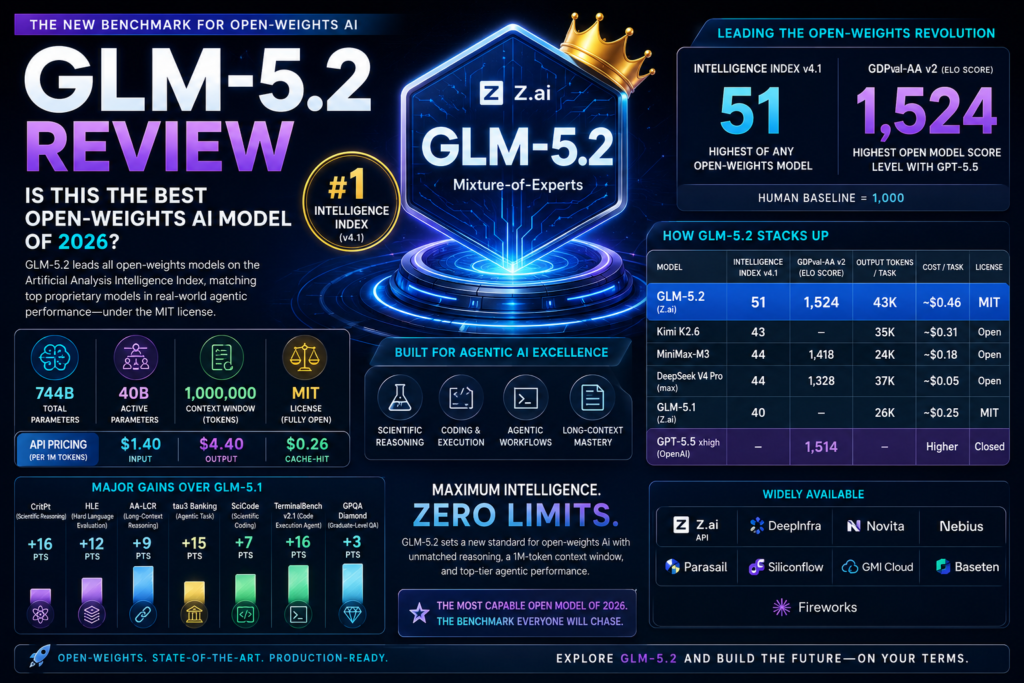
GLM-5.2 is now the top-ranked open-weights model on the Artificial Analysis Intelligence Index, scoring 51 points — 7 points ahead of its nearest rival. If you are evaluating open-source large language models for agentic workloads, scientific reasoning, or cost-sensitive deployments, GLM-5.2 is the benchmark to beat as of June 2026. GLM-5.2 Review
What Is GLM-5.2?
Definition: GLM-5.2 is a Mixture-of-Experts (MoE) large language model developed by Z ai, released on June 17, 2026. It is an upgrade to GLM-5.1 and is designed for advanced reasoning, long-context tasks, and real-world agentic workflows.
Despite being the same physical size as its predecessor — 744 billion total parameters with 40 billion active parameters — GLM-5.2 scores dramatically higher across nearly every evaluation category. This makes it one of the clearest examples in 2026 of how training refinement and architectural tuning can deliver major capability gains without increasing model size.
GLM-5.2 is available under an MIT license, which means it can be freely used, modified, and redistributed — a critical advantage for enterprises and developers who need full ownership and deployment flexibility.
Key Specs at a Glance
- Total parameters: 744B (Mixture-of-Experts)
- Active parameters: 40B per forward pass
- Context window: 1,000,000 tokens (up from 200,000 in GLM-5.1)
- License: MIT (fully open)
- API pricing: $1.40 / $4.40 / $0.26 per 1M input / output / cache-hit tokens
- Availability: Z ai first-party API, DeepInfra, Novita, Nebius, Parasail, Siliconflow, GMI Cloud, Baseten, Fireworks
How GLM-5.2 Performs on the Artificial Analysis Intelligence Index
What is the Artificial Analysis Intelligence Index? It is an independent evaluation suite that benchmarks LLMs across reasoning, coding, agentic performance, scientific problem-solving, and real-world knowledge tasks. The Intelligence Index v4.1 — used to evaluate GLM-5.2 — places special emphasis on agentic workloads, including longer-horizon trajectories and multi-step task completion.
GLM-5.2 scores 51 on the Intelligence Index v4.1. That is an 11-point improvement over GLM-5.1, which scored 40.
Intelligence Index Score Breakdown
GLM-5.2 posts gains across nearly every sub-benchmark compared to its predecessor:
- CritPt (scientific reasoning): +16 points, reaching 21%
- HLE (hard language evaluation): +12 points, reaching 40%
- AA-LCR (long-context reasoning): +9 points, reaching 71%
- tau3 Banking (agentic task): +15 points, reaching 27%
- SciCode (scientific coding): +7 points, reaching 50%
- TerminalBench v2.1 (code execution agent): +16 points, reaching 78%
- GPQA Diamond (graduate-level QA): +3 points, reaching 89%
These improvements are not incremental. They represent a meaningful jump in the model’s ability to handle tasks requiring multi-step planning, scientific domain knowledge, and autonomous code execution.
GDPval-AA v2 — Real-World Agentic Performance
What is GDPval-AA v2? It is Artificial Analysis’s primary benchmark for real-world agentic performance. It baselines Elo scores to human performance at 1,000, uses a rotating panel of frontier AI judges, and allows up to 250 turns per task — making it one of the most realistic evaluations of how an AI model performs on actual work.
GLM-5.2 scores 1,524 on GDPval-AA v2 — the highest score of any open-weights model on this benchmark. For context, GPT-5.5 (xhigh reasoning), a proprietary model from OpenAI, scores 1,514. That means GLM-5.2 is not merely competitive with the best open-source alternatives; it is effectively level with leading proprietary frontier models on real-world agentic benchmarks.
This is a landmark result. It signals that the gap between open-weights and closed-weights models continues to narrow, with GLM-5.2 leading that convergence.
GLM-5.2 vs. The Competition: How Does It Stack Up?
The table below compares GLM-5.2 directly against the other leading open-weights models and a key proprietary reference point as of June 2026.
| Model | Intelligence Index v4.1 | GDPval-AA v2 | Output Tokens / Task | Cost / Task | License |
|---|---|---|---|---|---|
| GLM-5.2 | 51 | 1,524 | 43k | ~$0.46 | MIT |
| Kimi K2.6 | 43 | — | 35k | ~$0.31 | Open |
| MiniMax-M3 | 44 | 1,418 | 24k | ~$0.18 | Open |
| DeepSeek V4 Pro (max) | 44 | 1,328 | 37k | ~$0.05 | Open |
| GLM-5.1 | 40 | — | 26k | ~$0.25 | MIT |
| GPT-5.5 xhigh (proprietary) | — | 1,514 | — | Higher | Closed |
Key takeaway: GLM-5.2 leads all open-weights models on both the Intelligence Index and GDPval-AA v2, and matches GPT-5.5 on real-world agentic performance — all under an MIT license.
The trade-off is cost per task. At approximately $0.46 per Intelligence Index task, GLM-5.2 is more expensive than MiniMax-M3 ($0.18) and DeepSeek V4 Pro ($0.05). However, for tasks requiring maximum accuracy, scientific reasoning, or long-horizon agentic execution, that premium is justified by the performance delta.
Where GLM-5.2 Improves Most Over GLM-5.1
Understanding the gap between GLM-5.2 and its predecessor matters for teams already using GLM-5.1 who are evaluating whether to upgrade.
Scientific Reasoning Gains
The most dramatic improvements in GLM-5.2 are concentrated in scientific and technical reasoning:
- On CritPt, which tests critical scientific reasoning, GLM-5.2 jumped 16 percentage points.
- On HLE (hard language evaluation), it improved by 12 points.
- On SciCode, a benchmark testing the ability to write and execute scientific code, it gained 7 points.
These gains are directly relevant for developers building AI-powered research tools, scientific assistants, or technical documentation systems.
Context Window Expansion
GLM-5.2 extends its context window from 200,000 to 1,000,000 tokens — a 5x increase. This matters for:
- Processing entire codebases in a single prompt
- Long-form document summarization and analysis
- Multi-turn agentic workflows that accumulate large histories
- Legal, scientific, and financial document review
For teams running long-horizon tasks, this expansion alone may justify migration from GLM-5.1.
What Are the Trade-offs? Token Efficiency and Cost
No model review is complete without discussing the limitations. GLM-5.2 has two notable trade-offs.
Higher output token usage: GLM-5.2 uses an average of 43,000 output tokens per Intelligence Index task, of which 37,000 are reasoning tokens. This is notably higher than MiniMax-M3 (24k) and even GLM-5.1 (26k). More reasoning tokens often correlate with better accuracy — but they also directly increase inference costs and latency.
Higher cost per task than alternatives: At roughly $0.46 per task, GLM-5.2 is not the cheapest open-weights option. DeepSeek V4 Pro (max) achieves a comparable Intelligence Index score of 44 at approximately $0.05 per task — nearly 9x cheaper.
When is the premium worth paying?
This depends entirely on your use case. If your application demands maximum agentic accuracy, scientific rigor, or long-context comprehension, GLM-5.2 offers capabilities that cheaper alternatives cannot match. If your workload is high-volume and accuracy requirements are moderate, DeepSeek V4 Pro or MiniMax-M3 may offer a better cost-to-performance ratio.
GLM-5.2 sits on the Pareto frontier of Intelligence vs. Cost per Task — meaning no other model at its intelligence level costs less per task. This does not mean it is the cheapest model overall; it means it is the most cost-efficient at its performance tier.
Who Should Use GLM-5.2?
GLM-5.2 is best suited for teams and use cases where intelligence and open licensing are the primary selection criteria.
Use GLM-5.2 if you need:
- Maximum open-weights performance — it leads every open-source alternative on both the Intelligence Index and GDPval-AA v2 as of June 2026
- Scientific or technical reasoning — gains in CritPt, HLE, and SciCode make it the strongest open model for research-grade tasks
- Long-context handling — a 1M token context window enables document-level and codebase-level reasoning that most competitors cannot match
- Open licensing — the MIT license allows full commercial use, modification, and self-hosting without vendor lock-in
- Agentic AI workflows — its TerminalBench and GDPval-AA v2 scores confirm strong real-world task completion capability
Consider alternatives if:
- Cost is a primary constraint — DeepSeek V4 Pro and MiniMax-M3 offer strong performance at significantly lower per-task costs
- Token efficiency matters — MiniMax-M3 achieves a competitive Intelligence Index score of 44 while using only 24k output tokens per task, roughly half of GLM-5.2
Frequently Asked Questions About GLM-5.2
What does GLM stand for? GLM stands for General Language Model. The GLM series is developed by Z ai, which has been a major contributor to the open-weights LLM ecosystem.
Is GLM-5.2 truly open source? Yes. GLM-5.2 is released under the MIT license, one of the most permissive open-source licenses available. This means you can use it commercially, modify it, and deploy it without royalties or restrictions.
How does GLM-5.2 compare to DeepSeek V4 Pro? GLM-5.2 scores 51 on the Artificial Analysis Intelligence Index v4.1 versus DeepSeek V4 Pro (max) at 44. On GDPval-AA v2, GLM-5.2 scores 1,524 compared to DeepSeek V4 Pro’s 1,328. However, DeepSeek V4 Pro is substantially cheaper at roughly $0.05 per task versus $0.46 for GLM-5.2.
Why does GLM-5.2 use so many output tokens? GLM-5.2 generates 43k output tokens per benchmark task, of which 37k are reasoning (chain-of-thought) tokens. This extended reasoning process is a key contributor to its high accuracy — the model “thinks” more thoroughly before producing its final answer. The trade-off is higher inference cost and latency.
Is GLM-5.2 available through third-party APIs? Yes. In addition to Z ai’s own API, GLM-5.2 is hosted by DeepInfra, Novita, Nebius, Parasail, Siliconflow, GMI Cloud, Baseten, and Fireworks — giving developers flexibility in provider selection, pricing negotiation, and regional availability.
How does GLM-5.2 compare to GPT-5.5? On GDPval-AA v2 — the most comprehensive real-world agentic benchmark in the Artificial Analysis suite — GLM-5.2 scores 1,524 and GPT-5.5 (xhigh reasoning) scores 1,514. GLM-5.2 effectively matches or slightly edges out GPT-5.5 on this benchmark, while remaining fully open under the MIT license.
Bottom Line: GLM-5.2 Is the Open-Weights Model to Beat in 2026
GLM-5.2 sets a new standard for what is achievable with an open-weights model. It leads every open-source alternative on the Artificial Analysis Intelligence Index v4.1, achieves competitive performance with the best proprietary models on real-world agentic benchmarks, and does so under a fully permissive MIT license.
The key caveats are real: GLM-5.2 uses more output tokens than its peers, and its per-task cost is higher than most open-source alternatives at comparable intelligence levels. Teams with budget-constrained, high-throughput workloads may find better economics with MiniMax-M3 or DeepSeek V4 Pro.
But for applications that demand the highest available open-weights intelligence — scientific research tools, long-context document analysis, advanced coding agents, and enterprise AI workflows requiring full licensing freedom — GLM-5.2 is the clearest choice available today.