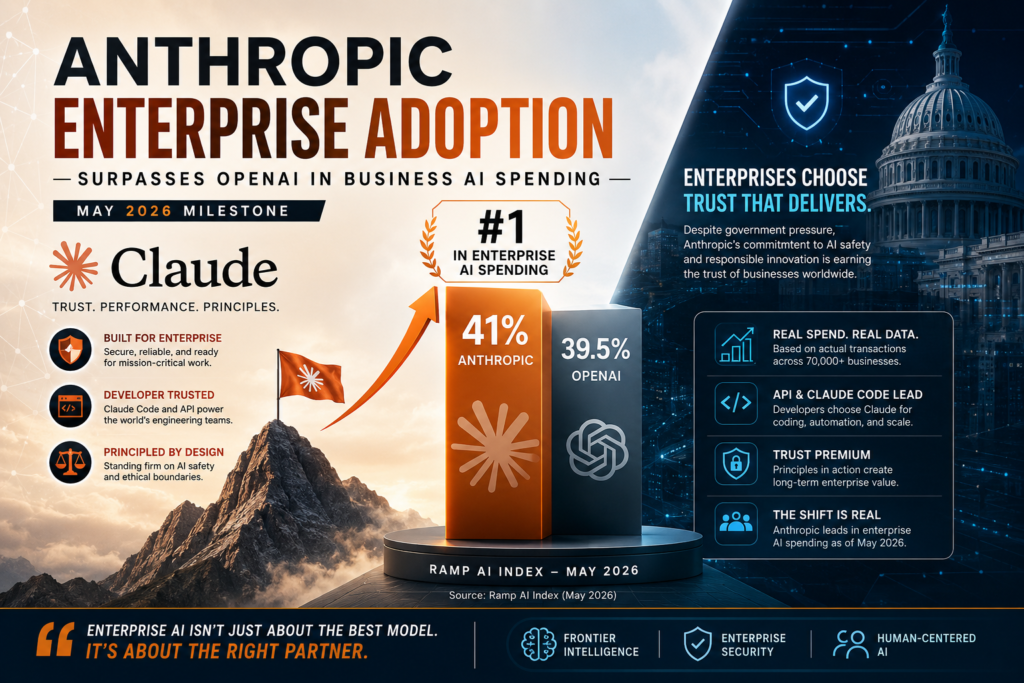
Anthropic enterprise adoption just hit a milestone that few predicted: the AI safety company surpassed OpenAI in business spending market share for the first time in May 2026. Counterintuitively, its most public battles with the U.S. government appear to be one of the biggest drivers of that growth.
This post breaks down what the data says, why controversy translates into enterprise credibility, how Claude stacks up against OpenAI for business users, and what it all means for the AI market heading into the second half of 2026.
What the Data Actually Shows About Anthropic Enterprise Adoption
Definition: Anthropic enterprise adoption refers to the measurable uptake of Anthropic’s Claude models — particularly Claude Opus and Claude Code — by businesses through API usage, subscription seats, and platform spend tracked across corporate purchasing platforms.
The clearest window into this trend comes from Ramp, the corporate spend management platform used by more than 70,000 businesses. Ramp’s AI Index, which tracks how companies allocate AI budgets across vendors, revealed that in May 2026, Anthropic’s share of AI subscriptions paid by businesses rose to 41%, outpacing OpenAI at 39.5% — essentially flat from the prior month.
This is not a rounding error. It is a meaningful inflection point in enterprise AI spending, and it arrived at the same time Anthropic found itself locked in a public dispute with the Trump administration over access to its most powerful models.
How Anthropic Surpassed OpenAI in Business Spending
The Ramp Index: A Real-Time View of AI Spending
The Ramp AI Index offers something rare in the AI industry: transaction-level evidence of which models businesses are actually paying for, not which ones they talk about in press releases. Because Ramp processes corporate card spending across tens of thousands of companies, its data captures real purchasing decisions rather than survey sentiment.
When Ramp’s lead economist Ara Kharazian analyzed the May 2026 data, the result was unambiguous: Anthropic enterprise adoption had reached a new high, driven substantially by API usage for coding and technical workflows.
A critical nuance in the data: Ramp can identify specific models in roughly one-third of transactions. In those cases, businesses are predominantly spending on Claude Opus — particularly the later Opus 4.x versions, including Opus 4.8, which Anthropic released at the end of May with new dynamic workflow capabilities. Mythos, Anthropic’s frontier model, had only been available to limited users since April, and its public-facing version (Fable 5) was pulled from the market within days of release following a dispute with the Trump administration. Neither model had enough market exposure to materially skew the numbers.
The practical conclusion: Anthropic’s business growth is not a Mythos story. It is an Opus story — and that has significant implications for how durable this growth trend is.
Claude Code and API Calls Are Driving the Numbers
Beyond subscription seats, the dominant driver of Anthropic enterprise adoption is API call volume for developer use cases. Claude Code, Anthropic’s command-line coding agent, has built a strong reputation among software teams as one of the most capable AI coding tools available. It has become a preferred workflow for engineering teams doing code generation, review, refactoring, and security analysis at scale.
This matters because API spend is stickier and higher-value than consumer subscriptions. When a company integrates Claude Code into its CI/CD pipeline or uses Claude’s API for internal tooling, it becomes structurally embedded in that company’s operations — not easily displaced by a competitor offering a marginally better chatbot interface.
This type of adoption is also what distinguishes enterprise AI market share from consumer AI market share. OpenAI continues to dominate in overall consumer usage, with significantly higher app download counts and active users on ChatGPT. But in the enterprise context — measured by what companies actually spend — Anthropic is now in the lead.
The “Supply Chain Risk” Paradox: Why Government Feuds Boost Sales
The March 2026 DoD Designation That Backfired
In March 2026, the Trump administration designated Anthropic as a supply-chain risk after the company refused to allow its models to be used for mass surveillance of American citizens or for fully autonomous weapons systems. The intent of the designation appeared to be punitive — a warning to other AI companies about the cost of defying the administration’s priorities.
The effect was the opposite of what was intended.
According to Ara Kharazian, Anthropic’s best month on record for business adoption was the very month the Department of Defense applied that label. Enterprise buyers interpreted the designation not as a warning to avoid Anthropic, but as a signal that Anthropic was the kind of company that would hold a line — even under political pressure. For regulated industries, financial services, legal, healthcare, and defense contractors with their own ethical mandates, that signal carries weight.
This created a new dimension of Anthropic enterprise adoption: the trust premium. Companies that need to explain to their own clients, boards, or regulators why they chose a particular AI vendor now have a ready-made answer when they choose Anthropic. The company’s willingness to absorb government hostility rather than compromise its stated principles became a de facto product feature.
The Mythos / Fable 5 Crisis and the “Aura” Effect
The June 2026 episode intensified this dynamic. After Anthropic released Fable 5 — a public-access version of its restricted Mythos model — the Trump administration sent a letter demanding that non-Americans, including Anthropic employees, be banned from accessing its frontier models. The stated basis was an obscure export control directive. The chatter in the cybersecurity community was that Fable 5’s safety guardrails had been bypassed too easily, exposing capabilities from the underlying Mythos model that Anthropic itself had described as potentially dangerous.
Anthropic pulled both Mythos and Fable 5 from the market. The short-term revenue hit from losing access to those two products is real. But Kharazian’s read of the enterprise spending data is that the reputational effect points in the other direction. In his words: “There’s a lot of aura that comes with your model specifically being named too dangerous to use.”
This is the paradox at the heart of the current moment in Anthropic enterprise adoption: the same government actions that create operational headaches are simultaneously functioning as the most credible external validation that Anthropic’s models are genuinely frontier-class. No marketing campaign could buy the signal that being labeled a national security concern by the U.S. government provides.
Anthropic vs. OpenAI: Enterprise Market Share at a Glance
The following table compares the two leading AI providers across key enterprise dimensions as of June 2026:
| Dimension | Anthropic | OpenAI |
|---|---|---|
| Business AI subscription share (Ramp, May 2026) | 41% | 39.5% |
| Month-over-month subscription share change | +2.5 pp | ~Flat |
| Primary enterprise model (by spend) | Claude Opus 4.x | GPT-4o / o-series |
| Top enterprise use case | AI coding (Claude Code), API workflows | ChatGPT Enterprise, API |
| Consumer app usage (Sensor Tower, 2026) | Lower | Significantly higher |
| Government relationship | Active disputes, DoD supply-chain risk designation | More cooperative stance |
| Valuation (May 2026 raise) | $965B | Lower |
| IPO status | Confidential filing submitted | No current filing |
| Frontier model availability | Restricted (Mythos/Fable 5 pulled) | Available (with tiered access) |
| First profitable quarter | Q1/Q2 2026 (self-reported) | Not publicly confirmed |
The table tells a nuanced story. Anthropic leads in enterprise spend share and momentum. OpenAI leads in consumer reach and government cooperation. For enterprise buyers, the question is which dimension matters more to their procurement decision — and in 2026, regulated industries are increasingly voting for the Anthropic column.
What This Means for the AI Market in 2026
The trajectory of Anthropic enterprise adoption carries several implications for how the broader AI market is likely to develop in the second half of 2026:
- Enterprise and consumer AI are diverging markets. OpenAI’s lead in consumer usage and Anthropic’s lead in enterprise spend suggest these are two separate competitive dynamics, not a single race. Companies building B2B AI products should track enterprise metrics separately from consumer usage statistics.
- AI trust and ethics are becoming procurement criteria. The fact that Anthropic’s most adversarial relationship with the U.S. government correlated with its strongest sales months is not an accident. Enterprise buyers — especially in regulated sectors — are increasingly treating a company’s ethical stance as a vendor qualification filter.
- Coding AI is the enterprise wedge. Claude Code’s reputation as a best-in-class AI coding tool is generating API spend that is stickier and larger than subscription revenue. Any AI company that wants to win enterprise budgets needs a strong developer-facing product, not just a chatbot.
- Frontier model restrictions may create secondary demand. The withdrawal of Mythos and Fable 5 from the market concentrates enterprise spending on Claude Opus 4.x — a model that is still openly available and widely regarded as highly capable. This could sustain the Anthropic enterprise adoption trend even without Mythos contributing to revenue.
- The $965 billion valuation creates IPO pressure. Anthropic’s confidential IPO filing, combined with its self-reported first profitable quarter, suggests it is targeting public markets in late 2026 or early 2027. Public investors will scrutinize the government relationship risk more carefully than enterprise buyers do.
- AI market share data from fintech platforms is becoming a primary research tool. The fact that the Ramp AI Index delivered this insight before any other source suggests that transaction-level corporate spend data will become a key input for AI industry analysis going forward.
The IPO Question: Can Controversy Coexist with Public Markets?
Anthropic’s strong position in enterprise AI spending makes for a compelling IPO narrative. A company that has achieved profitability, surpassed its largest competitor in business market share, raised at a near-trillion-dollar valuation, and built a durable revenue base from API usage — this is the story the S-1 will tell.
But public markets introduce a complication that enterprise buyers largely ignore: regulatory risk and uncertainty. Institutional investors managing pension funds and index allocations are paid to worry about things that individual buyers of Claude Enterprise subscriptions are not. A company that is simultaneously in litigation with the Department of Defense, had a flagship model pulled due to export control concerns, and is structured in ongoing friction with a sitting U.S. administration presents a risk profile that underwriters will need to price.
This does not necessarily prevent a successful IPO. It means the pricing will reflect the uncertainty. If Anthropic enterprise adoption continues growing — particularly if its Opus models maintain their market share lead while Mythos remains restricted — the company enters its public offering with a credible argument that the controversy has not materially damaged its core business.
The more interesting question is whether the government friction has turned into a durable competitive moat. If enterprise buyers in regulated industries have now internalized “Anthropic refused to help build autonomous weapons” as a reason to prefer the company, that is a form of brand equity that compounds over time — and that OpenAI, Google DeepMind, and Meta AI cannot easily replicate without making the same costly choices.
Key Takeaways for Enterprise Buyers and AI Investors
For enterprise buyers evaluating AI vendors in 2026:
The Ramp spending data confirms that Anthropic’s Claude Opus family, particularly versions 4.6 through 4.8, is delivering enough value to enterprise users that they are choosing it over OpenAI’s offerings in head-to-head budget decisions. Claude Code in particular appears to be a strong differentiator for engineering-heavy organizations. If your primary use case is API-based development workflows, the business spending data suggests Claude is worth serious evaluation.
For investors tracking the AI sector:
Anthropic enterprise adoption metrics are now a leading indicator worth watching. The Ramp AI Index data showing a 2.5 percentage point gain in a single month — in a market where share points represent tens of thousands of businesses — signals genuine acceleration, not noise. The IPO, when it comes, will likely price the government relationship risk as a discount to an otherwise strong fundamental story.
For the broader AI industry:
The clearest lesson from Anthropic’s current moment is that maintaining a coherent ethical stance — even when it is expensive — can become a product differentiator in enterprise markets. The companies that will struggle to replicate this are the ones that have already made their accommodations visible.