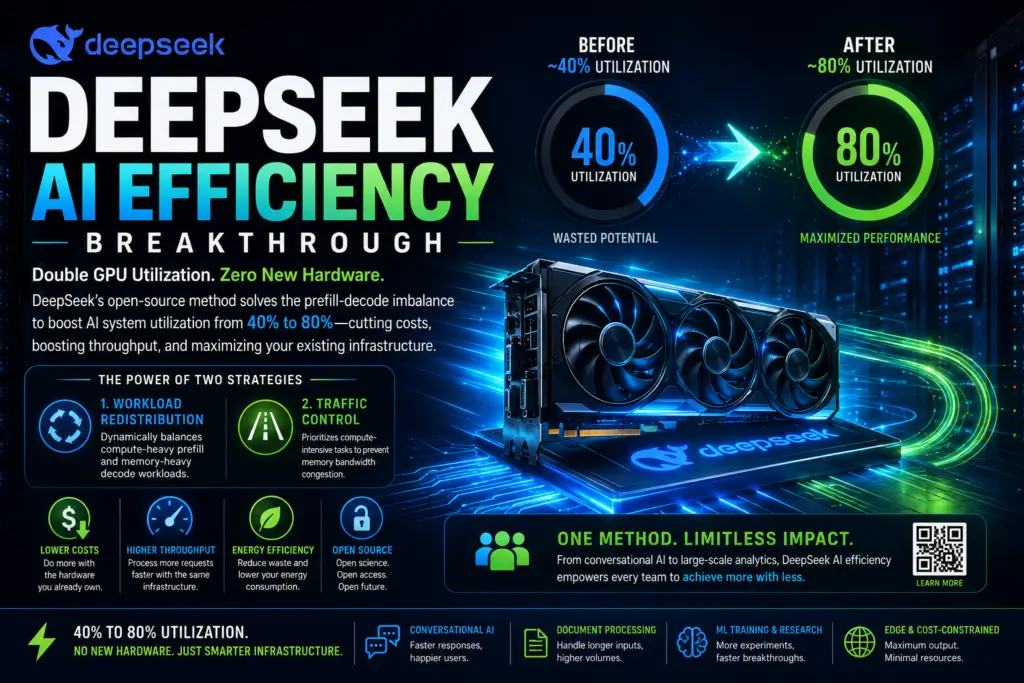
DeepSeek has released an open-source method that doubles AI system utilization rates — from 40% to 80% — without buying a single additional GPU. If you run large-scale AI workloads and you’re spending heavily on compute, this is the most important infrastructure story of mid-2026. DeepSeek AI Efficiency
Most enterprise AI systems are quietly wasting more than half their processing capacity. DeepSeek’s new approach fixes the root cause: unbalanced data flow between compute and memory components. The result is faster inference, lower energy bills, and a path to doing twice the work on the hardware you already own.
Why AI Systems Are Only Using Half Their Power (The 40% Problem)
What Causes Data Flow Bottlenecks in AI Infrastructure
A data flow bottleneck occurs when one component of an AI system becomes overwhelmed while another sits idle, breaking the pipeline.
In practical terms, modern large language model inference involves two distinct phases: prefill (processing the input prompt) and decoding (generating the output token-by-token). These two phases have completely different computational profiles. Prefill is compute-heavy. Decoding is memory-bandwidth-heavy. When both run on the same hardware pool without intelligent balancing, one phase starves while the other gorges.
The analogy is apt: imagine trying to fill a swimming pool through a garden hose. The water source (compute) is powerful, but the delivery mechanism (memory bandwidth) is the constraint. No matter how strong your pump is, the hose determines your throughput.
This mismatch is the primary reason industry research has consistently shown AI system utilization rates hovering around 40% — even in data centers running state-of-the-art hardware.
The Real Cost of Underutilization — Energy, Speed, and Money
Low GPU utilization is not just a performance issue. It compounds into three compounding costs:
- Energy waste: Data centers running at 40% utilization still consume roughly the same power draw as systems running at 80%. Idle GPUs don’t power down — they spin and wait, consuming energy without producing output.
- Operational cost inflation: Every wasted compute cycle represents money spent on hardware, cooling, and facility space that delivers no economic value.
- Throughput ceilings: Organizations hit artificial processing limits not because they lack hardware, but because their existing hardware is structurally underused. Scaling by purchasing more GPUs simply multiplies the inefficiency.
For enterprises managing multi-turn conversational AI, large document processing pipelines, or continuous machine learning model training, this inefficiency compounds at scale. A system processing a million requests per day at 40% utilization is effectively leaving 600,000 of those compute cycles on the floor.
What DeepSeek’s AI Efficiency Solution Actually Does
DeepSeek AI efficiency gains come from two coordinated mechanisms that work together to eliminate the prefill-decode imbalance. Neither requires new hardware. Both are released openly for any team to implement.
Strategy 1 — Workload Redistribution Between Prefill and Decode
Workload redistribution is the practice of dynamically rebalancing compute tasks between the prefill and decoding phases so that neither component is starved or overburdened.
In a standard deployment, prefill and decode operations compete for the same GPU resources. When a heavy prefill job runs, decoding stalls. When decode demands spike, prefill queues up. The system oscillates between states of over-demand and under-use.
DeepSeek’s redistribution mechanism separates these workloads into distinct operational lanes and allocates resources based on real-time demand signals. The system monitors which phase is currently resource-constrained and dynamically redirects capacity to eliminate the bottleneck before throughput degrades.
In testing scenarios involving long, multi-turn AI workloads — the kind common in enterprise chatbots, document analysis pipelines, and agentic systems — this redistribution approach raised effective system utilization from approximately 40% to 80%.
Strategy 2 — The Traffic Control Mechanism
The traffic control mechanism is a priority scheduler that routes computationally intensive tasks ahead of memory-heavy ones, preventing bandwidth saturation from blocking compute throughput.
Think of this as a dedicated express lane on a highway. Compute-intensive operations get priority routing; memory-heavy operations yield when the compute lane is clear. This prevents the most common failure mode in unoptimized AI systems — a flood of memory-bound decode operations blocking the GPU cores that could otherwise be executing prefill tasks.
The traffic control layer sits between the task queue and the hardware execution layer. It requires no changes to model architecture, no retraining, and no hardware modification. It operates as infrastructure-level middleware that any deployment team can integrate into an existing serving stack.
Together, these two strategies deliver what neither achieves alone: a system where compute and memory resources are continuously matched to task demand, eliminating idle time on both sides.
DeepSeek AI Efficiency vs. Traditional Optimization Approaches
How does DeepSeek’s approach compare to conventional methods organizations have used to improve AI infrastructure performance? The table below maps the key dimensions.
| Approach | Hardware Required | Model Changes Needed | Utilization Gain | Cost to Implement | Open Source |
|---|---|---|---|---|---|
| DeepSeek Workload Redistribution | None (existing) | None | ~40% → ~80% | Low (middleware) | Yes |
| GPU Scaling (Buy More Hardware) | Yes (additional GPUs) | None | Variable | Very High | N/A |
| Model Quantization | None | Yes (re-quantize) | Moderate | Medium | Varies |
| Batching Optimization | None | Minimal | Moderate | Low–Medium | Varies |
| Speculative Decoding | None | Yes (draft model) | Moderate | Medium | Varies |
| Dedicated Prefill/Decode Clusters | Yes (separate nodes) | None | High | Very High | N/A |
The DeepSeek approach is notable in this landscape for combining three properties rarely found together: no additional hardware, no model changes, and an open-source implementation. Most approaches that achieve comparable efficiency gains require either significant capital expenditure or architectural changes to the model itself.
For organizations already running large GPU clusters, the cost-benefit calculation is striking: a middleware-level change that eliminates 40 percentage points of waste, at near-zero marginal cost.
Who Benefits Most? Real-World Applications by Industry
DeepSeek AI efficiency gains are not uniform across all deployment types. The improvement is most pronounced in workloads characterized by high prefill-decode imbalance and long context lengths. Here is where the impact lands hardest.
Natural Language Processing and Conversational AI
Multi-turn conversational systems — enterprise chatbots, virtual assistants, customer service automation — are precisely the workloads where prefill and decode demands oscillate most dramatically. Each user turn triggers a new prefill operation over a growing context window, followed by a decode phase to generate the response. The imbalance compounds with every turn.
Deploying DeepSeek’s redistribution mechanism in these environments means faster response times, higher concurrent user capacity on the same hardware, and more consistent latency — three metrics that directly translate to user experience quality.
Large-Scale Data Analysis and Document Processing
Organizations processing large volumes of long documents — legal contracts, financial reports, clinical records — spend a disproportionate share of their compute budget on prefill operations for lengthy inputs. The traffic control mechanism’s ability to prioritize these compute-heavy operations while queuing memory-bound decode tasks produces measurable throughput gains at the pipeline level.
Machine Learning Model Training and Research
Research teams running iterative training cycles benefit from infrastructure-level efficiency gains because training throughput directly determines iteration speed. Faster utilization of existing GPU capacity means more experiments per day, shorter feedback loops, and faster convergence on optimal model configurations.
Edge and Cost-Constrained Deployments
For organizations that cannot justify large hardware investments but need to maximize output from limited compute resources — common in healthcare AI, academic research, and early-stage AI product companies — the open-source nature of DeepSeek’s approach makes these gains accessible without procurement budgets. This is AI efficiency democratized.
Limitations and Honest Caveats
DeepSeek AI efficiency gains are real, but they are not universal. Being clear about where this approach works — and where it does not — is essential for teams evaluating deployment.
Where effectiveness is strongest: Systems experiencing heavy multi-turn, long-context workloads with measurable prefill-decode imbalance. The 40%-to-80% utilization gain is documented specifically in these environments.
Where gains may be smaller: Workloads with short, uniform context lengths and consistent compute-to-memory ratios. If a system’s bottleneck is not the prefill-decode imbalance, the traffic control mechanism addresses a constraint that doesn’t exist at meaningful scale.
Integration considerations: Deploying this middleware layer requires engineering effort and compatibility testing with existing serving infrastructure. Teams running highly customized inference stacks may face non-trivial integration work.
Not a universal efficiency ceiling: Moving from 40% to 80% utilization is a major gain, but it does not mean all remaining compute waste is eliminated. Other inefficiency sources — suboptimal batching, I/O latency, network overhead in distributed deployments — require separate attention.
Organizations should treat DeepSeek’s methodology as a high-value starting point for infrastructure optimization, not a complete solution to all compute efficiency challenges.
Why Open Science Matters for AI Efficiency Gains
DeepSeek’s decision to publish this methodology under an open science framework is strategically significant beyond the technical content itself.
AI efficiency research has historically been treated as proprietary infrastructure advantage. The largest technology companies develop optimization techniques internally and treat them as competitive moats. The result is a compounding gap: organizations with the most resources build the most efficient systems, which generate more revenue, which funds more efficiency research.
By releasing workload redistribution and traffic control techniques openly, DeepSeek inverts this dynamic. The methodology can be studied, verified, extended, and adapted by researchers and engineering teams worldwide. This accelerates the pace at which the broader AI community can validate the claims, identify edge cases, and build upon the foundation.
Open-source AI efficiency tools also lower the barrier to entry for organizations that have been priced out of frontier AI deployment. When efficiency gains are proprietary, only well-capitalized organizations can access them. When they are open, the efficiency dividend is distributed across the entire AI ecosystem.
This is not altruism without strategic logic. DeepSeek benefits from ecosystem adoption: wider deployment of their methodology creates a community of practitioners who understand, contribute to, and build upon their technical approach. Open science in AI efficiency is, in this case, both principled and strategically sound.
What This Means for Enterprise AI Teams Right Now
The practical implications of the DeepSeek AI efficiency breakthrough fall into three immediate action areas for organizations running AI infrastructure.
Conduct a utilization audit before your next hardware purchase. If your current AI serving infrastructure is operating at utilization rates below 70%, buying additional GPUs will multiply your inefficiency, not solve it. Measure your current prefill-decode balance before committing to capital expenditure.
Evaluate your workload profile against DeepSeek’s documented gain conditions. Multi-turn, long-context workloads benefit most. If your primary workloads match this profile, the potential ROI from implementing DeepSeek’s open-source methodology is significant.
Treat open-source AI efficiency as infrastructure investment, not experimentation. The tendency to classify open-source techniques as “research-grade” rather than “production-ready” causes organizations to delay adoption of validated approaches. DeepSeek’s methodology is documented, verifiable, and freely available. The barrier to evaluation is engineering time, not cost.
Monitor the downstream ecosystem. Because this release is open, expect derivative implementations, framework integrations, and validated case studies to emerge from the research community over the next several months. Organizations that engage with the methodology early will be better positioned to evaluate and adopt refinements as they emerge.
Frequently Asked Questions
What exactly did DeepSeek release, and where can teams access it?
DeepSeek published its workload redistribution and traffic control methodology under an open science framework, making the technical approach freely available to researchers, engineers, and organizations worldwide. Teams looking to implement or evaluate the approach should monitor DeepSeek’s public research publications and open-source repositories for implementation details and reference code.
Is DeepSeek AI efficiency improvement relevant to my deployment if I use a third-party model provider?
The methodology addresses infrastructure-level serving optimization, not the model itself. If you control your own inference serving infrastructure — even when running third-party or open-source models — the principles are applicable. If you are exclusively using API-based access to hosted models, the efficiency gains apply at the provider level rather than your own infrastructure.
How does the 40%-to-80% utilization gain translate to cost savings in practice?
The translation depends on your current infrastructure cost structure. In environments where GPU compute costs are the primary operational expense, doubling utilization means that the same workload can be served on approximately half the hardware, or equivalently, twice the workload can be processed on the same hardware. For organizations running thousands of GPU hours per month, this represents a substantial cost reduction.
Does implementing this approach require changing the AI models being served?
No. DeepSeek’s workload redistribution and traffic control mechanisms operate at the infrastructure level, between the task queue and the hardware execution layer. No model retraining, re-quantization, or architectural changes are required.
What types of workloads see the smallest efficiency gains from this method?
Short, stateless inference tasks with consistent context lengths and low variance in compute-to-memory demand ratios benefit least. If your workloads are already well-matched to your hardware profile, the prefill-decode imbalance that DeepSeek’s approach corrects may be minimal.
How does DeepSeek’s open science approach affect the long-term trajectory of AI efficiency research?
Publishing verified efficiency methodologies openly accelerates the pace of collective improvement. Other research teams can validate, extend, and build upon the foundation, compressing the time between discovery and deployment across the global AI engineering community.
Conclusion
The rapid growth of artificial intelligence has made infrastructure efficiency one of the most important challenges for modern enterprises, and DeepSeek AI Efficiency offers a compelling answer to this problem. Instead of encouraging organizations to invest millions in new GPUs, DeepSeek AI Efficiency demonstrates that smarter resource allocation can unlock enormous performance gains from existing hardware. By addressing the long-standing imbalance between prefill and decode workloads, this open-source innovation has the potential to transform how AI systems are designed, deployed, and scaled.
What makes DeepSeek AI Efficiency especially remarkable is its practicality. Businesses no longer have to choose between expanding hardware capacity and limiting AI ambitions. Through workload redistribution and intelligent traffic control, DeepSeek AI Efficiency enables organizations to increase GPU utilization from around 40% to nearly 80%, dramatically improving throughput while reducing operational costs. This means faster inference speeds, lower energy consumption, and better returns on expensive AI infrastructure investments.
The significance of DeepSeek AI Efficiency extends beyond cost savings. As AI applications become more sophisticated, enterprises require infrastructure that can support long-context models, multi-turn conversations, document analysis, and autonomous AI agents without performance bottlenecks. DeepSeek AI Efficiency provides a scalable framework that keeps compute and memory resources balanced, ensuring that systems operate closer to their full potential. For organizations seeking sustainable growth, adopting DeepSeek AI Efficiency can be a strategic advantage rather than just a technical upgrade.
Another reason why DeepSeek AI Efficiency stands out is its open-source philosophy. By making these optimization techniques publicly available, DeepSeek encourages collaboration, innovation, and faster adoption across the AI ecosystem. Developers, researchers, and enterprises can all benefit from DeepSeek AI Efficiency, adapting and improving the methodology to suit their unique workloads and infrastructure requirements. This openness accelerates progress while lowering the barriers to entry for smaller organizations that previously struggled with high compute costs.
Looking ahead, DeepSeek AI Efficiency may become a defining standard for AI infrastructure optimization. As organizations continue searching for ways to maximize performance without escalating costs, the principles behind DeepSeek AI Efficiency are likely to influence future frameworks, serving architectures, and industry best practices. For enterprise AI teams, the message is clear: before purchasing more hardware, evaluate how effectively your current resources are being used. The next major AI breakthrough may not come from bigger models or larger GPU clusters—it may come from adopting smarter systems powered by DeepSeek AI Efficiency.