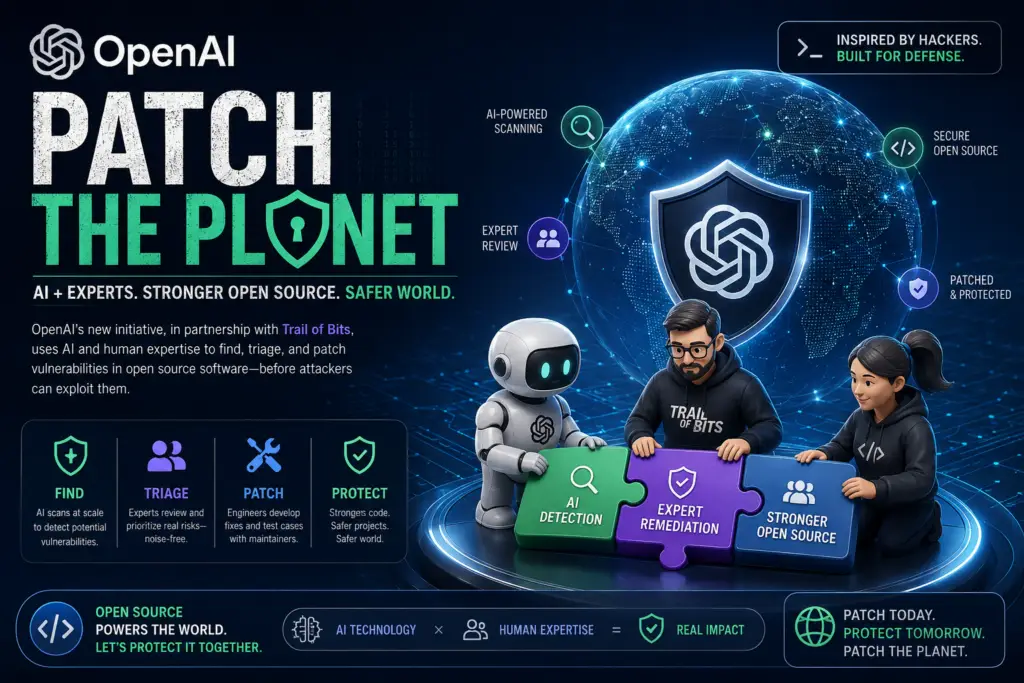
Open source security just got a powerful new ally. OpenAI launched “Patch the Planet” on June 22, 2026 — a first-of-its-kind initiative that deploys AI tools and human security engineers to find, triage, and patch vulnerabilities in open source software before attackers exploit them. If it scales, it could fundamentally change how the world defends its most critical software infrastructure. OpenAI Patch the Planet
Open source software quietly underpins nearly every commercial application, cloud platform, and enterprise system on the planet. But the communities that maintain it are chronically under-resourced. “Patch the Planet” is OpenAI’s bet that AI-augmented security teams can close that gap — and do it without overwhelming the maintainers who are already stretched thin.
What Is OpenAI’s “Patch the Planet” Initiative?
Definition: “Patch the Planet” is a collaborative open source security program launched by OpenAI in partnership with cybersecurity firm Trail of Bits. Its goal is to reduce the vulnerability burden on open source project maintainers by combining AI-powered scanning with expert human review and remediation support.
The name is a deliberate, tongue-in-cheek nod to “Hack the Planet” — the iconic rallying cry from the 1995 cult film Hackers. It signals something intentional: OpenAI is taking the ethos of hacker culture and redirecting it toward defense rather than offense.
The initiative is built around a simple but important insight: open source maintainers are already overwhelmed. More security reports mean more triage work, more context-switching, and more decisions made under time pressure — often by volunteers or small teams with no dedicated security staff. “Patch the Planet” is designed to reduce that burden, not compound it.
The Core Team: Trail of Bits as Code EMTs
Trail of Bits is one of the most respected independent security firms in the world, with deep experience in code auditing, formal verification, and vulnerability research. Within the “Patch the Planet” framework, their engineers act as what OpenAI describes informally as “code EMTs” — first responders who assess potential issues, stabilize the situation, and help projects recover without leaving maintainers to fend for themselves.
Specifically, Trail of Bits engineers:
- Review AI-generated security findings before those findings reach maintainers
- Work directly with open source projects to develop patches and test cases
- Build reusable security workflows that help teams sustain improvements long after the initial fixes land
That last point is particularly significant. The initiative isn’t just about fixing today’s bugs — it’s about leaving projects in a structurally stronger position than they were before.
How Codex Security Powers the Process
OpenAI’s Codex Security tool serves as the analytical backbone of the program. Codex Security is designed to scan codebases for potential vulnerabilities at scale — examining code patterns, logic flows, and known vulnerability signatures far faster than any human team could manage manually.
The AI does the heavy lifting of identification. Trail of Bits engineers do the expert interpretation. Open source maintainers receive a curated, vetted package of findings — not a raw flood of automated alerts. This division of labor is what makes the model potentially viable at scale, where most prior automated security tools have stumbled.
Why Open Source Security Has Been a Persistent, Systemic Problem
Open source security is not a new concern. Security researchers, government agencies, and enterprise technology teams have been raising alarms about it for decades. Yet the structural conditions that create vulnerability have proven stubbornly resistant to change.
The Decentralization Problem
Open source software is developed in a radically decentralized way. Projects can be maintained by a single individual working nights and weekends, a loose collective of contributors across a dozen time zones, or a foundation with rotating volunteer leadership. There is no central authority responsible for security standards, no mandatory review process, and no guaranteed funding for remediation work.
This isn’t a flaw in the open source model — it’s a defining feature of it. The same decentralization that enables global collaboration and rapid innovation also creates structural gaps in open source security. When a critical vulnerability surfaces in a widely-used library, there may be no clear chain of command for responding to it, no budget to pay for a fix, and no way to force downstream projects to apply the patch even once one exists.
The Log4j Lesson — One Bug, Global Fallout
The Log4j vulnerability, discovered in late 2021, became the defining case study for why open source security matters at a civilizational scale. Log4j is a logging utility — unglamorous, ubiquitous, and quietly embedded in applications used by millions of organizations worldwide.
When a critical remote code execution flaw was discovered in it, the fallout was extraordinary. Security teams across every major industry scrambled to identify every system that used Log4j (a non-trivial task, since many didn’t know), and then race to patch before attackers could exploit the vulnerability. The U.S. government’s Cybersecurity and Infrastructure Security Agency (CISA) described it as one of the most serious vulnerabilities in a decade.
The Log4j incident illustrated a hard truth: a single point of failure in a single open source component can create a global security emergency. Open source security is not a niche concern — it is a shared infrastructure problem with consequences that affect governments, enterprises, hospitals, and individuals alike.
How “Patch the Planet” Works: A Three-Phase Breakdown
Understanding the operational model of “Patch the Planet” helps clarify both its potential and its limitations.
Phase 1 — Automated Scanning with Codex Security
OpenAI’s Codex Security analyzes the target open source codebase, identifying potential vulnerabilities based on code patterns, logic anomalies, and known vulnerability signatures. This phase happens at machine speed and at a scale that no human team could replicate manually. The output is a prioritized list of candidate issues.
Phase 2 — Expert Triage by Trail of Bits Engineers
This is the critical filtering layer. Trail of Bits security engineers review every candidate issue generated by Codex Security before anything is communicated to the project’s maintainers. False positives are removed. Genuine findings are contextualized, prioritized, and framed in actionable terms. This step is what distinguishes “Patch the Planet” from standard automated security scanning tools, which often produce high-volume, low-signal reports that overwhelm rather than help.
Phase 3 — Collaborative Remediation and Workflow Development
Trail of Bits works directly with maintainers to develop patches, write test cases, and build security workflows that can be reused over time. The goal is not a one-time cleanup, but a durable improvement in the project’s security posture. Maintainers leave the engagement with better tools and processes than they had before.
This three-phase model attempts to thread a genuine needle: applying AI scale without sacrificing the human judgment that makes security findings actually useful.
Offensive AI vs. Defensive AI: The New Cybersecurity Arms Race
One of the most important contexts for understanding “Patch the Planet” is the broader dynamic between offensive and defensive uses of AI in cybersecurity. This is not an abstract debate — it is playing out in real time across the security industry.
| Dimension | Offensive AI Security Use | Defensive AI Security Use |
|---|---|---|
| Goal | Find vulnerabilities to exploit | Find vulnerabilities to patch |
| Speed | Rapid automated exploit discovery | Rapid automated vulnerability scanning |
| Actor | Malicious actors, nation-state hackers | Security researchers, AI companies, defenders |
| Scale | Can target thousands of systems simultaneously | Can review thousands of codebases simultaneously |
| Example tools | AI-powered exploit generators | Codex Security, automated patch assistants |
| Net effect | Lowers the cost and skill barrier for attacks | Lowers the cost and skill barrier for defense |
| Current balance | Offense has historically had a structural advantage | Defense is catching up with AI augmentation |
AI systems are now capable of automatically identifying existing vulnerabilities in codebases and generating exploits for them. The automation of cybercrime is not new, but AI tools make it meaningfully more accessible — reducing the technical skill required to launch sophisticated attacks and dramatically accelerating the reconnaissance phase.
“Patch the Planet” is a direct response to this dynamic. OpenAI is applying the same AI capability that could be used offensively — automated code analysis at scale — and redirecting it toward defense. The strategic logic is that if AI can find bugs faster than humans, defenders can use that same speed advantage to get ahead of attackers, rather than perpetually playing catch-up.
Whether defensive AI can actually outpace offensive AI remains one of the central unresolved questions of the next decade in cybersecurity.
What This Means for Open Source Maintainers
For the millions of developers who maintain open source projects — many of whom do so voluntarily and without dedicated security resources — “Patch the Planet” represents a potentially meaningful change in what support looks like. Here is what the initiative concretely offers:
- Pre-filtered security findings. Maintainers receive only vetted, actionable reports — not raw automated output that requires extensive triage before it can be acted upon.
- Direct engineering support. Trail of Bits engineers collaborate on patch development, meaning maintainers are not expected to fix complex security issues alone.
- Reusable security workflows. Projects exit the engagement with documented processes and automated checks that improve security on an ongoing basis.
- No additional reporting burden. The initiative is explicitly structured to reduce maintainer workload, not add to it. Reports arrive after expert review, not before.
- Access to enterprise-grade security tooling. Small open source projects typically cannot afford the kind of professional security audit that “Patch the Planet” provides at no cost to the maintainer.
- Improved downstream security posture. When foundational open source libraries are patched, every commercial product built on top of them becomes more secure — creating positive externalities far beyond the project itself.
The open question is scale. A program staffed by Trail of Bits engineers can engage deeply with a limited number of projects at any given time. The open source ecosystem includes millions of active repositories. How “Patch the Planet” plans to prioritize which projects receive attention — and whether it can develop a model that scales beyond a curated set of high-impact projects — remains to be seen.
OpenAI vs. Anthropic: Two Different Approaches to AI-Powered Security
It is difficult to discuss “Patch the Planet” without acknowledging the competitive context in which it was launched. The initiative arrives at a moment when AI companies are increasingly defining their identities not just through their models, but through how those models are applied to high-stakes real-world problems.
Anthropic, OpenAI’s primary competitor in the frontier AI space, has developed a highly advanced AI security model — Claude Mythos Preview — which is notable precisely because it has not been made publicly available. Due to significant cybersecurity concerns about its dual-use potential (i.e., the same capabilities that make it powerful for defense could make it dangerous in the wrong hands), Anthropic has restricted Mythos to a small number of trusted organizations through its Project Glasswing program.
The contrast in strategy is striking:
Anthropic’s approach prioritizes extreme caution. Mythos is kept off the open market entirely, available only to vetted partners, on the theory that a model powerful enough to be genuinely useful for security is also powerful enough to cause serious harm if misused.
OpenAI’s approach with “Patch the Planet” opts for structured deployment in a controlled, human-in-the-loop model. Rather than restricting the capability, OpenAI pairs it with Trail of Bits’ expert oversight to create a system where AI findings are reviewed before they can cause unintended harm.
Neither approach is obviously wrong. They represent genuinely different theories about how the cybersecurity community should navigate the dual-use nature of AI security tools. What is clear is that both companies recognize open source security as a critical battleground — and that AI will play a central role in determining who wins and who loses in the vulnerability arms race of the coming years.
The Road Ahead: Open Questions and Long-Term Potential
“Patch the Planet” is ambitious, clearly necessary, and genuinely innovative in its structure. It is also, by OpenAI’s own implicit acknowledgment, a work in progress. Several important questions remain unanswered:
How will projects be selected? The initiative does not yet have a publicly documented prioritization framework. Will it focus on the most widely-used projects? The most critically vulnerable? Projects that lack any existing security infrastructure? The selection criteria will largely determine the program’s real-world impact.
Can it scale meaningfully? Pairing AI scanning with expert human review is a compelling model, but Trail of Bits is not an unlimited resource. Scaling the program would likely require training more security engineers in the workflow, building self-service tooling for maintainers, or both. Neither path is trivial.
How will the open source community respond? Open source culture has a long and complicated relationship with institutional support. Some maintainers may welcome the help enthusiastically; others may approach external security audits with skepticism, particularly when they originate from a large commercial AI company with its own interests in the ecosystem.
What happens with discovered vulnerabilities before they’re patched? Responsible disclosure is a well-established practice in security research, but it requires coordination, timing, and trust. The program will need a clear and consistently applied policy for how it handles vulnerability discovery, especially for critical issues in widely-used projects.
These are not reasons to be pessimistic about the initiative — they are the natural questions that any serious program of this ambition should be expected to answer over time. The underlying logic of “Patch the Planet” is sound: open source security is a shared infrastructure problem, AI can help address it at scale, and the deficit of available security expertise in the open source community is both real and addressable.
Key Takeaways
- OpenAI launched “Patch the Planet” on June 22, 2026, in partnership with Trail of Bits, to improve open source security through AI-assisted vulnerability detection and human-expert remediation.
- The core model combines Codex Security scanning, Trail of Bits expert triage, and collaborative patch development — structured explicitly to reduce, not increase, the burden on maintainers.
- Open source security is a systemic infrastructure problem, not a niche concern. The Log4j incident demonstrated that a single flaw in a widely-used library can trigger a global security emergency.
- The initiative flips the AI cybersecurity equation, applying the same automated code analysis capability that could be used offensively toward a defensive, publicly-beneficial purpose.
- Open questions remain about scale, project selection, and maintainer adoption — but the structural logic of the program is sound and addresses a gap that has long needed addressing.
- The OpenAI/Anthropic contrast reveals two distinct philosophies about how to deploy powerful AI security tools responsibly — both worth watching as the field matures.
Conclusion
OpenAI Patch the Planet represents a significant step forward in the ongoing effort to strengthen open source security across the global software ecosystem. As cyber threats continue to evolve and attackers increasingly leverage automation and AI-driven techniques, the need for proactive defense has never been greater. By combining the speed and scale of AI-powered vulnerability detection with the expertise of professional security engineers, OpenAI Patch the Planet introduces a practical model for identifying and resolving security weaknesses before they become large-scale incidents.
One of the most compelling aspects of OpenAI Patch the Planet is its focus on reducing the burden placed on open source maintainers. Rather than overwhelming projects with automated alerts, the initiative delivers carefully reviewed findings, remediation support, and long-term security workflows. This approach ensures that maintainers can improve their projects without sacrificing valuable development time. As a result, OpenAI Patch the Planet has the potential to create lasting improvements that benefit not only individual repositories but also the countless applications and services that depend on them.
The broader impact of OpenAI Patch the Planet extends far beyond vulnerability management. It demonstrates how AI can be applied responsibly to solve real-world infrastructure challenges while maintaining human oversight. If OpenAI Patch the Planet successfully scales its operations and expands support to more critical projects, it could become a cornerstone of modern open source security practices. In a digital world where software powers nearly every aspect of business and society, initiatives like OpenAI Patch the Planet may play a crucial role in building a safer, more resilient technological future for everyone.