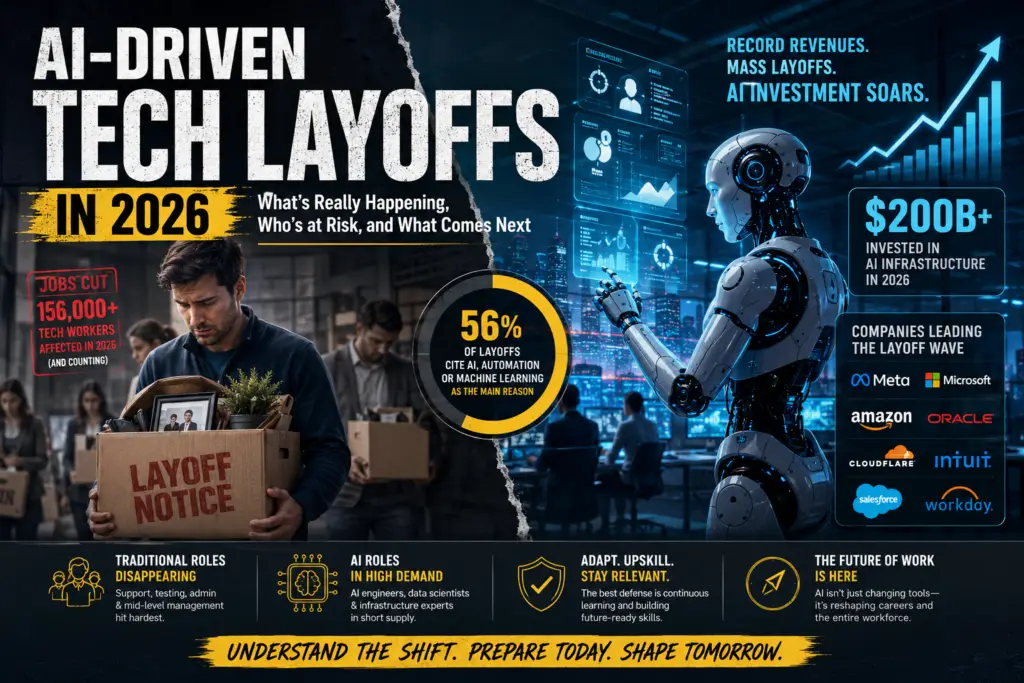
The short answer: In 2026, AI-driven tech layoffs have become the defining workforce story of the decade — with more than 150,000 tech workers cut by mid-year while the companies doing the cutting report record revenues. This isn’t a typical downturn. It’s a structural reshaping of the entire industry.
If you’ve been watching the headlines and wondering whether your role is safe, whether the AI narrative is real or exaggerated, or simply trying to make sense of what’s happening — this guide breaks it all down with facts, data, and clear analysis.
What Are AI-Driven Tech Layoffs?
Definition: AI-driven tech layoffs refer to workforce reductions in which a company explicitly attributes job eliminations — at least in part — to the adoption, deployment, or planned expansion of artificial intelligence technologies.
Expansion: The key distinction is that these are not layoffs caused by financial losses, missed earnings targets, or a contracting market. In most cases in 2026, they’re occurring at companies posting strong, even record-breaking revenue growth. The companies cutting workers are simultaneously pouring hundreds of billions of dollars into AI infrastructure, hiring machine learning engineers, and announcing agentic AI products. The premise is straightforward: where AI can now do what a person used to do, that person’s position is eliminated.
According to analysis by Skillsyncer’s layoff tracker, 56% of all layoff events through mid-2026 explicitly cite AI, automation, or machine learning as a driving force, affecting over 156,270 workers across 150 companies.
How This Wave Differs from the 2022–2023 Tech Downturn
Question: Weren’t there mass tech layoffs just a few years ago? What makes 2026 different?
Direct Answer: Yes — but the causes are structurally different. The 2022–2023 wave was triggered by overhiring during the COVID-19 pandemic followed by rising interest rates, forcing companies to reverse growth-at-all-costs models. The AI-driven tech layoffs of 2026 involve a different mechanism entirely: roles are being eliminated because AI tooling has made them redundant, not because the business is struggling.
As analysts at Invezz put it, companies report a 92% increase in hiring for AI-related positions in 2026, with a 56% wage premium attached to high-demand roles. The problem is that the workers being laid off are largely not the workers being hired. Customer support reps, QA testers, and content moderators are being cut; machine learning engineers and AI infrastructure specialists are in shortage.
The Scale of AI-Driven Tech Layoffs in 2026: By the Numbers
The numbers are staggering — and they’re still climbing.
- Over 92,000 tech workers had been laid off by late April 2026, according to Layoffs.fyi, pushing the cumulative post-2020 total to nearly 900,000.
- Tech layoffs hit their highest single month in years in May 2026, with AI cited as the most common reason, per outplacement firm Challenger, Gray & Christmas.
- Oracle alone disclosed a reduction of 21,000 employees — a 13% workforce decline — over the 12 months preceding June 2026, directly attributing a portion to AI deployment.
- Amazon cut approximately 16,000 corporate roles in Q1 2026, representing more than half of all tech sector layoffs in the quarter, while AWS simultaneously reported its fastest revenue growth in 13 quarters at 24%.
What makes this moment historically unusual isn’t just the volume of AI-driven tech layoffs — it’s the coexistence of mass cuts with record profits, stock market highs, and aggressive investment in the very technology displacing workers.
Company-by-Company Breakdown: Who Cut Jobs and Why
Big Tech Giants Leading the Wave
Meta announced the elimination of approximately 8,000 employees — 10% of its total workforce — effective May 20–21, 2026. In a parallel move, the company reassigned around 7,000 employees into newly created AI-focused units. CEO Mark Zuckerberg told staff that “success isn’t a given” in AI and that the restructuring was necessary to compete. Reports have since emerged that many of those reassigned workers describe the transition as deeply disorienting and demoralizing.
Microsoft offered voluntary retirement packages to 8,750 US-based employees, representing roughly 7% of its domestic workforce. The offers were concentrated in legacy product teams as the company accelerates its integration of Copilot and Azure AI services into its core business lines.
Amazon executed its largest single round of corporate layoffs in company history during Q1 2026, cutting 16,000 roles primarily from its corporate and technology divisions. The company’s AWS cloud unit, which powers much of the AI economy, simultaneously reported its best quarterly growth in more than three years.
Oracle reported in a June 2026 SEC filing that it had reduced its global headcount by 21,000 over the past fiscal year — a 13% decline. The filing stated plainly: “The adoption and deployment of AI technologies across our operations have resulted, and may continue to result, in reductions to our workforce.”
Mid-Tier Platforms and Cloud Providers
The AI-driven tech layoffs of 2026 are not confined to the industry’s largest players. Mid-tier companies have followed in rapid succession:
Cloudflare cut approximately 1,100 workers — 20% of its entire workforce — in May 2026, even as it reported the highest quarterly revenue in company history at $639.8 million, a 34% year-over-year gain. CEO Matthew Prince said the majority of those cut were “measurers”: middle management, finance, legal, internal auditing, and revenue recognition roles — functions he described as increasingly automated.
Intuit announced the elimination of roughly 3,000 jobs — 17% of its workforce — in a restructuring explicitly centered on AI reallocation. CEO Sasan Goodarzi said the company was reducing organizational complexity to redirect resources toward AI development.
Cisco cut nearly 4,000 jobs despite reporting better-than-expected revenue in May 2026. CFO Mark Patterson was explicit that this was “not a savings-driven restructure” but rather a reallocation toward silicon, optics, security, and AI capabilities.
GitLab laid off about 350 workers — 14% of its staff — in June 2026, announcing a “generational rebuild” of its core infrastructure to support AI-scale workloads. The company is exiting 22 countries and flattening management layers as part of the restructuring.
Block (Jack Dorsey’s payments company) executed one of the most dramatic cuts: 4,000 jobs, nearly half its entire workforce, reducing headcount from over 10,000 to under 6,000. Dorsey wrote that AI-paired “smaller and flatter teams” represent a “new way of working” and predicted most companies would reach the same conclusion within a year.
Salesforce, which had already cut 4,000 customer support roles in late 2025 after its Agentforce AI product began handling approximately 50% of customer interactions, made additional cuts in February 2026 across marketing, product management, and data analytics teams.
Snap slashed 16% of its workforce — around 1,000 employees — with CEO Evan Spiegel explicitly citing AI-driven efficiencies as the reason.
Major AI-Driven Tech Layoffs in 2026 at a Glance
| Company | Approx. Jobs Cut | % of Workforce | Key Reason Cited | Revenue Trend |
|---|---|---|---|---|
| Oracle | 21,000 | 13% | AI deployment in operations | Growing |
| Amazon | ~16,000 | ~10% | AI-driven efficiency / restructuring | +24% AWS growth |
| Meta | 8,000 | 10% | AI reallocation | Growing |
| Microsoft | ~8,750 | ~7% (US) | Voluntary retirement / AI integration | Growing |
| Intuit | 3,000 | 17% | AI-focused restructuring | Growing |
| Cisco | ~4,000 | 5% | AI reallocation away from legacy roles | Record quarter |
| Block | 4,000 | ~40% | AI + smaller teams model | Stable |
| Cloudflare | 1,100 | 20% | Middle management automation | Record high |
| GitLab | 350 | 14% | AI infrastructure investment | +23% YoY |
| Salesforce | ~5,000 (combined) | ~7% | Agentforce AI replacing support roles | Growing |
| Snap | ~1,000 | 16% | AI efficiency | Stable |
| Atlassian | 1,600 | 10% | AI era restructuring | Growing |
Which Roles Are Most at Risk?
Question: Which specific job types are most vulnerable to AI-driven tech layoffs?
Direct Answer: Analysis across 2026 layoff events consistently points to a set of role categories where the overlap between AI capabilities and existing job functions is highest. These include:
- Customer support representatives — AI chatbots and voice agents now handle the majority of tier-1 and tier-2 support interactions at large platforms (Salesforce reported Agentforce handling 50% of interactions before its cuts).
- Content moderators and quality assurance testers — Automated moderation systems and AI-based QA tooling have dramatically reduced headcount requirements in these areas.
- Data entry and document processing workers — Large language models and optical character recognition systems can now process unstructured data at scale without human intervention.
- Middle managers with small direct reports — Google cut more than 35% of its managers overseeing small teams; Cloudflare’s CEO explicitly targeted “measurers.”
- Traditional software engineers working on legacy codebases — Oracle’s cuts specifically targeted legacy database administrators and on-premises support teams.
- Marketing and content production teams — Salesforce, GitLab, and others have reduced these functions, which increasingly overlap with generative AI output.
- Finance, legal, and internal audit support roles — Cloudflare’s CEO included these among the roles eliminated in favor of AI-driven alternatives.
- Recruiting and HR coordinators — Meta’s May 2026 cuts included a 35–40% reduction in HR and recruiting staff.
Roles currently least affected — and actually growing — include machine learning engineers, AI safety researchers, data infrastructure specialists, and product managers with deep AI domain expertise.
Is AI Really the Cause, or Just the Excuse?
What Is “AI Redundancy Washing”?
Definition: “AI redundancy washing” is the practice of attributing workforce reductions primarily to AI adoption when the actual drivers may include overhiring reversals, investor pressure to improve margins, declining product lines, or general organizational restructuring.
Expansion: This term has entered mainstream analyst discourse in 2026. Deutsche Bank analysts flagged it as a significant trend, noting that companies sometimes reach for the AI explanation because it positions them favorably with investors — as forward-thinking and strategically lean — rather than as businesses correcting past mistakes or managing financial pressure.
Skillsyncer’s layoff tracker estimates that roughly half of AI-attributed layoffs may result in the same roles being rehired offshore or at lower salaries, which is a labor repricing story as much as a genuine automation story.
How to Tell the Difference
Not every company claiming AI as a layoff rationale is being misleading. Several signals can help distinguish genuine AI-driven workforce restructuring from AI washing:
Signs the AI rationale is credible:
- The company is simultaneously increasing AI infrastructure spend significantly.
- Specific role categories being cut (e.g., support, QA, data entry) directly overlap with known AI capabilities.
- The company is actively hiring AI and ML engineers to replace conventional headcount.
- Revenue in the AI-related product line is growing as headcount falls (Cloudflare, Salesforce, GitLab all fit this pattern).
Signs it may be AI washing:
- Job cuts span broad, unrelated departments with no clear AI connection.
- The company previously cited pandemic overhiring as a problem.
- Eliminated roles are being recreated offshore or via outsourcing contracts.
- No corresponding increase in AI infrastructure or tooling investment is announced.
The honest picture in 2026 is probably a blend: genuine AI-driven displacement is real and accelerating, but it is also providing convenient cover for companies doing what they would have done anyway for financial reasons.
What the Job Market Looks Like on the Other Side
Question: Are all these AI-driven tech layoffs a sign of long-term job destruction, or a temporary transition?
Direct Answer: The evidence suggests a structural transition rather than pure job destruction — but the transition is far more painful and uneven than most corporate communications acknowledge.
The workers being displaced are not the workers being hired. Senior engineers who lost positions at Salesforce, Intel, and Workday are finding that median time-to-hire in major tech hubs has stretched significantly compared to 2022–2023 levels. The wage premium on AI-related roles (estimated at 56% above market for high-demand positions) reflects a genuine scarcity of the skills the new economy demands.
For professionals navigating this environment, the picture involves three distinct groups:
Workers in highly automatable roles — customer support, data entry, content production, QA — face the most immediate risk. The safest short-term move is to develop adjacent AI-collaboration skills: prompt engineering, AI output evaluation, workflow automation, and agent management.
Mid-career engineers and managers — particularly those tied to legacy systems or middle management structures — face structural elimination as companies flatten hierarchies. Transitioning toward AI toolchain expertise or moving into product roles with AI specialization is the most commonly recommended path.
Specialists in AI infrastructure, safety, and evaluation — these roles are in genuine shortage across the industry. Machine learning engineers, AI safety researchers, and data infrastructure architects are seeing compensation increases and strong demand regardless of broader market conditions.
The broader labor market impact is also crossing sector lines. AI-driven workforce restructuring is now being reported in finance, logistics, consulting, media, retail, and manufacturing — not just in technology.
Key Takeaways
The 2026 wave of AI-driven tech layoffs is unlike anything the industry has seen before — not because it’s the largest in absolute numbers, but because of the paradox at its center: companies eliminating jobs while growing faster than ever, investing more than ever, and reporting record profits. That paradox is the signal.
Here’s what the evidence clearly shows:
- AI-driven tech layoffs are real, widespread, and accelerating across every tier of the industry.
- The roles most at risk are in customer support, QA, content, middle management, and legacy engineering.
- “AI redundancy washing” is a genuine complication — some companies overstate AI’s role to frame financial restructuring more favorably.
- The job market is bifurcating sharply: AI-adjacent skills command major wage premiums while traditional tech roles face compression.
- This is a structural shift, not a temporary correction. Workers, employers, and policymakers are only beginning to reckon with its full scope.
For anyone in the workforce right now — whether you’ve been directly affected or are watching the wave approach — the single most valuable investment you can make is developing a working understanding of how AI tools function in your specific domain. Not because it guarantees safety, but because it changes your value proposition in a market that is rewarding exactly that.