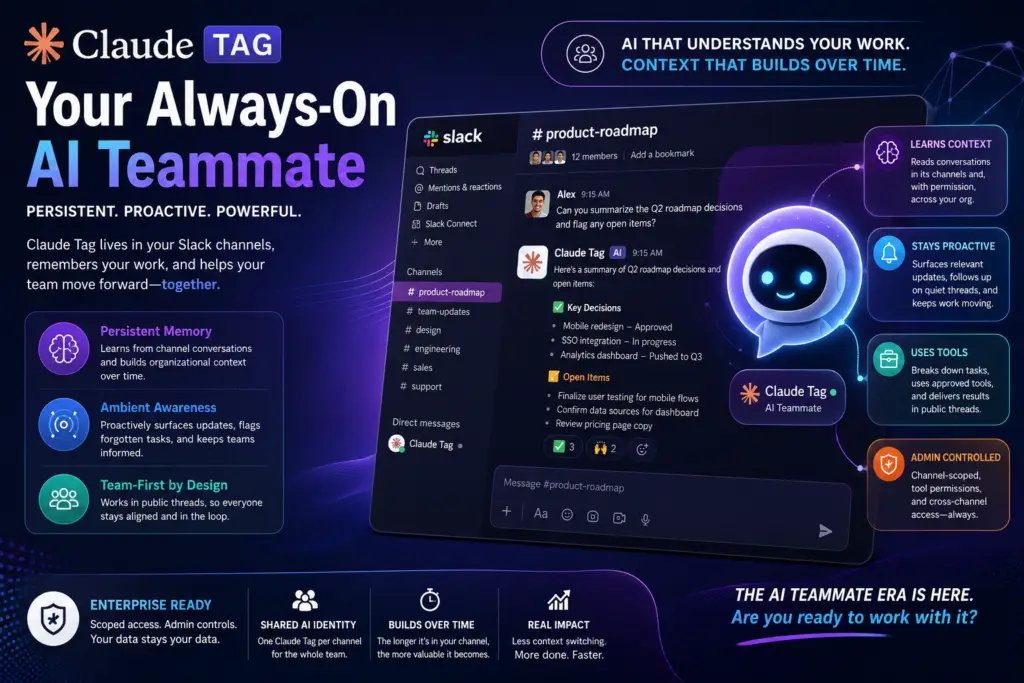
Anthropic’s Claude Tag turns Slack into a live organizational brain — and it’s the most significant enterprise AI workplace move of 2026. In short: Claude Tag is an always-on AI identity that lives inside Slack channels, learns your company’s context over time, and works alongside human teams as a persistent, memory-equipped digital colleague.
If you’ve been following the AI workplace wars — Microsoft Copilot, Glean, Slack’s own AI features — Claude Tag raises the stakes considerably. This post breaks down exactly what Claude Tag is, how it works, who it’s for, and why it matters for every organization evaluating enterprise AI today.
What Is Claude Tag?
Definition: An Always-On AI With Persistent Organizational Memory
Claude Tag is Anthropic’s research preview feature that embeds a persistent Claude AI identity directly inside Slack channels, available to Claude Enterprise and Claude Team customers. Unlike a chatbot you ping when you need a quick answer, Claude Tag functions as a standing member of your team — present in the channel, accumulating context from every conversation it observes, and capable of both responding on demand and acting proactively.
The key differentiator is persistence. As Anthropic put it in their launch statement, “As Claude follows along with its channel, it learns ever more about the work.” That ongoing learning is what separates Claude Tag from every prior Slack AI integration — it doesn’t reset between sessions. It remembers.
How Claude Tag Differs From Previous Claude Slack Integrations
Claude was already present in Slack before this launch, but in a more reactive, stateless form:
- DM @Claude — Users could message Claude directly for on-demand answers, with no channel-wide visibility.
- Tag @Claude in channels — Teams could mention Claude for help, but context was limited to the current thread.
- Claude Code in Slack — Coding tasks could be routed from Slack to full Claude Code sessions on the web, with updates posted back to threads.
Claude Tag goes further on two critical dimensions: shared context (every team member in a channel sees the same Claude identity and can pick up where the last person left off) and ambient awareness (Claude can proactively enter conversations, surface relevant information from elsewhere in the organization, and follow up on forgotten tasks).
How Claude Tag Works Inside Slack
Active Mode: Tagging Claude for On-Demand Tasks
The most familiar use of Claude Tag mirrors what people already do with AI tools: you tag it, you ask it something, it responds. But Claude Tag’s active mode is enhanced by the accumulated memory it holds from the channel.
When you assign Claude Tag a specific task, it breaks that task down into stages and works through each one using whatever tools it has been granted access to. Responses appear in a Slack thread — visible to everyone in the channel — so work is done in public view, not in a private conversation that no one else can see or build upon.
This transparency is intentional. One of the core design goals of Claude Tag is to make AI work a team activity, not a solo interaction.
Ambient Mode: Proactive Updates Without Being Asked
Claude Tag also operates in an ambient mode — perhaps its most novel capability. In ambient mode, Claude Tag proactively participates in channel activity:
- Flags relevant updates from across the organization (if granted cross-channel read access).
- Surfaces forgotten tasks or threads that have gone quiet.
- Keeps teams updated on ongoing work without anyone needing to prompt it.
This is what Anthropic means when they describe it as feeling like you’re “working with a real colleague.” A real colleague doesn’t wait to be directly addressed; they notice when something relevant is happening and speak up. Claude Tag is designed to do the same.
How Organizational Context Is Captured and Scoped
One of the most important — and most carefully governed — aspects of Claude Tag is how organizational context is built and bounded.
Context building: Claude Tag reads conversations in its assigned channels and, if administrators grant permission, gathers facts from other channels across the organization. Over time, this creates a rich model of the team’s work: ongoing projects, open questions, key decisions, team norms.
Context scoping: System administrators define which tools, information sources, and channels each Claude identity can access. Critically, each Claude identity is scoped to its assigned channels. A Claude set up for the legal team cannot seed its memory into the engineering channel. These are discrete, permissioned identities — not a single omniscient AI watching the whole company.
Claude Tag vs. Other Enterprise AI Tools
How does Claude Tag stack up against the alternatives in the enterprise AI Slack integration landscape? The table below compares the leading players across key dimensions.
| Feature | Claude Tag | Microsoft Copilot (Teams/Graph) | Glean | Slack AI (Native) |
|---|---|---|---|---|
| Platform | Slack | Microsoft Teams | Cross-platform | Slack |
| Persistent memory | Yes — channel-scoped | Yes — via Microsoft Graph | Yes — via enterprise search graph | Limited |
| Ambient / proactive mode | Yes | Partial (Copilot agents) | No | No |
| Organizational context scope | Admin-defined channels | Full Microsoft 365 graph | Full enterprise data connectors | Workspace search only |
| Shared AI identity (team-visible) | Yes | Partial | No | No |
| Admin access controls | Per-channel, per-tool | Azure AD / M365 policies | Enterprise-level ACLs | Workspace-level |
| Availability | Research preview (Team + Enterprise) | Generally available | Generally available | Generally available |
| Coding task support | Yes (via Claude Code in Slack) | Limited | No | No |
Key takeaway: Claude Tag is the only tool in this comparison that combines a shared, persistent AI identity with ambient proactive behavior — all scoped within a familiar Slack workflow. Its closest competitor in terms of organizational context depth is Microsoft’s Copilot backed by Microsoft Graph, but that ecosystem is locked to Teams and the broader Microsoft 365 stack.
The Institutional Knowledge Strategy Behind Claude Tag
The productivity angle of Claude Tag is obvious — it helps teams get answers faster and surface forgotten work. But the deeper strategic play is about institutional knowledge capture.
Every organization leaks institutional knowledge constantly. People leave. Decisions get buried in threads. Context lives in individuals’ heads, not in any searchable system. The more a company grows and the faster it moves, the worse this problem gets.
Claude Tag is designed to address this at the point of work — inside the communication tool where knowledge is actually created, not in a separate documentation system that people have to remember to update.
Anthropic is not alone in recognizing this problem. Microsoft has Graph, expressed through Copilot and Work IQ. Snowflake and Databricks are positioning their platforms as the back-end support containing tacit organizational knowledge that agents can tap into. Glean is also building an intelligence layer that understands company context and sits between the model and the enterprise data.
Claude Tag’s answer is to capture that context where it already exists — in Slack — rather than requiring teams to move data into a separate layer. It’s a different architectural bet: process the data where it lives, rather than centralizing it elsewhere.
Why Persistent Context Is the Real Moat
The feature set of any AI tool can be replicated. What’s harder to replicate is accumulated context. The longer a Claude Tag identity has been active in a channel, the more useful it becomes — because it understands the team’s history, vocabulary, open questions, and working style.
This creates a switching cost that purely reactive AI tools don’t have. An organization that has used Claude Tag for six months has built up a corpus of channel context that would be lost if they migrated to a different tool. That “memory moat” is a deliberate element of Anthropic’s enterprise strategy.
Privacy Controls and Admin Governance
What Administrators Control in Claude Tag
Enterprise AI tools live or die on their governance story, and Claude Tag’s admin controls are worth understanding in detail:
- Channel scoping: Each Claude identity is restricted to the channels admins assign. There is no default cross-channel access.
- Tool permissions: Admins specify which tools — file search, web access, API integrations — each Claude identity can use.
- Cross-channel read access: This is opt-in. If Claude Tag is given permission to read other channels for fact-gathering, that permission is explicitly granted by an administrator, not assumed.
- Visibility: Because Claude Tag operates in public channel threads, all work it produces is visible to human team members. There are no hidden background operations.
This governance design reflects a core tension in enterprise AI: the more context an AI has, the more useful it is — but the more context it can access, the more risk it creates. Claude Tag’s solution is to make every permission explicit, human-controlled, and channel-bounded.
Who Gets Access to Claude Tag?
Claude Tag is currently available in research preview for Claude Enterprise and Claude Team customers via Slack.
It is not yet available to Claude Free or Claude Pro individual subscribers. This positioning follows Anthropic’s broader enterprise strategy: enterprise features — particularly those involving organizational data, persistent memory, and multi-user AI identities — are developed and governed separately from the consumer product.
If you are a Claude Enterprise or Team administrator, you would access Claude Tag through your Slack workspace settings and Anthropic’s enterprise admin console. Research preview availability means features and capabilities may evolve based on feedback before a full general availability release.
How to Get the Most Out of Claude Tag
Whether you’re evaluating Claude Tag for your organization or preparing to roll it out, the following practices will help you extract the most value from its unique capabilities:
- Start with a single, high-activity channel. Claude Tag’s memory compounds over time. A channel with daily discussion will yield a more capable AI identity faster than a low-traffic channel. Start where the work is densest.
- Define clear channel purpose before activating. Claude Tag learns what your channel is for from the conversations it observes. If your channel is unfocused, the AI’s context model will be too. Tight, purpose-driven channels produce better results.
- Use active tagging to establish context early. In the first weeks of deployment, explicitly tag Claude Tag into important discussions and task assignments. This accelerates the context-building process.
- Leverage ambient mode for project follow-up. Set up Claude Tag in project channels and let it surface tasks that have gone quiet. This is where ambient mode delivers the most tangible team value.
- Work with admins to define cross-channel permissions carefully. The ability for Claude Tag to read other channels is powerful, but should be scoped thoughtfully. A sales Claude identity reading the engineering channel may not be appropriate — and isn’t, by default.
- Use public threads, not DMs, for work-relevant conversations. Since Claude Tag’s memory is built from what it can observe in its channels, work that happens in DMs is invisible to it. Move substantive project conversations into channels where Claude Tag is active.
- Document your Claude Tag identities. If your organization runs multiple Claude Tag identities (legal, engineering, sales), maintain a simple internal record of what each one is allowed to access. This prevents configuration drift over time.
Frequently Asked Questions About Claude Tag
Is Claude Tag the same as Claude in Slack?
No. Claude was already available in Slack as a reactive tool — you could DM it or tag it in a channel for on-demand help, but it had no persistent memory and no ambient mode. Claude Tag is a distinct, more advanced feature that adds persistent channel memory, shared team identity, and proactive participation. It is currently in research preview, while the basic @Claude Slack integration is more broadly available.
Can Claude Tag access all of a company’s Slack channels?
No — not by default. Each Claude Tag identity is scoped by administrators to specific channels. If an admin wants Claude Tag to read additional channels for fact-gathering, that permission must be explicitly granted. The default is restricted access, not open access.
What happens to Claude Tag’s memory over time?
Claude Tag accumulates context from the conversations in its assigned channels on an ongoing basis. Anthropic has not published specific limits on memory retention in the research preview, but the design intent is for memory to compound — making Claude Tag more useful the longer it has been active in a channel. Admins retain control over what the tool can access and can adjust permissions as needed.
How is Claude Tag different from a traditional Slack bot?
Traditional Slack bots are triggered by specific commands or keywords and return pre-programmed or API-driven responses. They have no persistent understanding of your organization’s context and no ability to act autonomously on multi-step tasks. Claude Tag is a reasoning AI that builds organizational context over time, breaks down complex tasks, and can proactively participate in conversations — behaviors no traditional bot architecture supports.
Conclusion: Claude Tag and the Future of AI-Native Work
Claude Tag represents something qualitatively new in the enterprise AI landscape: an AI that doesn’t just answer questions, but participates — building organizational memory, surfacing forgotten work, and operating in the same shared space as human teams.
The productivity case is strong and immediate. The strategic case is even more significant: as Claude Tag accumulates context in your organization’s channels, it becomes a more capable and harder-to-replace tool. That’s a deliberate design choice by Anthropic, and it positions Claude Tag as more than a productivity feature — it’s an organizational infrastructure play.
For enterprise teams evaluating AI tooling in 2026, Claude Tag deserves serious attention. Its combination of ambient awareness, persistent memory, scoped governance, and deep Slack integration addresses problems that purely reactive AI tools simply cannot.
The AI teammate era has arrived. The question now is which organizations are ready to work with it.