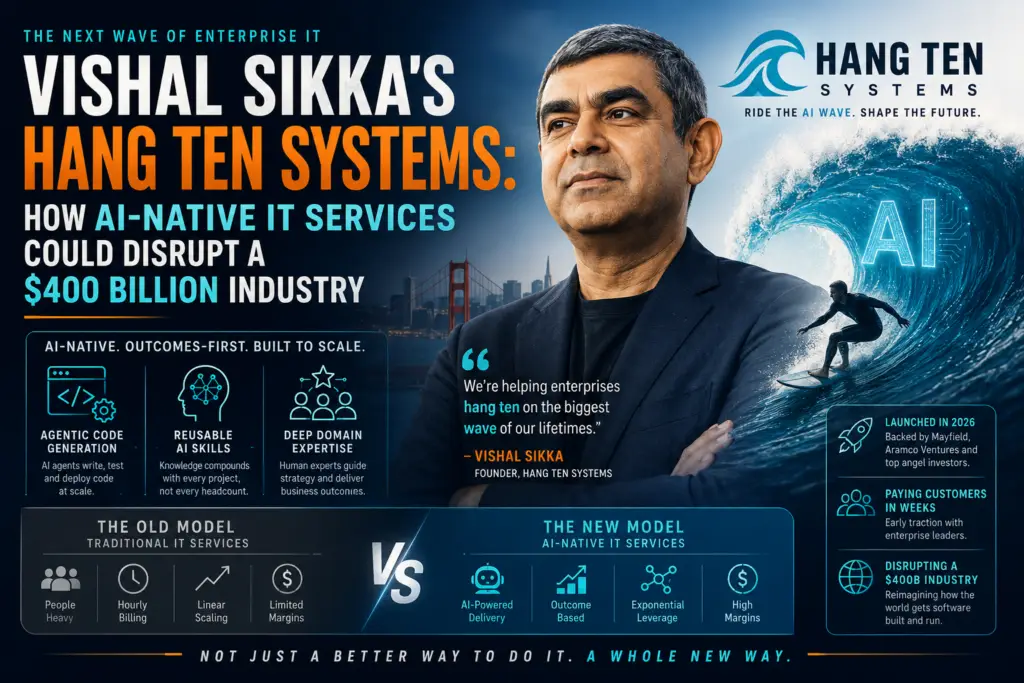
Former Infosys CEO Vishal Sikka has launched Hang Ten Systems, a startup designed to replace traditional IT outsourcing with AI-native IT services — and it already has paying enterprise customers just weeks after launch. If Sikka is right, the decades-old model of billing companies for human hours spent customizing and maintaining enterprise software is about to be fundamentally challenged.
What Is Hang Ten Systems?
Hang Ten Systems is a Bay Area-based enterprise AI company founded in mid-2026 by Vishal Sikka, the former Chief Executive of Infosys. It raised a $32 million seed round led by Mayfield, with a strategic investment from Aramco Ventures and participation from a network of angel investors.
The startup’s name is a surfing reference — and intentionally so. In a launch blog post, Sikka described the company as already helping large enterprises “hang ten on the biggest wave of our lifetimes,” a metaphor for riding the current surge of AI capability rather than being swept away by it.
At its most fundamental level, Hang Ten is positioning itself as the next generation of IT services: one built around machines doing the heavy lifting, not armies of consultants billing by the hour.
The Core Proposition: AI Over Headcount
Traditional IT services firms — Infosys, Wipro, TCS, Accenture — have operated on a simple economic model for decades: a client needs software customized, integrated, or maintained, so the firm deploys a team of engineers to do it. Revenue scales with headcount. More projects mean more people.
Hang Ten Systems is betting that this model is obsolete.
The startup describes itself as an enterprise AI services company built around three pillars: agentic code generation, reusable AI skills, and deep domain expertise. In plain terms, AI agents write and modify code, the company’s knowledge compounds with every project rather than walking out the door when a consultant does, and human experts guide strategy rather than execute repetitive tasks.
Mayfield Managing Partner Navin Chaddha captured the vision succinctly: “Traditional services scale linearly with headcount. Hang Ten is built so its leverage grows with every project.”
That is the fundamental bet at the heart of AI-native IT services — and it is a bet with enormous stakes.
Vishal Sikka: The Architect Behind the Idea
From SAP to Infosys to VianAI — A Proven Track Record
Vishal Sikka, now 59, is not a first-time founder with a theory. He spent 12 years at SAP building enterprise software at scale, then joined Infosys’ board of Oracle before becoming the first non-founder CEO of Infosys in 2014. During his three-year tenure, he pushed the company aggressively toward AI and automation — an agenda that, by his own account, was ahead of what the organization was ready to absorb.
After stepping down in 2017, Sikka founded VianAI, an enterprise AI startup that emerged from stealth in 2019 with $50 million in seed funding and later raised $140 million in a 2021 round led by SoftBank Vision Fund 2. VianAI focused on enterprise AI applications and analytics tooling to support AI-powered decision-making.
Hang Ten is distinct from VianAI in a meaningful way. Where VianAI was about helping enterprises use AI to make better decisions, Hang Ten is about using AI to deliver the software work that IT services firms have traditionally performed. It is a shift from AI as a product category to AI as the operating model of a services company itself.
Why Now? The Timing Is Deliberate
The answer lies in a confluence of three forces. First, large language models have become capable enough that agentic software development — AI autonomously writing, testing, and deploying code — is no longer a research concept. It is happening in production environments today.
Second, enterprises that had grown comfortable with the IT services outsourcing model are actively asking whether there is a cheaper, faster, and more flexible alternative. The pandemic, supply chain pressures, and the post-2022 tech efficiency wave have made every CIO more cost-conscious about multi-year outsourcing contracts.
Third, and perhaps most importantly, Sikka has the relationships. Mayfield’s Chaddha noted that Hang Ten “just got started a month back” and already has paying customers. That is not the result of product-market fit — it is the result of personal credibility built over three decades at the center of enterprise technology.
The $32 Million Seed Round: Who’s Backing It and Why
Mayfield’s Thesis: Leverage Over Headcount
Mayfield, one of Silicon Valley’s oldest and most respected venture firms, led the round. Its thesis is straightforward: it believes the AI-native IT services model can scale in ways that traditional IT firms simply cannot. When a traditional firm wins a new project, it needs to hire or redeploy engineers. When Hang Ten wins a new project, it deploys AI agents trained on accumulated institutional knowledge from previous projects.
This is a compounding leverage model that looks fundamentally different on a unit-economics spreadsheet. Gross margins in traditional IT services hover in the 25–35% range, constrained by the cost of maintaining large engineering workforces. An AI-native model, if it works as described, could conceivably operate at software-like margins while delivering services.
Aramco Ventures’ Strategic Play
The strategic investment from Aramco Ventures, the venture arm of Saudi Aramco, is telling. Saudi Aramco is one of the world’s largest and most complex industrial enterprises, running critical technology infrastructure across energy extraction, processing, and distribution. Its interest in Hang Ten is not purely financial — it signals that large industrial enterprises are actively exploring whether AI-native IT services can replace traditional IT outsourcing for mission-critical systems.
The board of Hang Ten also includes Jerry Yang, co-founder of Yahoo, adding a layer of Silicon Valley institutional credibility to a founding team that already carries deep enterprise software pedigree.
How Hang Ten Systems Actually Works
What Is Agentic Code Generation?
Agentic code generation refers to the use of AI systems that can autonomously plan, write, test, debug, and deploy software code with minimal human intervention at the execution layer. Unlike traditional AI coding assistants (such as GitHub Copilot, which suggests code to a human engineer), agentic systems can receive a high-level requirement and produce working software end-to-end.
Hang Ten applies this capability to the specific workflows that IT services firms have historically dominated: customizing enterprise software like SAP or Oracle ERP systems, integrating third-party applications, migrating legacy codebases, and maintaining production systems. These are labor-intensive, time-consuming, and notoriously prone to cost overruns.
By deploying AI agents for these tasks, Hang Ten claims to reduce both cycle time and cost — while building a reusable library of “AI skills” (pre-trained, task-specific AI capabilities) that improves with each engagement.
Real Enterprise Customers Already on Board
Unlike many seed-stage startups, Hang Ten is not operating on a pilot basis or chasing letters of intent. The company has confirmed that it is already working with Siemens Gamesa Renewable Energy and Fresenius, two large, complex industrial and healthcare enterprises, on AI-native project delivery.
These are not small or forgiving customers. Siemens Gamesa operates globally across wind energy manufacturing, installation, and maintenance — a domain requiring tight integration of operational technology with enterprise IT. Fresenius is one of the world’s largest healthcare companies, operating hospitals, dialysis clinics, and pharmaceutical manufacturing under strict regulatory frameworks.
Winning these customers at seed stage — before the product is even fully built out — validates the core thesis that experienced enterprise AI services leadership can immediately monetize relationships in ways that a product-only startup cannot.
The founding team reflects this orientation toward enterprise delivery excellence. Navin Budhiraja serves as CTO, Sanjay Rajagopalan as Chief Design Officer, and Tao Liu as Senior Vice President of Forward Deployed Engineering. All three have worked with Sikka at SAP, Infosys, or VianAI — a team that has operated together across multiple enterprise technology cycles.
Hang Ten Systems vs. Traditional IT Services: A Direct Comparison
Understanding where Hang Ten Systems differs from established IT services giants matters for enterprises evaluating their vendor relationships, and for investors sizing the opportunity.
| Dimension | Traditional IT Services (e.g., Infosys, TCS) | Hang Ten Systems (AI-Native IT Services) |
|---|---|---|
| Scaling Model | Linear — more revenue requires more headcount | Compounding — leverage grows with each project |
| Core Delivery Engine | Human consultants and engineers | AI agents + human strategic oversight |
| Knowledge Retention | Leaves when consultants do | Embedded in reusable AI skills and models |
| Gross Margin Profile | ~25–35%, constrained by labor costs | Potentially 50%+ as AI replaces repetitive execution |
| Time to Delivery | Weeks to months (staffing, onboarding, handoffs) | Faster cycles through automated code generation |
| Differentiation | Scale, global delivery centers, broad capability | AI-native architecture, compounding knowledge base |
| Primary Risk | AI disruption of the headcount model | Execution risk at enterprise scale; trust and reliability |
| Market Positioning | Defending existing model with AI bolt-ons | Built from the ground up as AI-native IT services |
| Funding Stage | Public companies with decades of scale | $32M seed round (June 2026) |
| Notable Clients | Hundreds of Fortune 500 companies | Siemens Gamesa, Fresenius (confirmed at launch) |
The table makes the competitive dynamic clear: Hang Ten is not competing with traditional IT firms on their own terms. It is proposing a structurally different cost and delivery model — one that becomes more attractive to enterprises as AI agent capabilities mature.
Is AI Disrupting the IT Services Industry? Two Competing Narratives
This is, frankly, the most contested question in enterprise technology right now — and Hang Ten Systems has placed itself at the center of it.
The Bear Case: AI Eats IT Services Margins
Analysts at Jefferies published a report earlier in 2026 arguing that IT services may be among the first sectors to face meaningful AI disruption. Their reasoning is structural: the core value proposition of IT services firms — deploying skilled labor to perform repeatable, process-oriented technical tasks — is precisely the category of work that current-generation AI agents are most capable of replacing.
The market has taken notice. Infosys shares are down over 35% year-to-date in 2026. The stock market is pricing in a world where the headcount-scaling model faces existential pressure, even if the full disruption takes years to materialize.
This is the opportunity Hang Ten is explicitly designed to capture. If a significant portion of IT services work can be done by AI at a fraction of the cost, then the firm that delivers AI-native services — rather than trying to graft AI onto a headcount model — captures the margin.
The Bull Case: AI Expands the Total Addressable Market
Not everyone agrees that disruption is the right frame. Infosys Chairman Nandan Nilekani argued this week that AI could actually expand the industry’s addressable market rather than shrink it. His case: historically, many enterprises have left IT projects unexecuted because they were too expensive or too slow to implement with human labor. AI reduces that barrier, bringing a new wave of projects into scope.
Infosys has told investors it believes “AI-first services” represent a $300–$400 billion market opportunity by 2030 — an extraordinary number that would represent a significant expansion of the current IT services market. The company is pursuing this through partnerships with both Anthropic and OpenAI, positioning itself as an established player that can integrate cutting-edge AI into its delivery model rather than be displaced by it.
What Does This Mean for the Industry?
Both narratives can be simultaneously true. AI may well expand the total addressable market for IT services work while simultaneously disrupting the pricing and margin structure of the traditional delivery model. In that scenario, the enterprises that benefit most are those early enough to position themselves as AI-native — and that is precisely where Hang Ten is placing its flag.
The outcome hinges on a question that is genuinely unanswered: can AI-native IT services reliably deliver the quality, compliance, and reliability that large enterprises require for mission-critical systems? Hang Ten’s work with Siemens Gamesa and Fresenius will be an important early test.
What Comes Next for Hang Ten Systems
Hang Ten told TechCrunch it is actively hiring across delivery, engineering, sales, and leadership, with plans to expand to multiple global locations to meet enterprise demand. The geographic expansion signals that Hang Ten is not positioning itself as a niche Silicon Valley boutique — it is building for global enterprise scale.
The $32 million seed round gives the company a meaningful runway to prove its model before requiring growth-stage capital. Given Sikka’s track record of attracting institutional support (VianAI’s $140 million round from SoftBank Vision Fund 2 is a reference point), the question is less about whether Hang Ten can raise follow-on funding and more about whether it can demonstrate that AI-native IT services work at enterprise scale within the next 18–24 months.
Three milestones will determine whether Hang Ten Systems becomes a transformational company or an interesting experiment:
First, can it expand its customer base beyond initial relationships to prove repeatable go-to-market motion? Second, can its AI systems handle the kind of complex, compliance-heavy enterprise environments that large industrial and healthcare clients demand? Third, can it build the institutional trust that traditional IT firms have earned over decades — the confidence that when something goes wrong at 2 AM, there is a team that will fix it?
If Hang Ten clears those bars, the AI-native IT services model it is pioneering could define how enterprise software is built, maintained, and delivered for the next decade.
Key Takeaways
- Hang Ten Systems was founded in mid-2026 by former Infosys CEO Vishal Sikka and raised a $32M seed round led by Mayfield, with participation from Aramco Ventures and angel investors including Yahoo co-founder Jerry Yang on the board.
- The company’s model is built on AI-native IT services: using agentic code generation and reusable AI skills to deliver the customization, integration, and maintenance work that traditional IT outsourcing firms have performed with human consultants.
- Unlike traditional IT services, which scale linearly with headcount, Hang Ten’s leverage is designed to compound with each project — as the AI systems accumulate domain knowledge, delivery speed and quality improve without proportional cost increases.
- The company already has paying enterprise customers — Siemens Gamesa Renewable Energy and Fresenius — just weeks after launch, demonstrating the power of founder credibility in shortening enterprise sales cycles.
- The founding team includes veterans of SAP, Infosys, and Sikka’s previous startup VianAI: Navin Budhiraja (CTO), Sanjay Rajagopalan (Chief Design Officer), and Tao Liu (SVP of Forward Deployed Engineering).
- The launch comes amid a genuine industry debate: Jefferies analysts say IT services may be the first sector to face serious AI disruption, while Infosys chairman Nandan Nilekani argues AI could expand the addressable market to $300–$400 billion by 2030.
- Hang Ten is expanding hiring and global footprint, positioning itself not as a niche AI startup but as a scalable alternative to the traditional IT services delivery model.
- The critical question the company must answer: can AI-native IT services reliably meet the quality, compliance, and reliability standards that enterprise clients require for mission-critical systems?