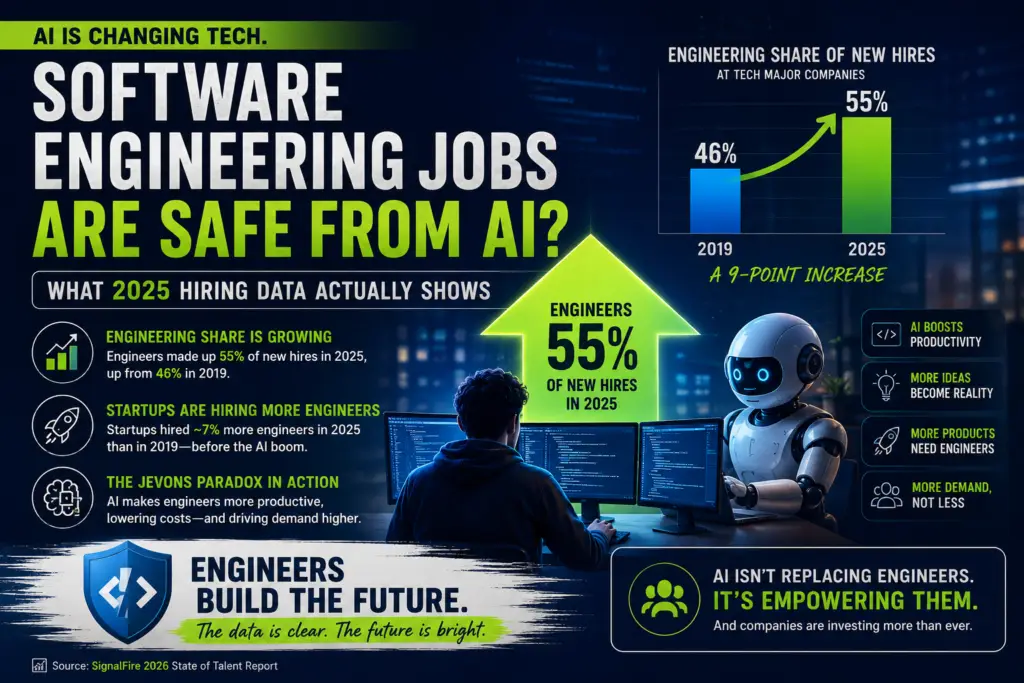
Software engineering jobs were supposed to be the first casualty of the AI revolution — but new data from venture firm SignalFire tells a radically different story. Far from shrinking, the engineering share of total tech hires actually grew between 2019 and 2025, making it the single most resilient job function in the technology sector.
If you’re a developer worried about your future, an engineering student wondering whether to switch majors, or a hiring manager trying to plan headcount, this article breaks down what the 2025 talent data actually says, why AI appears to be strengthening demand for engineers rather than gutting it, and what that means for your career decisions right now.
The Narrative vs. The Numbers
Why Layoff Headlines Can Mislead
Every major tech layoff announcement in the past two years has carried the same explanation: AI. Companies cite AI as the reason they need fewer people, and the media faithfully amplifies that narrative. In May 2026, the U.S. tech sector recorded its highest single-month job cut total in years, with AI listed as the primary driver by many firms, according to outplacement firm Challenger, Gray & Christmas.
On the surface, this seems to confirm the fear: AI is eating software engineering jobs. But there’s a critical flaw in reading layoff press releases as a proxy for employment trends. Layoffs measure what companies announce; hiring data measures what companies actually do.
These two signals can point in opposite directions at the same time, and when they do, hiring data is almost always the more honest indicator of what the labor market genuinely values.
SignalFire’s Methodology — Why Hiring Data Tells a Truer Story
Venture firm SignalFire took exactly this approach in its 2026 State of Talent Report. Rather than tracking layoff announcements — which are notoriously difficult to verify, and which employees often delay acknowledging in their employment profiles — SignalFire analyzed real-time career movement across millions of professionals and tens of millions of companies worldwide.
The result is a dataset that cuts through the noise. When SignalFire’s head of research, Asher Bantock, compared actual hiring flows for software engineering jobs against total tech hiring trends, he found something that contradicts the dominant AI-replacement narrative almost completely.
What the 2025 Talent Data Actually Shows
Engineers Claim a Growing Share of New Hires
Here is the headline finding: while total hiring across the twelve companies SignalFire classifies as “Tech Majors” — a group that includes Alphabet, Meta, Apple, Amazon, Microsoft, Netflix, NVIDIA, Tesla, Uber, Airbnb, Block, and Stripe — fell roughly 25% compared to 2019 baseline levels, engineering roles declined by only 11% over the same period.
That gap matters enormously. When every other function is contracting faster than engineering, engineers are becoming a larger proportion of the workforce, not a smaller one.
The numbers confirm this directly. In 2025, engineers accounted for 55% of all new hires across Tech Major companies — up from just 46% in 2019. That nine-point shift represents hundreds of thousands of software engineering jobs being prioritized over other roles at exactly the moment AI tools were supposed to be making engineers redundant.
In Bantock’s own words, what they observed on the ground is “a little inconsistent” with the theory that AI is replacing engineering talent.
Startups Are Hiring Even More Engineers Than Before AI
The trend is even more pronounced at early-stage companies, which are generally regarded as the fastest-moving indicator of where the economy believes value will be created. SignalFire’s data shows that collectively, startups hired approximately 7% more engineers in 2025 than they did in 2019 — a period that predates widespread AI adoption entirely.
Think about what that means: the cohort of companies most sensitive to cost pressure, most exposed to venture capital scrutiny, and most likely to replace humans with automation where possible actually increased their appetite for software engineering jobs during the peak AI boom.
If AI were acting as a true substitute for engineers, you would expect exactly the opposite pattern. The fact that startup demand for engineers is higher in absolute terms today than before AI tools existed suggests that something more complicated — and more favorable to engineers — is happening in the underlying economics.
The Jevons Paradox — The Economic Force Protecting Engineering Careers
The Jevons Paradox is a concept from 19th-century economics, originally applied to coal consumption. The paradox states that when a resource becomes more efficient to use, total demand for that resource tends to increase rather than decrease — because the lower cost unlocks new applications that weren’t previously viable.
Applied to software engineering: AI-powered coding tools have made each individual engineer dramatically more productive. A task that once required a full sprint can now be completed in an afternoon. According to conventional economic thinking, this should reduce the number of engineers needed to do the same amount of work. But the Jevons Paradox predicts the opposite — and the data backs it up.
When engineers become cheaper to operate per unit of output, the economic calculus shifts. Projects that were previously too expensive to staff suddenly become viable. New product categories open up. The total addressable surface area of software that companies want to build expands faster than the productivity gains reduce headcount requirements.
In short: AI doesn’t eliminate the need for software engineering jobs. It lowers the cost-per-feature, which causes companies to commission vastly more features. The work expands to consume the new capacity.
Bantock captured this dynamic precisely: engineers are “suddenly a lot more productive, and there’s endless work for them to do.”
What Industry Leaders Are Saying
The Jevons interpretation is not confined to SignalFire’s research team. Senior figures across the industry have arrived at the same conclusion independently.
Nvidia CEO Jensen Huang addressed this directly at a Stanford Graduate School of Business event in April 2026. After pushing back on the claim that AI would destroy software engineering jobs, Huang argued the opposite was true. With every Nvidia engineer now using agentic AI tools, software engineers across the company are working more intensively than at any prior point — not less. AI agents may be writing code at machine speed, but they are doing so in service of a constantly expanding backlog of ideas that only engineers can generate and direct.
Anthropic’s own head of economics, Peter McCrory, told TechCrunch in March 2026 that he had not yet observed any material, measurable increase in unemployment rates among workers whose jobs are theoretically most exposed to AI automation — including software engineers — compared to workers in roles AI cannot easily reach.
This is particularly striking given that Anthropic’s CEO Dario Amodei had previously warned that AI could eliminate up to half of all entry-level white-collar positions within five years. The company building the most capable AI tools in the world is finding, in its own economic analysis, that those tools have not yet produced the employment disruption the broader narrative predicts.
AI vs. Engineering: How Different Tech Job Functions Stack Up
The SignalFire data allows a function-by-function comparison that reveals where AI pressure is actually concentrated.
| Job Function | Hiring Change vs. 2019 | AI Displacement Risk | Key Trend |
|---|---|---|---|
| Software Engineering | -11% (but % of hires rose) | Lower than expected | Engineers = 55% of new hires in 2025 |
| Technical Recruiting | Significant decline | Elevated | AI screening tools reduce recruiter headcount |
| Data Entry / Ops | Sharp decline | High | Easily automated by LLMs |
| Finance & Accounting | Moderate decline | Moderate | AI handles routine reporting |
| Marketing & Content | Moderate decline | Moderate–High | AI generates drafts; strategy roles persist |
| Legal & Compliance | Modest decline | Moderate | Contract review automatable; judgment is not |
| General & Admin | Notable decline | High | Scheduling, coordination increasingly AI-handled |
| ML / AI Engineering | Strong growth | Very Low | Building the tools; irreplaceable for now |
The pattern that emerges is consistent: roles that require systems thinking, architectural judgment, and the ability to specify and verify AI outputs are holding or growing. Roles that primarily involve executing well-defined, repeatable tasks from a template are contracting — not because engineers are being fired, but because those tasks are increasingly automated away, removing the need for human execution.
Software engineering jobs sit firmly in the first category, not the second.
What Makes an Engineer Resilient to AI Displacement?
Not all engineering roles are equally insulated from AI pressure. The data suggests that certain skills, mindsets, and work patterns are far more durable than others. Based on the underlying dynamics that SignalFire’s research reveals, here is what actually protects an engineer’s position:
- Systems architecture and design judgment — AI tools are excellent at writing code within a specified system; they are poor at deciding what system to build, how to trade off complexity for reliability, or when to reject a technically feasible approach because it creates future maintenance debt.
- AI tool orchestration skills — The engineers who thrive are those directing AI agents, reviewing their output, catching subtle errors, and composing multi-agent pipelines. This is the new meta-skill.
- Domain-specific expertise — Deeply specialized knowledge in healthcare technology, fintech compliance, aerospace systems, or any domain where context shapes correctness provides durable protection. AI cannot absorb years of industry context from a prompt.
- Cross-functional communication — The ability to translate between business requirements and technical implementation remains entirely human. Stakeholders cannot articulate their needs in machine-parseable specifications, and engineers who bridge that gap are irreplaceable.
- Debugging and root-cause analysis — AI-generated code fails in novel ways. Engineers who can diagnose unexpected behavior in large, AI-augmented codebases are becoming more valuable, not less.
- Security, privacy, and risk reasoning — As more code is AI-generated, the attack surface for subtle vulnerabilities expands. Security-conscious engineers who can audit AI output for exploitable flaws are in growing demand.
- Greenfield product thinking — The creative act of identifying a problem worth solving and designing software to solve it remains deeply human. AI amplifies execution speed; it doesn’t generate the originating insight.
What This Means If You’re Planning a Career in Engineering
Should students still pursue software engineering degrees?
Yes — with a significant caveat about what to prioritize. The raw demand for software engineering jobs remains healthy and is, by share of total hiring, stronger than at any point in the pre-AI era. But the nature of the work is shifting.
Engineers who spend the next two to three years learning to work with AI tools — not just alongside them, but deeply integrating them into how they reason about and execute technical problems — will be positioned significantly better than those who treat AI as a sideshow to traditional software development practice.
The practical implication: time spent learning to prompt, evaluate, debug, and orchestrate large language models is not time stolen from “real engineering.” It is rapidly becoming core engineering practice.
Should working engineers be worried?
The data says no, with nuance. If you are an engineer who primarily executes well-specified, self-contained coding tasks — particularly at the junior end — you should be thoughtful about expanding your skill profile. The most vulnerable software engineering jobs in the short term are those where the primary value-add is code production rather than code judgment.
Senior engineers, architects, and those who own entire systems from design through delivery appear highly insulated. The data from startups is especially telling: companies building new products at the frontier of AI adoption are hiring more engineers, not fewer, because their product ambitions expand in direct proportion to their productivity gains.
What about layoffs that explicitly cite AI?
Treat these with some skepticism. Corporate announcements frequently cite the most culturally legible reason for restructuring decisions that are actually driven by interest rate environments, post-pandemic hiring overcorrections, shifts in business strategy, or competitive pressure. “AI” in a layoff press release often signals “we overhired in 2021–2022” more than it signals “AI made our engineers unnecessary.”
The hiring data — which tracks revealed preferences rather than stated rationales — is a far more reliable guide.
The Verdict: AI as Accelerant, Not Exterminator
The most accurate single-sentence summary of what 2025 data shows about software engineering jobs is this: AI has made engineers more productive, which has made them more valuable, which has made employers hire proportionally more of them even as total tech headcount contracts.
This is not the story most people expected. It is, however, the story that economic history repeatedly tells about general-purpose technologies: the productivity gains they deliver tend to expand the total scope of what is built, rather than reducing the number of builders.
The engineers most at risk are not “engineers” as a category, but specifically those whose primary function is generating routine code without bringing architectural judgment, system ownership, or specialized domain knowledge to the work. That profile will face meaningful pressure over the next decade. Every other profile of software engineering work looks durable, and by the hiring data’s measure, it looks stronger today than it did before AI existed.
For anyone navigating a career in technology right now, the SignalFire findings carry a clear and actionable message: don’t flee engineering. Learn to engineer with AI, and you will be navigating the most in-demand version of an already resilient profession.
Frequently Asked Questions
Q: Will AI eventually replace software engineers entirely? The current data shows no evidence of this trajectory. Engineering’s share of tech hiring is rising, not falling. Leading economists embedded at AI companies — including Anthropic — report no measurable employment displacement among engineers through 2026.
Q: Which engineering specializations are most protected from AI? AI/ML engineering, security engineering, systems architecture, and any specialization that requires deep domain expertise are the most insulated. General-purpose junior development roles carry the most exposure.
Q: Is the Jevons Paradox a guarantee that engineering jobs will remain safe? No. The Jevons Paradox describes a historically robust pattern, not a law. At some threshold of AI capability, the dynamic could reverse. But based on 2025 data, we are firmly in the expansion phase of the paradox, not approaching its limits.
Q: How reliable is SignalFire’s data? SignalFire’s analysis tracked career paths across tens of millions of companies using real-time employment movement data — a significantly more reliable methodology than layoff tracking or survey-based research.
The Long View: What Happens When AI Gets Even More Capable?
One fair objection to the bullish case for engineers is that we are still in the early stages of AI capability. Models are improving rapidly. Agentic systems that could not maintain multi-file context six months ago can now manage entire codebases with minimal supervision. Is it possible that the Jevons dynamic is only temporary — a brief window before AI capability crosses a threshold that genuinely displaces engineers at scale?
This is the honest uncertainty that lives at the center of every labor market projection right now, and it deserves a straightforward answer: yes, that scenario is possible, and no one can rule it out with certainty.
What the data tells us is that we are not in that scenario today, and there is no trajectory in the 2025 hiring numbers that suggests we are approaching it imminently. The directional signal — engineers becoming a larger share of the workforce even as AI tools advance — is moving in the opposite direction from what a near-term displacement narrative would predict.
The more grounded concern is not wholesale replacement but role stratification: a bifurcation in which senior, specialized, and architecturally-minded engineers become scarcer and better compensated while the market for routine junior development work shrinks or gets absorbed by AI-assisted non-engineers. This is a plausible near-term evolution of the labor market for software engineering jobs, and it has real implications for compensation, career laddering, and how engineering teams are structured.
Companies that understand this dynamic are already adjusting their hiring profiles — looking for fewer, more senior engineers who can direct AI toolchains rather than larger pools of developers who execute narrow, well-scoped tickets. That shift is visible in the hiring data, and it is a useful signal for anyone positioning their career for the next five years.