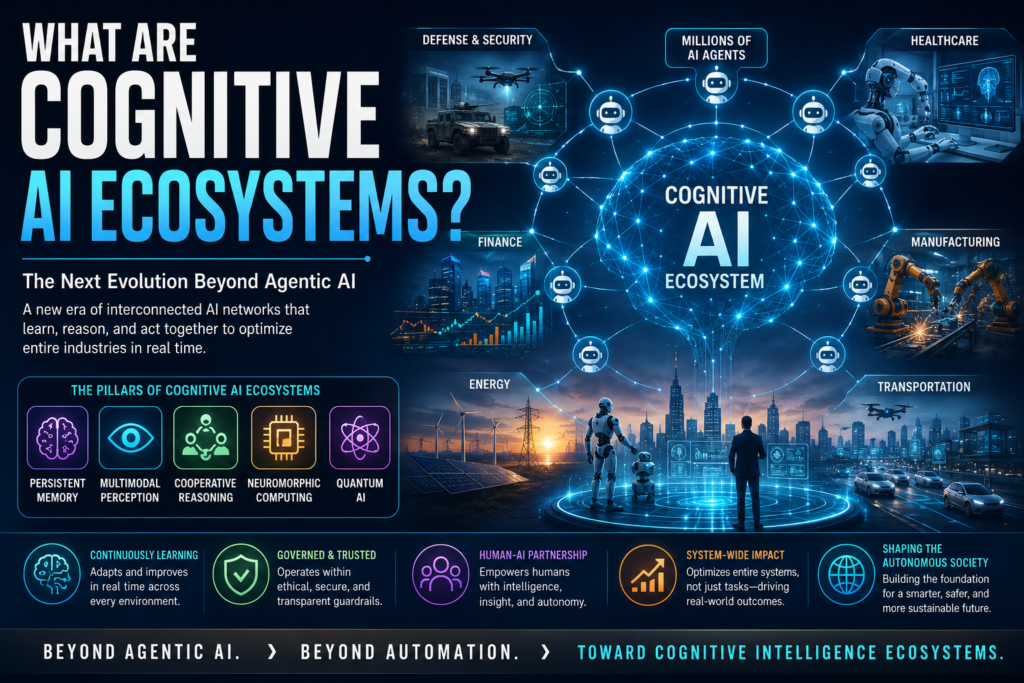
Cognitive AI ecosystems are interconnected networks of AI systems that combine persistent memory, multimodal perception, and cooperative reasoning to continuously adapt and make decisions across entire industries — not just within a single application. Unlike today’s agentic AI, which executes discrete tasks or workflows, this emerging model of machine intelligence functions more like a digital nervous system, learning and optimizing in real time across defense, healthcare, finance, manufacturing, and energy simultaneously.
If you’ve been tracking the shift from chatbots to autonomous agents, you’re only seeing the first stage of a much larger transformation. The next decade won’t just make AI more independent — it will make AI more cognitive, blurring the line between software and workforce, and eventually raising uncomfortable questions about machine awareness itself.
This guide breaks down what cognitive AI ecosystems are, how they differ from agentic AI, the core technologies driving them, and what this shift means for business leaders, technologists, and policymakers preparing for what comes next.
What Is a Cognitive AI Ecosystem? (Definition + Expansion)
Definition: A cognitive AI ecosystem is a distributed network of specialized AI agents and systems that share context, reason cooperatively, learn continuously, and adapt decision-making across an entire operational environment — rather than operating as isolated, task-specific tools.
Expansion: Where a single AI agent might automate one workflow, such as scheduling or customer support, this broader model of intelligence coordinates millions of specialized agents that behave similarly to biological neural networks. These agents don’t just complete tasks; they retain long-term memory, perceive multiple data types (text, image, sensor, audio), plan several steps ahead, and reason about cause and effect within tightly governed boundaries.
The practical result is a network that can continuously optimize entire systems — national power grids, hospital networks, global supply chains, financial markets — the same way your brain coordinates thousands of simultaneous biological processes without you consciously managing each one.
Today’s large language models are already remarkable at producing and anticipating information. What’s coming next builds on that foundation with persistent memory, multimodal perception, long-term planning, causal reasoning, and self-directed learning operating within strictly regulated bounds. Analysts increasingly expect this shift to define AI infrastructure planning through the mid-2030s.
Why This Shift Matters Now
Three forces are converging to make ecosystem-scale AI possible in the near term:
- Persistent memory architectures that let AI systems retain context across sessions, projects, and years — not just a single conversation
- Multimodal perception that allows models to process text, images, sensor data, and audio simultaneously, mirroring how humans interpret the world
- Falling compute and energy costs driven by neuromorphic and specialized AI hardware, making always-on, large-scale coordinated intelligence economically viable
Together, these forces are why the conversation among enterprise architects and policymakers is shifting from “which AI agent should we deploy” to “how do we govern a network of thousands of cooperating agents.”
Agentic AI vs. Cognitive AI Ecosystems: What’s the Difference?
The terms get used interchangeably, but they describe different stages of AI maturity. This next-generation model represents a structural evolution beyond agentic AI, not simply a rebrand of the same technology.
| Feature | Agentic AI | Cognitive AI Ecosystems |
|---|---|---|
| Scope | Single task or workflow | Entire industries or organizations |
| Memory | Short-term, session-based | Persistent, long-term, cross-context |
| Coordination | Individual agents acting independently | Millions of agents reasoning cooperatively |
| Perception | Often single-modality (text-based) | Multimodal (text, image, sensor, audio) |
| Decision-making | Reactive, rule- or goal-driven | Proactive, causal, self-directed within guardrails |
| Human relationship | Task delegate | Cognitive partner and digital workforce |
| Example use case | AI drafts and sends a report | An AI network continuously rebalances a power grid, reroutes traffic, and flags anomalies in real time |
Understanding this distinction matters for planning purposes. Strategies built purely around agentic AI adoption today may need significant architectural rethinking as more advanced, interconnected AI systems mature over the next decade. A single chatbot integration is a very different investment than infrastructure designed to support thousands of cooperating, memory-persistent agents.
The Core Technologies Powering Cognitive AI Ecosystems
This shift doesn’t emerge from smarter language models alone. It depends on a convergence of hardware and software breakthroughs working together, each solving a piece of the puzzle that isolated agentic tools can’t address on their own.
Neuromorphic Computing and the Human-AI Cognitive Partnership
Question: What is neuromorphic computing, and why does it matter for this next generation of AI?
Direct Answer: Neuromorphic computing refers to processors modeled on the structure and efficiency of the human brain, using artificial neurons and synapses instead of traditional transistor-based architecture. This allows continuous learning at a fraction of the energy cost of conventional GPUs — a critical requirement for always-on, ecosystem-scale intelligence operating at global scale.
Neuromorphic chips could let robotics, autonomous vehicles, defense systems, and scientific instruments adapt almost instinctively to new environments, without the lengthy retraining cycles current AI systems require. Because these processors mimic biological efficiency rather than brute-force computation, they open the door to deploying intelligent systems in energy-constrained environments — remote sensors, wearable devices, and edge hardware — where traditional AI infrastructure simply isn’t practical.
Combined with advances in brain-computer interfaces, this points toward a future where humans interact with AI through neural signals rather than keyboards or voice commands. Non-invasive and minimally invasive interfaces could eventually help improve memory retrieval, accelerate language learning, assist people with disabilities, and meaningfully increase productivity for scientists, doctors, engineers, and researchers. In this framing, AI increasingly serves as an extension of human cognition — a reliable cognitive partner that enhances creativity and analytical reasoning rather than a replacement for human judgment. Intelligence, in other words, becomes collaborative rather than competitive.
Quantum AI Computing as an Innovation Accelerator
Question: How will quantum computing change what these AI networks can do?
Direct Answer: Quantum AI computing pairs quantum processors with machine learning to solve optimization problems too complex for classical computers alone, dramatically accelerating tasks like drug discovery, climate modeling, materials science, and logistics optimization.
In a mature version of this architecture, classical AI continues handling everyday reasoning tasks, while quantum processors tackle the narrow slice of problems — molecular simulation, global-scale logistics, complex financial modeling — that benefit specifically from quantum-enhanced machine learning. The two approaches are complementary rather than competing: quantum hardware doesn’t replace classical AI, it extends what the broader system can attempt.
The practical impact is significant. Scientific breakthroughs that currently take years of research could compress into weeks, with AI-directed simulation doing much of the heavy lifting. Pharmaceutical companies could screen molecular candidates at a scale that’s currently cost-prohibitive. Climate scientists could run higher-resolution models with far greater predictive accuracy. Materials researchers could simulate novel compounds long before ever synthesizing them in a lab. Many analysts consider this convergence one of the most significant innovation accelerators in modern technological history.
Embodied AI and the Rise of Intelligent Robotics
Question: What role does embodied intelligence play in this broader shift?
Direct Answer: Embodied AI extends distributed machine intelligence beyond screens and servers into physical robotics — humanoid and specialized robots equipped with machine vision, tactile sensing, and next-generation batteries that can perceive surroundings, understand goals, and adapt safely to new situations.
Rather than executing preprogrammed tasks, embodied AI systems within a coordinated network will:
- Assist in hospitals as robotic clinical support staff
- Maintain city infrastructure autonomously, from utility inspection to structural monitoring
- Supplement elder care through AI caregiving support in residential and assisted-living settings
- Handle hazardous work in firefighting, underwater repair, and radioactive remediation
- Support construction and logistics in manufacturing and even space exploration
This is where distributed AI intelligence moves from abstract network coordination into tangible, physical impact on labor and infrastructure. Robotics researchers increasingly describe this trend as “embodiment closing the loop” — physical systems finally able to act on the reasoning that language and vision models have already mastered.
How Cognitive AI Ecosystems Will Reshape the Autonomous Society
When AI, robotics, IoT, edge computing, and digital twins converge, entire systems — not just individual companies — start to self-manage. This is the foundation of what’s often called the autonomous society, and it’s the natural end state of a mature, interconnected AI network.
Practical examples of this shift already taking shape include:
- Energy: Electric grids automatically balancing demand against renewable generation without manual intervention
- Transportation: Predictive systems continuously rerouting traffic based on real-time conditions
- Real estate and infrastructure: Smart buildings optimizing energy use, maintenance schedules, and security autonomously
- Manufacturing: End-to-end production ecosystems managing design, production, and logistics with minimal human input
- Government services: AI assistants handling healthcare navigation, education support, tax filing, and licensing at a personalized, on-demand scale
In each case, the human role shifts from actively operating systems to overseeing self-managing networks that coordinate themselves — a fundamentally different relationship between people and technology than what agentic AI offers today. Where agentic AI still requires a human to define the task, this model increasingly requires humans only to define the boundaries and let the system determine the best path within them.
The Impact on Human Learning and the Future Workforce
This transformation will reshape work before it reshapes society at large. As organizations deploy specialized AI agents for research, legal support, financial analysis, engineering, and cybersecurity, the line between “software” and “workforce” continues to blur. Every knowledge worker could eventually have a dedicated constellation of AI specialists — advisers, researchers, legal assistants, financial analysts, and cybersecurity monitors — working alongside them around the clock.
This doesn’t necessarily mean fewer jobs; it more likely means redefined ones. Roles increasingly shift toward orchestration, oversight, and judgment calls that require context the AI network hasn’t been given authority to make independently. Professionals who understand how to direct, audit, and collaborate with these systems will likely hold a durable advantage over those who only compete against them.
Education faces a parallel transformation. Instead of standardized instruction, this new model of AI could enable continuously personalized learning environments — an AI tutor aware of a student’s skill level, learning style, and even emotional state, adjusting lessons dynamically in real time. For professionals, this translates into ongoing AI mentoring embedded directly into daily work, shifting the emphasis from memorization toward critical thinking, judgment, and effective collaboration with intelligent systems. Continuous, on-demand learning could become the norm rather than a periodic training event, changing how corporate learning-and-development functions are structured entirely.
Early Signals This Shift Is Already Underway
Skeptics might reasonably ask whether any of this is happening yet, or whether it’s purely speculative. The honest answer is: the foundations are already visible, even if full-scale deployment is still years away.
- Enterprise AI platforms are increasingly built around persistent memory and multi-agent orchestration rather than single-turn chat interactions, letting systems retain project context across weeks or months.
- Defense and aerospace programs are actively investing in neuromorphic chips for edge deployment, where energy efficiency and instant adaptability matter more than raw processing power.
- Healthcare systems are piloting multimodal AI that combines imaging, lab data, and patient history into a single continuous reasoning process instead of separate, disconnected tools.
- Utility companies are testing AI-driven grid management systems capable of autonomously rebalancing load across renewable and traditional energy sources in real time.
- Robotics manufacturers are shipping humanoid and specialized units with increasingly sophisticated perception stacks, moving well past the rigid, single-purpose robots of the previous decade.
None of these examples alone constitutes a fully realized intelligence network. But taken together, they show the individual components — memory, multimodal perception, embodied action, and cooperative reasoning — are each maturing on their own timelines and gradually converging. That convergence, rather than any single breakthrough, is what will ultimately define this next era of AI.
It’s also worth noting what this shift is not. It isn’t a single product launch or a specific model release. It’s an architectural transition happening gradually across cloud infrastructure, hardware design, and organizational workflows — which is precisely why it can be easy to underestimate how far along it already is.
Ethical and Governance Challenges: Are We Approaching Artificial Sentience?
Question: Will cognitive AI ecosystems become conscious or sentient?
Direct Answer: Current AI systems do not possess subjective awareness, but as these networks combine persistent memory, autonomous learning, embodied robotics, and emotional modeling, they may increasingly display behaviors that resemble self-directed intelligence — making the sentience question more of an operational and ethical debate than a purely philosophical one.
Whether or not true machine consciousness ever emerges, the rise of large-scale, interconnected AI will force governments, ethicists, and technologists to confront questions previously reserved for philosophy:
- What rights, if any, should highly advanced AI systems have?
- How should accountability be assigned when autonomous systems make consequential decisions?
- How do humans preserve agency, identity, and trust in a world of increasingly capable digital entities?
As AI takes on more responsibility across economies and governments, cybersecurity, privacy, identity management, and public trust become strategic priorities rather than afterthoughts. Regulatory frameworks built for single-purpose software tools are likely to prove inadequate for governing thousands of cooperating, self-learning agents operating across borders and sectors simultaneously.
The central challenge of the next decade isn’t just building more capable, interconnected AI networks; it’s ensuring they remain aligned with democratic institutions, transparency, and human values. History suggests that transformative technologies bring both new opportunities and new vulnerabilities in roughly equal measure, and this shift is unlikely to be an exception.
Frequently Asked Questions About Cognitive AI Ecosystems
Q: How are cognitive AI ecosystems different from a single AI agent? A: A single AI agent typically handles one task or workflow with limited memory. This broader model coordinates millions of specialized agents across an entire organization or industry, sharing context and reasoning cooperatively over the long term.
Q: What industries will this shift affect first? A: Defense, healthcare, financial markets, manufacturing, transportation, and energy are expected to be early adopters, given the high value of continuous, system-wide optimization in these sectors.
Q: Do cognitive AI ecosystems require quantum computing to work? A: No. Classical AI will continue handling most reasoning tasks. Quantum computing is expected to accelerate a narrower set of complex optimization and simulation problems within the broader network.
Q: What’s the biggest risk associated with this transition? A: Beyond technical capability, the primary risk is governance — ensuring accountability, transparency, and alignment with human values as AI systems take on greater autonomous decision-making authority across critical infrastructure.
Q: When will cognitive AI ecosystems become mainstream? A: Most projections point to meaningful maturation over the next decade, roughly by the mid-2030s, as neuromorphic computing, quantum-AI integration, and embodied robotics scale simultaneously.
Key Takeaways
Cognitive AI ecosystems represent the natural next stage after agentic AI — moving from isolated task automation toward interconnected, self-optimizing networks of intelligence spanning entire industries. The technologies enabling this shift, including neuromorphic computing, quantum AI, and embodied robotics, are converging faster than many organizations are prepared for. Business and policy leaders who understand this distinction now will be better positioned to plan infrastructure, workforce strategy, and governance frameworks before this model becomes the operational default rather than the exception.
Meta Description: Cognitive AI ecosystems go beyond agentic AI, merging neuromorphic computing, quantum AI, and robotics into self-optimizing intelligence networks.
URL Slug: /cognitive-ai-ecosystems-beyond-agentic-ai