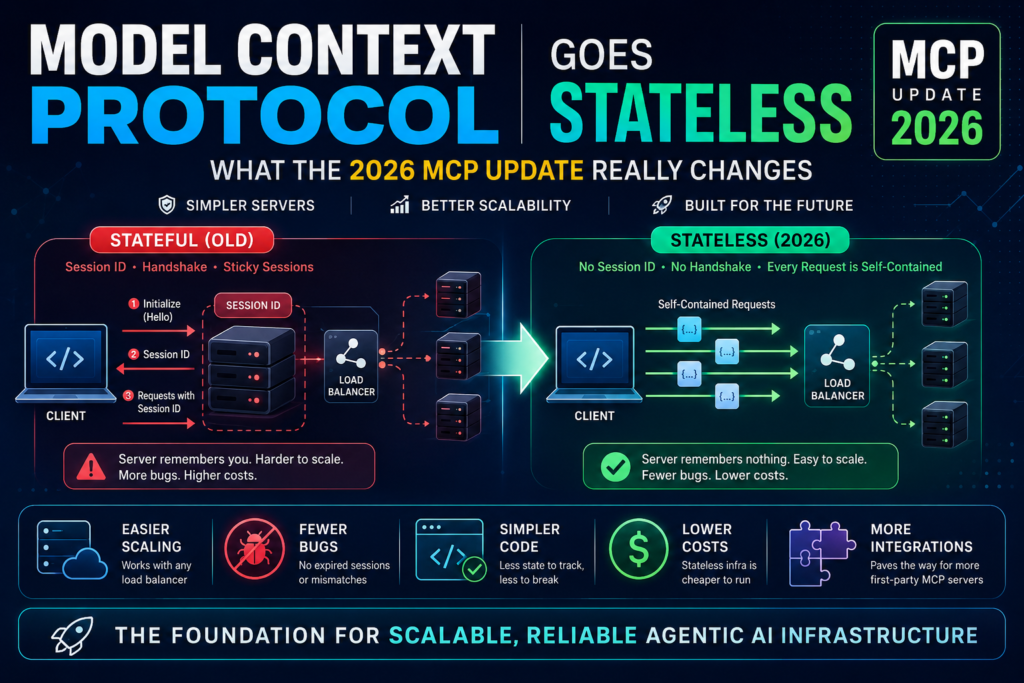
The Model Context Protocol is dropping session IDs in its next release, moving from a stateful handshake to a stateless, per-request design similar to how the ordinary web already works. In plain terms: MCP servers will no longer need to “remember” a client between requests, which makes them dramatically easier to run at scale — but it also means every existing MCP client and server has to be rewritten to speak the new version.
If that sentence felt dense, don’t worry. By the end of this article, you’ll understand exactly what changed, why it changed, and what you need to do about it — whether you’re an engineer maintaining an MCP server, a founder evaluating agentic AI infrastructure, or someone simply trying to keep up with how AI tools talk to each other behind the scenes.
What Is MCP (the Model Context Protocol)?
Definition: MCP is an open standard that gives AI models a secure, consistent way to connect to external data sources and tools — a calendar, a company database, an internal API — without engineers building bespoke integration code for every single connection.
Expansion: Think of it as a universal adapter. Before this standard existed, connecting an AI assistant to a CRM meant writing custom glue code for that one model and that one CRM. Swap either side out, and you rebuilt the integration from scratch. The protocol standardizes that connection so any compatible client — Claude, ChatGPT, or another assistant — can talk to any compatible server using the same set of rules. That’s why it gets described as one of the foundational building blocks of AI interoperability: it’s the plumbing, not the faucet.
Since its release, this framework has become the de facto way AI companies expose tools and data to language models. That popularity is precisely why a change to its core mechanics ripples across the entire ecosystem instead of staying confined to one vendor’s codebase.
Why It’s Called “Context” Protocol
The name is worth unpacking briefly. The whole point of the system is to feed a language model the context it needs — documents, live data, tool outputs — at the moment it needs it, rather than baking that information into the model’s training data. That context-delivery job doesn’t change with this update. What changes is purely mechanical: how the connection carrying that context is established and maintained.
Why Is the Model Context Protocol Changing in 2026?
The short answer: the original design worked beautifully on a laptop and poorly in a data center.
The Problem With Stateful Sessions
In the current version of the protocol, a client connects to a server with a “hello” message — introducing itself, its version, and its capabilities. The server responds with its own capabilities and hands back a session ID. This exchange is called initialize. From that point forward, the client includes the session ID on every subsequent request so the server knows it’s talking to the same ongoing conversation. Sometimes that ID expires, and the client has to notice, request a new one, and carry on.
On a single machine, that bookkeeping is trivial — the session ID just lives in memory, and nothing else needs to know about it. The trouble starts the moment you leave your laptop behind and try to run this at real scale.
How Load Balancers Break Stateful MCP
Picture a server built to handle millions of users. It sits behind a load balancer whose entire job is routing each incoming request to whichever machine in the fleet happens to be free — sometimes in a completely different region. Under the older, stateful approach, every one of those machines would need to know about a session ID some other machine issued moments earlier. That’s not impossible, but it actively fights the load balancer instead of working with it, and it forces engineering teams to build extra coordination just to keep track of who’s who.
This is a familiar problem to anyone who has run web infrastructure before. Years ago, the standard answer was “sticky sessions” — pinning a specific browser to a specific server so that server alone remembered the visitor. As the web scaled, most applications abandoned that approach in favor of statelessness, where the server doesn’t need to remember anything about you between requests at all. The protocol governing AI tool connections is now catching up to that same lesson, decades later.
This scaling friction is also a big reason first-party MCP servers from major companies have been slower to arrive than the hype around agentic AI might suggest. Plenty of teams can stand up an impressive demo in an afternoon. Getting that demo to production scale, serving millions of concurrent users, runs straight into the session problem — and frequently stalls there for months.
What Does “Stateless” Actually Mean Here?
This is the part that’s easy to misread, so it’s worth being precise.
Going stateless does not mean the system loses the ability to handle complex, multi-step interactions. It means the server no longer has to remember anything between requests, because the client now sends everything the server needs on every single call.
Practically speaking, the opening handshake disappears entirely. Instead of negotiating a session once and reusing an ID for the rest of the conversation, the client identifies itself on every request — the same way a browser sends a user-agent header with each page load rather than logging in once and being remembered by the server’s memory alone. It’s a small change in mechanics with large downstream consequences for how systems get deployed.
Stateful vs. Stateless: Key Differences
| Aspect | Stateful (Current Version) | Stateless (2026 Update) |
|---|---|---|
| Session handling | Server issues and tracks a session ID | No session ID; every request is self-contained |
| Handshake | Required initialize exchange before use | No upfront handshake needed |
| Scaling behavior | Fights load balancers; often needs sticky routing | Works naturally with standard load balancing |
| Common failure modes | Expired or mismatched sessions cause dropped connections | Fewer session-related bugs by design |
| Best suited for | Local, single-machine servers | Multi-region, high-traffic deployments |
| Server complexity | More conversational state to track and store | Simpler server logic overall |
| Analogy | Sticky-session web apps from the early 2000s | Modern stateless REST APIs |
The pattern should look familiar if you’ve worked with web APIs before. This update is essentially bringing MCP in line with the same statelessness that REST APIs have relied on for decades — proven infrastructure, borrowed rather than reinvented.
Why This Matters If You Build on the Model Context Protocol
The Short-Term Pain: A Breaking Change
In protocol terms, this is a hard break. A client built to expect the older, stateful version won’t successfully initialize a session with a server running the new stateless version, and the reverse is also true.
The ecosystem does have an escape hatch: version negotiation. A client can declare that it only speaks the older protocol version, and a server capable of speaking both can continue serving that client while also supporting newer clients on the updated spec. That keeps the ecosystem from falling apart outright, but maintaining two versions simultaneously is real, ongoing engineering work rather than a one-time patch. For anyone who has already written extensive stateful session-handling code, this is a genuine rewrite, even though the new design is objectively simpler once it’s in place.
The Long-Term Payoff: Scale and Stability
The rewrite is inconvenient, but the benefits are concrete and compound over time:
- Easier horizontal scaling — servers no longer need special coordination to share session state across machines or regions
- Fewer connection bugs — a large share of today’s reported issues trace back to brittle session handling, such as expired sessions or dead connections that refuse to reconnect
- Simpler server code — less conversational state to track means less surface area for subtle, hard-to-reproduce bugs
- Lower operating cost at scale — stateless infrastructure is generally cheaper to run than infrastructure requiring sticky routing or a shared session store
- More first-party integrations — removing the biggest scaling obstacle makes it far more realistic for large companies to ship official, supported servers instead of leaving things at the demo stage
Put simply, this update trades a short migration headache for a materially more reliable foundation — the kind of unglamorous infrastructure work that rarely makes headlines but quietly determines whether agentic AI tools actually work in production.
Model Context Protocol vs. Building Custom AI Integrations
It’s worth stepping back to compare the Model Context Protocol against the alternative most teams used before it existed: hand-rolled integrations built one at a time for each model-and-tool pairing.
Custom integrations give you full control, but that control comes at a steep maintenance cost — every new AI model or every new internal tool means another bespoke connector to write and keep updated. A standardized protocol flips that math. Write one server that speaks the shared standard, and any compliant client can use it, present and future. The stateless update reinforces that advantage rather than undermining it: once the rewrite is behind you, the resulting servers are not only interoperable but also genuinely simpler to operate than the custom pipelines they replaced.
| Approach | Maintenance Burden | Interoperability | Scaling Story |
|---|---|---|---|
| Custom, one-off integration | High — rebuilt per model/tool pair | Low — locked to a specific pairing | Depends entirely on the team’s own infrastructure |
| MCP (stateful) | Moderate — shared standard, but session handling is fiddly at scale | High — any compliant client and server can connect | Weak — fights load balancers by design |
| MCP (stateless) | Lower — no session bookkeeping to maintain | High — same broad compatibility | Strong — behaves like standard web infrastructure |
Seen this way, the stateless update isn’t a departure from what made the original protocol appealing. It’s the same idea with the last major operational weakness sanded off.
A Real-World Analogy
If the older, stateful design was like a restaurant host who has to personally remember every table’s order by walking back to the kitchen each time, the stateless model is closer to a ticket system: every order slip already has everything the kitchen needs printed on it, so any cook who’s free can pick it up and start cooking. No one has to track who took the original order. That’s the operational shift happening underneath the Model Context Protocol this year — and it’s why infrastructure teams, not just AI researchers, are paying close attention to a change that sounds, on paper, like a minor technical footnote.
How to Prepare for the Stateless MCP Update
If you build, operate, or depend on MCP servers, here’s a practical checklist for the transition:
- Audit your current implementation to confirm whether it relies on session IDs and the
initializehandshake, and identify every place that assumption is baked in. - Check your SDK version — official SDKs are being updated for compliance with the new spec, so confirm you’re tracking the latest release rather than an older, cached one.
- Test against the official conformance suite to verify your server or client actually speaks the protocol correctly, not just approximately — subtle mismatches are easy to miss without automated checks.
- Plan for a fragmentation window — expect a period where some clients have updated and some servers haven’t, or vice versa, and build monitoring that can catch version mismatches early rather than after users complain.
- Consider a gateway layer if you operate many servers or an entire agent fleet — routing version differences through one controlled layer is far easier than patching every client-server pair individually.
- Keep authorization and governance logic outside the protocol layer, so a transport-level rewrite doesn’t also force you to rebuild your security and access controls from scratch.
None of these steps require guessing. The underlying changes are already documented publicly, which means the migration path is really a scheduling and prioritization problem, not an open design question.
Frequently Asked Questions
Is the Model Context Protocol still going to support complex, multi-turn interactions after this change? Yes. Going stateless changes where information is stored and transmitted, not what the system is capable of doing. Complex agent workflows remain fully supported; the client simply carries the relevant context on each request instead of relying on the server’s memory to hold it between calls.
Will my existing MCP server stop working immediately after the update ships? Not immediately, thanks to version negotiation. A server that supports both protocol versions can keep serving older clients while also handling new ones. Long term, though, sticking with the stateful version means missing out on the scaling and stability benefits, and eventually losing easy compatibility as the rest of the ecosystem moves forward.
Why does this update matter if I’m not building servers myself? Even as an end user of an AI assistant that relies on this protocol behind the scenes, this change affects reliability. A meaningful share of today’s connection glitches — dropped sessions, tools that mysteriously stop responding mid-task — trace directly back to the session-handling problems this update is designed to remove.
Does “stateless” mean the system is less secure? No. Statelessness is about where conversational state lives, not about authentication or authorization. Security and governance controls are generally expected to live in a separate runtime or gateway layer rather than inside the session-tracking mechanism itself, so this change doesn’t inherently weaken security — if anything, it removes a category of bugs that could previously cause unpredictable behavior.
When does the new version actually take effect? The updated specification has been publicly available as a release candidate since earlier in the year, with the formal release following shortly after. Teams already have documentation to start testing against well ahead of the cutover.
Do I need to rewrite everything at once? Not necessarily. Because version negotiation lets clients and servers declare which protocol they speak, teams can migrate incrementally — updating a gateway or a subset of servers first, then expanding coverage as testing confirms stability, rather than flipping every system over on a single deadline.
The Bottom Line
The Model Context Protocol isn’t getting flashier with this release — it’s getting more boring in exactly the way that matters. Dropping stateful session IDs in favor of a stateless design brings the standard in line with how the rest of the web has scaled for decades, trading a one-time, ecosystem-wide rewrite for servers that are simpler to build, cheaper to run, and far less prone to the connection bugs that have plagued early implementations. For anyone betting on agentic AI infrastructure, this is the unglamorous plumbing work that quietly makes the bigger promises of autonomous agents actually deployable at scale — proof that not every part of AI progress happens at breakneck speed, and that’s not necessarily a bad thing.
Meta description: MCP is dropping session IDs for a stateless design. Here’s what the Model Context Protocol update changes, why it broke, and how to prepare.
Slug: model-context-protocol-stateless-update