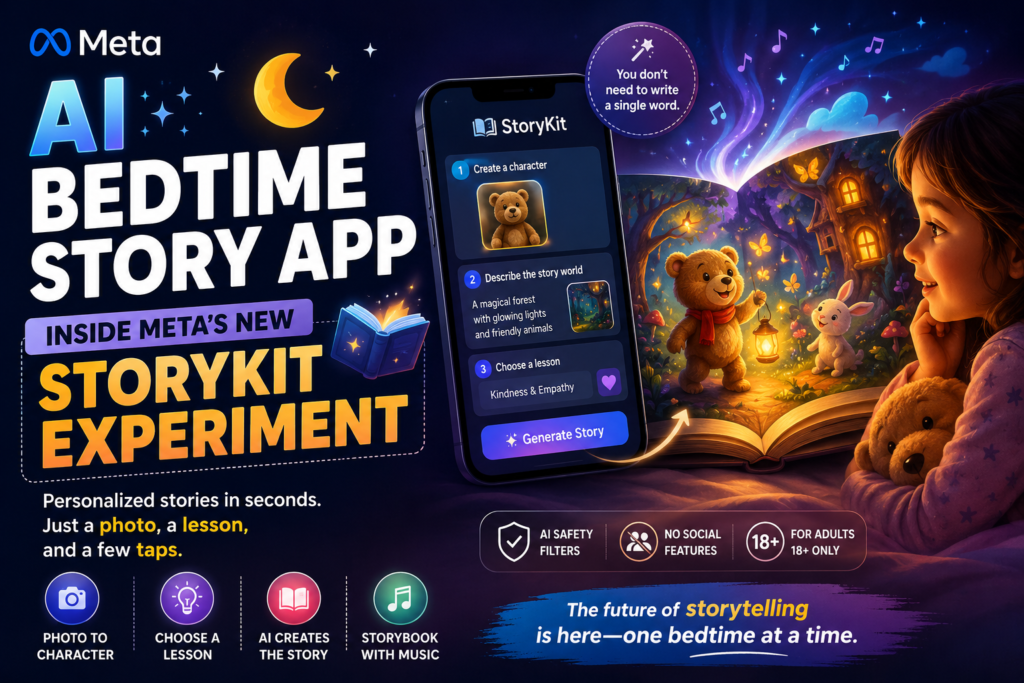
Meta is quietly testing an AI bedtime story app called StoryKit that writes personalized children’s stories in seconds, using nothing more than a photo, a chosen lesson, and a few taps. If you’ve been wondering whether generative AI is about to reshape the nightly ritual of reading — or making up — a story for a child, the short answer is: it’s already happening, and Meta wants in.
This isn’t a hypothetical. StoryKit is live in select markets right now, and it signals something bigger than one product launch: a shift toward outsourcing one of the oldest human traditions — storytelling — to a machine. In this article, we’ll break down exactly what Meta’s new app does, how it compares to traditional storytelling, whether it’s safe for families, and whether parents should actually consider adding it to their bedtime routine.
What Is Meta’s AI Bedtime Story App?
Meta’s new release, StoryKit, is a mobile application that generates custom children’s stories — complete with characters, settings, moral lessons, and background music — based on prompts a parent provides. <cite index=”1-53″>The app markets itself directly to parents with a simple pitch: “You don’t need to write a single word.”</cite>
Definition: What Makes an App Fall Into This Category?
Software in this space uses large language models and generative media tools to automatically produce narrative content designed to be read aloud to children at night. Instead of a parent inventing characters and plot on the spot, or reading from a printed book, StoryKit assembles a story algorithmically based on user inputs like character appearance, setting, and theme.
StoryKit fits squarely into this emerging category of personalized, AI-generated children’s stories. <cite index=”1-54″>The app was first spotted in the App Store by 9to5Mac</cite>, and <cite index=”1-55″>Meta confirmed to TechCrunch that it is piloting the tool in select countries to gauge how parents respond to it</cite>.
Key Facts About StoryKit at a Glance
| Detail | Information |
|---|---|
| Developer | Meta |
| App category | AI storytelling app for families |
| Minimum user age | 18+ (adults only can create accounts) |
| Social features | None |
| Content moderation | AI safety filters |
| Availability | Piloting in select countries |
| Core input | Photo of a toy or person, chosen setting, chosen lesson |
| Output | Personalized illustrated storybook with music |
<cite index=”1-56″>A Meta spokesperson described StoryKit as a creative storytelling app used to craft personalized, imaginative storybooks for children, noting that it uses AI safety filters, has no social features, and is only available to users over the age of 18</cite>.
How Does the AI Bedtime Story App Work?
Direct answer: Parents open the app, create a character from a photo, describe a story world, choose a moral lesson, and the tool generates a complete illustrated story automatically.
Here’s the step-by-step process, based on the app’s own description:
- Create a character. <cite index=”1-58″>Parents can create a character by snapping a photo of their child’s favorite toy or a person to “bring them to life” inside the story.</cite>
- Describe the story world. The parent types a short description of the setting — a jungle, outer space, an underwater kingdom, or anywhere else imaginable.
- Choose a lesson. <cite index=”1-59″>Parents select a value or lesson, allowing them to “weave in values like kindness, courage, or empathy without it feeling like a lecture.”</cite>
- Generate the story. The system compiles the inputs into a finished storybook, complete with music, without requiring the parent to write any of the narrative themselves.
This workflow is what separates a dedicated AI bedtime story app from a simple story-generator chatbot: StoryKit is purpose-built around a guided, low-effort input flow specifically for tired parents at the end of a long day.
Why Is Meta Building This Now?
Meta’s push into AI-generated children’s stories fits a broader pattern of the company experimenting aggressively — and sometimes controversially — with consumer-facing generative AI products. <cite index=”1-64″>Meta has previously shipped features like Instagram deepfake generators and AI-powered smart glasses that drew backlash for enabling covert, invasive photography.</cite>
Compared to those experiments, a personalized AI storytelling app is a relatively low-risk category: it targets a universal parenting need (getting a child to sleep), it avoids social sharing entirely, and it restricts account creation to adults. That combination suggests Meta is treating StoryKit as a controlled pilot rather than a flagship product — a way to test demand for AI-generated stories for kids without the reputational exposure of its riskier AI ventures.
It also reflects a larger industry trend. As generative models become cheap and fast enough to produce coherent, personalized, long-form content in real time, this type of app is becoming its own product category, not just a novelty prompt typed into a general-purpose chatbot. Expect competitors to follow Meta’s lead if the pilot shows strong parent engagement.
AI Bedtime Story App vs. Traditional Storytelling
How does an app like StoryKit actually compare to the traditional alternatives — reading a printed book or improvising a story yourself? Here’s a side-by-side breakdown.
| Factor | AI Bedtime Story App (e.g., StoryKit) | Traditional Storytelling |
|---|---|---|
| Effort required | Low — a few taps and a photo | Higher — requires reading or improvising |
| Personalization | High — character built from a real photo | Medium — parent can personalize verbally |
| Originality | Algorithmic, based on prompt patterns | Fully human-generated, often spontaneous |
| Parent-child bonding | Reduced — parent reads a pre-written script | High — direct verbal and emotional exchange |
| Consistency of quality | Predictable, formulaic | Variable, but often more emotionally resonant |
| Cost | App subscription or one-time fee | Free (with existing books) or $0 improvisation |
| Speed | Instant story generation | Depends on parent’s creativity and available time |
| Screen involvement | Requires a smartphone at bedtime | None required |
This comparison highlights the core trade-off: this type of app optimizes for speed and personalization, while traditional storytelling optimizes for connection and originality.
Pros and Cons of Using an AI Bedtime Story App
Before deciding whether to add one of these tools to your nightly routine, it helps to weigh the practical advantages against the trade-offs.
Potential advantages:
- Saves time for exhausted parents who don’t have the bandwidth to improvise a story every single night
- Offers high personalization by turning a child’s actual toy or a familiar person into a story character
- Lets parents select specific values or lessons to reinforce, such as kindness or courage
- Provides consistent, structured content without requiring any writing skill from the parent
- Includes built-in safety filters and restricts account creation to adults only
Potential drawbacks:
- Introduces a screen into a bedtime routine that many pediatric sleep experts recommend keeping screen-free
- Reduces opportunities for spontaneous, imaginative parent-child interaction
- Relies on formulaic, machine-generated narratives rather than original human storytelling
- Normalizes outsourcing creative and emotional labor to software at an early age
- May limit a child’s exposure to a parent’s unique voice, humor, and improvisational style
Is It Safe for Kids?
Direct answer: StoryKit itself cannot be used by children — only adults 18 and older can create accounts — and Meta says the app includes AI safety filters and no social features.
<cite index=”1-56″>Meta has stated that StoryKit uses AI safety filters, has no social features, and is restricted to users over the age of 18</cite>. In practice, this means a child does not interact directly with the AI system; a parent or guardian generates the story on their behalf, which mitigates many of the direct-interaction risks associated with AI chatbots and young users.
That said, “safe” in the account-access sense doesn’t fully address separate questions parents may have, such as:
- Whether machine-generated narratives model storytelling patterns as effectively as human-authored children’s books
- Whether nightly screen use for story generation conflicts with sleep hygiene guidance that recommends reduced pre-bed screen exposure
- How character images generated from real photos of a child’s toys or family members are stored and used by Meta going forward
Parents weighing an AI bedtime story app against these questions should treat Meta’s stated safety measures as a starting point, not a complete answer, before making the app a regular part of their routine.
The Bigger Trend: AI Storytelling Apps for Children
StoryKit isn’t happening in isolation. It’s part of a growing wave of AI storytelling tools built specifically for parents, following the same broader trend that has brought generative AI into writing, coding, design, and now bedtime routines. As models get better at producing coherent, personalized, long-form narrative content on demand, personalized AI stories for kids are shifting from a niche use case into a mainstream product category that major tech companies are willing to invest in.
This matters beyond StoryKit specifically. Whether or not Meta’s pilot succeeds, the underlying capability — instantly generating a personalized children’s story from a photo and a prompt — is now technically trivial to build. That means more companies, from small app developers to other major platforms, are likely to release competing tools in the near future, making this category worth understanding now rather than after it’s already ubiquitous in the parenting app market.
It’s also worth noting how this fits into the culture around AI and creativity more broadly. Storytelling has always drawn on shared traditions — myths, fables, and oral history passed down and reshaped by each new generation. An algorithm remixing prompt patterns into “new” stories raises a fair question about whether personalization is the same thing as imagination, or simply a faster, more convenient substitute for it.
What This Means for Children’s Publishing
Traditional children’s book publishers have historically competed on illustration quality, narrative voice, and the reputation of individual authors. Personalized AI stories for kids compete on a different axis entirely: speed, customization, and convenience. A printed book can’t insert a child’s actual toy as the main character in under a minute, and it can’t generate a brand-new adventure every single night on demand.
That doesn’t necessarily mean AI-generated children’s stories will replace printed books outright. More likely, families will use both — physical books for shared reading time and richer illustration, and an AI storytelling app for quick, highly personalized stories on busier nights. Publishers and toy companies are already watching this space closely, since character licensing and personalized merchandise could become natural extensions of apps like StoryKit.
Tips for Using These Tools Responsibly
If you do decide to try a personalized storytelling app with your family, a few practical habits can help keep the experience healthy:
- Treat it as an occasional tool, not a nightly default, so screen-free bedtime routines stay the norm
- Sit with your child while the story plays, rather than handing them the device
- Review generated stories before reading them aloud, especially the lesson or moral being reinforced
- Balance app-generated stories with printed books and your own improvised tales
- Periodically check the app’s privacy settings, especially around photos used to create characters
Should Parents Actually Use One?
This is ultimately a personal decision, and reasonable parents will land in different places. An AI bedtime story app can be a genuinely useful backup on nights when a parent is too exhausted to improvise, or when a child wants an endless supply of personalized adventures featuring their favorite stuffed animal. Used occasionally, it’s unlikely to cause any real harm.
The trade-off worth considering is what gets displaced. Bedtime has traditionally been one of the few unstructured, screen-free windows in a child’s day — a moment built on improvisation, silliness, and direct connection rather than polished output. Leaning on this kind of tool as a default, rather than an occasional backup, risks quietly replacing that moment of connection with a passive, algorithmically generated substitute. A reasonable middle ground many parents may land on: keep the app in reserve for genuinely depleted nights, and protect the rest of the week for the messier, more improvised version of storytelling that only a parent can offer.
Frequently Asked Questions
What is the name of Meta’s AI bedtime story app? Meta’s app is called StoryKit, and it is currently being piloted in select countries.
Can children use StoryKit directly? No. Only users 18 and older can create an account; a parent or guardian generates the story on the child’s behalf.
How does StoryKit personalize stories? Parents upload a photo of a favorite toy or person, describe a setting, and choose a lesson, and the app generates a story built around those inputs.
Does the app include music? Yes, StoryKit generates stories that include custom music along with the narrative and characters.
Is StoryKit available worldwide? Not yet. Meta confirmed it is piloting the app in select countries to evaluate parent reception before any wider rollout.
Are there social or sharing features in the app? No. Meta has stated the app has no social features, distinguishing it from many of Meta’s other consumer products.
Is this different from asking a general AI chatbot for a bedtime story? Yes. General chatbots require the parent to write and refine prompts manually, while a dedicated AI bedtime story app is built around a guided flow — photo, setting, lesson — specifically designed for quick, low-effort use at night.
Will other tech companies build similar apps? It’s likely. Because the underlying generative technology behind personalized, illustrated children’s stories is now widely available, smaller developers and larger platforms alike have strong incentive to launch competing products if StoryKit shows meaningful parent adoption during its pilot phase.
Does StoryKit replace reading physical books to children? Not necessarily. Most families are likely to use both — printed books for shared reading time and richer illustrations, and an app-generated story for quick, highly personalized content on nights when time or energy is limited.
Conclusion
Meta’s entry into this space with StoryKit represents a small but telling experiment in how far generative AI is being pushed into everyday family life. It’s designed to be fast, personalized, and low-effort — solving a real problem for exhausted parents — but it also raises a genuine question about what gets lost when one of humanity’s oldest traditions, telling a child a story, gets handed off to an algorithm. Whether StoryKit expands beyond its current pilot or fades into Meta’s long list of shelved experiments, the rise of the AI bedtime story app category is a trend worth watching closely.