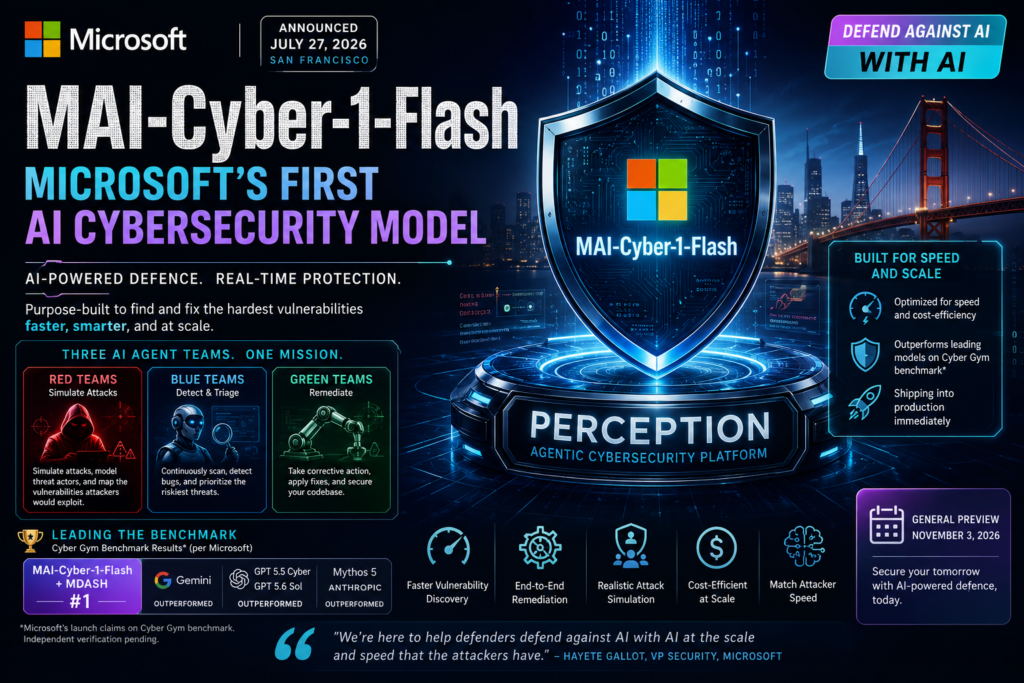
Microsoft has entered the AI security race with MAI-Cyber-1-Flash, its first purpose-built cybersecurity model, paired with a new agentic platform called Perception. Announced on July 27, 2026, at an event in San Francisco, the launch is a direct challenge to Anthropic, Google, and OpenAI in the fast-growing market for AI-driven cyber defense.
If you’re trying to understand what this new model actually does, how Perception fits around it, and how the pairing compares to rival offerings, this guide breaks it all down in plain language — no security jargon required.
What Is MAI-Cyber-1-Flash?
MAI-Cyber-1-Flash is Microsoft’s first cybersecurity-specialized AI model, engineered specifically to find hard-to-detect vulnerabilities in complex, real-world codebases. Unlike general-purpose large language models that treat security questions as just another prompt, this model is trained and tuned around one job: hunting down software flaws that would otherwise take human security researchers hours or days to uncover.
Microsoft describes it as being built “to find challenging vulnerabilities in complex codebases,” and it’s designed to work inside MDASH, the company’s dedicated harness for identifying and remediating software vulnerabilities. Think of the model as the engine, and MDASH as the chassis that lets that engine actually drive value inside an organization’s codebase.
Why “Flash” in the Name?
The “Flash” designation signals that Microsoft’s new cybersecurity model is optimized for speed and cost-efficiency, not just raw capability. Microsoft has positioned it as significantly more cost-effective than rival models while still outperforming them on benchmark testing — a combination that matters enormously for enterprises that need to run continuous, large-scale vulnerability scans without runaway compute bills.
Who Announced It, and Where?
The launch took place at a small event in San Francisco, where Mustafa Suleyman, the co-founder of DeepMind and current CEO of Microsoft AI, presented benchmark results directly comparing Microsoft’s system against competitors. “We’re very very excited to announce our results,” Suleyman said, adding that the combination of the new model and MDASH “beats out Gemini, GPT 5.5 Cyber, GPT 5.6 Sol, and Mythos 5” on what he called the industry’s primary cybersecurity benchmark. He also confirmed the system is “shipping into production immediately,” underscoring how fast Microsoft wants to move in this space.
How Does the Perception Platform Work?
Perception is Microsoft’s new agentic cybersecurity system, and it’s built to deploy coordinated teams of AI agents that automate core security workflows — from spotting a vulnerability to actually fixing it. Hayete Gallot, Microsoft’s vice president for security, framed the platform’s mission simply: it exists to help enterprise defenders “defend against AI with AI at the scale and speed that the attackers have.”
That framing matters. As offensive AI tools make it easier for attackers to probe systems around the clock, defenders have needed something that can match that pace. Perception is Microsoft’s answer, and its underlying cybersecurity model is the brain running much of the workflow beneath it.
Perception organizes its agents into three functional groups, each with a distinct job inside the broader security pipeline.
Red Teams: Simulating the Attack
Perception’s red teams behave like an always-on offensive security squad. They run detailed simulations of potential attacks, model likely threat actors, and map out the vulnerabilities those attackers would most plausibly exploit. This gives defenders a realistic picture of their exposure before a real adversary finds it first, effectively turning attack forecasting into a continuous background process rather than an occasional audit.
Blue Teams: Detecting and Triaging
Blue teams handle detection and triage. Rather than waiting for a human analyst to sift through alerts, these agents continuously scan for existing bugs and prioritize which ones pose the greatest risk — a task that traditionally consumes enormous amounts of analyst time and is prone to fatigue-driven oversight when done manually at scale.
Green Teams: Taking Corrective Action
Green teams close the loop by taking corrective action against confirmed issues. This is where Perception moves beyond detection into actual remediation, aligning with how Dave Weston, the platform’s lead engineer, described the shift: work that used to take “hours and hours of manual work from multiple specialized folks across the security organization” can now be compressed into minutes, complete with detection, posture fixes, and even code-level fixes.
MAI-Cyber-1-Flash vs. Competing AI Security Models
Microsoft’s central claim is that its new cybersecurity model, paired with GPT 5.4 inside the MDASH harness, outperforms rival models on Cyber Gym, which Suleyman called “the primary benchmark that we all use.” Here’s how the competitive landscape stacks up based on Microsoft’s own comparison at launch.
| Model / Platform | Company | Benchmark Standing (per Microsoft) | Delivery Model |
|---|---|---|---|
| MAI-Cyber-1-Flash + MDASH | Microsoft | Claimed top performer on Cyber Gym | Shipping into production immediately |
| Gemini | Cited as outperformed on Cyber Gym | General-purpose model | |
| GPT 5.5 Cyber / GPT 5.6 Sol | OpenAI | Cited as outperformed on Cyber Gym | Security-tuned variants |
| Mythos 5 | Anthropic | Cited as outperformed on Cyber Gym | Limited release via Glasswing program |
It’s worth noting these are Microsoft’s own benchmark claims made at launch, not independently verified third-party results — a normal caveat for any vendor announcement in a highly competitive field where every major lab has an incentive to present its own numbers favorably.
Why Microsoft Built an AI Cybersecurity Model Now
The timing isn’t accidental. As the original TechCrunch report notes, hackers are increasingly weaponizing AI in their own attacks, which has flipped the economics of cyber defense. Traditional, human-only security teams simply can’t match the speed of AI-assisted adversaries who can probe, adapt, and exploit weaknesses continuously. Microsoft’s bet with its new model and Perception is that only AI-versus-AI defense can close that gap in real time.
This also comes at a moment when rivals have already staked out ground in the same space:
- Anthropic launched Mythos earlier in 2026, a security platform released to a small group of partner organizations through a program called Glasswing.
- OpenAI launched its own security offering in May 2026 through a program called Daybreak.
- Google has its own AI security tooling built around Gemini, which Microsoft directly benchmarked against in its launch presentation.
Microsoft entering this field signals that AI-native cybersecurity is no longer a niche experiment — it’s becoming a core battleground among the major AI labs and hyperscalers, each racing to prove their models can outpace attackers rather than just react to them after the fact.
How MDASH Powers the Model
MDASH is the harness that gives Microsoft’s cybersecurity model its practical teeth. Rather than operating as a standalone chatbot-style tool, MAI-Cyber-1-Flash runs inside MDASH’s structured environment, which is specifically built for vulnerability identification and remediation across real codebases.
Definition: A “harness,” in this context, is the surrounding software infrastructure that gives an AI model the tools, context, and guardrails it needs to perform a specialized task reliably — in this case, scanning code, understanding its structure, and proposing fixes.
Expansion: This distinction matters because raw model capability alone rarely translates into safe, production-ready security work. MDASH gives the model the scaffolding to operate consistently across large, messy, real-world codebases rather than the clean, curated examples models are typically benchmarked on. Perception, in turn, integrates directly with MDASH, meaning organizations can move from vulnerability discovery to automated remediation without stitching together separate tools from different vendors — a workflow gap that has historically slowed down enterprise security teams.
Perception vs. Mythos and Daybreak
How does Perception compare to Anthropic’s Mythos and OpenAI’s Daybreak? All three are agentic AI security platforms launched in 2026, but they differ meaningfully in reach and rollout strategy.
Mythos, Anthropic’s offering, has so far been available only to a small coterie of partner organizations through the Glasswing program — a deliberately limited, controlled rollout designed to test the platform with trusted partners before wider release. Daybreak, OpenAI’s security platform, launched more broadly in May 2026, giving it a head start in general availability. Perception, by contrast, is positioned by Microsoft for wide enterprise availability, with the company stating the tools will enter preview on November 3, 2026.
The competitive distinction Microsoft is drawing isn’t just about model quality — it’s about who can operationalize agentic cybersecurity at enterprise scale fastest. By tying its cybersecurity model directly into Perception’s red, blue, and green team structure, Microsoft is betting on integration and speed of deployment as much as raw benchmark performance to win over enterprise security buyers.
What Enterprise Security Teams Should Watch For
Beyond the headline benchmark claims, a few practical factors will determine how much impact this launch actually has once organizations start testing it in production environments.
Independent Benchmark Verification
Microsoft’s Cyber Gym results are self-reported at this stage. Security teams evaluating any new AI cybersecurity model, including this one, should look for independent, third-party validation before making purchasing decisions based purely on vendor-supplied numbers.
Integration Complexity
Because Perception is designed to integrate with MDASH, organizations already invested in Microsoft’s security ecosystem may see a smoother rollout than those running a heavily mixed-vendor stack. Compatibility with existing tools will likely shape adoption speed as much as raw model performance.
Preview Timeline
With general preview access set for November 3, 2026, enterprises have a defined window to evaluate the platform before committing budget. Early access programs, if offered before that date, could give security teams a head start on testing red, blue, and green team workflows against their own codebases.
The Broader AI Cybersecurity Market in 2026
Microsoft’s launch doesn’t exist in isolation — it’s the latest move in a rapidly consolidating market where nearly every major AI lab now offers some form of security-focused product. What used to be a handful of niche startups building AI-assisted vulnerability scanners has, in the space of roughly a year, become a battleground for the biggest names in AI.
This shift reflects a broader reality in enterprise IT: security budgets are increasingly being redirected toward tools that can operate at machine speed rather than relying solely on human analysts working through alert queues. Boards and CISOs are asking a simple question — if attackers are already using AI to find weaknesses faster than ever, why would defenders continue to rely on manual processes alone?
That question is exactly what Microsoft, Anthropic, and OpenAI are each trying to answer with their respective platforms. The differences lie less in the underlying ambition — faster, smarter, more automated defense — and more in execution details: how controlled the rollout is, how deeply the platform integrates with existing developer and security tooling, and how transparent each company is willing to be about benchmark performance.
For Microsoft specifically, pairing a dedicated security model with an existing harness like MDASH gives it a structural advantage many rivals don’t have out of the gate: an installed base of enterprise customers already using Microsoft’s security ecosystem, from Defender to Sentinel to Azure-native tooling. Whether that installed base translates into faster adoption once the new platform reaches preview will be one of the more interesting stories to watch through the rest of 2026.
There’s also a talent and credibility dimension worth noting. Mustafa Suleyman, who co-founded DeepMind before taking the reins of Microsoft AI, brings a research pedigree that Microsoft is clearly leaning on to lend weight to its benchmark claims. Pairing that credibility with a concrete shipping date and a named enterprise-ready platform is a deliberate signal to the market: Microsoft doesn’t just want to compete in AI security research, it wants to own enterprise deployment at scale.
Key Benefits of Agentic Cybersecurity for Enterprises
Agentic platforms like Perception, powered by models purpose-built for security work, promise several practical advantages for security teams navigating an increasingly AI-driven threat landscape:
- Faster vulnerability discovery — automated scanning finds issues that would take human researchers far longer to locate manually.
- Reduced manual workload — routine triage, prioritization, and posture fixes shift from analysts to coordinated AI agents.
- End-to-end remediation — detection, prioritization, and code-level fixes happen within a single connected workflow rather than across disconnected tools.
- Realistic attack simulation — red team agents model plausible attacker behavior before real adversaries strike.
- Cost efficiency at scale — a “Flash”-tier design keeps continuous, large-scale scanning economically viable for large codebases.
- Matching attacker speed — agentic defense is built to operate at the same tempo as AI-assisted attacks, rather than lagging behind them.
Frequently Asked Questions
What is MAI-Cyber-1-Flash used for? It’s used to find and help remediate vulnerabilities in complex software codebases, operating inside Microsoft’s MDASH harness for automated security analysis.
Is MAI-Cyber-1-Flash available now? Microsoft said the new security tools, including Perception, will be available in preview starting November 3, 2026, though Suleyman indicated the underlying model is shipping into production immediately.
How does MAI-Cyber-1-Flash compare to Gemini and GPT security models? According to Microsoft’s own benchmark claims on Cyber Gym, the model combined with GPT 5.4 inside MDASH outperforms Gemini, GPT 5.5 Cyber, GPT 5.6 Sol, and Anthropic’s Mythos 5 — though these figures come from Microsoft’s own launch presentation rather than independent verification.
What is the Perception platform? Perception is Microsoft’s agentic cybersecurity system that deploys red, blue, and green AI agent teams to simulate attacks, detect and triage bugs, and take corrective remediation action, integrating directly with the MDASH harness.
How is Perception different from Anthropic’s Mythos and OpenAI’s Daybreak? Mythos has been limited to select partner organizations through Anthropic’s Glasswing program, Daybreak launched more broadly through OpenAI in May 2026, and Perception is aimed at wider enterprise preview availability starting in November 2026.
Who leads the Perception platform at Microsoft? Dave Weston is described as the lead engineer for Perception, while Hayete Gallot, Microsoft’s vice president for security, has been the platform’s public spokesperson on its defensive strategy.
What This Means for Enterprise Security Teams
The arrival of MAI-Cyber-1-Flash and Perception confirms that AI-native cybersecurity has moved from experimental pilots into full competitive rollout among the industry’s largest players. For enterprise security teams, the practical takeaway is that vulnerability detection, triage, and remediation are converging into a single AI-driven workflow rather than remaining separate, manually stitched processes handled by different teams and tools.
Whether Microsoft’s benchmark claims hold up once independently tested remains to be seen, but the launch — alongside Anthropic’s Mythos and OpenAI’s Daybreak — makes one thing clear: agentic, model-driven defense is quickly becoming the new baseline expectation for how organizations protect their codebases against AI-powered attackers. Security leaders evaluating vendors over the coming months would do well to track how MAI-Cyber-1-Flash performs once it moves from a controlled launch demo into real-world enterprise deployments starting this November.