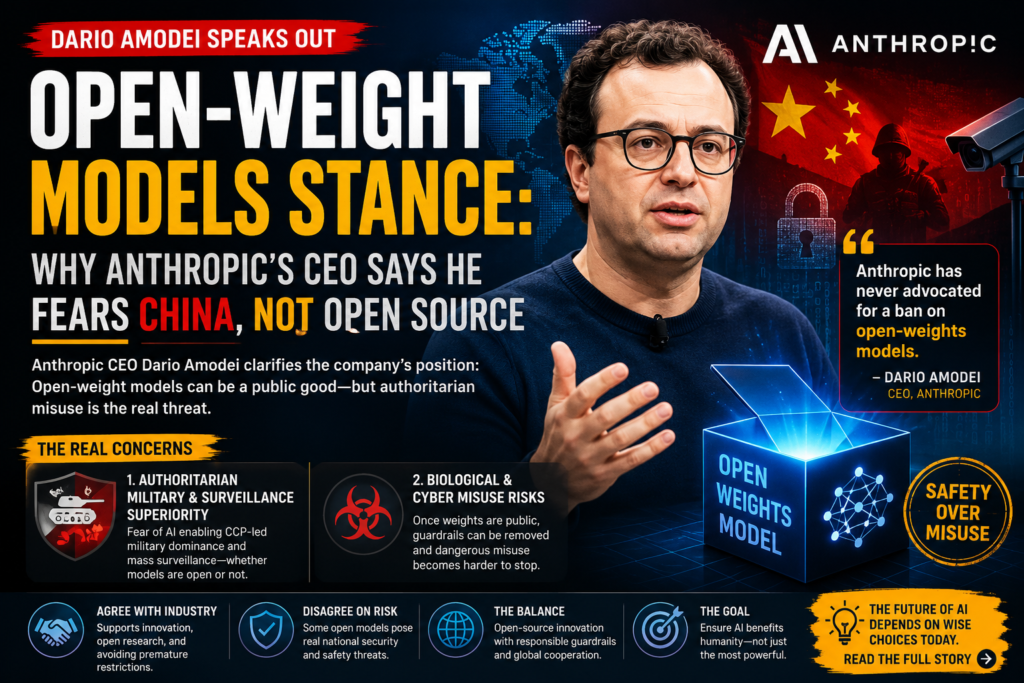
Dario Amodei’s open-weight models position is simple to state and easy to misread: Anthropic has never called for a ban on open-weights AI, but its CEO believes authoritarian governments — especially China’s — pose a far bigger threat than any open-source license ever could. On July 27, 2026, Amodei published a direct rebuttal to industry chatter suggesting Anthropic secretly wants open models banned, and the clarification reshapes how founders, policymakers, and AI builders should think about the open-weights debate heading into late 2026.
This piece breaks down exactly what Amodei said, why he said it now, how it compares to the Nvidia-backed industry letter, and what it means if you build, deploy, or write about open-weight AI systems.
What Triggered Dario Amodei’s Open-Weight Models Statement?
Amodei’s blog post, “Our position on open-weights models,” was a response to two converging pressures: reports that US officials were weighing restrictions on Chinese open-weight models, and public accusations that Anthropic was quietly lobbying for a broader open-source AI ban to protect its own commercial position.
The timeline matters:
- Mid-July 2026: Reports surfaced that US officials were considering banning the use of Chinese open-weights models by American companies.
- July 24, 2026: Nvidia CEO Jensen Huang shared an open letter — his first-ever post on X — signed by Nvidia, Hugging Face, Meta, Microsoft, Mistral, and others, urging policymakers to avoid “premature restrictions” on open-weight models generally.
- July 27, 2026: Amodei responded directly, stating in bold text that “Anthropic has never advocated for a ban on open-weights models.”
The Dario Amodei open-weight models clarification was, in effect, damage control against a narrative that had been building for days — one that painted Anthropic as anti-open-source rather than anti-authoritarian-misuse.
Why the Confusion Happened in the First Place
Anthropic has long been the most vocal Frontier lab about AI safety risk, and it has previously flagged concerns about distillation — where one AI model is bombarded with prompts to learn how a rival model works, effectively copying its capabilities cheaply. Because several Chinese labs release open-weight models built partly through distillation of Western systems, critics conflated Anthropic’s concern about distillation and authoritarian misuse with a blanket objection to openness itself. Amodei’s post exists specifically to separate those two ideas.
Does Anthropic Support Open-Weight AI Models?
Yes — with conditions. Amodei explicitly calls open-weights models “a public good” when they lack dangerous capabilities, noting they cost nothing beyond compute and provide real value to businesses, developers, and researchers. This is a notably pro-open-source framing from a company frequently cast as the industry’s safety hawk.
Direct answer: Anthropic does not oppose open-weight models as a category. It opposes specific downstream risks — authoritarian military superiority, mass surveillance, and unmonitored biological or cyber misuse — that it believes certain actors could exploit regardless of a model’s license.
The Two Nightmare Scenarios Behind Amodei’s Concerns
Amodei’s essay grounds the entire open-weights debate in two distinct fears, both of which he says he has held consistently for years, referencing his earlier essay “The Adolescence of Technology.”
Scenario One: Authoritarian Military and Surveillance Superiority
Amodei’s primary concern isn’t open licensing — it’s that authoritarian governments, with the CCP as the most capable example, could build AI systems more powerful than anything in the US and use them for permanent military dominance or domestic repression. He points out this concern is shared inside the US government, citing warnings from Vice President Vance and the Intelligence Community’s 2026 Annual Threat Assessment about foreign AI progress challenging US economic and security advantages.
Critically, Amodei argues this risk exists whether or not the resulting models are ever released with open weights. A model trained in secret and handed directly to a military or intelligence agency, he notes, could be more dangerous than any public open-weight release.
Scenario Two: Biological and Cyber Misuse via Open Models
The secondary concern is more technical: powerful models — regardless of country of origin — are harder to safeguard once released as open weights, because guardrails can be stripped and usage can’t be monitored. Amodei cites a UK AI Security Institute report warning that once weights are public, “these options are lost permanently.”
He’s particularly focused on biological risk, arguing that AI could eventually let capable models weaponize dangerous pathogens faster than defenders can respond, pointing to the multi-year timeline of an effort like Operation Warp Speed as a benchmark for how slow real-world defense actually is.
Dario Amodei vs. the Nvidia-Backed Open Letter: Where They Agree and Disagree
The open-weights debate isn’t a simple two-sided fight — Amodei agrees with large parts of the industry letter Nvidia circulated. The disagreement is narrower and more specific than headlines suggested.
| Point of Comparison | Nvidia-Backed Open Letter | Dario Amodei / Anthropic Position |
|---|---|---|
| Open-weight models as a category | Should not face broad, premature restrictions | Agrees — calls them “a public good” when not dangerous |
| Do open models help defenders more than attackers? | Generally yes, broad access strengthens defense | Disputes this — believes the opposite may be true, especially in biology |
| Chip export controls to China | Not a central focus of the letter | Strongly supports restricting powerful chips and chipmaking equipment |
| Distillation by Chinese labs | Not specifically addressed | Wants a formal crackdown on industrial-scale distillation |
| Mandatory safety testing | Not the letter’s core ask | Explicitly supports global, mandatory testing for capable models, open or closed |
| Chinese AI specifically | Letter doesn’t name China | Names CCP as the “most capable” authoritarian threat |
This comparison shows the real fault line: it’s not “open vs. closed,” it’s whether open access inherently favors defenders — a claim Amodei directly challenges based on the asymmetry he sees in biological risk.
What Policy Actions Does Amodei Actually Support?
Instead of a ban, the Dario Amodei open-weight models framework rests on three concrete policy proposals he says Anthropic has “consistently advocated for”:
- Restrict chip exports to China. Amodei argues China’s limited domestic chip production capacity means blocking access to powerful chips and chipmaking equipment is the most direct way to prevent authoritarian actors from training frontier-level models, citing scaling laws as the underlying reason chips — not open weights — are the real bottleneck.
- Crack down on industrial-scale distillation. Because distillation lets a country build stronger models with fewer chips than training from scratch would require, Amodei wants targeted policy interventions against operations that systematically extract capability from Western frontier models, while noting Anthropic already bans accounts caught doing this.
- Require mandatory global safety testing for capable models. Amodei wants pre-release testing for cyber, biological, and alignment risks applied to all sufficiently capable systems — open or closed, regardless of country of origin — while exempting smaller models from startups and academia. He argues this needs to be global, meaning China would need to participate too, and believes limited cooperation on biological weapons prevention may actually be achievable because it serves China’s interests as well.
None of these three measures involves banning open-weight models. That distinction is the entire point of Amodei’s post.
Why This Matters for AI Builders, Founders, and Policy Watchers
If you build products on open-weight models, evaluate vendors, or track AI policy for your organization, the practical takeaways from Dario Amodei’s open-weight models statement go beyond the headline.
For Developers and Startups Using Open Models
Nothing in Amodei’s position threatens your ability to use open-weight models today. His concerns target industrial-scale, state-backed distillation operations and frontier-capability systems — not the long tail of startups, researchers, and developers building on existing open releases. In fact, his framework explicitly proposes exempting smaller models from mandatory testing requirements.
For Policy Teams and Compliance Functions
Expect the real regulatory action to center on chip export enforcement and safety-testing frameworks rather than blanket open-source restrictions. Anthropic’s stated preference for global, standardized testing — potentially including Chinese participation — signals where near-term policy proposals are likely headed, especially given reported alignment with recent Trump administration moves in this direction.
For Journalists and Content Strategists Covering AI Policy
The story is frequently mischaracterized as “Anthropic vs. open source.” The more accurate framing, grounded directly in Amodei’s own words, is “Anthropic vs. unmonitored authoritarian capability” — a distinction that changes how the debate should be reported and discussed.
Frequently Asked Questions
Has Anthropic ever called for banning open-weight AI models?
No. Amodei stated explicitly, with his own emphasis, that “Anthropic has never advocated for a ban on open-weights models,” directly refuting accusations that circulated after the Nvidia-backed open letter was published.
Why does Dario Amodei think open-weight models are risky?
He believes risk comes from two sources unrelated to licensing itself: authoritarian governments building superior military and surveillance AI, and the difficulty of applying safety guardrails or monitoring usage once any model’s weights are publicly released, regardless of who published them.
What does Amodei propose instead of a ban?
Three measures: restricting powerful chip exports to China, cracking down on industrial-scale distillation operations, and requiring mandatory global safety testing for all sufficiently capable models — open or closed.
Does Amodei’s position apply only to Chinese open-weight models?
No. His biological and cyber misuse concerns apply to open-weight models regardless of country of origin. His concern about authoritarian military superiority is broader than China too, though he identifies the CCP as the most capable current threat.
How does this compare to the industry letter Nvidia shared?
Amodei agrees with much of the letter’s pro-open-access stance but disputes its core defender-favoring assumption, arguing that in domains like biology, open access could favor attackers more than defenders — a question he says should be settled through rigorous testing, not assumed.
Key Takeaways
Dario Amodei’s open-weight models clarification reframes a debate that had drifted toward a simplistic “Anthropic wants a ban” narrative. His actual position is more nuanced: open models are a public good worth protecting, the real threats are authoritarian misuse and unmonitored dangerous capability, and the right response is chip controls, anti-distillation policy, and global mandatory safety testing — not prohibition. For anyone building on, investing in, or regulating open-weight AI, that distinction is the one worth remembering.