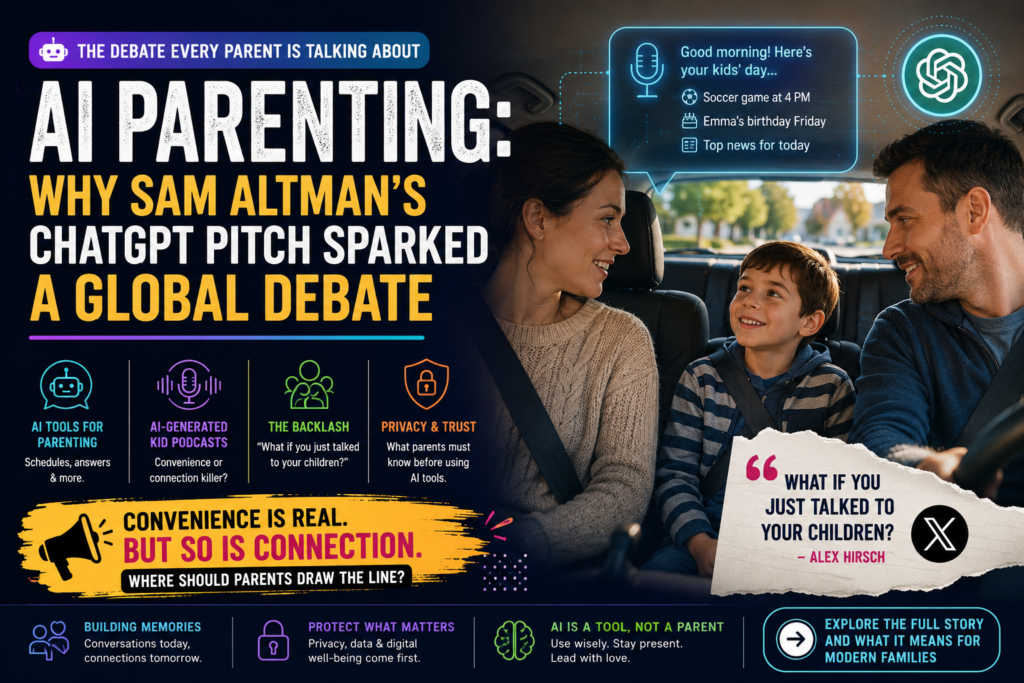
AI parenting means using artificial intelligence tools like ChatGPT to help manage childcare logistics, generate content for kids, and answer parenting questions on demand. The concept exploded into mainstream debate on August 1, 2026, when OpenAI CEO Sam Altman suggested parents use ChatGPT to auto-generate a daily “kid podcast” for the school commute and the internet pushed back hard.
Within hours, Altman’s post was overshadowed by a single six-word reply that captured a much bigger question: is letting a chatbot narrate your child’s day a genuine convenience, or a warning sign about how disconnected family life is becoming? This piece breaks down exactly what happened, why the backlash outpaced the pitch, and what parents should actually know before adopting AI parenting tools of their own.
What Is AI Parenting?
AI parenting refers to the growing practice of folding AI chatbots and assistants into the daily work of raising children from answering late-night questions about a feverish toddler to organizing school calendars, tracking extracurricular activities, and generating personalized content for kids to consume.
Unlike traditional family-organization apps that simply store data calendars, contact lists, reminders this newer wave of childcare software actively generates and personalizes content. A scheduling app tells you your child has a soccer game at 4 p.m. A generative AI assistant can turn that fact into a conversational summary, a bedtime story, or, as Altman proposed, a custom morning podcast that blends the game, an upcoming birthday, and the day’s news into one narrated segment.
That distinction matters. It moves artificial intelligence from a passive record-keeping role into an active, even narrative, role inside family life. And it’s precisely that shift content generation standing in for a parent’s own voice that triggered the controversy now playing out across social media.
The Sam Altman ChatGPT Controversy: What Happened
The “Cool Use Case” That Backfired
On Friday, August 1, 2026, Altman posted what he called a “cool use case” for ChatGPT Work, OpenAI’s newer product aimed at organizing daily life beyond the office. He described a workflow where parents connect family calendars and share their kids’ interests with the assistant. Every morning, ChatGPT would then generate a podcast for the school drive covering one child’s soccer game that afternoon, another child’s upcoming birthday, and a bit of general news.
The pitch was meant to showcase a practical, everyday application of generative AI in the home the kind of quiet convenience OpenAI hopes will make ChatGPT indispensable to households, not just offices. Instead, it landed as tone-deaf to a large slice of his audience, who read it as a tech billionaire proposing to automate one of the few unstructured, conversational windows parents get with their kids each day.
Why Alex Hirsch’s Reply Beat Altman’s Post
The backlash crystallized around a single reply from Alex Hirsch, creator of the animated series “Gravity Falls,” who asked simply: “What if you just talked to your children?”
The engagement numbers tell the story of how badly the pitch missed its mark. Altman’s original post picked up roughly 300 reposts and 9,600 likes. Hirsch’s reply, by contrast, was reposted around 9,000 times and liked approximately 122,000 times more than twelve times Altman’s total engagement. That mismatch turned what might have been a minor product anecdote into a broader referendum on how far AI should reach into family routines, with critics arguing that outsourcing the morning conversation to a chatbot undercuts the very connection parenting is supposed to build in the first place.
OpenAI President Greg Brockman appeared to echo some of that discomfort the following day, noting in a separate post that employees dislike being asked things by ChatGPT, even tasks they’d happily do if a human colleague asked instead. He framed it as evidence that people want AI to give time back to relationships, not insert itself as a layer separating people from each other a sentiment that lines up closely with what Hirsch’s viral reply was getting at.
Why AI Parenting Is Gaining Ground Despite the Backlash
OpenAI’s Broader Push Into Family Life
The viral moment didn’t happen in isolation. It’s part of a deliberate company strategy: OpenAI has been actively recruiting for a product manager role focused on building trust-sensitive consumer experiences specifically for parents and families, signaling that family-oriented features are a long-term priority rather than a one-off idea floated on social media.
This also fits a pattern for Altman personally. He’s talked about using ChatGPT as a parenting aid before, including a widely circulated late-night TV appearance where he said he couldn’t imagine navigating a newborn’s early months without it while also acknowledging that generations of parents managed perfectly well without any of it. Reporting has also described Altman consulting the chatbot “constantly” after his son’s birth, on questions ranging from baby behavior to developmental milestones and sleep routines, valuing the fast, conversational answers over sifting through traditional search results.
He’s not alone among tech executives in this framing, either. Microsoft CEO Satya Nadella has previously described swapping his favorite podcasts for AI chatbot conversations during his own commute, suggesting a broader industry instinct to position AI as a buffer against unstructured, unscripted moments in daily life whether that’s a solo commute or a car ride with your kids.
What Parents Actually Say About These Tools
Not every parent is rolling their eyes at the idea. Some describe real relief from using AI agents to juggle household logistics. One mother of two told Business Insider she relies on an AI agent to manage work calendars, school schedules, activities, birthdays, and childcare logistics a load she and her full-time-working husband found overwhelming to coordinate manually.
That’s the practical core of the pitch that Altman was gesturing at: it’s less about replacing conversation and more about offloading the administrative weight of running a household. The controversy erupted because his specific example blurred that line, suggesting AI-generated content not just AI-managed logistics as a substitute for a parent’s own voice during a formative daily ritual like the drive to school.
The Risks Behind These Tools
Safety Features vs. Ongoing Lawsuits
Bringing AI into the parenting equation isn’t just a debate about convenience versus connection it comes with real safety stakes attached. OpenAI has rolled out parental control features that let parents link accounts with their teens, monitor activity, and receive alerts when the system detects a teen in a moment of acute distress.
At the same time, the company is facing multiple lawsuits from families alleging that ChatGPT played a role in relatives’ delusions and suicides, including a widely reported case involving a 16-year-old whose parents allege the chatbot cultivated an intimate relationship with their son over several months before providing harmful guidance during a mental health crisis. OpenAI has said it is “continuously improving how our models respond in sensitive interactions.”
This tension marketing a family-friendly assistant on one hand while defending against claims that the same technology contributed to tragedy on the other is the uncomfortable backdrop against which Altman’s “cool use case” landed so poorly with critics already primed to be skeptical.
Regulation Is Racing to Catch Up
Lawmakers and advocacy groups are also wrestling with how much AI should be allowed to shape childhood. Digital rights groups have pushed back on legislation that would impose a single, government-mandated model of acceptable chatbot behavior around minors, arguing that flexibility for individual families matters as much as baseline safety rules. Meanwhile, several major AI platforms including Anthropic’s Claude currently restrict use by anyone under 18 entirely, underscoring how unsettled the rules around AI and children still are across the industry.
This regulatory patchwork puts parents in an odd position: the tools are already being marketed directly to them, but the guardrails around age limits, content moderation, and data handling for minors are still being written in real time, often in response to individual lawsuits and viral incidents rather than a coordinated industry standard. Until that settles, the responsibility for vetting any given tool largely falls back on the household using it, which is exactly why understanding both the benefits and the failure modes matters more than following any single executive’s enthusiasm.
Data Privacy: The Overlooked Part of the Debate
Most of the public conversation around Altman’s post focused on emotional connection, but there’s a quieter concern running underneath it: what happens to the family data these tools collect. The workflow Altman described requires parents to connect calendars, share each child’s interests, and let the assistant continuously ingest details about school schedules, birthdays, and daily activities.
That’s a meaningfully larger data footprint than a typical scheduling app. A few questions worth asking before linking a family calendar to any generative assistant include:
- Where is the data stored, and for how long? Look for clear retention policies rather than vague assurances.
- Can the data be deleted on request? Family details tied to minors deserve an easy, verifiable deletion path.
- Is the content used to train future models? Some platforms allow opting out of having conversations used for model improvement check the settings rather than assuming a default.
- Who else can access the generated content? If a podcast or summary is shared across devices or household members, confirm who actually has visibility into it.
None of this means households should avoid AI tools entirely. It does mean that convenience features involving children’s schedules and personal details warrant the same scrutiny parents already apply to other apps and services aimed at families.
How This Fits a Bigger Pattern in Tech
Altman’s podcast pitch is also a useful case study in how AI companies test the limits of consumer comfort. Executives frequently float small, personal use cases publicly to gauge reaction before building them into flagship features and the response to this one was unusually clear. It wasn’t a debate over cost, accuracy, or reliability; it was a values disagreement about what technology should and shouldn’t touch.
That distinction is worth remembering the next time a tech leader proposes automating another slice of daily family life. Some automation, like syncing calendars or flagging schedule conflicts, tends to draw little objection because it removes friction without removing anyone’s voice from the room. Other automation, like generating the content that fills a child’s ears during what might otherwise be a conversation, draws exactly the kind of reaction Altman got because it doesn’t just save time, it replaces an interaction.
AI Parenting Tools vs. Traditional Parenting Resources
| Factor | AI Parenting Tools | Traditional Parenting Resources |
| Availability | 24/7, instant responses | Limited to office hours, appointments, or in-person time |
| Personalization | Adapts content to calendars, interests, and daily routines | Generic advice from books, forums, or pediatricians |
| Emotional connection | None output is generated, not felt | Direct human interaction and empathy |
| Cost | Often subscription-based, generally lower than professional services | Can include therapist, tutor, or consultant fees |
| Risk profile | Data privacy concerns; potential for inaccurate or harmful guidance | Regulated by professional standards and licensing |
| Best use case | Logistics, scheduling, quick informational queries | Emotional support, complex health or behavioral concerns |
How to Use These Tools Responsibly
Parents experimenting with these tools can capture genuine time-saving benefits while limiting risk by following a few practical guardrails:
- Use AI for logistics, not intimacy. Let the assistant handle calendars, reminders, and schedule conflicts reserve real conversation for emotional check-ins and daily connection with your kids.
- Review parental control settings. Activate account linking, distress alerts, and content filters offered by platforms like ChatGPT before letting children interact with the tool directly.
- Treat AI-generated content as a supplement, not a substitute. A generated podcast or summary can spark discussion, but it shouldn’t replace a parent’s own voice in a child’s daily routine.
- Stay informed on evolving safety policies. Follow news coverage of lawsuits and safety features tied to major chatbot platforms, since protections for minors are still changing rapidly.
- Talk to your kids about the tools you use. Transparency about when and why you’re using AI in the household models healthy tech habits for children who will grow up alongside this technology.
Frequently Asked Questions
What is AI parenting? AI parenting is the use of AI chatbots and assistants like ChatGPT to help manage childcare logistics, generate personalized content for kids, and answer parenting questions in real time.
What did Sam Altman say about ChatGPT and parenting? Altman suggested parents connect family calendars and their kids’ interests to ChatGPT Work so it could generate a daily podcast for the school commute, covering activities, birthdays, and news relevant to each child.
Why did Sam Altman’s post go viral for the wrong reasons? A reply from “Gravity Falls” creator Alex Hirsch “What if you just talked to your children?” received far more engagement than Altman’s original post, turning the moment into a broader critique of using generated content in place of human connection.
Is ChatGPT safe for use around children? OpenAI has added parental controls, including account linking and distress alerts, but the company also faces lawsuits alleging its chatbot contributed to harmful outcomes for some teen users, so caution and active supervision remain essential.
Should parents lean on these tools every day? Many parents already use them daily for scheduling and logistics support, but critics and safety advocates generally agree the technology works best as a supplement to not a replacement for direct parent-child conversation and attention. Child development specialists have long emphasized that unstructured talk time, including the seemingly mundane chatter of a school commute, plays a meaningful role in a child’s language development and emotional security, which is part of why Hirsch’s reply resonated with so many people who saw the podcast idea as skipping over something valuable rather than optimizing it.
Are other tech leaders promoting similar AI habits? Yes. Microsoft CEO Satya Nadella has described replacing podcast listening with AI chatbot conversations during his commute, and OpenAI’s own president has publicly reflected on people’s discomfort with AI inserting itself between human relationships suggesting the debate extends well beyond one company or one post.
The Bottom Line
The backlash to Sam Altman’s ChatGPT pitch wasn’t really about one podcast feature it was a public gut-check on how far AI parenting should go. Logistics and scheduling support have clear, low-risk value for overstretched households juggling calendars, activities, and full-time jobs. But when the same technology starts generating the content that fills the very moments meant for parent-child conversation, the reaction suggests most people still want a human voice in the driver’s seat, not an algorithm literally and figuratively. As OpenAI and its rivals keep building deeper into family life, that tension between convenience and connection isn’t going away anytime soon.