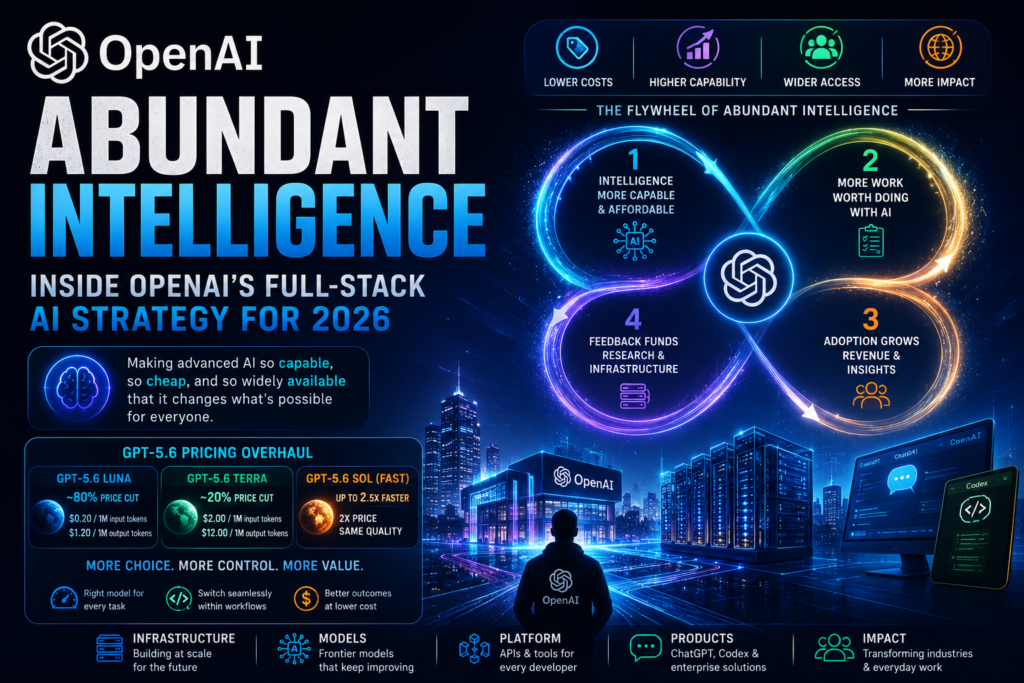
If you’ve been wondering why OpenAI keeps cutting prices while pushing model capability higher, the answer is a single strategic idea: abundant intelligence. In simple terms, it is OpenAI’s plan to make advanced AI so capable, so cheap, and so widely available that it changes what kinds of work are worth doing at all , for individuals, businesses, and entire industries.
This isn’t just a slogan. It’s a full-stack strategy that connects infrastructure, model research, product design, and pricing into a single feedback loop, and it has quietly become the organizing logic behind almost every major OpenAI announcement in 2026 , from GPT-5.6’s pricing overhaul to its infrastructure buildout to the way ChatGPT and Codex are positioned for enterprise work.
For founders, developers, and marketers watching this space , including teams here in India building on top of frontier models , understanding this strategy matters for a practical reason: it tells you where AI pricing, capability, and access are headed next, and how to plan your own product or content roadmap around that trajectory. In this article, we’ll break down what abundant intelligence actually means, how OpenAI is executing on it through GPT-5.6, what the underlying numbers reveal, and why the strategy matters for anyone building on AI in 2026.
What Is Abundant Intelligence?
Abundant intelligence is the idea that as the cost of useful AI output falls and model capability rises at the same time, more tasks become economically worth automating , which in turn generates more revenue, more usage data, and more capital to reinvest in the next generation of models and infrastructure.
Think of it as a flywheel with four stages:
- Intelligence becomes more capable and more affordable.
- More real-world work becomes worth doing with AI.
- Adoption grows, generating revenue and usage feedback.
- That feedback funds further research and infrastructure , which restarts the cycle at a higher level of capability.
OpenAI’s own framing, laid out by CFO Sarah Friar in a company update, treats this concept as the throughline connecting its mission (ensuring AI benefits all of humanity) with its commercial engine. The goal isn’t simply to build bigger data centers or bigger models , it’s to make useful intelligence more within reach for more people, faster than the cost of delivering it rises.
It’s worth pausing on why this framing is different from how the AI industry has typically talked about progress. For much of the last few years, the public conversation centered almost entirely on raw capability , which model scored highest on which benchmark, which lab shipped the largest parameter count. OpenAI’s newer framing shifts the conversation toward access: capability only matters if it’s cheap enough, fast enough, and reliable enough for someone to actually use it to get real work done. That shift in emphasis, from “how smart” to “how usable,” is really what sits underneath this entire strategy.
Why “Abundant” and Not Just “Cheap”
A lower price alone doesn’t create this kind of abundance. What matters is the combination of falling cost and rising capability, applied to real outcomes. A model that’s cheap but unreliable doesn’t expand what’s possible , it just shifts the burden of retries and corrections onto the user. This concept only shows up in practice when both variables move in the customer’s favor at once: capability climbing while cost falls, not one traded off against the other.
This is also why price cuts alone shouldn’t be read as a sign of commoditization. A model can get dramatically cheaper and still represent a meaningful jump in what customers can accomplish with it , and that combination is precisely the signal OpenAI is trying to send with its GPT-5.6 pricing changes.
The Economics Behind OpenAI’s Abundant Intelligence Strategy
This strategy rests on a simple economic reframe: stop measuring AI value by the price of a token, and start measuring it by the cost of a successful outcome. It’s a subtle shift, but it changes how a developer or business should actually evaluate which model to use for a given task.
GPT-5.6 Pricing Cuts Explained
OpenAI recently restructured pricing across its GPT-5.6 model family to make this point concrete:
- GPT-5.6 Luna , price cut by roughly 80%, now priced near $0.20 per million input tokens and $1.20 per million output tokens.
- GPT-5.6 Terra , price cut by roughly 20%, now priced near $2 per million input tokens and $12 per million output tokens.
- GPT-5.6 Sol (Fast mode) , runs up to 2.5x faster than standard processing at double the price, with no change in output quality.
These changes aren’t cosmetic. They’re designed to expand the range of tasks that make economic sense to automate, while giving developers direct control over the tradeoff between speed, cost, and capability within the same workflow , sometimes switching multiple times inside a single task.
Consider what an 80% price cut on Luna actually unlocks. At the old price, a high-volume use case , say, classifying thousands of support tickets a day, or generating first-draft product descriptions at scale , might have been marginal or unprofitable. At the new price, that same workload can run continuously, at scale, without the unit economics working against the business. That’s the mechanism by which cheaper intelligence expands demand rather than simply shrinking margins: it pulls previously uneconomical work across the line into “worth doing.”
The Fast mode option on Sol tells a related but different story. Here, the price actually goes up , customers pay double for 2.5x the speed , but capability stays constant. This matters because it shows the strategy isn’t only about making things cheaper. It’s about giving customers granular control over which lever to pull: some tasks are cost-sensitive and tolerate latency; others are latency-sensitive and can absorb a cost premium. A single support workflow might use a low-cost model for routine ticket triage and switch to Fast mode the moment a customer is actively waiting on a live chat response.
Cost-Per-Outcome vs. Cost-Per-Token
Here’s the core question OpenAI wants developers and businesses to ask: not “which model is cheapest per token,” but “which model delivers the successful outcome for the lowest total cost, including retries, oversight, and human correction?”
| Approach | What It Measures | Risk of Misjudging Value |
| Cost-per-token | Raw API price for input/output tokens | Cheap models can cost more overall if they need repeated attempts or heavy human review |
| Cost-per-outcome | Total cost to reach a correct, usable result | Requires tracking retries, oversight time, and error rates , harder to measure, but far more accurate |
A stronger, pricier model that solves a problem correctly on the first attempt can be cheaper in practice than a discount model that needs three retries and a human review pass. This is the economic logic underpinning OpenAI’s strategy: apply the maximum useful intelligence at the right price for the outcome required, not the cheapest option available on paper.
For teams evaluating which model tier to build on, this reframe suggests a fairly practical checklist:
- Estimate the retry rate. How often does the cheaper model produce output that a human has to redo or heavily edit?
- Price the human time. Oversight and correction time is a real cost, even if it never shows up on an API invoice.
- Test at the task level, not the account level. The right model can , and often should , differ from one workflow to the next inside the same product.
- Re-test after every pricing change. As token prices fall, the breakeven point between “use the stronger model” and “use the cheaper model” shifts too.
How OpenAI Extracts More Value From Every Unit of Compute
This kind of abundance doesn’t come from data centers alone , it comes from making every unit of compute do more work. OpenAI has been explicit that this requires engineering gains at the software and systems layer, not just hardware scale.
Engineering Gains: Serving Costs and Speculative Decoding
In recent internal engineering work, OpenAI used GPT-5.6 Sol itself to help optimize the production software that serves its models. The results:
- End-to-end serving costs reduced by roughly 20%
- Speculative decoding improvements that increased token-generation efficiency by more than 15%
This is a notable detail: the model is now participating in the optimization of its own infrastructure, compounding gains across generations. It’s a small but telling example of the flywheel in action , a more capable model helps engineer a more efficient system, and that more efficient system in turn makes the next model cheaper to serve.
The ARC-AGI-3 Benchmark Case Study
Efficiency isn’t only about the model itself , the surrounding system matters just as much. OpenAI’s own benchmark analysis showed that improvements to context management and retained reasoning lifted GPT-5.6 Sol’s score on the public ARC-AGI-3 task set from 13.3% to 38.3%, while using six times fewer output tokens. The underlying model weights didn’t change , the system architecture around the model did.
That’s a striking pair of numbers to sit with: nearly triple the benchmark score, at one-sixth the token cost, from software changes alone. It’s a reminder that “which model” is often the wrong question to ask when troubleshooting an underperforming AI workflow. Just as often, the bottleneck is in how context is passed to the model, how much irrelevant information it’s forced to re-process on every call, or how many redundant steps a poorly designed agent loop introduces.
This case study is central to the broader argument here: capability gains increasingly come from smarter routing, better context management, and more efficient tooling, not just larger models. For developers building agentic products, that’s an actionable insight , investing in context management and tool design can sometimes deliver bigger performance gains than upgrading to a more expensive model tier.
Why the Full Stack Matters
This strategy depends on owning , or at least coordinating , every layer of the stack: infrastructure, models, platform, and products, because each layer strengthens the others.
| Layer | Role in the Feedback Loop |
| Infrastructure | Provides the raw compute capacity, planned years ahead of demand |
| Models | Convert compute into usable intelligence and capability gains |
| Platform/API | Distributes that intelligence to developers and enterprises at scale |
| Products (ChatGPT, Codex) | Surface real-world usage patterns and friction points that guide research |
Real-world product usage reveals where customers find value and where they hit friction. That feedback shapes research priorities. Research improvements strengthen products and lower the cost of serving them. Demand signals across ChatGPT, ChatGPT Work, Codex, and the API inform where OpenAI adds infrastructure capacity next.
Importantly, OpenAI doesn’t insist on owning every asset in this stack , the company has said it will own, partner, or buy depending on what best serves the customer and the economics involved. What matters most is coordinating the learning loop across the whole system, not vertical ownership for its own sake.
This distinction is worth underlining because it’s often missed in coverage of AI infrastructure spending. The headline-grabbing number is usually the size of a data center commitment or a chip purchase. But the strategic value OpenAI is describing isn’t the size of any single investment , it’s the speed and fidelity of the feedback loop connecting usage data to research priorities to infrastructure decisions. A company could theoretically spend the same amount on compute and get far less value from it if that feedback loop is slow, siloed, or disconnected from real product usage.
Scale of Adoption , By the Numbers
This flywheel is already visible in OpenAI’s usage data:
- Over 1 billion active users across OpenAI’s products
- More than 2 million businesses using OpenAI’s tools
- Users send roughly 50% more messages per day, six months after signing up
- Users apply ChatGPT to roughly twice as many kinds of tasks after six months of use
- 99.8% of weekly output tokens inside OpenAI’s own engineering work now come from agentic tools like Codex
- ChatGPT Work is shifting usage patterns from “asking” questions to “doing” complex, multistep work
Inside individual companies, adoption tends to follow a similar pattern: a single team or workflow starts using AI, and as quality and economics improve, usage spreads across the organization until AI becomes embedded in how the business operates.
The most telling number in that list may be the 99.8% figure for agentic output inside OpenAI’s own engineering work. That’s not a customer-facing metric , it’s a description of how the company itself now works internally, with agentic tools like Codex handling the overwhelming majority of weekly output tokens across teams, including functions like Finance that historically had little to do with software engineering. If a company’s own finance team is running the majority of its work through agentic AI tools, that’s a strong signal about where knowledge work in general is headed, well beyond OpenAI’s own walls.
Building AI Infrastructure With Discipline
Sustaining this kind of abundance requires infrastructure planning that looks years into the future, while models, products, and customer demand shift far more quickly. That timing mismatch is exactly why OpenAI frames its infrastructure investment as a discipline problem, not just a scale problem.
Building a data center or securing chip supply is a multi-year commitment. Model capability and customer demand, by contrast, can shift meaningfully within a single quarter , a new architecture, a competitor’s release, or a sudden spike in enterprise adoption can all change what “enough compute” actually means. Planning infrastructure against a target that moves this fast is inherently risky, which is presumably why OpenAI leans so heavily on evidence-based triggers rather than fixed multi-year roadmaps.
Investment decisions are reportedly grounded in measurable evidence:
- User and workload growth
- Enterprise commitments
- API consumption and utilization
- Revenue performance
- Progress in model capability and efficiency
Rather than building infrastructure for its own sake, the stated goal is to deploy the right capacity, at the right time, against credible, evidence-backed demand , using a mix of product revenue, private capital, and long-term commercial partnerships to fund that capacity.
Key Questions Guiding the Strategy
OpenAI’s leadership has framed its infrastructure discipline around four core questions:
- How quickly does new compute capacity become productive?
- How efficiently is that capacity actually used?
- What real customer demand does it support?
- How fast can technical progress lower the cost of delivering useful intelligence?
These questions tie long-term ambition to short-term operating discipline , a balance that’s central to sustaining this strategy as an ongoing business model rather than a one-time pricing event.
What Abundant Intelligence Means for Builders and Businesses
Strategy write-ups from a major AI lab can feel abstract, but this one has a handful of concrete implications for anyone building products, content, or services on top of frontier models.
- Expect further price drops, not price stability. If falling cost is structurally tied to OpenAI’s growth strategy, businesses should plan cost models around continued price declines rather than assuming today’s API pricing is a stable baseline.
- Re-evaluate “too expensive to automate” workflows regularly. Tasks that didn’t pencil out economically a year ago may already be worth automating today, and will likely cross that threshold again as prices keep falling.
- Model choice should be dynamic, not fixed. The same product may reasonably use a cheap, fast model for one step and a stronger, pricier model for another , sometimes within the same user session.
- Watch the efficiency layer, not just new model releases. Improvements in context management and system design, like the ARC-AGI-3 case study above, can deliver outsized performance gains without waiting for the next model generation.
- Agentic adoption inside a business is often a leading indicator. If a company’s own internal teams , engineering, finance, support , are shifting meaningfully toward agentic workflows, that’s usually a preview of what’s coming for its customers too.
For agencies, educators, and content platforms , including teams working in fast-growing AI markets like India , this pattern also has a direct commercial implication: the market for AI literacy, implementation support, and workflow redesign tends to expand right alongside falling model prices, since more businesses become capable of adopting AI profitably at each price drop.
FAQ: Abundant Intelligence, Explained
What does “abundant intelligence” mean in AI? It describes a strategy where AI becomes progressively more capable and more affordable at the same time, expanding the range of tasks worth automating and creating a self-reinforcing cycle of adoption, revenue, and reinvestment.
Is this just about lowering AI prices? No. Price cuts alone don’t create it. The strategy depends on pairing lower cost with equal or greater capability, measured by the total cost of achieving a correct outcome , not the price per token.
How does GPT-5.6 pricing relate to abundant intelligence? The GPT-5.6 pricing cuts , up to 80% lower for some tiers , are a direct expression of the strategy: making high-capability models cheap enough that more real-world tasks become worth automating.
Why does OpenAI emphasize the “full stack” in this approach? Because each layer , infrastructure, models, platform, and products , feeds usage data and efficiency gains back into the others. Coordinating across the full stack, rather than optimizing one layer in isolation, is what sustains the flywheel over time.
Does abundant intelligence require OpenAI to own all of its infrastructure? No. OpenAI has stated it will own, partner, or buy infrastructure depending on what serves customers and the underlying economics best , the priority is coordinating the system, not owning every asset.