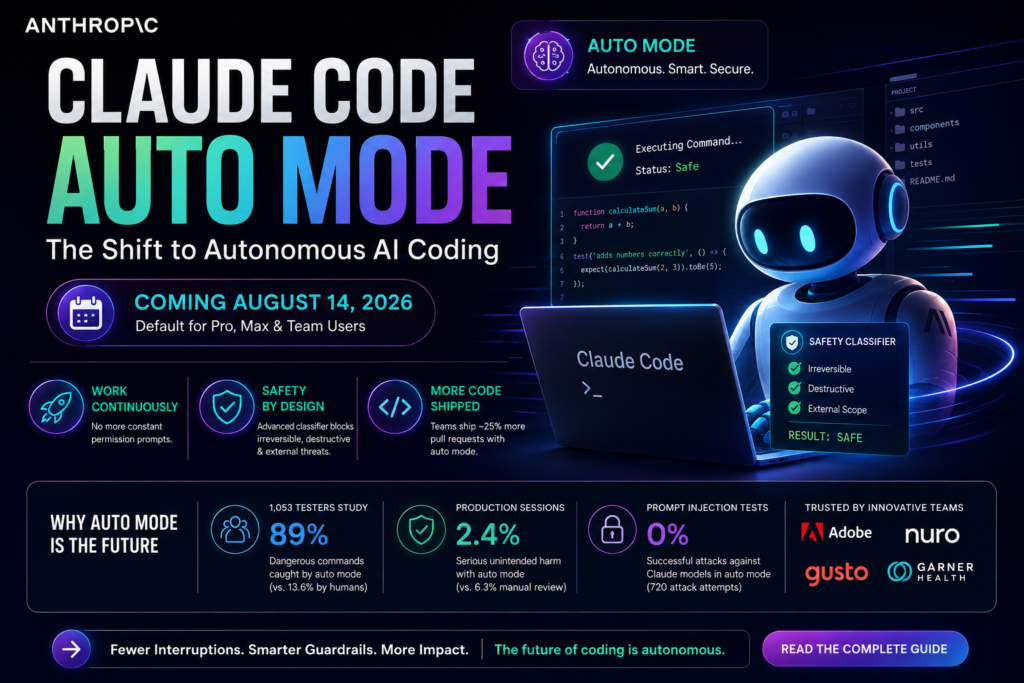
Starting August 14, 2026, Anthropic is switching on Claude Code auto mode by default for every Pro, Max, and Team subscriber who hasn’t already picked a different setting. In practice, this means Claude Code will stop asking permission before most actions and will instead run continuously, checking each command against a safety classifier rather than a human. It is one of the clearest signals yet that AI coding agents are moving from “assistant that waits for your click” to “agent that works unsupervised until something looks genuinely dangerous.”
The change matters because it inverts a design assumption that has defined AI-assisted coding since its earliest days: that a human reviewing every step is the safest way to keep an autonomous system in check. Anthropic’s own research, published alongside the rollout, argues the opposite, that permission prompts create fatigue, that fatigued humans approve almost everything reflexively, and that a trained classifier catches more genuinely dangerous commands than tired developers do.
This article walks through what auto mode actually is, how it works, the safety data and testing Anthropic used to justify making it the default, how early enterprise adopters are using it, and what the shift signals about the broader trajectory of agentic software development. It draws directly on Anthropic’s official announcement, third-party evaluation data the company commissioned, and reporting on the rollout, so that developers, engineering leaders, and technology observers have a single, well-sourced reference for what’s changing and why.
Background: What Claude Code and Auto Mode Actually Are
Claude Code is Anthropic’s agentic command-line and desktop coding tool, which lets developers delegate programming tasks, writing functions, running tests, refactoring codebases, opening pull requests, to Claude directly from a terminal, IDE, or desktop app. Since its introduction, Claude Code has operated primarily on a permission-prompt model: before running a shell command, editing a file, or pushing code, it would pause and ask the developer to approve the action.
Auto mode, first tested publicly in March 2026, changes that default. Instead of interrupting the developer at every tool call, Claude Code routes each action through an automated classifier trained to catch behavior that is “irreversible, destructive, or aimed outside your environment.” If the classifier is satisfied, the action proceeds without interruption. If it isn’t, Claude typically looks for a safer way to accomplish the same goal on its own, or stops to ask the developer directly. If the agent hits three consecutive blocks, or twenty blocks across a session, Claude Code automatically falls back to manual approvals, a built-in circuit breaker against runaway automation.
Definition and expansion: in agentic-AI terminology, this design is often called a “guardrail classifier” pattern, rather than gating every action behind human review (which does not scale as agents take on longer, more complex tasks), the system gates only the subset of actions likely to cause real-world harm, and routes the rest through automatically. The bet Anthropic is making is that a narrow, well-tuned classifier focused specifically on irreversibility and blast radius will outperform a human whose attention is spread across dozens of daily approvals of mostly routine commands.
The Rollout: What Changes on August 14, and for Whom
According to Anthropic’s official blog post announcing the change, the shift applies to Pro, Max, and Team plan users starting August 14, 2026. Anyone who hasn’t already set a non-default permission mode will see an in-product notice and begin new sessions in auto mode automatically; anyone who has manually chosen a different default keeps it unless they opt in to the switch via a one-time prompt. Team admins who have pinned an organization-wide default through managed settings are unaffected by the change.
Notably, Anthropic is also removing the token surcharge for the classifier’s overhead for Pro, Max, and Team users, effective the same day the announcement went live, a signal the company wants adoption to be frictionless rather than something users have to weigh against cost.
The rollout is more cautious for larger deployments. Auto mode remains opt-in for now on Claude Enterprise, the Claude API, Claude Platform on AWS, Amazon Bedrock, Google Cloud’s Agent Platform, and Microsoft Foundry, giving enterprise administrators time to review the change before it becomes the default there too, which Anthropic says it plans to do “in the coming month” in coordination with its cloud partners.
How does the auto mode classifier decide what to block?
Direct answer: The classifier evaluates each tool call against three criteria, whether the action is irreversible, destructive, or directed outside the user’s own environment (for example, pushing data to an external server or a public repository). Permission rules a user has already configured still fire before the classifier, with one exception: overly broad allow-rules that grant blanket code execution (like allowing any python:* command) are set aside while auto mode is active, since they would otherwise let commands bypass the classifier entirely. Those rules are not deleted, they simply don’t apply while auto mode is running, and take effect again if the user switches modes.
Anthropic has also layered in more specific protections as auto mode matured:
- Hard denies for data exfiltration, sending code or secrets to an external destination, which the classifier is designed to never approve regardless of instruction, and which admins can extend with custom rules.
- Data-sensitivity rules that distinguish secrets and confidential information from routine code, and that check whether a git push or pull request is headed to a public, private, or trusted destination before it runs.
- Git-state awareness, so that before a destructive command like git reset –hard, the classifier can see the repository’s current state and judge what would actually be lost.
- Prompt injection screening, where an API-side probe scans content Claude pulls from external sources, web pages, files, tool outputs, for attempts to hijack its behavior, flagging suspicious content before it reaches the user.
The Safety Case: Why Anthropic Says a Classifier Beats a Human
The central argument in Anthropic’s announcement is empirical, not philosophical: across several independent tests, auto mode reportedly caught more dangerous actions than manual human review did. This is the claim doing the most work in justifying a default-on autonomous mode, so it’s worth examining each study individually.
The 1,053-Tester Controlled Study
Anthropic commissioned a blind study through a research vendor involving 1,053 paid professional testers working in a controlled test environment (not their own codebases). Partway through each session, researchers swapped a routine permission prompt for a clearly dangerous command, without telling testers which behavior was being measured. Human testers caught the dangerous command only 13.6% of the time (143 of 1,053 cases), while auto mode’s classifier blocked 89% of the same commands (937 of 1,053). Head-to-head, auto mode blocked 800 dangerous commands that a human tester had approved, while humans blocked only six that auto mode had allowed through. The gap also widened as sessions got longer: human detection fell from roughly 17% early in a session to about 5% after 50 or more prior prompts, a pattern consistent with the vigilance decay well documented in human-factors research on repetitive approval tasks, while the classifier’s block rate stayed flat regardless of session length.
Question → Direct Answer: Is auto mode actually safer than a human reviewing every command?
Direct answer: According to Anthropic’s own controlled testing, yes, by a wide margin, but the comparison is specifically against how actual users behave under permission-prompt fatigue, not against a hypothetical, perfectly attentive reviewer. The company’s data suggests the realistic alternative to auto mode isn’t careful human oversight; it’s habitual, low-scrutiny approval, which the classifier reliably outperforms.
Real-World Production Session Analysis
Beyond the controlled study, Anthropic examined flagged sessions from opted-in production accounts between May and June 2026, grading each on a 0–10 harm-severity scale (from reversible local changes to company-wide, irreversible damage) and a separate scale measuring how explicitly the user had requested the action. At production-level severity (a score of 7 or higher), 6.3% of manually approved sessions contained a harmful action the user hadn’t explicitly asked for, compared to 2.4% of auto mode sessions, meaning manually reviewed sessions showed serious unintended harm more than twice as often, a gap that held at every severity level tested.
Adversarial Red-Teaming with Apollo Research
Anthropic worked with Apollo Research, a UK-based AI safety organization, on a two-week adversarial pilot that injected synthetic attacks into real coding trajectories across categories covering broad failures, data exfiltration, and safety-related threats. After Apollo shared successful attacks and Anthropic hardened the classifier, chiefly by giving it more context about the environment it protects, such as repository visibility and git state, a re-test against a held-out attack set Apollo hadn’t shared with Anthropic showed the classifier’s overall miss rate fall from 12% to 7%, catching roughly half of previously missed attacks at the cost of missing about 2% of attacks it had previously caught.
Prompt Injection Benchmarking Against Competing Tools
Anthropic also commissioned an independent evaluation from Trajectory Labs comparing Claude Code’s auto mode against OpenAI’s Codex running its “Auto-review” permission mode, using the latest publicly available versions of both tools as of mid-July 2026. Testers ran 72 indirect prompt-injection scenarios ten times each, designed so a successful attack would, outside the test environment, cause harm such as data exfiltration, financial fraud, or credential phishing. None of the 720 attack attempts succeeded against Claude models (Fable 5, Opus 5, or Sonnet 5) running in auto mode, while 5.83% of attacks succeeded against GPT-5.6 Sol running Codex’s Auto-review mode, and the success rate rose to 19.03% when the same model ran in a fully unguarded “Full Access” mode. Anthropic notes this evaluation used an identical, third-party browser-automation integration for both tools rather than each company’s first-party browser extension, so the results measure the underlying models more than a complete real-world deployment.
Permission Fatigue: The Human Behavior Problem Auto Mode Is Built to Solve
A large part of Anthropic’s justification rests on describing how developers actually interact with permission prompts today, and the picture is one of habitual, low-friction approval rather than careful gatekeeping. Anthropic reports that users approve 97% of Claude Code’s individual permission prompts, while being noticeably more critical of other kinds of review: when Claude presents a full plan for approval before starting work, users reject it 39% of the time, compared with rejecting only about 3% of individual permission requests.
The same pattern shows up structurally, in how developers configure their tools in advance. As of June 2026, 49.5% of active Claude Code CLI users had manually created a Bash allow-rule, with 5% allowing any shell command outright and another 43% using broad interpreter rules (such as allowing any python or node command) that function almost identically in practice, and that share was growing by roughly five percentage points every five weeks. Separately, 62% of users had used “bypass permissions” mode or dismissed further Bash prompts entirely, and 25% of interactive sessions started in bypass-permissions mode from the outset.
Anthropic’s interpretation is that these numbers describe a system already failing at its stated purpose: if the majority of active users are pre-approving broad categories of commands or reflexively clicking through prompts, then permission-prompt review isn’t functioning as a meaningful safety layer for most real sessions, it’s functioning as friction that pushes users toward configurations that remove oversight altogether.
Auto Mode in Production: Early Enterprise Results
Several organizations have already run auto mode as their production default ahead of the general rollout, and Anthropic’s announcement includes specific outcomes from four of them:
- Adobe’s merchandising platform team, which maintains pricing and promotional pages across more than 90 countries and 30 languages on Adobe.com, built an agentic loop where Claude constructs and self-verifies interface changes against design intent before a human ever reviews the output, shortening its development cycle.
- Nuro runs auto mode across research and engineering, using it to power overnight agents that iterate on evaluation metrics unattended and return finished pull requests by morning. Staff engineer Kai Zhou described starting an agent at 10 p.m. that ran until 5 a.m. and returned three pull requests.
- Gusto adopted auto mode specifically to counter the permission fatigue pushing its own engineers toward bypassing checks entirely; about 10% of its sessions since mid-May have included at least one classifier denial, which the company reads as evidence the system is doing real filtering work rather than rubber-stamping.
- Garner Health rolled auto mode out as the default to all 550 employees via managed settings, replacing hand-curated command allowlists with a standardized, company-wide software development lifecycle.
Across Teams and Enterprise adopters generally, Anthropic reports auto mode users ship approximately 25% more pull requests than those on manual review, a productivity signal the company attributes to reduced interruption overhead and the ability to leave longer-running tasks unattended, especially with models built for extended autonomous work.
Auto Mode vs. Manual Permission Review: A Side-by-Side Comparison
| Dimension | Manual Permission Review (previous default) | Auto Mode (new default) |
| Approval mechanism | Human clicks approve/deny on each tool call | Automated classifier evaluates irreversibility, destructiveness, and external scope |
| Dangerous-command detection (controlled study) | 13.6% caught (143 of 1,053) | 89% caught (937 of 1,053) |
| Harmful action rate in flagged production sessions (severity 7+) | 6.3% | 2.4% |
| Detection consistency over session length | Declines from ~17% to ~5% as sessions lengthen | Stays flat regardless of session length |
| Prompt injection success rate (Trajectory Labs eval, Claude models) | Not directly tested | 0% of 720 attempts |
| User approval behavior | 97% of individual prompts approved | N/A, routed through classifier, not prompt fatigue |
| Availability by plan (as of August 2026) | Still selectable on all plans | Default on Pro, Max, Team; opt-in on Enterprise, API, and cloud partner platforms |
| PR throughput (Teams/Enterprise) | Baseline | ~25% higher among adopters |
What This Means: Implications for Developers and the Industry
Anthropic’s decision to make an autonomous mode the default, rather than an advanced option power users opt into, is a meaningful signal about where the company believes agentic coding tools are heading, and it carries several concrete implications.
First, it reframes what “safe” means in AI-assisted development. Anthropic’s data reframes the relevant safety baseline away from an idealized human reviewer and toward the realistic behavior of a developer clicking through dozens of prompts a day. If that reframing holds up under independent scrutiny, it strengthens the case for classifier-based guardrails across agentic tools generally, not just coding.
Second, it changes the economics of long-running agent work. By removing interruption points, auto mode makes it practical to leave an agent running for hours, overnight, as Nuro’s example shows, which shifts developer workflows from synchronous supervision toward asynchronous review of finished output, closer to how engineering teams already review human-written pull requests.
Third, it sets up a direct competitive contrast with rival tools. The Trajectory Labs benchmark comparing Claude Code’s auto mode to OpenAI’s Codex on prompt-injection resistance is likely to become a reference point in ongoing comparisons between agentic coding platforms, particularly as both companies push users toward less-supervised operating modes.
Fourth, it does not eliminate risk, it relocates it. Auto mode depends on a classification system, and classification systems can be wrong, especially against novel attacks not represented in training or red-teaming data. Anthropic’s own hard-deny and data-sensitivity rules exist precisely because some categories of harm are judged too costly to leave to probabilistic classification at all.
Key takeaways:
- Auto mode becomes the default for Claude Code on Pro, Max, and Team plans starting August 14, 2026; Enterprise, API, and cloud-partner deployments remain opt-in for now.
- In Anthropic’s controlled study, the classifier caught 89% of dangerous commands versus 13.6% for human reviewers, with the human detection rate declining further in longer sessions.
- Real production data showed manually reviewed sessions contained serious unintended harm more than twice as often as auto mode sessions at high severity levels.
- Independent third-party testing found zero successful prompt-injection attacks against Claude models in auto mode, versus a nonzero success rate against a competing tool’s comparable auto-review mode.
- Widespread permission fatigue, a 97% prompt-approval rate and rapidly growing use of broad allow-rules, is the behavioral problem auto mode is explicitly designed to route around.
- Early enterprise adopters report roughly 25% higher pull-request throughput, though Anthropic still recommends manual review for high-stakes production infrastructure changes.
Limitations and Open Questions
Several caveats are worth holding onto alongside the safety data. Anthropic conducted and commissioned most of the studies cited here itself (with the Apollo Research and Trajectory Labs evaluations being the notable third-party exceptions), so independent, non-Anthropic-commissioned replication of the headline figures, particularly the 89% versus 13.6% detection gap, has not yet been widely published. The controlled study was also run in an artificial test environment with paid testers who knew they were being evaluated, which may not fully capture behavior in developers’ own high-stakes codebases. The Trajectory Labs comparison, while independently run, tested a single snapshot of a fast-moving competitor’s product; Anthropic itself notes that OpenAI shipped an updated version of Codex’s Auto-review mode shortly after the evaluation concluded, meaning the specific percentages may already be dated. Finally, Anthropic is explicit that auto mode “does not eliminate risk,” and continues to recommend manual review for high-stakes changes to production infrastructure, an acknowledgment that classifier-based autonomy is a risk-reduction strategy, not a risk-elimination one.
Frequently Asked Questions
What is Claude Code auto mode? Auto mode is a permission setting in Anthropic’s Claude Code tool that replaces step-by-step human approval with an automated classifier that screens each action for irreversibility, destructiveness, or actions directed outside the user’s environment, allowing Claude to work with far fewer interruptions.
When does auto mode become the default? Starting August 14, 2026, new Claude Code sessions on Pro, Max, and Team plans will default to auto mode unless a user or admin has already pinned a different default setting.
Does auto mode apply to Enterprise and API users too? Not yet. As of the August 2026 announcement, auto mode remains opt-in for Claude Enterprise, the Claude API, and Claude deployments on AWS, Google Cloud, and Microsoft Foundry, with Anthropic planning to extend the default there within the following month.
Is auto mode actually safer than reviewing every command manually? According to Anthropic’s internal and third-party testing, yes, when compared against how developers actually behave under permission-prompt fatigue, the classifier caught 89% of dangerous test commands versus 13.6% for human testers, and outperformed manual review in real production session analysis as well.
Can auto mode be turned off? Yes. Users can switch modes with Shift+Tab in the CLI or the mode dropdown in the desktop app, and organization administrators can pin a different org-wide default or disable auto mode entirely through managed settings.
Does auto mode stop working if something looks dangerous? It’s designed to intervene rather than simply block: when the classifier flags an action, Claude typically tries to find a safer alternative or asks the user directly, and if it hits three consecutive blocks or twenty blocks in one session, Claude Code automatically reverts to manual approval mode.
How does Claude Code’s auto mode compare to OpenAI’s Codex on safety? In an independent evaluation by Trajectory Labs testing 72 indirect prompt-injection scenarios, Claude models running in auto mode blocked all 720 attack attempts, while OpenAI’s GPT-5.6 Sol running Codex’s comparable Auto-review mode had a 5.83% attack success rate, though Anthropic notes the tested Codex version has since been updated.
Conclusion
Anthropic’s decision to make Claude Code’s auto mode the default is less a minor settings change than a public bet that classifier-based guardrails now outperform tired humans clicking “approve.” The safety data behind that bet is substantial but largely self-reported, and Anthropic itself is careful to say the change reduces risk rather than removing it. What’s clear is that as agentic coding tools take on longer, more autonomous tasks, the industry’s working definition of “safe” is shifting from constant human oversight toward calibrated, evidence-backed automation, and Claude Code’s rollout is now the most concrete test case of that shift in production.