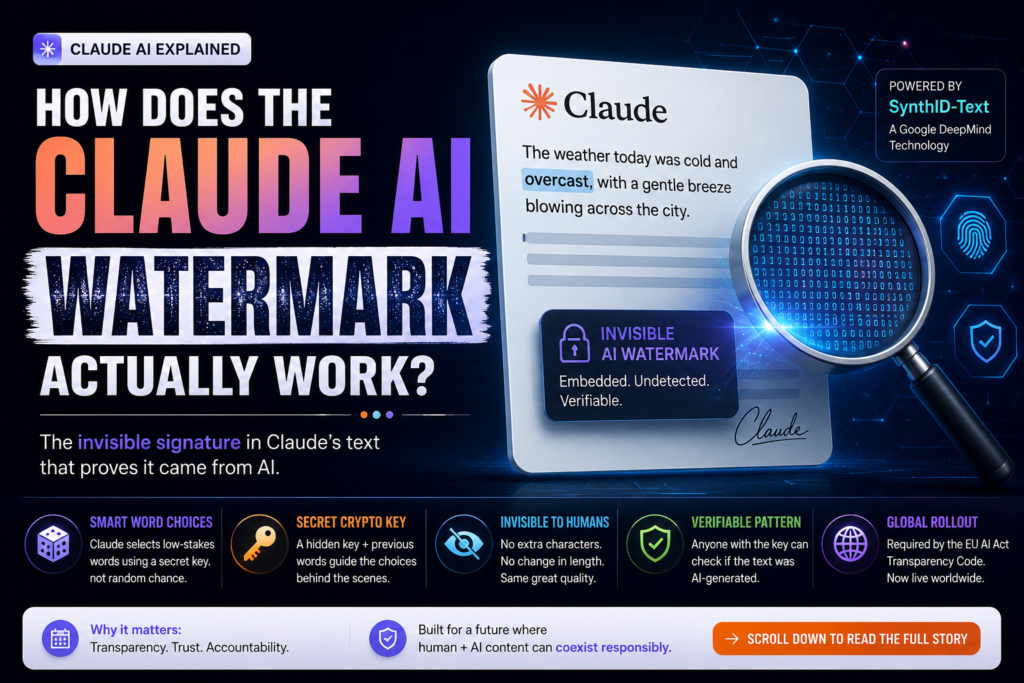
If you’ve used Claude to draft an email, polish an assignment, or write code this month, there’s a good chance your text is now carrying an invisible signature. Anthropic confirmed that its Claude AI watermark embeds a statistical pattern into generated text that a special detection key can read later, and this pattern is completely invisible to the person reading the output. The company published a detailed explainer on August 14, 2026 to answer the wave of questions , and some anger , that followed its original watermarking announcement a few days earlier.
For readers in India tracking global AI regulation, this story matters beyond Anthropic. It’s an early, concrete look at how the EU AI Act is reshaping what AI companies must build into their products worldwide, including tools many Indian students and professionals use daily. Here’s what this new watermarking system actually does, how it works under the hood, and what it means for anyone who writes with Claude.
Why Is Anthropic Adding a Watermark to Claude’s Text?
The short answer: EU law now requires it. Anthropic, along with roughly 190 other signatories, signed the EU Code of Practice on Transparency of AI-Generated Content in July 2026 , a voluntary framework tied to the EU AI Act that took effect on August 2, 2026 for AI providers serving the European market.
What is the EU AI Act’s Transparency Code? It’s a set of commitments requiring AI companies to use technical methods that make it possible to identify AI-generated content, so platforms, regulators, and the public can tell when text, images, or audio came from a machine rather than a person. Anthropic isn’t acting alone here , several other major model developers signed the same code and are rolling out their own watermarking systems in parallel, according to Anthropic’s blog post.
Because Anthropic said it doesn’t yet have a reliable way to apply the rule only to EU users, the Claude AI watermark is being rolled out globally, not just in Europe. That’s the detail that triggered the loudest reaction from users worldwide, including reports from Business Insider that some Claude subscribers said they were cancelling their plans over the change.
How Does the Claude AI Watermark Actually Work?
Watermarking works by controlling which word Claude picks when several options are equally good. Large language models like Claude generate text one word at a time, and at many points in a sentence, multiple next-words would work equally well. Anthropic’s own example: in the sentence “The weather today was cold and…”, the next word could reasonably be “overcast” or “grey” , either works, and readers won’t notice or care which one appears.
Low-stakes word choice is the technical term for exactly this situation , a point in a sentence where two or more words are roughly equally likely and equally correct. In normal, unwatermarked generation, Claude settles these micro-decisions with a random number. With watermarking switched on, that randomness is no longer arbitrary , it’s generated using a secret cryptographic key combined with the preceding words. The word Claude picks is still effectively random to a human reader, but it’s now consistent with what the key would predict, which means someone holding that key can check a passage and calculate the probability that Claude generated it.
Anthropic uses an analogy to make this concrete: imagine a Monopoly game where, instead of rolling dice, players use a long sequence of the digits of pi to decide how many spaces to move. The moves still look random to anyone watching the game. But if you know the exact sequence of pi digits used and you can see the full record of moves afterward, you can work out whether that particular game was “powered” by pi. Claude’s watermark works the same way , nothing about the reading experience changes, but the pattern is recoverable by anyone with the key.
The specific technique Claude uses is called SynthID-Text, a watermarking method Google DeepMind first published in a Nature paper in 2024. It belongs to a broader family of approaches tracing back to a 2022 proposal by computer scientist Scott Aaronson, all built on the same core idea: watermark by changing the source of randomness, not the content itself.
Will the Claude AI Watermark Change the Quality of Claude’s Answers?
No , Anthropic says watermarking has no measurable effect on output quality. According to the company, internal testing found no impact on the content, creativity, or readability of watermarked text compared to unwatermarked text. Google DeepMind’s own SynthID-Text research, run across a portion of live Gemini traffic, found no statistically significant difference in user thumbs-up/thumbs-down ratings between watermarked and unwatermarked responses, and controlled human-rater studies comparing the two side by side also found no perceptible quality gap.
A few other practical points worth knowing:
- Watermarking doesn’t add extra words, hidden characters, or invisible symbols to the text , the output is exactly as long as it would otherwise be.
- It doesn’t require extra tokens, so it does not make Claude slower or more expensive to use.
- The watermark carries no identifying information , it cannot be traced back to your account, your organization, or a specific chat.
- It applies globally at launch, across every Claude conversation, not just EU-based accounts.
This is different from a printed watermark on currency or a stamped digital document, both of which are meant to be visible. Claude’s watermark is designed to be statistically detectable, not visually noticeable , you would never spot one just by reading the text.
Can You Remove or Bypass a Claude AI Watermark by Editing the Text?
Partially, but only through heavy rewriting. Anthropic has been direct about this limitation: light editing on watermarked text probably won’t strip the watermark out entirely, because most of the original word choices , and the pattern embedded in them , remain intact. A complete rewrite, where essentially every word is replaced, will remove it, because at that point almost none of the original AI-selected words are left.
Does light proofreading by Claude still trigger detection? Usually not with much confidence. If you write your own essay and only ask Claude to fix grammar and punctuation, nearly all the words on the page remain yours. Anthropic notes there’s “very little (if anything) for the watermark to attach to” in that scenario, and detection accuracy depends heavily on the length of the passage and how much Claude actually changed.
There’s an important nuance in Anthropic’s own framing here: once a passage has been rewritten so thoroughly that virtually no original AI wording survives, the company itself acknowledges it becomes arguable whether that text should still be called “AI-generated” at all. That’s a genuinely interesting philosophical wrinkle buried inside a compliance announcement , the watermark’s removability is, in effect, tied to a definitional question about authorship.
Watermark detection also gets less reliable on short passages. A single sentence or two doesn’t give the detection key enough word choices to build statistical confidence. Confidence rises as the passage gets longer, because there are simply more low-stakes decisions for the pattern to appear in.
Does the Claude AI Watermark Affect Code Anthropic Generates?
Barely, and that’s by design. Code is fundamentally different from prose because most of it has to be exact , a variable name has to match how it’s used elsewhere, a function call has to follow correct syntax, and a logical operator can’t be swapped for a “roughly similar” one without breaking the program. Anthropic explains that watermarking only has room to operate where there’s a genuine choice between equally valid options; where there isn’t (like completing “2 + 2 =” with anything other than “4”), the watermark simply has nothing to attach to.
That means Claude’s watermark shows up far less in generated code than in ordinary writing. The one place it can still appear is in areas of arbitrary stylistic choice within code , such as the wording of a comment , but Anthropic is explicit that this has a negligible effect on the actual functioning code that’s produced. Developers using Claude for coding assistance don’t need to worry about the watermark altering logic, variable behavior, or program output.
Claude AI Watermark vs AI Detection Tools: What’s the Difference?
A lot of confusion online has come from conflating Anthropic’s watermarking system with third-party “AI detector” tools like Pangram, GPTZero, or Turnitin’s AI flag. They solve a similar-sounding problem in completely different ways.
| Feature | Claude AI Watermark (SynthID-Text) | Third-Party AI Detectors (e.g., Pangram) |
| How it detects AI text | Cryptographic pattern embedded in word-choice randomness | Statistical analysis of writing “tells” and phrasing patterns |
| Requires a secret key? | Yes , only Anthropic’s key (or its future API) can confirm it | No , works on any text without needing a provider’s key |
| Accuracy on short text | Low confidence on very short passages | Varies by tool, generally also weaker on short text |
| Can flag non-Claude AI text | No , only detects Claude-generated content | Yes , can flag output from many different AI models |
| Visible to the reader | Never , completely invisible in normal reading | Not applicable , analyzes text after the fact |
| Survives heavy editing? | No , a full rewrite removes it | Sometimes , depends on how much phrasing changes |
As Anthropic put it, spotting AI “tells” , like the now-famous “this isn’t just [X], it’s [Y]” construction, or an unusually frequent use of the word “quietly” , is a fundamentally different approach from checking a cryptographic watermark. Third-party detectors are essentially pattern-matching guesses based on how AI models tend to write; Anthropic’s watermark is a verifiable, key-based signal built directly into the generation process.
What Does the Claude AI Watermark Mean for Students and Professionals in India?
This detail matters a lot for Kalinga.ai’s audience , students submitting assignments, freshers polishing resumes and cover letters, and young professionals using Claude for work output. Here’s what to actually keep in mind:
- Using Claude to brainstorm or heavily rewrite your own draft is low-risk for detection. If you write the core content yourself and use Claude mainly for light editing, there’s little watermark signal left for anyone to find.
- Using Claude to generate a full assignment or report end-to-end leaves a strong, detectable pattern, especially in longer passages, once Anthropic’s detection API becomes available.
- Translations produced by Claude are watermarked too, since every word in a translation is chosen by the model , there’s no “human-written baseline” the way there is in light editing.
- Code you generate with Claude will carry minimal watermarking, so this specific compliance change isn’t something developers need to factor into coding workflows.
- The watermark cannot identify who you are. It only signals that Claude was likely involved in producing a piece of text , it carries no account, organization, or chat-level identifying data.
- A detection API is coming, not live yet. Anthropic said in its blog post that it’s still working out the implementation details, so there’s currently no public tool where you can paste text and get a definitive Claude-authorship score.
For institutions, employers, or platforms in India considering AI-usage policies, the practical takeaway is that this watermarking system can eventually offer probabilistic evidence of AI involvement , not binary, courtroom-grade proof, and not something that works reliably on short pieces of text.
How Will You Be Able to Check If Text Was Written by Claude?
Through a watermark detection API that Anthropic says it will release soon. As of the August 14, 2026 announcement, Anthropic confirmed it’s still finalizing implementation details for this API, so there’s no self-serve public detector available yet. Once live, it should let someone submit a piece of text and receive back a probability estimate of Claude’s involvement, based on how consistent the word choices are with the secret key.
It’s worth setting expectations correctly here: even with the future API, a watermark check will only ever answer “how likely is it Claude was involved,” never a hard yes/no. It also can’t distinguish between Claude having written a passage outright versus Claude having heavily edited someone else’s draft , both scenarios can trigger a similar watermark signal.
What About Images, PDFs, and Other Files Claude Creates?
Text watermarking is only part of the picture. When Claude produces a file in a supported image format , such as .png, .jpg, or .svg , it attaches a small, cryptographically signed content credential to the file’s metadata, marking that the file was created or processed with Claude. This uses an existing open industry standard called C2PA, the same content-credentialing system already used by camera manufacturers and photo-editing software to record an image’s origin.
This is a meaningfully different mechanism from text watermarking: nothing in the image itself is altered or hidden, the credential simply lives in the metadata layer, and any C2PA-compatible tool can read it. Like the text watermark, this credential doesn’t carry any information that could identify the specific user or organization behind the file.
FAQ: Claude AI Watermark, Answered
Does Claude’s watermark make responses slower or more expensive? No. Anthropic says watermarking has a negligible impact on generation speed and doesn’t add extra tokens, so there’s no added cost to using Claude.
Can the watermark be traced back to my account or organization? No. The watermark identifies that Claude was likely involved in producing the text , it carries no data about the specific user, chat, or organization that generated it.
Does watermarking apply to older Claude models too? Eventually, yes. The EU law includes a transition period for models launched before August 2, 2026, and Anthropic says it’s working to extend watermarking to those models over the coming months.
Will Claude be the only AI tool that watermarks its text? No. Anthropic signed the same EU Code of Practice as several other major AI developers, all of whom are expected to roll out their own watermarking systems using their own detection keys.
Does a watermark prove who owns an AI-generated output? No. Anthropic is explicit that a watermark only signals the likelihood Claude was involved in the content , it says nothing about ownership, authorship rights, or legal responsibility for the output.
Can proofreading by Claude trigger a false “AI-written” flag? It’s unlikely for lightly edited work. Since most of the original words remain the human writer’s, there’s minimal watermark signal to detect, though this depends on the length of the passage and how heavily Claude edited it.
Where to Go From Here
Watermarking is a small technical change with a big compliance story behind it, and it’s a preview of how global AI regulation will keep shaping the tools we all use daily , even outside the EU. If you’re building AI literacy for your team, classroom, or career in Odisha, Kalinga.ai’s AI/tech news coverage and upcoming LLM Engineering workshops go deeper into exactly these kinds of product and policy shifts as they happen.