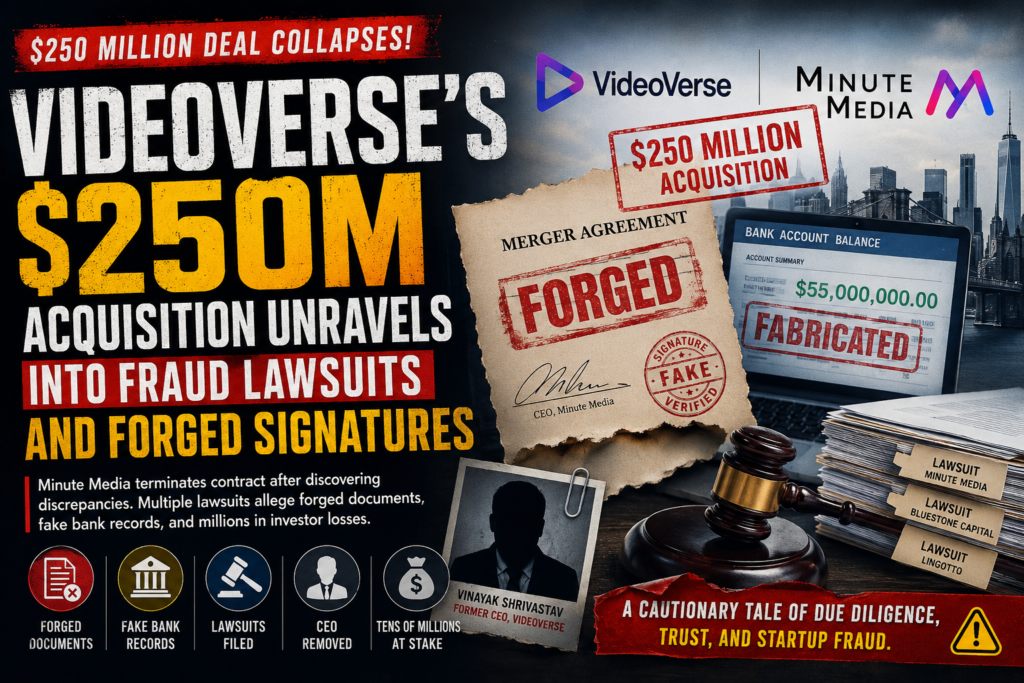
San Francisco/New York, August 17, 2026 , The $250 million VideoVerse acquisition by sports publisher Minute Media has unraveled less than a year after it closed, with multiple lawsuits now accusing VideoVerse co-founder Vinayak Shrivastav of using forged merger documents and fabricated bank records to extract tens of millions of dollars from investors and lenders. VideoVerse acquisition fraud
Minute Media confirmed to TechCrunch, in a report published August 12 by Russell Brandom, that it terminated its engagement with VideoVerse in May after discovering “significant discrepancies” in the Indian startup’s representations. The disclosure caps a rapid unraveling of a deal once celebrated as a milestone exit for India’s startup ecosystem.
Key Facts
- Minute Media, a New York- and Tel Aviv-based sports publisher, acquired Indian video-clipping startup VideoVerse in a $250 million deal announced in September 2025, according to TechCrunch’s earlier reporting cited in the August 12 article.
- Minute Media told TechCrunch it terminated its contract with VideoVerse in May 2026 after finding discrepancies in the startup’s representations.
- Bluestone Capital, a 2023-round investor, is suing VideoVerse for fraud, alleging the company withheld acquisition proceeds owed under its investment terms.
- A separate creditor lawsuit seeks to recover $64 million from a loan Shrivastav took out shortly after the acquisition closed, alleging he used fraudulent merger documents to win shareholder approval.
- Investment firm Lingotto says in a court filing that Shrivastav supplied forged documents , including a bank-balance screenshot and a signature falsely attributed to Minute Media’s CEO , to secure a $55 million structured loan in October 2025.
- VideoVerse’s former COO, Sabya Das, alleges in a separate complaint that Shrivastav forged his signature on loan and share-repurchase agreements to extract tens of millions of dollars from the company.
- Shrivastav was removed as CEO by the end of April 2026, according to the TechCrunch report, and did not respond to multiple requests for comment.
Why It Matters
The collapse of the VideoVerse acquisition is a cautionary case study in startup due diligence, showing how a high-profile, venture-backed exit can mask years of undisclosed debt and alleged document fraud until creditors start calling in loans. For India’s startup sector, the case complicates a deal that was widely framed as validation of homegrown AI tooling reaching global acquirers. For Minute Media and the investors involved , Bluestone Capital and Lingotto , the dispute now centers on recovering tens of millions of dollars through Delaware Chancery Court, with overlapping claims that will likely take months or years to resolve. The episode also underscores a broader risk in fast-moving AI and startup M&A: acquirers and lenders relying on founder-provided documentation without independent verification can be exposed to the same fabrication schemes now alleged against Shrivastav.
The Details
VideoVerse built its business around Magnifi, an AI-powered clipping tool used by clients including the Indian Premier League, FIFA+, and Nippon TV to automatically extract highlight packages , such as every three-point shot in a basketball game , from long-form broadcasts, according to TechCrunch’s report. The company’s reach in what the outlet described as a billion-dollar clipping industry made it an attractive target for Minute Media, which had hoped to expand VideoVerse’s software into the U.S. sports market.
That expansion plan stalled as internal problems surfaced. Even after the VideoVerse acquisition closed, the two companies continued operating as separate legal entities, TechCrunch reported , a structural detail that became significant once Minute Media moved to terminate its contract with the startup in May.
According to the Lingotto court filing cited by TechCrunch, Shrivastav approached the investment firm in October 2025 seeking a $55 million structured loan, ostensibly to pay off an earlier creditor. With the Minute Media merger publicly valued at more than four times that amount, the loan appeared low-risk. Lingotto transferred $53 million to an account controlled by VideoVerse’s corporate entity, Clippings, on October 1, 2025, under a standard repayment schedule, the filing states.
Lingotto’s lawsuit alleges that documents backing the loan , including statements attributed to the earlier creditor and to Minute Media’s own CEO , were forged, and that screenshots purporting to show internal bank balances were fabricated. When a $4 million payment due March 31, 2026 failed to arrive, Lingotto called in the full loan amount with interest and discovered, according to the TechCrunch report, a long list of other parties waiting to be paid. A separate loan from Bluestone Capital had already entered settlement a few months earlier over similarly overdue payments.
Shrivastav was pushed out as CEO by the end of April 2026, TechCrunch reported. In the months since, Minute Media, Lingotto, and Bluestone Capital have each filed competing claims in Delaware Chancery Court seeking restitution. Former COO Sabya Das filed a separate complaint alleging a further web of fraud involving secondary share sales and a confidential high-interest loan, and accusing Shrivastav of forging his signature on loan and share-repurchase agreements.
TechCrunch reported that Shrivastav did not respond to multiple attempts to reach him for comment, and that his most recent listed address, cited in Das’s complaint, is on the Palm Jumeirah islands in Dubai.
What Happens Next
The competing fraud claims from Minute Media, Lingotto, and Bluestone Capital are proceeding through Delaware Chancery Court, where each party is seeking restitution tied to the collapsed deal. With Shrivastav unreachable and the claims involving conflicting accounts of where tens of millions of dollars went, resolution is likely to depend on court-ordered discovery into the company’s finances rather than a swift settlement.