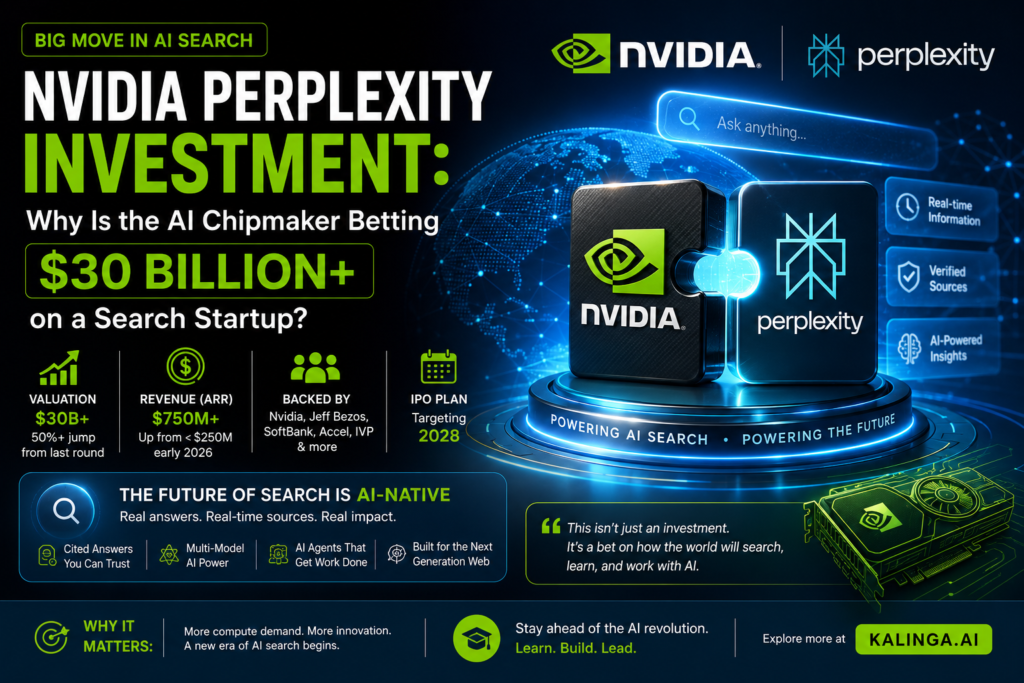
Nvidia is reportedly in talks to invest in Perplexity as part of a new equity funding round that would value the AI search startup at more than $30 billion, a jump of over 50% from its valuation just a year ago. The report, first published by The Information on August 23, 2026 and picked up by Reuters, comes as Perplexity’s annualized revenue has surged past $750 million, up from less than $250 million at the start of the year. In short: the world’s most valuable chipmaker wants a bigger stake in the company trying to reinvent how people search the internet.
If you’re a student or young professional in Odisha tracking the AI industry, this Nvidia Perplexity investment story is worth understanding, not just as market gossip, but as a signal of where AI search, AI agents, and enterprise AI spending are headed in 2026.
What Exactly Is Happening Between Nvidia and Perplexity?
Nvidia is discussing a direct equity investment in Perplexity’s upcoming funding round, according to people familiar with the matter cited by The Information. The round would value Perplexity at more than $30 billion and would mark more than a 50% increase from its previous valuation set about a year ago.
Nvidia isn’t a new name on Perplexity’s cap table. The chipmaker has already backed Perplexity in earlier rounds, investing alongside high-profile names like Amazon founder Jeff Bezos, SoftBank, Accel, and IVP. What’s notable this time is the path Nvidia reportedly took to get here.
What alternatives did Nvidia consider before deciding to invest? Before settling on a straightforward equity investment, Nvidia had reportedly explored other ways of deepening its relationship with Perplexity, including a technology licensing arrangement and even hiring some of Perplexity’s staff. The conversation eventually shifted toward Nvidia simply taking a larger ownership stake instead.
This detail matters because it tells you Nvidia wasn’t casually writing a check, it weighed multiple structures before landing on direct investment, suggesting a deliberate strategic bet rather than a routine follow-on round.
Deal Snapshot
| Detail | Information Reported |
| Reported new valuation | More than $30 billion |
| Increase from prior round | 50%+ jump from ~$20B (Sept 2025) round |
| Perplexity ARR (current) | $750 million+ |
| Perplexity ARR (early 2026) | Under $250 million |
| Nvidia’s prior involvement | Existing investor since a 2024 round |
| Other backers in the round | Jeff Bezos, SoftBank, Accel, IVP |
| Source of the report | The Information, confirmed via Reuters coverage |
| Official comment | Perplexity declined to comment; Nvidia did not immediately respond |
Why Has Perplexity’s Valuation Grown So Fast?
Perplexity’s valuation has climbed roughly 250x in about three years, from just over $121 million in 2023 to a reported $20 billion in September 2025, and now potentially past $30 billion in 2026. Few startups in any industry, let alone AI, have compressed that kind of growth curve into 36 months.
Answer engine is the term commonly used for what Perplexity builds, a definition worth pausing on. An answer engine is a search tool that skips the traditional list of blue links and instead gives you a direct, synthesized answer with citations, generated by pulling from real-time web data and large language models (LLMs). Instead of you clicking through five articles to piece together an answer, the answer engine does that synthesis for you and shows its sources. Perplexity, ChatGPT Search, and Google’s AI Overviews all compete in this space, though with different approaches to sourcing and citation transparency.
Two factors are driving Perplexity’s current revenue jump:
- Enterprise and consumer subscription growth, as more professionals adopt AI-native search over traditional engines.
- Perplexity Computer, a cloud-based AI agent that lets professionals automate computer-based tasks, which has reportedly contributed meaningfully to the recent revenue acceleration.
- A $750 million Microsoft Azure partnership signed earlier in 2026, which underpins Perplexity’s ability to run multiple frontier models (from OpenAI, Anthropic, and others) at scale.
- Continued expansion of Comet, Perplexity’s AI-powered browser, which went free worldwide in late 2025.
Is a 50%+ valuation jump in a year unusual for an AI startup? Not in 2025–2026’s market. Comparable AI companies have seen similar or steeper re-rates, for instance, reports the same week noted AI coding startup Cognition negotiating a round that could value it near $40 billion, and Hugging Face reportedly exploring a sale near $13 billion, nearly triple its earlier valuation. Rapid re-pricing has become the norm for infrastructure-adjacent AI companies with strong revenue growth.
Why Would Nvidia Want to Invest Deeper in an AI Search Company?
This is the part students and early-career tech professionals should pay closest attention to, because it reveals how Nvidia thinks beyond just selling GPUs (Graphics Processing Units, the specialized chips that power most AI model training and inference).
Strategic investment, in this context, means a company invests not purely for financial returns but to secure influence, access, or a closer commercial relationship with a fast-growing customer. Nvidia doing this with Perplexity strengthens its position in two ways: it deepens ties with a company that consumes massive compute for AI inference (running trained AI models to answer real queries), and it gives Nvidia a stake in what could become one of the default interfaces people use to access AI-driven information.
Does Nvidia only invest in hardware-adjacent companies? No, Nvidia has increasingly taken equity stakes in AI application and infrastructure companies where it also has a customer or technology relationship, not just pure hardware plays. The Perplexity talks fit a broader pattern of Nvidia using its enormous cash position (fueled by GPU sales) to build a portfolio of strategically important AI companies, similar to how it has approached other names across the AI stack.
A few reasons this matters for Nvidia specifically:
- Compute demand assurance: A growing Perplexity means growing demand for the GPU-powered infrastructure Nvidia’s chips ultimately power.
- Distribution and relevance: As AI search becomes a genuine alternative to Google, Nvidia gains visibility and influence with a platform shaping how millions of users discover and consume information.
- Portfolio hedging: Spreading strategic bets across AI labs, infrastructure providers, and application-layer companies like Perplexity reduces Nvidia’s dependence on any single customer segment.
- Signal to the market: Nvidia’s continued backing reinforces investor confidence in Perplexity ahead of its planned 2028 IPO (Initial Public Offering, when a private company first sells shares to the public), something Perplexity CEO Aravind Srinivas has publicly discussed.
How Does Perplexity Compare to Other AI Search Tools?
For readers weighing which AI search tool to actually use, or which company to watch as a career-relevant player, here’s how Perplexity stacks up against its closest competitors as of 2026.
| Feature | Perplexity | ChatGPT Search (OpenAI) | Google AI Overviews / Gemini |
| Core model approach | Multi-model routing (GPT, Claude, Gemini, etc.) | Primarily OpenAI’s own models | Primarily Google’s Gemini models |
| Citation transparency | Strong, cited, sourced answers by default | Improving, citations available | Citations present but often secondary to summary |
| Dedicated AI browser | Yes, Comet | No standalone browser (as of this report) | Chrome integration |
| Agentic task automation | Yes, Perplexity Computer | Yes, various agent features | Yes, Gemini-based agents |
| Reported 2026 backing | Nvidia, Bezos, SoftBank, Accel, IVP | Microsoft, Thrive Capital, others | Alphabet (internal) |
| Reported valuation (2026) | $30B+ (in talks) | Far higher (multi-hundred-billion range) | N/A, part of Alphabet |
The comparison matters less for “which is best” and more for understanding a bigger trend: AI-native search is no longer a niche experiment, it’s a genuine, well-funded challenge to the traditional search-engine business model that has dominated the internet for over two decades.
What Does This Mean for Students and Professionals in India?
Why should someone in Odisha or India care about a Silicon Valley funding round? Because the shift toward AI-native, cited-answer search changes how information is discovered, ranked, and monetized online, which directly affects careers in content, marketing, SEO, and AI-adjacent roles.
This is exactly the shift behind Generative Engine Optimization (GEO), the practice of structuring content so it gets surfaced, cited, and quoted by AI systems like Perplexity, ChatGPT, and Google’s AI Overviews, rather than optimizing purely for traditional search-engine rankings. As AI search tools like Perplexity attract enterprise-scale funding and usage, the demand for professionals who understand how to create AI-retrievable content, not just SEO-friendly content, is growing quickly.
A few practical takeaways:
- Freshers entering content, marketing, or tech roles should build familiarity with both traditional SEO and emerging GEO practices, since employers are increasingly asking for both.
- Aspiring AI/ML professionals should track how compute demand (driven by companies like Perplexity) continues to fuel Nvidia’s core hardware business, it’s a useful lens for understanding the AI job market’s underlying economics.
- Anyone building a personal brand or business online should study how answer engines cite sources, since visibility in AI-generated answers is becoming as valuable as ranking on Google’s first page.
Frequently Asked Questions
Is the Nvidia-Perplexity deal confirmed? No. As of this report, the deal is based on people familiar with the discussions, as reported by The Information and covered by Reuters. Perplexity declined to comment, and Nvidia did not immediately respond to requests for comment, so the terms and timing could still change.
What is Perplexity’s current valuation compared to before? Perplexity was valued at roughly $20 billion in a funding round in September 2025, and around $23 billion in a Series E-6 round that closed in January 2026. The talks with Nvidia would push that valuation past $30 billion, more than a 50% increase from the prior round.
How much revenue does Perplexity generate? Perplexity’s annualized revenue run rate has reportedly crossed $750 million, up sharply from less than $250 million at the start of 2026. Part of this growth is linked to Perplexity Computer, its AI agent product for automating computer-based tasks.
Why is Nvidia investing in an AI search company instead of just selling it chips? Nvidia already supplies GPUs that power AI infrastructure broadly, but a direct equity stake in Perplexity gives it closer strategic alignment with a fast-growing AI application company, deeper compute-demand assurance, and a stake in a platform that could shape how people access AI-driven information going forward.
Does Perplexity plan to go public? Yes. Perplexity CEO Aravind Srinivas has said the company is planning to go public in 2028, regardless of how the market receives listings from other major AI labs like Anthropic and OpenAI.
Who else has invested in Perplexity besides Nvidia? Perplexity’s backers include Amazon founder Jeff Bezos, SoftBank, Accel, and IVP, among others, across multiple funding rounds since its 2022 founding.
Keep Up With AI’s Biggest Moves
The Nvidia Perplexity Investment story is more than another headline about billions flowing into artificial intelligence. It is a clear signal that the next stage of the AI race is moving beyond models and chips toward the applications people use every day. For students, developers, marketers, content creators, and technology professionals, understanding the Nvidia Perplexity Investment can provide valuable insight into where the industry is heading in 2026.
The reported Nvidia Perplexity Investment places Perplexity at the center of the rapidly expanding AI search market. With a potential valuation above $30 billion and annualized revenue reportedly exceeding $750 million, Perplexity has become an important company to watch. The Nvidia Perplexity Investment also demonstrates how major technology companies are looking for strategic opportunities across the entire AI ecosystem.
For Nvidia, the Nvidia Perplexity Investment could strengthen its relationship with an AI application that requires significant computing infrastructure. As users conduct more searches, generate more answers, and interact with AI agents, demand for inference computing can increase. That makes the Nvidia Perplexity Investment strategically interesting because Nvidia can potentially benefit from both its hardware ecosystem and the growth of AI applications.
For Perplexity, the Nvidia Perplexity Investment could provide another powerful industry relationship as it competes with established technology companies offering AI-powered search. Its answer-engine approach, citations, browser technology, and agentic features position the company within a rapidly changing information landscape. The Nvidia Perplexity Investment therefore represents more than financial backing; it could strengthen Perplexity’s ability to scale its technology and compete for users and enterprise customers.
The broader lesson from the Nvidia Perplexity Investment is that AI search is becoming an increasingly important part of the digital economy. Traditional search depends heavily on users visiting websites and comparing multiple results. AI-native search attempts to provide synthesized answers, sources, and task assistance within a single interface. The Nvidia Perplexity Investment highlights how investors and technology companies are recognizing this shift.
This development also matters for professionals working in SEO and Generative Engine Optimization (GEO). The Nvidia Perplexity Investment reinforces the importance of creating content that AI systems can understand, retrieve, summarize, and cite. As answer engines become more influential, businesses will need strategies that extend beyond traditional rankings. The Nvidia Perplexity Investment could accelerate this transition by increasing competition and investment in AI-driven information discovery.
Students and freshers can also learn from the Nvidia Perplexity Investment by looking beyond the headline number. Study how AI companies generate revenue, how infrastructure supports applications, how investors evaluate growth, and how strategic partnerships influence technology markets. Following the Nvidia Perplexity Investment can therefore become a practical case study in AI economics, venture funding, cloud computing, search technology, and startup strategy.
Ultimately, the Nvidia Perplexity Investment is a reminder that the AI industry is developing across multiple layers simultaneously. Chips power infrastructure, models provide intelligence, applications deliver user experiences, and AI search changes how people access information. Keeping track of developments such as the Nvidia Perplexity Investment can help readers identify emerging opportunities before they become mainstream.
For anyone building a career in technology, marketing, AI, or digital content, the key takeaway is simple: don’t just follow AI model launches. Watch the investments, partnerships, products, acquisitions, and business models shaping the ecosystem. The Nvidia Perplexity Investment is one of those moves worth watching closely as the future of AI search continues to take shape.