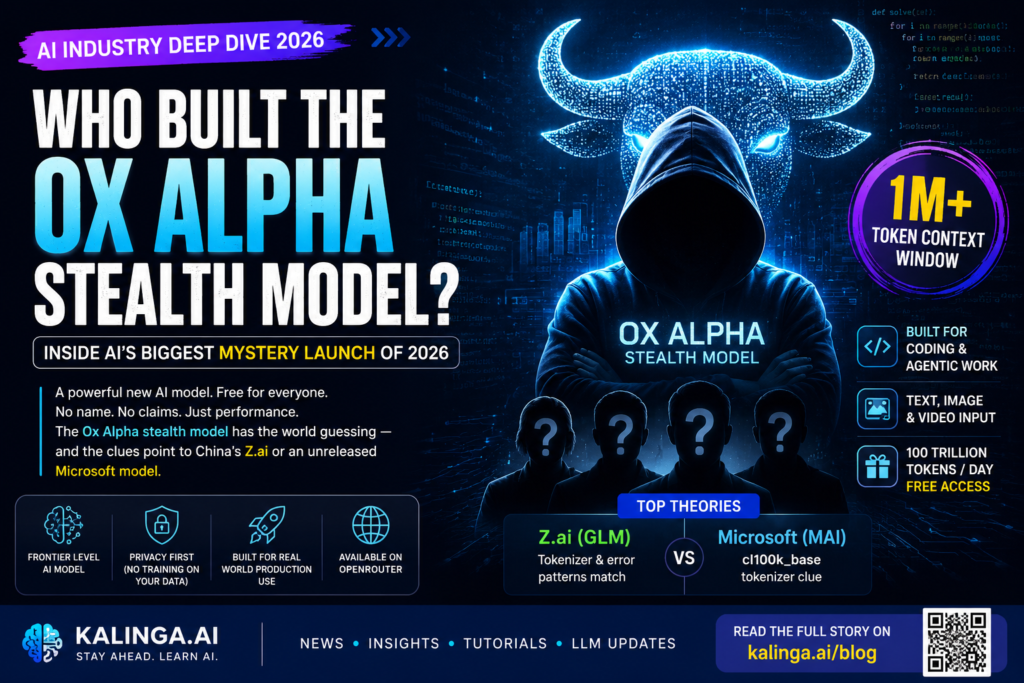
Imagine a brand-new AI model showing up online, beating expectations on coding tasks, offering a free ride to millions of developers, and refusing to say who made it. That is exactly what happened with the Ox Alpha stealth model. In short: Ox Alpha is an anonymous “stealth” AI system that appeared on the developer platform OpenRouter on August 20, 2026, and its creator has still not come forward, though technical clues point mainly toward China’s Z.ai or an unreleased Microsoft model.
If you’re a student, fresher, or young professional in Odisha tracking the AI industry, this story is worth understanding, not just as gossip, but as a lesson in how frontier AI labs actually test models before announcing them. Let’s break down what the Ox Alpha stealth model is, why nobody will claim it, and what the guessing game tells us about the AI industry in 2026.
What Is the Ox Alpha Stealth Model?
Ox Alpha is a free, high-capability AI model that appeared on OpenRouter, a marketplace that lets developers access hundreds of AI models through one interface, on August 20, 2026. OpenRouter’s own listing describes it as a reasoning model built for coding, long-running “agentic” work (tasks where an AI operates semi-independently across many steps), and production-level software use.
The specs are what got people’s attention. The Ox Alpha stealth model ships with a 1,048,576-token context window, roughly one million tokens, meaning it can process huge volumes of text, code, or documents in a single conversation. It also supports a maximum output of 131,072 tokens and, unusually, accepts text, image, and video as input. Multimodal video input is still rare among widely available models, which is part of why the Ox Alpha stealth model stood out immediately.
Perhaps the biggest hook: it’s completely free. OpenRouter’s provider notes state that the Ox Alpha stealth model does not train on user prompts or completions during this preview, and the anonymous provider has reportedly offered capacity for up to 100 trillion tokens a day, according to the open-source coding agent OpenCode. That is an enormous, almost implausible, amount of free compute to give away, which is exactly why so many people assumed a major, well-funded lab had to be behind it.
Why does a free, anonymous model matter to developers? Because it lets them stress-test a frontier-class system, one built for serious agentic coding, at zero cost, before the maker’s identity or long-term pricing is even known.
What Is a “Stealth Model” and Why Do AI Labs Use Them?
A stealth model is a frontier-level AI system released without public attribution, usually through a neutral routing platform like OpenRouter, so a lab can collect real-world usage data and feedback before formally announcing the model under its own brand. Think of it like a car manufacturer road-testing a new vehicle with camouflage wrapping, the product is real, but the badge is hidden.
Labs use this approach for a few practical reasons: to benchmark performance against rivals without tipping off competitors early, to gather large-scale feedback from real developers rather than internal testers, and to avoid the reputational risk of a public launch before the model is fully polished. According to reporting from Decrypt, this is not a new tactic, Z.ai (also known as Zhipu AI) has previously tested an earlier GLM model anonymously under a different codename before its official release.
Is a stealth model release unusual in the AI industry? Not really, it’s become a fairly standard pre-launch tactic among frontier labs, though the scale of free usage offered by the Ox Alpha stealth model is on the larger end of what’s been seen so far.
Timeline: How the Ox Alpha Stealth Model Mystery Unfolded
Here’s how the story moved from a quiet listing to an internet-wide guessing game:
- August 20, 2026: OpenRouter posts about the new “stealth model,” describing Ox Alpha as built for efficient coding, sustained agentic work, and real-world production use, with a 1M-token context window and multimodal input.
- August 20–21, 2026: The open-source coding tool OpenCode makes the Ox Alpha stealth model free for a week with near-unlimited usage, and developers begin running independent tests, including tokenizer “fingerprinting” to guess the model’s origin.
- Weekend of August 21–22, 2026: Speculation splits between two main camps online, one pointing to Z.ai’s GLM family based on tokenizer and error-pattern matches, another pointing to an unreleased Microsoft MAI model based on a different tokenizer clue (the cl100k_base encoding).
- August 23, 2026: TechCrunch reports that Stripe CEO Patrick Collison publicly called the Ox Alpha stealth model “very impressive” on X, adding fuel to the mystery given Stripe’s newly announced acquisition of OpenRouter.
- August 24, 2026 onward: Outlets including Bloomberg, Decrypt, and Wccftech publish competing analyses; benchmark testing (on a coding test called DeepSWE) suggests the model performs roughly on par with GPT-5.6 Sol rather than dramatically outperforming rivals, tempering some of the earlier hype.
Who Might Be Behind Ox Alpha? The Leading Theories
Nobody has confirmed ownership of the Ox Alpha stealth model, but independent developers have run technical tests, mainly “tokenizer fingerprinting,” which studies how a model breaks text into chunks called tokens, to narrow down the possibilities. Two theories have pulled ahead of the rest.
Which lab is most likely behind Ox Alpha? As of late August 2026, no theory is confirmed, but the strongest circumstantial evidence, matching tokenizer behavior and video-processing patterns, points to Z.ai’s GLM family, while a competing tokenizer analysis points instead to an unreleased Microsoft MAI model. Both cannot be true, and neither company has confirmed anything.
The case for Z.ai (Zhipu AI) rests on a few data points. Per Decrypt’s reporting, independent fingerprinting matched the Ox Alpha stealth model’s tokenizer to GLM-5.3 across normalized tests, and its video-token spend matched GLM-5V-Turbo exactly across sample clips. Z.ai also has precedent for anonymous testing and runs large GPU clusters that could plausibly support a big free giveaway. The counter-argument, raised in several reports, is that the sheer scale of free compute, up to 100 trillion tokens a day, feels large even for a well-resourced Chinese lab.
The case for Microsoft centers on a different clue entirely. Developer Robert Lukoszko argued on X that the Ox Alpha stealth model uses the cl100k_base tokenizer, an encoding originally built by OpenAI that also shows up in Microsoft’s Phi and MAI model lines, which would rule out Chinese frontier labs and most Western ones too, pointing instead to an unreleased “MAI-2” model. This theory gained attention partly because Microsoft has recently shipped a capable image-generation model, making a broader frontier push plausible.
Other names have been floated and mostly dismissed. Decrypt reported that Xiaomi’s MiMo v2.5 was ruled out because it accepts audio input, which Ox Alpha rejects, and that DeepSeek was ruled out because it has never shipped video capability and typically releases open weights rather than running stealth previews. Google and Alibaba’s Qwen were also considered and set aside due to mismatched tokenizers and video encoders. A smaller number of commentators have floated ByteDance’s Seed models or Cursor’s Composer running on xAI infrastructure, though these remain minority theories.
Comparison: The Leading Ox Alpha Theories
| Candidate | Key Supporting Evidence | Counter-Evidence | Precedent for Stealth Launch |
| Z.ai (GLM family) | Tokenizer matches GLM-5.3; video-token usage matches GLM-5V-Turbo exactly | Scale of free compute (100T tokens/day) seems very large to give away | Yes, GLM was reportedly tested anonymously before |
| Microsoft (MAI-2) | Uses cl100k_base tokenizer, linked to Microsoft’s Phi/MAI lineage | Conflicts directly with GLM tokenizer probes; no reproducible count table published | No confirmed prior stealth release from Microsoft |
| Xiaomi (MiMo) | Initially floated as a candidate | Ox Alpha rejects audio input; MiMo v2.5 accepts it | No |
| DeepSeek | Initially floated given its frontier reputation | No video capability shipped; typically releases open weights instead | No |
| Google / Qwen | Initially floated due to frontier-level performance | Different tokenizers and video encoders entirely | No |
Table based on technical claims reported by Decrypt, Wccftech, and other outlets as of August 24, 2026. None of these attributions has been confirmed by the companies named.
Why Is Stripe’s CEO Talking About Ox Alpha?
This is where the story gets an unexpected corporate twist. Stripe, the payments company, had just agreed to acquire OpenRouter itself, in a deal reported by The New York Times at roughly $7.5 billion, shortly before the Ox Alpha stealth model appeared. When Stripe co-founder and CEO Patrick Collison posted on X that Ox Alpha was “very impressive,” according to TechCrunch, it added a layer of intrigue: the head of the company about to own the platform hosting this mystery model was publicly endorsing it, without revealing who built it either.
Does Stripe’s OpenRouter acquisition affect the Ox Alpha mystery? Not directly, Stripe is acquiring the routing platform, not the model itself, and OpenRouter has stated it is not the developer, owner, or provider of Ox Alpha. But the timing put extra eyes on the story, since OpenRouter now sits at the center of two of the biggest AI-industry conversations of the month.
Stripe’s OpenRouter deal is significant in its own right: OpenRouter connects developers to more than 400 models from over 80 providers and processes trillions of tokens daily. Stripe framed the acquisition around helping businesses manage “the central currency for companies building with AI”, tokens, much like it already helps businesses optimize payments.
Should You Use the Ox Alpha Stealth Model? Key Considerations
If you’re a developer or student tempted to try the free Ox Alpha stealth model, it’s worth weighing a few practical points before you do:
- Data retention: According to OpenRouter’s own listing, prompts and completions sent to the Ox Alpha stealth model are retained by the anonymous provider, even though they aren’t used for training. Avoid sending anything sensitive, proprietary, or personal.
- Unknown accountability: Since nobody has confirmed ownership, there’s no public entity to hold accountable for uptime, data handling changes, or future pricing once the free preview ends.
- Performance claims need context: An early viral claim suggested the Ox Alpha stealth model beat top rivals on a coding benchmark called DeepSWE, but that came from a small 10-task sample; fuller 113-task runs reportedly placed it roughly level with GPT-5.6 Sol, not dramatically ahead.
- It’s a preview, not a product: OpenRouter frames Ox Alpha as a temporary, feedback-gathering release. Free access, generous token limits, and top billing are common in this early phase and are not guaranteed to continue.
- Good for learning, cautious for production: Testing the Ox Alpha stealth model for coursework, practice projects, or benchmarking curiosity is low-risk; wiring it into a production business workflow before its maker is confirmed is a different risk calculation entirely.
What the Ox Alpha Stealth Model Story Means for AI Learners in India
For students and young professionals building AI skills in Odisha and across India, the Ox Alpha stealth model saga is a useful real-world case study rather than just internet drama. It shows how frontier labs, whether based in China, the US, or elsewhere, actually validate models in the wild before a formal launch, using neutral platforms like OpenRouter as testing ground. It also shows how technically literate developers can investigate a model’s likely origin using tokenizer analysis and benchmark testing, skills that map directly onto applied AI and prompt-engineering learning paths.
Understanding stories like the Ox Alpha stealth model launch, and being able to read past the hype toward what’s actually confirmed versus speculated, is exactly the kind of AI literacy that turns casual model exploration into practical, employable skill. Watching how the AI community reasoned through incomplete evidence here is itself a mini-lesson in technical due diligence.
FAQ: Ox Alpha Stealth Model
What is the Ox Alpha stealth model? Ox Alpha is a free, anonymous AI model that appeared on OpenRouter on August 20, 2026, built for coding, agentic work, and production use, with a roughly one-million-token context window and support for text, image, and video input.
Who created the Ox Alpha stealth model? As of late August 2026, no company has confirmed building Ox Alpha. OpenRouter describes it only as coming from “a third-party provider who has chosen to remain anonymous during this preview.” The leading theories point to Z.ai’s GLM family or an unreleased Microsoft MAI model, but neither is confirmed.
Is the Ox Alpha stealth model free to use? Yes. OpenRouter lists Ox Alpha at zero cost during its preview window, and the provider has reportedly offered capacity for up to 100 trillion tokens a day, though this is a temporary arrangement rather than a permanent pricing plan.
Does the Ox Alpha stealth model train on user data? According to OpenRouter’s listing, the provider does not train on prompts or completions sent to the Ox Alpha stealth model, though it does retain them, so users should still avoid sharing sensitive information.
Why is Stripe CEO Patrick Collison connected to the Ox Alpha story? Collison publicly called the Ox Alpha stealth model “very impressive” on X around the same time Stripe was finalizing its roughly $7.5 billion acquisition of OpenRouter, the platform hosting the model, a coincidence of timing that added attention to the mystery, though Stripe has no confirmed connection to the model’s actual creator.
Is the Ox Alpha stealth model actually better than models like GPT-5.6 Sol? Not clearly. An early viral claim of it beating top rivals on the DeepSWE coding benchmark came from a small sample of just 10 tasks; more complete test runs across 113 tasks reportedly showed performance roughly level with GPT-5.6 Sol.
Keep Following the Story
The identity behind the Ox Alpha stealth model may well be confirmed in the coming weeks, stealth previews rarely stay anonymous forever. If you want to build the kind of applied AI skills that let you evaluate models like this one yourself, benchmarking, prompt design, and agentic workflows, explore Kalinga.ai’s AI training programs for students and young professionals across Odisha.