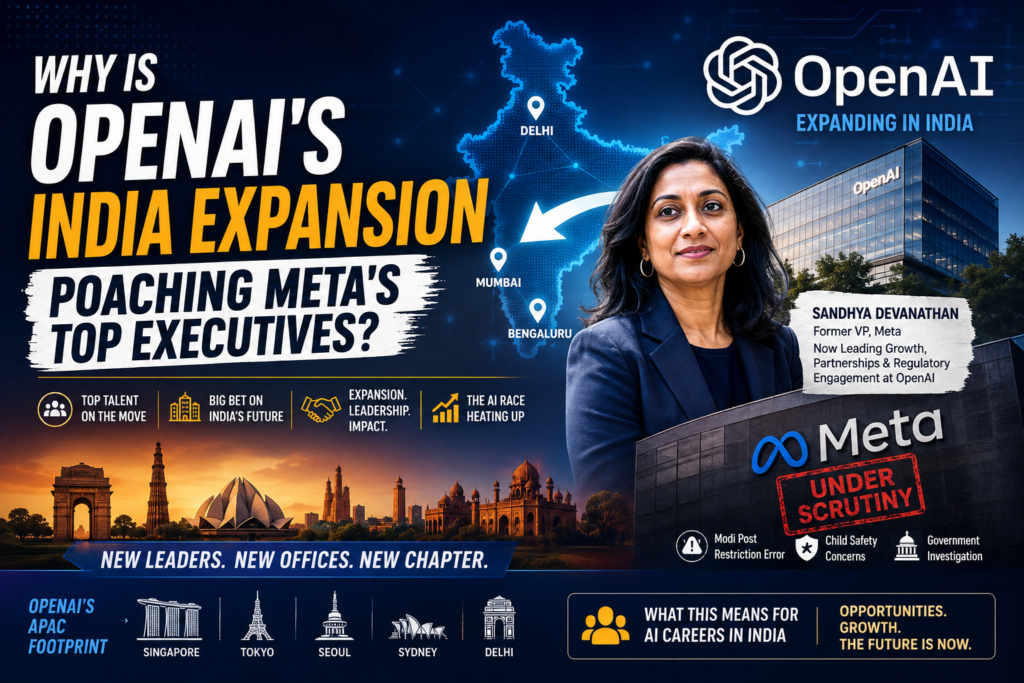
Imagine spending a decade building a company’s business in the world’s most populous country, only to watch its biggest AI rival hire you away in the same week regulators are grilling your old employer. That is exactly what happened to Sandhya Devanathan, and it is the clearest sign yet that OpenAI’s India expansion has moved from “opening an office” to “actively dismantling the competition’s leadership bench.” OpenAI confirmed to TechCrunch that Devanathan, Meta’s vice president for India and Southeast Asia, is leaving after more than ten years to join OpenAI, where she will help run consumer growth, enterprise adoption, and regulatory engagement across a huge swath of Asia-Pacific. OpenAI India expansion
For students, freshers, and young professionals tracking the AI job market in Odisha and across India, this is not just celebrity gossip about a tech executive switching sides. It is a real-time case study in how fast the AI industry is reshaping who leads it, where the jobs are, and which companies are betting the most on India as a growth market. This post breaks down what happened, why Meta is losing ground, and what OpenAI’s India expansion actually looks like on the ground.
If you have been following AI news even casually, you have probably noticed how often “India” comes up in the same sentence as “OpenAI” lately. That is not an accident. OpenAI’s India expansion has become one of the company’s most visible regional priorities in 2026, and this executive move is the clearest evidence yet of how seriously the company is taking the market.
Who Is Sandhya Devanathan and Why Does Her Exit Matter?
Sandhya Devanathan is a senior technology executive who joined Meta in 2016 and rose through leadership roles including running its Asia Pacific gaming business before being named vice president for India and Southeast Asia in June 2025. She is now moving to OpenAI, based in Singapore, where she will report to Kiran Mani, OpenAI’s Asia-Pacific managing director.
What will Devanathan actually do at OpenAI? She will oversee consumer growth, enterprise adoption, partnerships, regulatory engagement, and operations across Southeast Asia and Australia. That is a broad remit, and it signals OpenAI wants someone with real regulatory and market-building experience in the region, not just a product manager.
Her departure is significant for three reasons. First, she was reportedly involved in Meta’s internal decision-making process for India, meaning her exit strips the company of institutional knowledge at a sensitive moment. Second, it follows a pattern: OpenAI has now pulled two major regional leaders away from established consumer tech giants in the space of a couple of months. Third, it shows that OpenAI’s India expansion strategy is being built on hiring people who already know how to navigate India’s regulatory and business landscape, rather than starting from scratch.
Inside OpenAI’s India Expansion Strategy in 2026
OpenAI’s push into India and the wider Asia-Pacific region has been building for a while, and Devanathan’s hire is the latest data point in a much bigger pattern. Understanding this pattern matters if you are trying to predict where AI jobs, partnerships, and investment will land next.
What does “India expansion” actually mean for OpenAI? It means OpenAI is building out local leadership, physical offices, and dedicated regional strategy for India rather than serving the market remotely from the US. This is a meaningful shift because it signals long-term commitment, not just a temporary marketing push.
Here is what OpenAI’s India expansion has looked like so far:
- June 2026: OpenAI hired Prabhjeet Singh, formerly Uber’s India and South Asia chief of more than a decade, to lead its India operations as India head.
- August 2026: OpenAI confirmed Sandhya Devanathan, Meta’s VP for India and Southeast Asia, is joining to oversee growth and regulatory engagement across Southeast Asia and Australia.
- Physical footprint: Over the past two years, OpenAI has opened offices in Singapore, Tokyo, Seoul, Sydney, and Delhi, according to the company’s own announcements.
- Leadership pattern: Both major India-region hires came from companies with deep, hard-won experience navigating Indian regulation, logistics, and consumer behavior, Uber and Meta respectively.
This is not a coincidence. OpenAI’s India expansion depends on people who already understand how Indian regulators think, how Indian consumers adopt new tech, and how enterprise deals get done in the country. Poaching proven operators is faster than training new ones, and it is a strategy Big Tech has used for decades when entering a new, high-stakes market.
For anyone building a career in AI in India, this expansion pattern is worth watching closely. When a company like OpenAI commits senior leadership and physical offices to a region, it typically follows with hiring across product, sales, policy, and partnerships teams, not just at the top.
The Bigger Pattern Behind OpenAI’s India Expansion
It helps to zoom out and look at OpenAI’s India expansion as part of a broader industry trend, rather than as two isolated hiring decisions. Across the AI industry, companies are racing to secure leaders who already understand India’s regulatory system, its consumer behavior, and its enterprise buying cycles.
Why does OpenAI need experienced local leadership instead of hiring fresh talent and training them? Because India is a uniquely complex market, high user growth, active regulators, intense media scrutiny, and enormous language and cultural diversity, and getting it wrong can be costly. Experienced operators reduce that risk from day one.
Consider the sequence of events that makes up OpenAI’s India expansion so far in 2026:
- OpenAI had already opened physical offices across the Asia-Pacific region, including in Delhi, laying the infrastructure groundwork.
- In June 2026, it hired Prabhjeet Singh away from Uber to lead its India operations, bringing more than a decade of India and South Asia market experience.
- In August 2026, it confirmed Sandhya Devanathan’s move from Meta, adding another decade-plus veteran with deep India and Southeast Asia experience to its regional leadership.
Each step in OpenAI’s India expansion builds on the last. Offices create the physical presence, an India head sets local strategy, and a regional growth and regulatory leader connects that strategy to the rest of Asia-Pacific. This is a textbook enterprise expansion playbook, just executed at AI-industry speed.
It is also worth noting who is not getting mentioned in these stories: junior hires. Executive moves like Devanathan’s tend to happen first, with broader hiring across product, engineering, sales, and policy following months later once the leadership structure is in place. That is exactly the phase OpenAI’s India expansion appears to be entering now.
Why Is Meta Facing Growing Scrutiny in India?
Devanathan’s move away from Meta is happening against a backdrop of real regulatory pressure on the company in India, and that context matters for understanding why this particular executive exit is getting so much attention.
What is Meta actually being scrutinized for right now? Two major issues: a mistaken restriction of a Prime Minister Narendra Modi post on Instagram, and questions from the Indian government over child sexual abuse material (CSAM) appearing in Instagram advertisements.
Here is the timeline of what has happened:
- In July 2026, Instagram mistakenly restricted a post by Prime Minister Modi. Meta apologized for the error earlier this month, and the Indian government summoned Meta executives, including chief global affairs officer Joel Kaplan, to explain the incident.
- Last month, a BBC investigation found Instagram advertisements that allegedly offered access to child sexual abuse material. The Indian government sought a formal explanation from Meta over the report.
- Meta responded in a blog post stating it had removed the violating ads and accounts, and it rejected any suggestion that it knowingly targeted such advertisements based on inappropriate user interests. The company also said it had removed 160,000 accounts in India over six months based on signals of child-exploitative activity.
This is the environment Devanathan is leaving behind. While there is no public evidence tying her departure directly to these controversies, the timing places her exit squarely inside a period when Meta’s India leadership is under unusually intense pressure from regulators, journalists, and the public. Following her departure, Meta’s India managing director, Arun Srinivas, will now report directly to Benjamin Joe, the company’s vice president for Asia-Pacific, a structural change that consolidates reporting lines at a moment when the company needs clear accountability.
OpenAI vs. Meta in India: A Side-by-Side Comparison
If you are trying to make sense of how these two companies currently stack up in the Indian market, here is a snapshot based on what is publicly known as of late August 2026.
| Factor | Meta (India) | OpenAI (India) |
| Senior India leadership | Reporting lines consolidated under APAC VP Benjamin Joe after Devanathan’s exit | Prabhjeet Singh (India head) and Sandhya Devanathan (regional growth, based in Singapore) |
| Years of India-specific experience of top hires | Devanathan had a decade at Meta before leaving | Both recent hires bring 10+ years of India market experience from Uber and Meta |
| Recent regulatory pressure | High, Modi post restriction, CSAM ad concerns, executive summons | Not currently facing comparable public regulatory scrutiny in India |
| Physical office footprint in the region | Long-established presence | New offices opened in Delhi, Singapore, Tokyo, Seoul, and Sydney over the past two years |
| Public narrative in India right now | Defensive, responding to safety and content moderation concerns | Expansionary, actively hiring and building out regional leadership |
This table is a snapshot, not a permanent scoreboard, Meta remains a massive platform in India with hundreds of millions of users, and OpenAI’s on-the-ground presence is still young by comparison. But the direction of momentum, at least in terms of leadership hiring and public narrative, currently favors OpenAI’s India expansion.
What This Talent War Means for AI Careers in India
If you are a student, fresher, or early-career professional in Odisha or anywhere else in India, executive moves like this one are not abstract corporate drama, they are leading indicators of where hiring, investment, and opportunity are headed.
Here is what to take away from this story if you are thinking about your own AI career path:
- Global AI companies are betting real money on India. OpenAI’s decision to build a dedicated leadership structure for the region, rather than manage it remotely, usually precedes broader hiring across roles like partnerships, policy, sales, and technical support.
- Regulatory and trust-and-safety skills are increasingly valuable. Meta’s current struggles show how much scrutiny large AI and social platforms face in India around content moderation, child safety, and political neutrality, a growing field for people with legal, policy, or compliance backgrounds alongside tech skills.
- Experience matters more than titles. Both of OpenAI’s major India-region hires came with a decade or more of hands-on experience navigating the Indian market, not just AI-specific credentials. Building real operational and market experience, even outside a pure AI role, can position you for AI industry jobs later.
- Watch office announcements, not just product launches. When companies like OpenAI open physical offices in cities like Delhi, it is usually a stronger signal of upcoming hiring than a splashy product announcement.
- The AI talent war is a two-way street. Just as OpenAI is pulling talent from Meta, Meta and other companies will likely respond by strengthening their own India leadership, which could mean more open roles across the industry, not fewer.
Following OpenAI’s India expansion closely over the coming months, new office openings, new leadership hires, and how the company handles India-specific regulation, will give you an early read on where the AI job market in India is heading next.
Should students and freshers care about executive-level hiring news like this? Yes, because executive hires are usually the earliest visible signal of a company’s regional intent, well before job postings for entry-level roles appear. Tracking OpenAI’s India expansion at the leadership level today can help you time your applications and skill-building for the hiring wave that typically follows six to twelve months later.
Here is a simple way to think about it: when a global AI company commits senior leadership, dedicated offices, and public statements to a region, that region moves from “opportunistic market” to “strategic priority” in internal planning. OpenAI’s India expansion has clearly crossed that threshold in 2026, and the practical effect for job seekers is a growing pipeline of roles, not just in Bengaluru and Delhi, but potentially in emerging tech hubs like Bhubaneswar as companies look beyond the usual metro clusters for talent.
It is worth remembering that none of this happens in a vacuum. Meta is not the only company that has lost leadership to OpenAI this year, and OpenAI is not the only AI company aggressively hiring in Asia-Pacific. Google, Microsoft, and Amazon all maintain large India teams, and Anthropic has been expanding its own presence in the region as well. What makes OpenAI’s India expansion stand out right now is the speed and visibility of it, two senior, decade-plus veterans poached from major consumer platforms within a matter of weeks, paired with a five-city office buildout across the region. For anyone mapping out where the next wave of AI hiring will land, that combination of speed and visibility is exactly the kind of signal worth paying attention to.
Frequently Asked Questions
Who is Sandhya Devanathan, and why is she in the news? Sandhya Devanathan is Meta’s outgoing vice president for India and Southeast Asia. She is leaving after more than a decade at Meta to join OpenAI, where she will oversee consumer growth, enterprise adoption, and regulatory engagement across Southeast Asia and Australia.
What role will Devanathan have at OpenAI? She will be based in Singapore and report to OpenAI’s Asia-Pacific managing director, Kiran Mani, overseeing consumer growth, enterprise adoption, partnerships, regulatory engagement, and operations across Southeast Asia and Australia.
Is this OpenAI’s first major India-region hire from a rival company? No. Days before Devanathan’s move was confirmed, OpenAI hired Prabhjeet Singh, formerly of Uber, where he led the India and South Asia business for more than a decade, to serve as OpenAI’s India head.
Why is Meta facing scrutiny in India right now? Meta has faced pressure over two recent incidents: Instagram’s mistaken restriction of a post by Prime Minister Narendra Modi, for which the company apologized, and questions from the Indian government over Instagram advertisements that a BBC report alleged offered access to child sexual abuse material.
How has OpenAI’s India expansion progressed physically, not just in hiring? Over the past two years, OpenAI has opened offices in Singapore, Tokyo, Seoul, Sydney, and Delhi, building out a genuine regional footprint across the Asia-Pacific rather than managing the market remotely.
What does this mean for someone starting a career in AI in India? It signals that major AI companies are investing heavily in India-region leadership and infrastructure, which typically precedes broader hiring in roles spanning product, partnerships, policy, and trust and safety, areas worth watching closely for emerging opportunities.
Ready to Build Your Own AI Career Edge?
Executive moves like this one show how fast the AI industry is evolving in India, and how much value companies place on people who understand both the technology and the market. If you want to build practical, job-ready AI skills instead of just reading about the industry from the sidelines, explore Kalinga.ai’s AI training programs and workshops designed for students and young professionals across Odisha and India.