File Name: meta-teen-rules-tiktok-youtube.jpg
Title: Meta Teen Rules: TikTok and YouTube
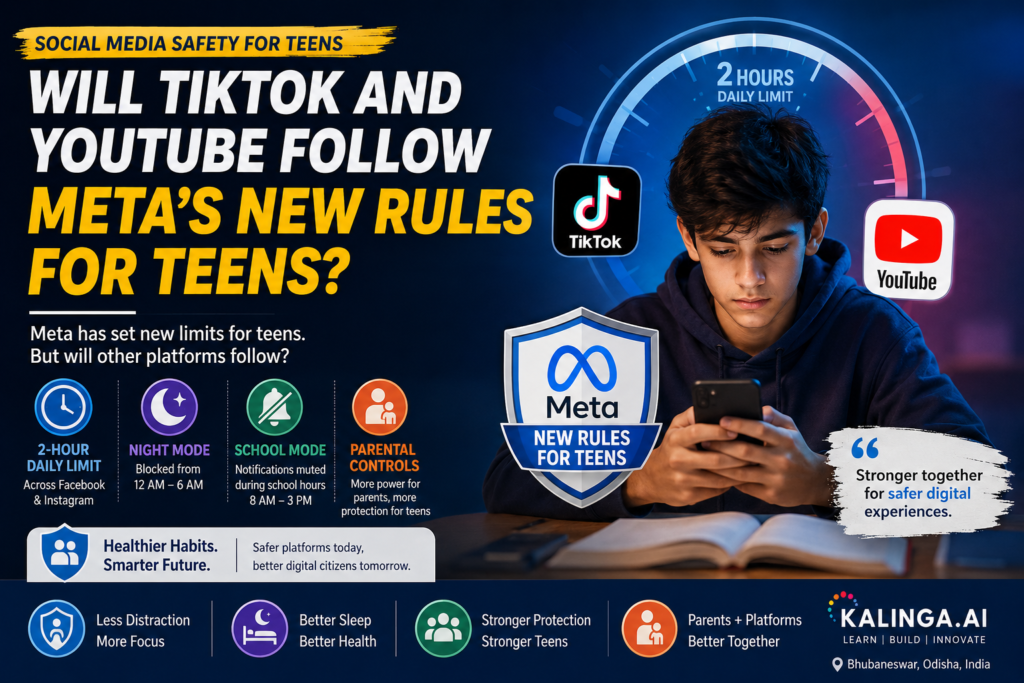
Caption: Meta’s new teen rules could reshape social media safety—but will TikTok and YouTube follow?
Description: A landscape editorial graphic showing a teenager using a smartphone alongside TikTok, YouTube, and Meta branding, with visual icons for daily time limits, night mode, school mode, and parental controls. The image highlights Meta’s push for industry-wide teen safety standards and the question of whether competing platforms will adopt similar restrictions.
Alt Text: Meta teen rules limiting social media use as TikTok and YouTube face pressure to follow
Planned H2/H3 structure
- What Are Meta’s New Rules for Teens?
- The two-hour daily limit
- Night Mode and School Mode
- Other protections for teen accounts
- Why Is Meta Asking TikTok and YouTube to Follow?
- Will TikTok Follow Meta’s Teen Rules?
- Will YouTube Follow Meta’s Teen Rules?
- Why Industry-Wide Teen Rules Are Difficult
- Meta vs. TikTok vs. YouTube: What Could Change?
- What Does This Mean for Teenagers and Parents in India?
- The Bigger Question: Can Platform Rules Actually Reduce Harm?
- FAQ About Meta’s New Rules for Teens
- The Bottom Line
Focus Keywords
- Primary keyword: Meta teen rules
- Secondary keyword: TikTok teen rules
- Secondary keyword: YouTube teen rules
- Secondary keyword: social media safety for teens
- Secondary keyword: teen social media limits
A two-hour daily limit sounds straightforward. The harder question is what happens when a teenager simply opens TikTok or YouTube after Instagram shuts them out.
That is exactly the problem Meta is trying to solve. Following a settlement with U.S. state attorneys general, Meta has agreed to introduce stricter protections for teenagers on Facebook and Instagram and is asking TikTok and YouTube to adopt similar standards. Whether those companies actually follow Meta’s lead is far less certain.
What Are Meta’s New Rules for Teens?
Meta teen rules are a proposed set of restrictions and parental controls designed to reduce how much time teenagers spend on Facebook and Instagram and limit access during periods such as late night and school hours.
The changes are part of Meta’s agreement with a bipartisan group of U.S. state attorneys general. TechCrunch reported that the agreement is tied to an $18 billion settlement over allegations concerning social media harms to children. The protections are expected to remain in place for 10 years, pending judicial approval.
Meta says the new framework is intended to establish a broader industry standard rather than simply change Instagram and Facebook.
The two-hour daily limit
The most visible part of the Meta teen rules is a default two-hour daily time limit for teenagers using Facebook and Instagram.
The limit is cumulative, meaning time spent across both platforms counts toward the same two-hour allowance. Once the limit is reached, teenagers would be locked out unless the restriction is disabled with parental permission.
Question → Direct Answer: Is the two-hour limit only for Instagram?
No. According to Meta’s settlement terms, the limit applies cumulatively across Facebook and Instagram, rather than giving teenagers two separate hours on each platform.
Meta is also adding more frequent usage prompts. Teenagers will receive reminders after every 15 minutes of continuous use, alongside existing notifications about total daily usage.
The idea is not simply to stop teenagers from using social media. It is to make prolonged, automatic scrolling more deliberate.
Night Mode and School Mode
The Meta teen rules go beyond a daily timer.
Meta says its new default Night Mode will block underage users from accessing, posting or viewing content on its platforms between midnight and 6 a.m. Notifications will also be blocked during that period.
During school hours, Meta plans to mute most notifications between 8 a.m. and 3 p.m. Direct messages and account-security or safety alerts are exceptions.
Question → Direct Answer: Why block notifications during school hours?
The goal is to reduce interruptions that can pull teenagers back into social platforms during school. Meta’s argument is that a consistent industry approach would work better because teenagers can otherwise switch to another app when one platform becomes restrictive.
Other protections for teen accounts
The proposed changes are not limited to time management.
Meta also plans to:
- Allow parents and teenagers to turn off autoplay.
- Hide like and reaction counts by default for underage users.
- Restrict access to what Meta calls extreme makeup filters.
- Strengthen technology for identifying users who may actually be teenagers despite entering an adult birth date.
- Continue default private-account protections and restrictions on suspicious adult interactions.
Definition + Expansion: Teen account
A teen account is a social-media account configured with additional protections because the platform identifies the user as a minor.
These protections can include limits on who can contact the user, what content can be recommended, and how much control parents have over settings. Meta has already introduced Teen Accounts, and its latest agreement expands the restrictions around time, notifications and nighttime access.
The important shift is that Meta is moving from optional controls toward default restrictions for teenagers.
Why Is Meta Asking TikTok and YouTube to Follow?
Meta’s argument is simple: restrictions on one platform may have limited impact if teenagers can immediately move to another.
Imagine a teenager reaches the two-hour limit on Instagram. Instead of putting the phone down, they could open TikTok, watch YouTube Shorts, or move between several other apps.
That is why Meta’s open letter explicitly calls on TikTok and YouTube to introduce similar measures. Meta says the protections will only be truly effective if major platforms adopt the same approach.
Question → Direct Answer: What does Meta want TikTok and YouTube to copy?
Meta is asking them to adopt a two-hour daily limit, nighttime access restrictions, school-hour notification restrictions and 15-minute usage prompts, alongside stronger parental controls.
Meta’s proposal therefore turns a platform-specific safety debate into an industry-wide one.
That distinction matters.
If Instagram limits teenagers while TikTok and YouTube remain unrestricted, the overall amount of screen time may not change much. The teenager could simply redistribute that time.
Will TikTok Follow Meta’s Teen Rules?
The answer is uncertain.
There is already evidence that TikTok has been developing tools aimed at reducing excessive use and protecting younger users. But adopting the exact Meta teen rules would represent a much more significant commitment.
TikTok reached a separate $400 million settlement with the U.S. Department of Justice in August 2026 over allegations involving children’s privacy. The agreement includes stronger age-related controls, additional safeguards for children and greater parental oversight, although TikTok did not admit wrongdoing.
That means TikTok is already under pressure to strengthen protections for young users.
But stronger child-safety measures do not necessarily mean TikTok will accept Meta’s proposed two-hour industry standard.
TikTok already has screen-time controls
TikTok has previously introduced tools intended to help users manage screen time, including reminders and controls designed to encourage breaks.
The distinction is important.
A voluntary screen-time reminder is not the same thing as a default two-hour lockout that requires parental permission to bypass.
Question → Direct Answer: Does TikTok already have tools for limiting teen usage?
Yes. TikTok has offered screen-time management and safety features, but the existence of those tools does not mean the company has agreed to adopt Meta’s proposed framework.
For TikTok, the business question is complicated. The platform’s recommendation system is built around keeping users engaged with a continuous stream of short-form videos. A mandatory daily ceiling could directly affect how users consume the service.
That does not prove TikTok will reject Meta’s proposal. It does explain why copying the exact framework could be commercially and technically significant.
Will YouTube Follow Meta’s Teen Rules?
YouTube faces a different situation because it serves a much broader range of users and content.
A teenager might use YouTube for entertainment, music, tutorials, schoolwork or technical education. A blanket restriction therefore raises a different question: should watching a 20-minute educational video count exactly the same way as scrolling through short-form entertainment?
YouTube has already been experimenting with parental controls.
In January 2026, for example, YouTube introduced a feature allowing parents to set a timer for children’s Shorts viewing and even block Shorts altogether on connected children’s accounts.
YouTube has also expanded parental supervision tools for teenagers. In 2024, it introduced a system allowing parents to link their account to a teenager’s account and receive information about activities such as uploads, subscriptions and comments.
Question → Direct Answer: Does YouTube already have teen safety controls?
Yes. YouTube already provides several parental and screen-management tools, but those tools are not the same as agreeing to Meta’s proposed industry-wide two-hour limit and nighttime lockout.
That difference could become central to the debate.
Why Industry-Wide Teen Rules Are Difficult
The biggest obstacle may not be technology. It may be incentives.
Every platform has a reason to keep users engaged. More viewing can mean more opportunities for advertising, subscriptions, creator activity and interaction.
A universal limit changes that equation.
Definition + Expansion: Industry-wide standard
An industry-wide standard is a common set of rules adopted by multiple companies rather than a restriction imposed by only one platform.
In this case, the proposed standard would mean teenagers face broadly similar limits across major social platforms. The theory is that common rules prevent users from escaping one platform’s restrictions simply by moving to another.
The concept sounds logical, but implementation raises several difficult questions.
1. What counts as social-media time?
Suppose a teenager spends 90 minutes watching TikTok entertainment and another 90 minutes watching educational YouTube videos.
Should both be counted equally?
A platform-wide standard would need clear definitions.
2. Who verifies age?
Age assurance means determining whether someone is actually within a particular age group.
That is difficult because users can enter incorrect birthdays, share devices or create multiple accounts.
Meta says it is investing in technology to identify accounts that may belong to teenagers even when an adult birth date has been provided.
3. What happens across multiple devices?
A teenager might watch YouTube on a phone, TikTok on a tablet and Instagram on another device.
If every platform has its own two-hour timer, the teenager could theoretically receive two hours on each service.
That is very different from a true industry-wide two-hour limit.
4. What about different countries?
The current Meta agreement concerns U.S. states and territories.
The rules therefore cannot automatically be treated as a global policy for every teenager using Instagram, Facebook, TikTok or YouTube.
For Indian users, especially, the immediate question is less about whether these exact U.S. restrictions apply and more about whether major platforms eventually introduce similar protections globally.
Meta vs. TikTok vs. YouTube: What Could Change?
The three platforms already approach teen safety differently.
| Platform | Current direction | Meta’s proposed industry standard | Biggest challenge |
| Meta | Stronger default teen protections | Two-hour limit, Night Mode, school-hour notification restrictions | Implementing and enforcing age-based restrictions |
| TikTok | Screen-time and child-safety tools | Two-hour limit and broader restrictions | Balancing engagement with stronger limits |
| YouTube | Parental controls and Shorts limits | Two-hour limit and nighttime restrictions | Distinguishing entertainment from educational use |
The table highlights an important point: following Meta does not simply mean adding another timer.
Each platform would have to integrate the restrictions into its own recommendation systems, account architecture, parental controls and age-assurance technology.
The business incentive problem
There is also a competitive issue.
If one platform becomes significantly more restrictive than another, teenagers may spend more time on the less restrictive service.
Meta itself makes this argument in its open letter, saying teenagers move between many apps and that restrictions on one service can simply push them elsewhere.
Question → Direct Answer: Why would platforms want a common standard?
A common standard could reduce the competitive disadvantage of being the platform with the strictest teen restrictions. If everyone follows roughly the same rules, no major platform has to worry as much about losing teen engagement solely because it imposed stronger safeguards.
That is the strongest argument for coordination.
But there is another side.
If TikTok or YouTube believes it can differentiate itself through fewer restrictions, it may have little commercial reason to voluntarily copy a competitor’s limits.
That is why the podcast team’s skepticism is significant. TechCrunch’s Equity team questioned whether TikTok and YouTube would actually follow Meta’s request.
What Does This Mean for Teenagers and Parents in India?
The immediate legal framework comes from the United States, so Indian teenagers should not assume that the new Meta teen rules automatically apply to their accounts.
However, the underlying debate is global.
Indian students increasingly use platforms such as YouTube and Instagram for entertainment, communication, tutorials, exam preparation, coding lessons and career content. A restriction designed around social-media harm therefore has to account for the fact that not all screen time has the same purpose.
Question → Direct Answer: Should parents in India wait for platforms to introduce stricter rules?
No. Parents can already use device-level and platform-level controls to establish boundaries instead of waiting for an industry-wide standard.
A practical approach is to:
- Set reasonable daily screen-time expectations.
- Keep phones away during study sessions.
- Use existing parental controls on social platforms.
- Disable unnecessary notifications.
- Establish a device-free bedtime.
- Discuss why recommendation feeds can encourage continuous scrolling.
- Treat educational video use differently from passive entertainment where appropriate.
- Review privacy and account settings periodically.
For students, the most useful lesson is not simply “social media is bad.”
It is that platform design influences behaviour.
Autoplay, recommendation feeds, notifications and infinite scrolling are designed to make continued use easy. Learning how those systems work can help young users make more deliberate choices.
The Bigger Question: Can Platform Rules Actually Reduce Harm?
The new Meta teen rules raise a bigger issue: can technical restrictions solve social-media problems on their own?
Probably not.
A two-hour limit can reduce access. A nighttime block can protect sleep hours. Muting notifications can reduce interruptions.
But none of those measures automatically addresses every potential problem associated with social media.
A teenager can spend two hours on a harmful feed just as easily as they can spend two hours watching educational content.
Time is only one part of the equation
Consider two hypothetical users.
One spends 90 minutes learning Python through videos and another spends 90 minutes endlessly scrolling short-form content.
Both have used the same amount of screen time.
But the experience, purpose and outcome may be completely different.
That does not make time limits useless. It means time should be treated as one safety signal, not the entire definition of healthy technology use.
Recommendation algorithms matter too
Recommendation algorithms are systems that select and rank content based on signals such as user behaviour, interests and engagement.
They are central to TikTok, YouTube and Meta’s products.
A teen might open an app intending to watch one video and then receive a sequence of increasingly relevant recommendations. The friction required to continue watching is extremely low.
That is where prompts and autoplay controls become interesting.
Meta plans to allow parents and teenagers to disable autoplay, requiring a deliberate action before additional content appears.
The design principle is simple: introduce a small pause between one piece of content and the next.
That pause may not solve every problem, but it changes the default behaviour.
Why the Meta Settlement Could Matter Beyond Facebook and Instagram
The most important part of this story may not be the $18 billion figure.
It may be the attempt to establish common expectations across competing technology companies.
Meta is effectively saying that protecting teenagers is difficult when platforms operate independently. If one service imposes strict limits while another does not, young users can simply move.
That argument could influence future debates about social-media regulation.
It also creates an unusual situation where a technology company is asking its competitors to impose restrictions that could potentially reduce engagement.
Question → Direct Answer: Is Meta creating a universal social-media law?
No. Meta’s agreement is a settlement framework connected to U.S. state-level legal action, not a universal law governing every social platform worldwide. Meta is separately asking TikTok and YouTube to adopt similar measures voluntarily.
That distinction matters.
A voluntary industry standard is different from legislation. It also means the final outcome depends heavily on whether competitors believe cooperation is in their interest.
What Could Happen Next?
There are several plausible outcomes.
Scenario 1: TikTok and YouTube adopt similar rules
This would be the clearest victory for Meta’s proposal.
Teenagers could encounter similar time, nighttime and notification restrictions across major platforms. That would make it harder to escape one platform’s limits simply by switching apps.
Scenario 2: They introduce different versions
This may be more realistic.
TikTok could introduce stricter short-video limits, while YouTube could distinguish Shorts from long-form educational content. Both companies could claim to support teen safety without copying Meta exactly.
Scenario 3: Companies resist a common standard
TikTok and YouTube could argue that they already have safety and parental-control systems and that a universal two-hour rule is too blunt.
That would leave Meta with stronger restrictions while the broader ecosystem remains fragmented.
Scenario 4: Governments create additional requirements
If voluntary measures fail to produce consistent protections, regulators could pursue their own rules.
That would shift the conversation from “Will platforms cooperate?” to “What should platforms legally be required to do?”
For technology companies, that could ultimately be a much more consequential debate.
What Should Young Users Take Away?
The discussion around Meta teen rules can easily become a fight between “social media is harmful” and “social media is useful.”
The reality is more complicated.
Social platforms can help young people discover educational resources, follow creators, communicate with friends, build communities and learn about careers.
At the same time, endless feeds, notifications and recommendation systems can make it difficult to stop using them.
A healthier approach is to understand the technology rather than simply fear it.
For students and young professionals, that means asking:
- Why am I opening this app?
- How long did I intend to use it?
- What content is the recommendation system showing me?
- Did I choose to continue watching, or did autoplay do it for me?
- Are notifications interrupting my study time?
- Am I using the platform for learning, communication or simply habit?
- Would I still open the app if notifications were disabled?
Those questions are useful regardless of whether TikTok and YouTube eventually adopt Meta’s framework.
FAQ: Meta’s New Rules for Teens
What are Meta’s new rules for teens?
Meta’s new teen protections include a default two-hour daily limit across Facebook and Instagram, a default nighttime block from midnight to 6 a.m., muted notifications during school hours, 15-minute usage prompts and additional parental controls, subject to judicial approval.
Will TikTok adopt Meta’s teen rules?
It has not been established that TikTok will adopt Meta’s exact framework. Meta has publicly asked TikTok and YouTube to introduce similar time limits, nighttime restrictions, school-hour notification controls and usage prompts.
Will YouTube adopt Meta’s teen rules?
There is no confirmation that YouTube will adopt Meta’s exact two-hour framework. YouTube already offers parental controls, including tools that allow parents to limit or block Shorts viewing on connected children’s accounts.
Why does Meta want TikTok and YouTube to follow the same rules?
Meta argues that teenagers move between multiple apps, so restricting only Instagram and Facebook could simply shift usage to TikTok, YouTube or another platform. Meta says common standards would make the protections more effective.
Do these Meta teen rules apply to teenagers in India?
The agreement described by Meta concerns under-18 users in participating U.S. states and territories, pending judicial approval. It should not be assumed that the same settlement requirements automatically apply to teenagers in India.
Are time limits enough to make social media safer for teenagers?
Time limits can reduce exposure and encourage breaks, but they are only one part of social-media safety. Age assurance, recommendation systems, privacy controls, content moderation, parental involvement and platform design also influence the experience.
The Bottom Line
Meta’s new teen rules could become an important test of whether competing social-media companies are willing to accept common restrictions for younger users. Meta has committed to stronger limits on Facebook and Instagram and is asking TikTok and YouTube to follow the same model.
But for now, the biggest unanswered question remains the simplest one: will TikTok and YouTube actually follow Meta’s lead?
The answer will determine whether this becomes a genuine industry-wide shift or simply another set of protections that varies from one social platform to another.
For students and young professionals, the broader lesson is worth watching: the future of social media may increasingly be shaped not only by what platforms want users to watch, but also by how governments, parents and technology companies decide when young users should stop scrolling.
Meta Title
Meta Teen Rules: Ultimate 2026 Guide to Safer Social Media
Meta Description
Meta teen rules could reshape social media safety, but TikTok and YouTube may not follow. See what parents and teens need to know.
SEO Meta Configuration
Keyword Categorization
Primary Keyword:
- Meta teen rules
Secondary Keywords:
- TikTok teen rules
- YouTube teen rules
- social media safety for teens
- teen social media limits
LSI / Long-Tail Keywords:
- will TikTok follow Meta teen rules
- will YouTube follow Meta teen rules
- Meta rules for teenagers 2026
- social media time limits for teens
URL Slug: meta-teen-rules-tiktok-youtube