File Name: humanoid-robots-chinese-automakers.jpg
Title: Humanoid Robots Transform Chinese Automakers
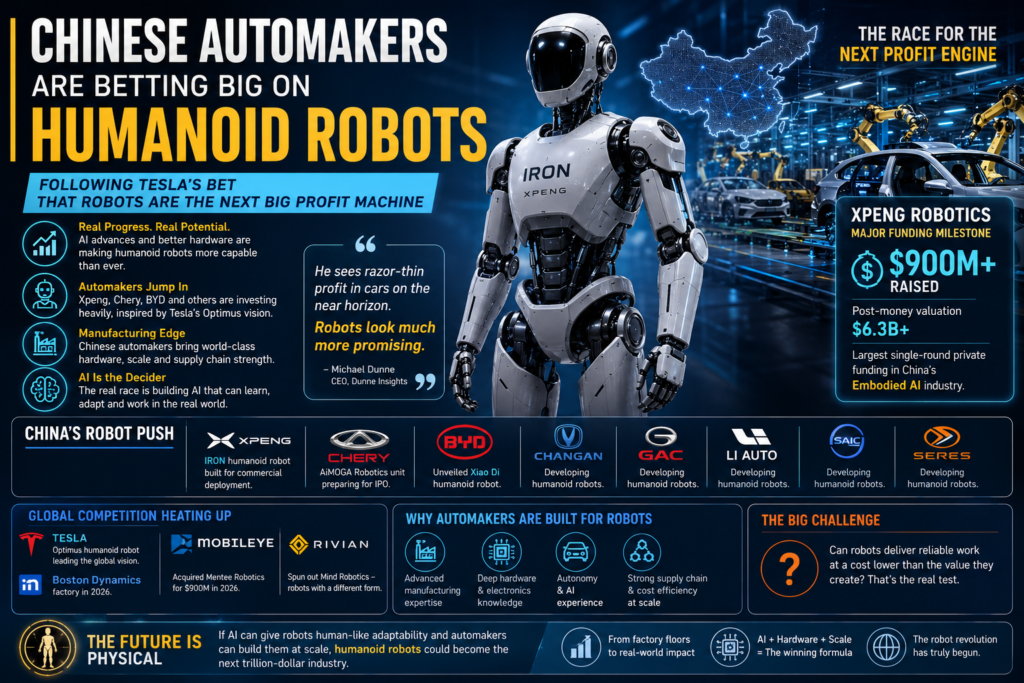
Caption: Chinese automakers are betting that humanoid robots could become the next major profit engine beyond cars.
Description: This landscape featured image depicts a futuristic humanoid robot working inside an advanced automotive factory, surrounded by vehicles and robotic manufacturing equipment. The visual represents the growing race among Chinese automakers such as Xpeng, BYD and Chery to develop humanoid robots powered by AI, highlighting the convergence of automotive manufacturing, robotics and embodied AI.
Alt Text: Humanoid robots from Chinese automakers compete with Tesla in the race for AI-powered machines
Planned structure:
- Why Chinese automakers are entering humanoid robotics
- Tesla’s Optimus bet and the changing auto industry
- Xpeng’s major investment in humanoid robots
- Why Chinese automakers have a manufacturing advantage
- What Xpeng, Chery, BYD and other automakers are building
- Can automotive AI skills transfer to humanoid robots?
- How Hyundai, Boston Dynamics and Mobileye are competing
- The biggest challenge: turning robots into profitable products
- What the humanoid robot race means for the future
- FAQ
Focus Keywords:
- Primary Keyword: humanoid robots
- Secondary Keywords: Chinese automakers, Xpeng robotics, Tesla Optimus, embodied AI
- LSI / Long-Tail Keywords: why Chinese automakers are building humanoid robots, how humanoid robots could become profitable, Chinese car companies investing in robots, future of humanoid robots
Why Are Chinese Automakers Betting on Humanoid Robots?
What if the next major profit opportunity for a car company isn’t another electric vehicle, but a robot that can walk into a factory and do the work of a human?
That possibility is becoming harder to dismiss. Chinese automakers are increasingly investing in humanoid robots, following a path that Tesla has already made highly visible with its Optimus project. Xpeng, Chery, BYD and several other Chinese automotive companies are now developing robots, betting that advances in artificial intelligence and manufacturing could eventually turn machines into a major commercial business.
The strategy makes sense on paper: automakers already know how to build complex machines at scale, while modern AI could give those machines the ability to learn and perform a wider range of tasks.
But there is a major question underneath the excitement: can the manufacturing expertise that makes a good car also help create a profitable humanoid robot?
The answer is still uncertain. The physical capabilities of robots are improving, and researchers increasingly believe AI techniques associated with large language models could help robots learn complex tasks. Yet moving from impressive demonstrations to reliable commercial deployment remains a much harder challenge.
Why Are Chinese Automakers Entering the Humanoid Robot Race?
The rise of humanoid robots is not happening in isolation from the automotive industry.
For years, automakers have invested heavily in automation, sensors, artificial intelligence, autonomous driving and advanced manufacturing. Those technologies overlap with many of the capabilities required to build sophisticated robots.
A humanoid robot needs motors, batteries, sensors, cameras, processors, software and mechanical components. A modern vehicle requires many of the same broad categories of technology, even though the engineering requirements are very different.
That gives established automakers a potential starting advantage.
Definition + Expansion: Embodied AI
Embodied AI refers to artificial intelligence systems that operate directly through physical machines, allowing software to perceive and act in the real world.
A chatbot operates primarily in a digital environment. An embodied AI system has to deal with gravity, objects, people, surfaces, movement and unexpected situations.
That difference is crucial for humanoid robots. A robot can understand an instruction in language, but understanding the instruction is only the beginning. It must also determine how to move its body, identify objects, manipulate them and respond when something does not go according to plan.
The industry is betting that increasingly capable AI models can eventually make this process much more flexible.
Question → Direct Answer: Why are car companies interested in robots?
Chinese automakers are interested in robots because they already possess extensive manufacturing and hardware capabilities while also investing in AI and autonomy. That combination could help them compete in a market where physical manufacturing and intelligent software are both essential.
There is also a business argument.
The automotive industry is highly competitive, and the source article describes car profits as potentially thin in the near future. Robots, by contrast, are being viewed by some executives and investors as a potentially much larger opportunity.
Tesla Helped Make the Robot Bet Mainstream
Tesla has played a major role in turning humanoid robots into a mainstream technology story.
The company’s Optimus robot has become one of the most recognizable examples of the idea that an automaker could eventually become a robotics company as well.
That vision has attracted attention from competitors.
According to Michael Dunne, CEO of advisory firm Dunne Insights, Xpeng is the Chinese automaker most closely following Tesla’s initiatives in this area.
Dunne told TechCrunch that Xpeng is particularly focused on autonomy and was the first among Chinese automakers to commit heavily to humanoid robots.
The thinking is straightforward: if cars become a lower-margin business, a successful robot business could provide another path to growth.
Question → Direct Answer: Is Xpeng copying Tesla?
Xpeng is clearly pursuing a strategy that resembles Tesla’s broader combination of automotive manufacturing, autonomy and humanoid robotics, but the company is developing its own robot and robotics business.
Xpeng founder He Xiaopeng is described in the source as a technology entrepreneur known for moving quickly and adjusting strategy.
That willingness to move early may matter in a market where companies are still determining what successful commercial robots will look like.
Xpeng Is Making a Major Financial Bet on Humanoid Robots
The scale of Xpeng’s recent robotics investment shows that this is more than a side project.
Earlier in the week covered by the source article, Xpeng’s robotics unit raised more than $900 million at a post-money valuation of more than $6.3 billion.
The funding round was led by IDG Capital and included participation from Gaorong Ventures, Tencent and Alibaba.
Xpeng described the financing as the largest single-round private financing recorded in China’s embodied AI industry.
That is a substantial amount of capital for a robotics business, especially one whose commercial future is still developing.
The company’s bet centers on Iron, a humanoid robot designed with a realistic human shape and intended for commercial deployment.
The strategy is not simply to build a robot that looks impressive in demonstrations. The stated goal is to eventually create something that can perform useful work.
That distinction separates robotics research from robotics businesses.
A research robot can demonstrate that a particular movement is possible.
A commercial robot needs to perform reliably, repeatedly and economically.
Xpeng’s founders are investing personally
The commitment also extends to Xpeng’s leadership.
According to the Wall Street Journal, He Xiaopeng and Xpeng co-president Brian Gu invested approximately $100 million of their own funds into the recent fundraising round.
That personal financial commitment is another signal of how seriously the company’s leadership views robotics.
It does not guarantee success.
But it demonstrates that Xpeng’s robotics strategy is not being treated as a small experimental project.
Why Chinese Automakers May Have a Manufacturing Advantage
Building humanoid robots is not only an AI problem.
It is also a manufacturing problem.
A robot needs thousands of physical components to work together. Its motors need to move accurately. Its sensors need to function reliably. Its batteries need to provide enough energy. Its mechanical systems need to withstand repeated movement.
And ultimately, the machine has to be manufactured at a cost that makes commercial deployment economically viable.
This is where Chinese automakers may have an advantage.
Michael Dunne told TechCrunch that Chinese automakers already have much of the hardware expertise required to build sophisticated physical products.
That does not mean they automatically have the best robotics AI.
It means they may be well positioned to manufacture robots once the underlying technology becomes mature enough.
Question → Direct Answer: What is China’s biggest advantage in humanoid robotics?
A major potential advantage is manufacturing expertise. Chinese automakers already operate complex production systems and have experience building vehicles at scale, giving them a foundation for producing sophisticated physical machines.
But hardware is only half of the equation.
As Dunne put it, the question is whether these companies can catch Tesla on the AI side.
That may be the harder challenge.
The AI Problem Could Be More Important Than the Hardware
A robot can have excellent motors and mechanical components and still be nearly useless if it cannot understand its environment or perform tasks reliably.
This is where embodied AI becomes critical.
Large language models have demonstrated that AI systems can learn complex patterns from enormous quantities of data. Researchers now believe similar AI techniques could help physical machines learn tasks rather than requiring engineers to manually program every movement.
Imagine telling a robot to move a box from one part of a warehouse to another.
A traditional automated system might be designed specifically for that workflow.
A more advanced AI-powered robot could potentially learn how to identify the box, navigate around obstacles, pick it up and place it somewhere else.
That flexibility is the promise.
But real-world environments are messy.
A box may be heavier than expected.
The floor may be slippery.
Another person may walk into the robot’s path.
The object could be placed differently from the previous example.
A successful commercial robot has to cope with those variations.
Question → Direct Answer: Why is AI so important for humanoid robots?
AI could allow robots to learn and adapt to a wider range of tasks instead of relying entirely on manually programmed instructions. That flexibility could be essential if companies want robots to work in unpredictable real-world environments.
This is why the competition is not simply about who can build the strongest robot.
It is also about who can build the most capable robotic intelligence.
Xpeng Is Not Alone in China
The growth of humanoid robots among Chinese automakers extends well beyond Xpeng.
The source identifies several other companies entering the field.
Chery Automobile’s robotics unit, AiMOGA, reportedly began preparing for an IPO in August 2026.
BYD has unveiled a humanoid robot called Xiao Di.
Other Chinese automakers,including Changan, GAC, Li Auto, SAIC and Seres,are also developing humanoid robots.
That creates the possibility of a much broader Chinese robotics ecosystem.
Instead of one automaker experimenting with robots, multiple automotive companies could be developing competing platforms simultaneously.
This could increase investment, engineering talent and manufacturing capacity across the sector.
It could also intensify competition.
A growing automotive robotics landscape
| Company | Robotics initiative | Strategic focus described in source |
| Xpeng | Iron | Humanoid robot for commercial deployment |
| Chery | AiMOGA | Robotics unit preparing for reported IPO |
| BYD | Xiao Di | Humanoid robot |
| Changan | Humanoid robotics | Developing humanoid robots |
| GAC | Humanoid robotics | Developing humanoid robots |
| Li Auto | Humanoid robotics | Developing humanoid robots |
| SAIC | Humanoid robotics | Developing humanoid robots |
| Seres | Humanoid robotics | Developing humanoid robots |
The important takeaway is that China’s automotive robotics push is not dependent on a single company.
It is becoming a broader industry trend.
The Global Competition Is Much Bigger Than China vs. Tesla
While Tesla has helped popularize the automotive humanoid robot strategy, it is far from the only company working toward commercial deployment.
Several robotics companies are pursuing similar goals, including Agility Robotics, Apptronik and Figure.
These companies have different backgrounds from traditional automakers, but they are chasing a similar objective: putting capable robots into real commercial environments at scale.
That creates an interesting competitive dynamic.
Automakers may have manufacturing advantages.
Dedicated robotics companies may have deeper experience in robotic systems.
AI companies may have advantages in machine learning.
The eventual winners could therefore come from several different parts of the technology industry.
Question → Direct Answer: Will automakers automatically win the robot race?
No. Manufacturing expertise is valuable, but successful humanoid robots also require advanced AI, robotics engineering, reliable hardware and commercially useful applications.
That means automotive companies have a strong starting position, but not a guaranteed path to leadership.
Hyundai Is Building Its Own Robotics Strategy
Chinese automakers are not the only vehicle companies pursuing humanoid robots.
Hyundai, through its ownership of Boston Dynamics, is also pushing toward commercial deployment.
The source says Hyundai plans to bring Boston Dynamics’ Atlas humanoid robot to its Georgia factory in 2026 and eventually use the robots for tasks such as parts sequencing by 2028.
Hyundai is also opening a U.S. facility called the Robot Metaplant Application Center.
The facility is intended to teach robots movements such as lifts and turns.
Hyundai has also partnered with Google’s AI research lab DeepMind to accelerate Atlas development.
This strategy demonstrates another way automakers can enter robotics: rather than building everything internally, they can combine automotive manufacturing with established robotics and AI expertise.
Mobileye and Rivian Are Also Exploring Robots
The robotics trend extends even further across the automotive ecosystem.
Mobileye, a company known for autonomous-driving technology, acquired humanoid robot startup Mentee Robotics earlier in 2026 for $900 million.
The deal illustrates how technologies developed for autonomous vehicles could potentially connect with robotics.
Both fields involve perception, decision-making and physical interaction with the environment, although the actual engineering challenges are different.
Rivian is taking another approach.
The electric vehicle company has created a robotics spinout called Mind Robotics. However, the source notes that Rivian’s robots are not expected to have the humanoid appearance used by many competitors.
That is an important reminder that the future of robotics does not necessarily belong entirely to human-shaped machines.
Do Robots Actually Need to Look Human?
The humanoid form is attractive because human environments are designed around human bodies.
Doors have handles.
Stairs have steps.
Workstations are built around human height.
Tools are designed for human hands.
A robot with a human-like shape could potentially operate in environments without requiring companies to redesign everything around the machine.
But that does not mean every useful robot needs two arms, two legs and a human-shaped body.
Rivian’s approach illustrates this alternative.
A specialized machine could potentially be more efficient for a specific job than a general-purpose humanoid.
For example, if a robot only needs to transport components around a factory, giving it a human body might not be necessary.
Definition + Expansion: Commercial Deployment
Commercial deployment means putting technology into real-world business operations where it performs useful tasks rather than existing only as a research demonstration.
This is the milestone that many robotics companies are chasing.
A robot that can walk, balance or manipulate objects in a controlled demonstration is technically impressive.
A robot that can perform useful work every day in a factory is a business product.
The second achievement is much harder.
The Biggest Challenge Is Making Humanoid Robots Profitable
The excitement around humanoid robots often focuses on what machines might eventually do.
The business challenge is more basic:
Can companies make robots that cost less than the value of the work they perform?
That question determines whether robotics becomes a major industry or remains an expensive technology demonstration.
Suppose a company spends heavily on a robot but needs constant maintenance, supervision and software support.
Even if the robot can technically perform a task, the economics may not work.
For widespread adoption, businesses need a compelling return on investment.
The robot needs to justify its purchase, operation and maintenance costs.
Question → Direct Answer: What will determine whether humanoid robots become profitable?
The key factor will be whether robots can reliably perform valuable tasks at an economically competitive cost. Better AI and hardware can make robots more capable, but commercial success depends on whether businesses gain enough value from deploying them.
This is why the manufacturing advantage of Chinese automakers could become important.
If a company can produce robots efficiently while also developing capable AI, it could potentially reduce the cost of deploying robots.
But the industry has not yet proven that this model works at scale.
What This Means for the Future of the Auto Industry
The rise of humanoid robots could eventually change what it means to be an automaker.
Today, a company like Xpeng primarily competes by building vehicles.
In a future where robotics becomes commercially significant, the same company could potentially manufacture cars, autonomous systems and physical AI machines.
That would make the boundary between the automotive and robotics industries much less clear.
The technology could also reshape factories.
If robots become capable enough, automakers could use them to perform manufacturing tasks internally before selling robots to external customers.
This creates a potential feedback loop:
- Automakers develop robots.
- Robots are tested inside factories.
- Factory deployments generate real-world experience.
- That experience improves robot hardware and AI.
- Better robots become easier to sell to other businesses.
- Larger deployments generate more data and operational experience.
The source material does not establish that this cycle will definitely happen.
But it explains why commercial deployment is such an important target.
What Does the Robot Race Mean for Students and Young Professionals?
For students and early-career professionals, the most important lesson is that robotics is becoming increasingly interdisciplinary.
You do not necessarily need to become a traditional mechanical engineer to work in this emerging ecosystem.
The technology combines multiple fields, including:
- Artificial intelligence
- Machine learning
- Robotics
- Computer vision
- Electronics
- Mechanical engineering
- Autonomous systems
- Software development
- Manufacturing
- Human-machine interaction
The rise of embodied AI is particularly important because it connects software intelligence with physical machines.
For someone learning AI today, that means the industry may increasingly reward people who understand how intelligent systems interact with the real world.
A model that can generate text is useful.
A model that can control a machine safely in a physical environment creates an entirely different set of possibilities,and challenges.
Are Humanoid Robots the Next Big Profit Machine?
That is the bet being made by Tesla, Xpeng and an expanding group of automotive and robotics companies.
The opportunity is potentially enormous because robots could eventually perform useful work across factories and other commercial environments.
But the industry is still at a relatively early stage.
The source material shows strong investment and rapid company activity, but it does not prove that humanoid robots will become a major source of profits.
That distinction matters.
A billion-dollar fundraising round demonstrates investor confidence.
It does not guarantee a billion-dollar business.
A sophisticated robot demonstrates technical progress.
It does not guarantee mass adoption.
A manufacturing advantage can reduce production challenges.
It does not automatically solve the AI problem.
Question → Direct Answer: Are humanoid robots ready to replace human workers?
The supplied source does not support that conclusion. It describes companies working toward commercial deployment and researchers exploring AI techniques that could make robots more capable, but widespread replacement of human workers is not established.
For now, the strongest evidence points to an industry moving rapidly toward practical experimentation.
The Bottom Line
The automotive industry’s interest in humanoid robots is not simply another technology fad.
There is a logical connection between cars and robots: both require sophisticated hardware, sensors, software, batteries, manufacturing systems and increasingly advanced AI.
Chinese automakers appear particularly interested in the opportunity.
Xpeng has made one of the industry’s largest private robotics financing moves, raising more than $900 million at a valuation above $6.3 billion for its robotics business. Chery’s AiMOGA is reportedly preparing for an IPO, BYD has unveiled Xiao Di, and several other Chinese automakers are developing their own machines.
Meanwhile, Hyundai, Boston Dynamics, Mobileye, Rivian and dedicated robotics startups are pursuing different approaches.
The biggest unanswered question is not whether companies can build robots that walk.
It is whether they can build robots that work reliably, learn effectively and make financial sense.
That is where the real competition will be decided.
Tesla may have helped popularize the idea that robots could become a major business for automakers. Chinese companies are now showing that they do not intend to leave that opportunity to Tesla alone.
If AI can give machines the flexibility researchers expect,and manufacturers can produce those machines economically,the next major chapter of the automotive industry may happen far beyond the road.
It may happen on the factory floor.
FAQ: Humanoid Robots and Chinese Automakers
Why are Chinese automakers building humanoid robots?
Chinese automakers are entering humanoid robotics because they already have substantial manufacturing capabilities and are increasingly investing in AI, autonomy and advanced hardware. Companies such as Xpeng, Chery, BYD, Changan, GAC, Li Auto, SAIC and Seres are developing robotics initiatives.
What is Xpeng’s humanoid robot called?
Xpeng’s humanoid robot is called Iron. The source describes Iron as a humanoid robot with a realistic human shape that is intended for commercial deployment.
How much did Xpeng’s robotics unit raise?
Xpeng’s robotics unit raised more than $900 million in a funding round that gave it a post-money valuation of more than $6.3 billion. Xpeng described it as the largest single-round private financing recorded in China’s embodied AI industry.
Why does manufacturing matter for humanoid robots?
Manufacturing matters because humanoid robots require complex physical components, including motors, sensors, batteries and mechanical systems. Chinese automakers may have an advantage because they already possess extensive experience manufacturing sophisticated physical products at scale.
Is Tesla the only automaker developing humanoid robots?
No. Tesla is one of the most prominent automakers associated with humanoid robots through Optimus, but companies including Xpeng, Chery, BYD, Hyundai and others are also pursuing robotics. Automotive-adjacent companies such as Mobileye and Rivian are exploring robotics through acquisitions or dedicated ventures.
Will humanoid robots become profitable?
The source material does not establish that humanoid robots will definitely become profitable. Their commercial success will depend on whether robots can reliably perform valuable tasks at a cost that makes economic sense for businesses.
What is embodied AI?
Embodied AI is artificial intelligence integrated into physical machines so that AI can perceive and act in the real world. It is particularly important to humanoid robotics because robots need to combine intelligence with physical movement, perception and interaction.
Meta Title
Humanoid Robots: Powerful 2026 Chinese Automaker Race
SEO Meta Description: Chinese automakers are betting big on humanoid robots. Explore Xpeng, BYD, Tesla and the AI race shaping the future of robotics.
SEO Meta Configuration
Keyword Categorization
Primary Keyword:
- humanoid robots
Secondary Keywords:
- Chinese automakers
- Xpeng robotics
- Tesla Optimus
- embodied AI
LSI / Long-Tail Keywords:
- why Chinese automakers are building humanoid robots
- Chinese automakers investing in humanoid robots
- how humanoid robots could become profitable
- future of humanoid robots in the auto industry
URL Slug: humanoid-robots-chinese-automakers