File Name: flipkart-minutes-india-quick-commerce.jpg
Title: Flipkart Minutes Leads India’s Quick-Commerce Race
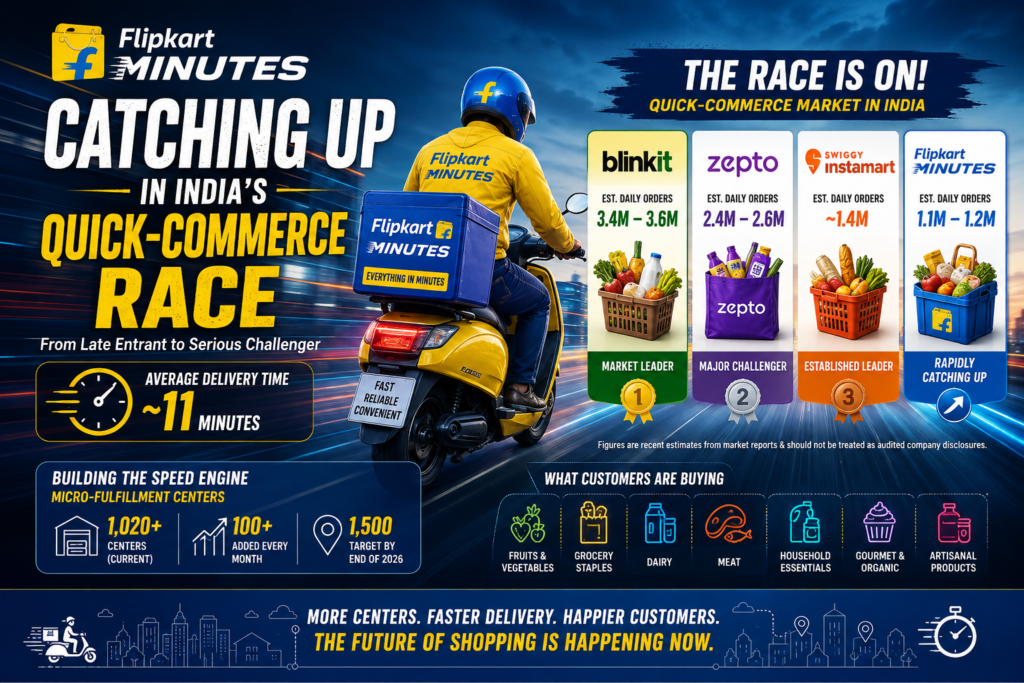
Caption: Flipkart Minutes is rapidly closing the gap with India’s quick-commerce leaders as faster delivery and expanding fulfillment networks reshape everyday shopping.
Description: The image should visually highlight Flipkart Minutes’ rapid growth in India’s quick-commerce market, featuring instant grocery delivery, micro-fulfillment centers, and a competitive comparison with major rivals such as Blinkit, Zepto, and Instamart. The visual reinforces the article’s focus on Flipkart’s rising order volumes, expanding infrastructure, and approximately 11-minute delivery times.
Alt Text: Flipkart Minutes expands quick-commerce delivery with over 1,000 micro-fulfillment centers across India.
Planned H2/H3 structure:
● Flipkart Minutes is closing the quick-commerce gap ● How Flipkart Minutes reached 1 million daily orders ● Why micro-fulfillment centers are the secret engine ● Can Flipkart compete with Blinkit, Zepto, and Instamart? ● Why existing e-commerce customers give Flipkart an advantage ● What customers are buying on quick-commerce platforms ● Amazon Now enters the same battle
● Why India’s quick-commerce market is becoming harder to ignore ● What this means for shoppers and businesses
● FAQ
Focus Keywords:
● Primary keyword: Flipkart Minutes
● Secondary keywords: India quick commerce, quick-commerce market, Flipkart quick commerce, micro-fulfillment centers
● LSI/Long-tail keywords: Flipkart Minutes daily orders, Flipkart vs Blinkit vs Zepto, quick grocery delivery in India, Amazon Now India
How Flipkart Minutes Is Catching Up in India’s Quick-Commerce Race
What if the grocery app you already use could deliver your milk, vegetables, snacks, and household essentials before you have time to finish your coffee?
That is essentially the bet behind Flipkart Minutes, Flipkart’s quick-commerce service, which has grown from a late entrant in India’s instant-delivery market into a serious competitor. According to people familiar with its operations cited by TechCrunch, Flipkart Minutes is now handling roughly 1.1 million to 1.2 million orders a day, up sharply from around 390,000 to 400,000 daily orders in November.
That puts Flipkart Minutes surprisingly close to Swiggy Instamart, which is estimated at about 1.4 million daily orders, even though Blinkit and Zepto remain significantly larger.
The bigger story is not simply that Flipkart is delivering groceries faster.
It is that India’s e-commerce giants are now racing to make instant delivery a standard expectation, rather than a premium feature.
Flipkart Minutes Is Closing the Gap With India’s Quick-Commerce Leaders
India’s quick-commerce market was once dominated by specialist startups that convinced consumers to order everyday products online and expect them within minutes.
Now, the country’s largest e-commerce companies want a piece of that behavior.
Question → Direct Answer: Is Flipkart Minutes becoming a major quick-commerce player?
Yes. Based on recent estimates cited by TechCrunch, Flipkart Minutes is processing around 1.1 million to 1.2 million orders daily, putting it within striking distance of Swiggy Instamart’s roughly 1.4 million daily orders.
The numbers become even more interesting when compared with the market leaders.
Recent estimates from market research firm Datum Intelligence put Blinkit’s daily orders at approximately 3.4 million to 3.6 million, while Zepto is estimated at around 2.4 million to 2.6 million.
That gives the current market something like this:
Quick-commerce service
Estimated daily orders
Position
Blinkit 3.4M–3.6M Market leader
Zepto 2.4M–2.6M Major
challenger
Swiggy Instamart ~1.4M Established
leader
Flipkart Minutes 1.1M–1.2M Rapidly
catching up
Figures are recent estimates cited by TechCrunch and should not be treated as audited company disclosures.
The gap between Flipkart and Instamart is particularly notable because Flipkart entered the market later.
Flipkart launched Minutes in August 2024, while Swiggy introduced Instamart in 2020 and Zepto arrived in 2021.
Blinkit’s history goes back even further through Grofers, which was founded in 2013 before eventually becoming Blinkit.
So how did a relatively late entrant move this quickly? The answer starts with infrastructure.
How Flipkart Minutes Reached More Than One Million Daily Orders
Building a quick-commerce service is not simply about putting groceries on an app.
The real challenge is getting products physically close enough to customers to make very fast delivery possible.
That is where micro-fulfillment centers become important. Definition + Expansion: Micro-fulfillment center
A micro-fulfillment center is a small warehouse located close to customers and designed to process online orders quickly.
Instead of storing products in one giant warehouse outside a city, a quick-commerce company distributes inventory across many smaller facilities inside or near urban neighborhoods.
When you place an order, the product may already be sitting just a few kilometers,or sometimes much closer,from your home.
That reduces the distance a delivery worker needs to travel. And in quick commerce, distance matters.
Flipkart’s rapid infrastructure expansion
According to people familiar with the company’s operations cited by TechCrunch, Flipkart Minutes had approximately 1,020 to 1,050 micro-fulfillment centers at the time of reporting.
That is a dramatic increase from:
● About 340 centers a year earlier
● Around 600 centers in January
● More than 1,000 currently
● A target of 1,500 by the end of 2026
The company is reportedly adding roughly 100 facilities per month.
That expansion helps explain how Flipkart Minutes has been able to increase order volume so quickly.
Think about it this way.
If you have one warehouse serving an entire city, delivering an order in 10 or 15 minutes is difficult.
If you have hundreds of smaller facilities distributed throughout the city, the nearest location can potentially serve each customer much faster.
Question → Direct Answer: Why does Flipkart need so many small warehouses?
Because quick commerce depends on placing inventory close to customers. More micro-fulfillment centers can shorten delivery distances and allow the company to process orders faster across more neighborhoods.
This is one reason quick-commerce businesses often talk about “dark stores.”
A dark store is essentially a retail-like facility designed primarily for online order fulfillment rather than walk-in customers.
You don’t visit it to browse shelves.
The shopper sees the products on the app.
The worker inside the facility picks and packs the order. A delivery worker collects it.
Then the order travels to the customer.
That entire process is optimized for speed.
Why Flipkart Has an Advantage That Startups Cannot Easily Copy
There is an interesting twist to the Flipkart Minutes story.
Flipkart may have entered quick commerce later, but it did not enter Indian e-commerce later.
The company has spent years building a massive online customer base. That matters.
A new quick-commerce startup has to convince consumers to download an app, create an account, trust the service and develop a shopping habit.
Flipkart already has many of those ingredients.
Someone who has previously used Flipkart for electronics, fashion or household purchases may already have:
● A Flipkart account
● Saved payment details
● An existing relationship with the brand
● Familiarity with the app
● Previous purchase history
● An expectation that Flipkart can deliver products
Now Flipkart can introduce a faster shopping option inside that existing ecosystem.
Satish Meena, an adviser at Datum Intelligence, told TechCrunch that Flipkart’s existing customer base gives Minutes an important advantage.
“Flipkart is already a serious player,” Meena said, pointing to the significance of reaching around a million daily orders and opening approximately 1,000 dark stores.
This is an important lesson in technology businesses:
Distribution can be just as valuable as technology.
A company doesn’t always win because it has the best product.
Sometimes it wins because it already has the customers, infrastructure, brand recognition and payment relationships needed to scale that product.
Customers Are Not Just Trying Quick Commerce,They Are Coming Back
Getting someone to place their first order is one thing. Getting them to return every month is much more valuable.
According to people familiar with the business cited by TechCrunch, around 65% to 70% of customers using Flipkart Minutes each month are repeat buyers.
At the same time, transactions per customer have reportedly increased by 50% to 60% year over year.
That suggests an important shift.
Quick commerce is becoming less about an occasional emergency purchase and more about routine shopping.
Imagine ordering:
Monday: milk and bread.
Tuesday: vegetables.
Wednesday: snacks.
Thursday: household supplies.
Friday: ingredients for dinner.
Once customers build that habit, the platform becomes part of everyday life.
What are shoppers buying?
According to the supplied reporting, average order values on Flipkart Minutes are around ₹400 to ₹500.
Fast-growing categories include:
● Fruits and vegetables
● Grocery staples
● Dairy
● Meat
● Everyday household products
● Gourmet products
● Organic products
● Artisanal products
That category expansion is strategically important.
Quick-commerce companies initially became famous for convenience products: snacks, drinks, milk and emergency groceries.
Now they want a larger share of the customer’s total grocery spending.
That means convincing people that quick commerce is not merely for “I forgot to buy onions.”
It can become the place where they do regular shopping.
Flipkart Minutes Is Also Getting Faster There is another number worth watching.
The average delivery time for Flipkart Minutes has reportedly fallen to approximately 11 minutes, compared with around 13 minutes a year earlier.
That may sound like a small improvement.
It isn’t necessarily small in a business where the entire value proposition revolves around speed.
If one service delivers in 15 minutes and another usually arrives in 10 or 11, the faster option may become the default for urgent purchases.
This creates a feedback loop:
More stores → products closer to customers → faster delivery → more customers → more orders → better store economics → more expansion
That is one of the central mechanics behind quick-commerce competition.
Question → Direct Answer: Does shaving a few minutes off delivery really matter?
Yes, because speed is the core product in quick commerce. Once consumers become accustomed to receiving everyday products within roughly 10–15 minutes, even relatively small differences in delivery time can influence which service they choose.
But speed is only one part of the equation.
Price, product selection, reliability and availability matter too.
Can Flipkart Catch Blinkit, Zepto, and Instamart?
The short answer is: it is catching up, but the leaders still have a substantial advantage.
Blinkit remains far ahead in daily order volume based on the recent estimates cited by TechCrunch.
Zepto also maintains a significant lead.
Instamart has a large established network, with Swiggy saying it operates more than 1,200 dark stores across more than 130 cities and has more than 14 million monthly transacting users.
Swiggy also said that more than 45% of its Instamart dark-store network was contribution-margin positive, indicating that a significant portion of the network had reached a positive contribution margin.
What does contribution margin mean?
Contribution margin measures how much revenue remains after variable costs associated with serving an order or product are accounted for.
It is different from overall company profit because it doesn’t necessarily include every corporate expense.
For quick commerce, improving contribution margins is important because the business requires enormous investment in warehouses, inventory, delivery operations and technology.
A company can grow quickly.
The harder question is whether it can grow sustainably.
Factor Flipkart Minutes
Blinkit Zepto Instamart
Market entry 2024 Roots in Grofers
2021 2020
Recent
estimated daily orders
1.1M–1.2M 3.4M–3.6M 2.4M–2.6M ~1.4M
Major
advantage
Infrastructur e strategy
Existing
Flipkart
ecosystem
Rapid
micro-fulfil lment
expansion
Scale and early-mover position
Large
dark-store network
Strong
quick-commer ce focus
Dense
quick-commer ce network
Swiggy
ecosystem
1,200+ dark stores
Key challenge Closing the scale gap
Maintaining leadership
Sustaining growth
economics
Competing against larger
rivals
These figures come from different sources and reporting periods, so they are best understood as directional comparisons rather than a perfectly standardized market ranking.
Amazon Now Is Entering the Same Battle
Just as Flipkart is expanding Minutes, Amazon is increasing its investment in Amazon Now.
That makes India’s quick-commerce market even more competitive.
Amazon said during CEO Andy Jassy’s visit to India in June that Amazon Now had become its fastest-growing business in India, with orders reportedly doubling every quarter since launch.
The company also announced plans to expand Amazon Now to more than 300 cities and build a network of more than 1,000 micro-fulfillment centers, alongside larger facilities that can support a wider range of products.
The strategic logic is similar to Flipkart’s.
Amazon already has millions of customers who shop online. Now it wants to change what those customers expect from delivery. Why are Amazon and Flipkart moving into quick commerce?
Because specialist quick-commerce companies have changed consumer expectations.
A customer who can get groceries in 10 or 15 minutes may become less willing to wait one or two days for certain everyday products.
That creates a defensive problem for traditional e-commerce platforms.
If customers use Blinkit or Zepto for groceries, those platforms get another opportunity to build a broader relationship with them.
Over time, the traditional e-commerce companies risk losing not just individual orders but shopping frequency.
That is why quick commerce is becoming a strategic battleground.
India’s Quick-Commerce Market Is Changing How People Shop
The most important impact of quick commerce may not be the number of dark stores.
It may be the change in consumer behavior.
Traditional online shopping often involves planning.
You know you need something.
You search for it.
You compare prices.
You place the order.
Then you wait.
Quick commerce changes that psychology.
Now the thought can become:
“I need it now.”
That sounds simple, but it changes purchasing behavior.
A person may be more willing to order a single missing ingredient rather than modify a meal plan.
A student may order snacks late at night.
A family may order milk when they realize it is finished. A young professional may order household essentials between meetings.
Convenience removes some of the friction associated with buying small quantities.
And once that behavior becomes normal, reversing it becomes difficult.
Satish Meena captured this shift in comments reported by TechCrunch, arguing that consumers are unlikely to return to scheduled grocery delivery after becoming accustomed to quick commerce.
That may be the biggest competitive advantage of the entire category. The customer expectation has already changed.
Why Quick Commerce Is More Than “10-Minute Delivery”
It is easy to reduce the industry to one marketing promise: delivery in minutes.
But the real technology stack is much more complicated. A quick-commerce platform has to coordinate:
Demand forecasting → inventory management → warehouse operations → order picking → routing → delivery → customer service
If one piece fails, the customer experience suffers.
Suppose an app promises a product in 10 minutes but the local warehouse is out of stock.
The delivery speed doesn’t matter.
Suppose the product is available but the warehouse worker takes five minutes to locate it.
Again, the delivery promise becomes difficult.
Suppose everything works but traffic causes a delivery delay. The customer still sees the delay.
This is why quick commerce is as much a logistics technology business as it is an e-commerce business.
What technology helps make it possible?
Quick-commerce platforms can use technology for:
● Demand forecasting
● Inventory allocation
● Product recommendations
● Warehouse management
● Delivery routing
● Order batching
● Real-time stock updates
● Customer personalization
● Fraud detection
● Pricing and promotions
For students and young professionals interested in AI, this is an especially interesting area.
Not every AI application has to be a chatbot.
Some of the most valuable AI and data-science applications happen quietly in the background.
What the Quick-Commerce Race Means for Indian Consumers
For shoppers, increased competition can be good news.
When Flipkart, Amazon, Blinkit, Zepto and Instamart compete for the same customer, they have incentives to improve:
● Delivery speed
● Product availability
● App experience
● Pricing
● Selection
● Discounts
● Reliability
● Geographic coverage
But there is another side.
Fast delivery requires a complicated physical network. Warehouses need rent.
Products need inventory.
Workers need to pick and pack orders.
Delivery workers need to travel.
Companies need technology infrastructure.
The business therefore has to find a sustainable economic model.
This is why the next stage of the market may be less about who can deliver fastest and more about who can deliver quickly while making the economics work.
That is a much harder competition.
What Flipkart Minutes Could Mean for the Future of E-Commerce
The growth of Flipkart Minutes suggests that the boundaries between traditional e-commerce and quick commerce are becoming increasingly blurred.
Traditional e-commerce companies used to compete primarily on: Selection + price + delivery reliability
Quick commerce introduced another dimension:
Speed
Now the major players want all four.
That creates a difficult business problem.
Customers want huge product selection.
They want low prices.
They want fast delivery.
And they want reliable service.
Providing all of those simultaneously is expensive.
Flipkart’s strategy is therefore particularly interesting because the company can combine its traditional e-commerce infrastructure and customer base with a growing network of local fulfillment facilities.
Amazon is attempting a similar strategy.
Meanwhile, Blinkit, Zepto and Instamart have already spent years building specialized quick-commerce operations.
The result could be one of India’s most intense battles for everyday consumer spending.
What Students and Young Professionals Can Learn From This Competition
The quick-commerce race offers a useful business lesson beyond grocery delivery.
Infrastructure can create competitive advantage.
An app can be copied.
A basic shopping interface can be copied.
Even a delivery promise can be copied.
But a dense network of fulfillment centers, customers, delivery workers, data, inventory systems and logistics relationships is much harder to replicate quickly.
That is why companies are spending so heavily on physical infrastructure.
For aspiring founders, the lesson is important.
If you’re building a technology business, ask:
1. What makes the product difficult to copy?
2. Do you have an existing distribution advantage?
3. Can your infrastructure scale with demand?
4. Does each additional customer improve the economics? 5. Can customers develop a repeat habit?
6. What happens when competitors copy your core feature?
The strongest businesses often have several answers.
The Bottom Line: India’s Quick-Commerce Race Is Getting Serious
Flipkart Minutes may have entered the quick-commerce race two years after some of its biggest competitors, but its recent growth shows why being a late entrant does not necessarily mean being a weak competitor.
With an estimated 1.1 million to 1.2 million daily orders, more than 1,000 micro-fulfillment centers, rising repeat purchases and average delivery times of around 11 minutes, Flipkart has moved firmly into the competitive conversation.
Blinkit and Zepto remain significantly larger by estimated daily order volume.
Instamart has substantial scale and more than 1,200 dark stores across over 130 cities, according to Swiggy.
And Amazon is expanding Amazon Now with ambitions for more than 300 cities and 1,000-plus micro-fulfillment centers.
So this isn’t a three-company race anymore.
It is becoming a fight between India’s established e-commerce giants and the specialists that built quick commerce from the ground up.
And for consumers, the biggest change may already have happened.
When you can get groceries in minutes, waiting until tomorrow suddenly feels very slow.
FAQ
What is Flipkart Minutes?
Flipkart Minutes is Flipkart’s quick-commerce service, launched in August 2024 to provide groceries, household products and other everyday goods through rapid delivery. Its strategy relies on a network of micro-fulfillment centers located close to customers.
How many orders does Flipkart Minutes deliver each day?
Flipkart Minutes is estimated to deliver around 1.1 million to 1.2 million orders per day, according to people familiar with its operations cited by TechCrunch. That is up from approximately 390,000 to 400,000 daily orders in November.
Is Flipkart Minutes bigger than Blinkit or Zepto?
No. Recent estimates cited by TechCrunch put Blinkit at approximately 3.4 million to 3.6 million daily orders and Zepto at about 2.4 million to 2.6 million. Flipkart Minutes is currently closer in scale to Swiggy Instamart, estimated at roughly 1.4 million daily orders.
What is a micro-fulfillment center?
A micro-fulfillment center is a small warehouse located close to customers that is designed to process online orders quickly. Quick-commerce companies use networks of these facilities to reduce delivery distances and support deliveries within minutes.
Why is Amazon entering India’s quick-commerce market?
Amazon is expanding Amazon Now because consumer expectations around delivery speed are changing and established e-commerce companies risk losing everyday purchases to quick-commerce specialists. Amazon has announced plans to expand Amazon Now to more than 300 cities and build more than 1,000 micro-fulfillment centers.
Will quick commerce replace traditional e-commerce in India?
Quick commerce is unlikely to replace traditional e-commerce completely, but it is changing what consumers expect for groceries and other frequently purchased products. Traditional e-commerce remains
better suited to many products that do not require immediate delivery, while quick commerce focuses on speed and convenience.
Why is Flipkart Minutes growing so quickly?
Flipkart Minutes is benefiting from rapid expansion of its micro-fulfillment network and Flipkart’s existing e-commerce customer base. The service reportedly operates around 1,020 to 1,050 micro-fulfillment centers and is targeting 1,500 by the end of 2026.
Meta Description:
Flipkart Minutes is closing in on India’s quick-commerce leaders. Explore its growth, dark stores, rivals, delivery speed and market strategy.
URL Slug: flipkart-minutes-india-quick-commerce