What Is Krafton’s New $250 Million India Investment?
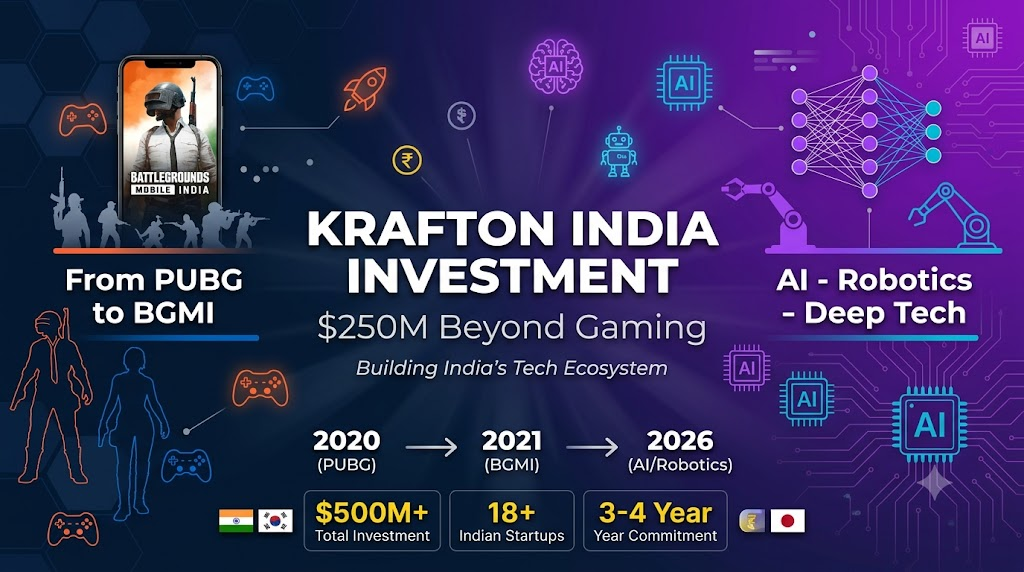
Krafton announced its latest India commitment on September 4, 2026, saying it plans to invest another $250 million over the next three to four years.
The money is intended to expand Krafton’s presence beyond its traditional gaming business and into areas including artificial intelligence, robotics and deep technology.
Question → How much is Krafton planning to invest in India?
Krafton plans to invest another $250 million in India over the next three to four years. Including the more than $250 million it has already invested since 2021, the company’s planned investment in India will exceed $500 million.
There is an important distinction here. This new $250 million commitment is separate from another India-focused growth fund that Krafton announced with South Korean internet company Naver and investment firm Mirae Asset in December 2025.
That growth fund was announced at $670 million, with Krafton saying at the time that it would contribute about $137 million at the fund’s first close.
So, when looking at Krafton’s India strategy, it is useful to separate its direct investment plans from its participation in the larger growth fund.
Krafton’s India commitment at a glance
| Area | Details |
| New commitment | $250 million |
| Investment period | 3–4 years |
| Planned total investment in India | More than $500 million |
| Existing investment since 2021 | More than $250 million |
| Separate India-focused growth fund | $670 million |
| Key new areas | AI, robotics and deep tech |
| Major gaming property in India | BGMI |
| Indian companies backed | About 18 |
The numbers show something bigger than a single funding announcement: Krafton has been building a long-term India strategy rather than making a short-term market experiment.
Why Does India Matter So Much to Krafton?
Question → Why is Krafton investing so heavily in India?
India gives Krafton access to a huge digital consumer and developer market, with more than 1 billion internet subscribers and over 700 million smartphone users, according to the information cited by TechCrunch.
For a company that originally entered India through mobile gaming, those numbers are obviously attractive.
But Krafton now appears to see India differently.
The country is not simply a place where people play mobile games. It is also home to a rapidly expanding startup ecosystem, a large technology workforce, increasing digital consumption and companies working across AI, fintech, consumer technology, media, robotics and other sectors.
Definition , Deep tech: Deep technology refers to innovations based on significant scientific or engineering advances, such as artificial intelligence, robotics, advanced computing or other technically complex technologies.
Deep-tech companies can take longer to develop than ordinary software startups because they may require specialized research, hardware, engineering expertise or scientific breakthroughs.
That makes Krafton’s shift particularly interesting. The company is effectively saying that its opportunity in India may extend beyond the entertainment products that originally established its presence.
The India opportunity goes beyond gaming
Krafton’s strategy now touches several layers of the technology ecosystem:
- Gaming, through BGMI and investments in studios.
- Consumer internet, through investments in companies serving Indian users.
- Media and content, through investments such as Pratilipi and Kuku FM.
- Creator economy, through companies such as One Impression.
- AI and deep tech, through its newly announced investment focus.
- Talent development, through programs such as KIGI Academy.
- Acquisitions, including Pune-based gaming studio Nautilus Mobile.
That combination is important because it gives Krafton multiple ways to participate in India’s technology economy.
How Did Krafton Build Its India Business?
The story of Krafton India investment cannot be separated from PUBG.
Krafton initially built its Indian presence around gaming, particularly through PUBG Mobile. But India’s relationship with the game became complicated in 2020, when the Indian government banned PUBG Mobile along with hundreds of other apps amid rising tensions between India and China.
The ban created an enormous challenge for Krafton.
Instead of abandoning the market, the company redesigned its India strategy.
In 2021, Krafton introduced Battlegrounds Mobile India, or BGMI, as a localized successor to PUBG Mobile.
The company also made structural changes. Tencent Games was removed as the publisher for the Indian version, while India’s game servers were moved to Microsoft’s Azure cloud as Krafton worked to address concerns from Indian authorities.
Question → What happened to PUBG Mobile in India?
PUBG Mobile was banned in India in 2020. Krafton subsequently launched BGMI in 2021 as a localized version designed specifically for the Indian market.
But the challenges did not end there.
In 2022, BGMI was itself removed from India’s major app stores and became unavailable in the country. The federal government later allowed the game to return in 2023 on a three-month trial basis.
Krafton continued building around BGMI after its return and now plans to launch BGMI Lite in India by the end of 2026.
This history helps explain why the company’s latest investment is significant.
Krafton has experienced both the enormous potential and the regulatory uncertainty of India’s gaming market. Rather than relying exclusively on one game, it is increasingly spreading its bets across other businesses and technology categories.
Why Is Krafton Moving Beyond Gaming?
The simplest answer is diversification.
Question → Why would a gaming company invest in AI and robotics?
Because gaming companies increasingly possess capabilities that can be valuable outside games, including artificial intelligence, graphics, real-time computing, digital communities and interactive technology.
Krafton is not abandoning gaming. Gaming remains central to its identity and India strategy.
Instead, the company appears to be expanding the definition of what its India business can become.
That is a familiar strategy across the technology industry. Companies often use expertise developed in one market to enter adjacent categories.
For Krafton, the connections could include:
Gaming → AI → interactive technology → robotics → digital products
Artificial intelligence, for example, can be used in games for non-player characters, personalization, recommendation systems, content generation and other applications. Some of the same technical capabilities can potentially be adapted to products outside entertainment.
Robotics presents a different opportunity, but it also depends heavily on AI, computer vision, sensors, software and increasingly sophisticated computing.
The exact companies or projects that will receive the new $250 million have not all been identified. That makes the investment more of a strategic direction than a detailed project list at this stage.
What Does Krafton’s Startup Strategy Look Like?
Krafton has already been investing in Indian startups for several years.
The company confirmed that it has backed approximately 18 companies in India, including around four to five gaming studios.
Its portfolio includes names such as:
- Nodwin Gaming
- Loco
- Pratilipi
- Kuku FM
- One Impression
- Nautilus Mobile
These investments show that Krafton has not limited itself to companies making games.
Content and creator platforms
Companies such as Pratilipi and Kuku FM operate in digital content, while One Impression is associated with the creator economy.
This is strategically relevant because gaming and creator businesses increasingly overlap.
Gamers can become streamers. Streamers can become creators. Creators can build communities around games. Communities can generate content, and content can drive engagement.
For Krafton, investing across these categories can create exposure to multiple parts of the digital entertainment ecosystem.
Gaming studios
Krafton has also invested directly in gaming development.
One major example is Nautilus Mobile, the Pune-based studio behind the Real Cricket franchise.
Krafton acquired a controlling stake in Nautilus Mobile in 2025 in a deal reported by TechCrunch at approximately $14 million.
That acquisition gave Krafton deeper access to Indian game-development talent and intellectual property rather than simply investing as a minority financial backer.
What Is KIGI Academy and Why Does It Matter?
Money alone does not build a technology ecosystem.
You also need people who know how to build the products.
Krafton has been addressing that challenge through KIGI Academy, an industry-academia initiative focused on developing talent in game development and digital creation.
Question → Why would Krafton invest in education?
Because building a sustainable technology and gaming business requires a steady pipeline of skilled developers, designers, engineers and creators.
For students and fresh graduates, initiatives like this can matter because they create potential pathways between education and industry.
The broader lesson is important: large technology companies are increasingly competing not only for finished products and startups but also for talent.
India’s enormous young population has long been considered one of its major economic advantages. But population size alone is not enough. Skills in areas such as AI, software engineering, game development, robotics and digital design determine how much value the workforce can create.
Krafton’s investment in training therefore fits into its larger India strategy.
It is investing in companies.
It is investing in technology.
And it is also investing in the people who can build that technology.
What Does the $250 Million Bet Mean for Indian Startups?
For Indian startups, the new Krafton India investment could create another source of international capital.
That matters because startups working in AI, robotics and deep tech often need substantial funding.
A consumer software startup might be able to launch with a relatively small team and limited infrastructure. A robotics company may need hardware, laboratories, specialized engineers, testing facilities and longer development cycles.
Question → Which Indian startups could benefit from Krafton’s new strategy?
The clearest potential beneficiaries are startups working in AI, robotics, deep tech, gaming, digital entertainment and related technology categories. Krafton has not publicly announced a complete list of companies that will receive the new $250 million, so specific future investments should not be assumed.
This distinction is important.
It would be tempting to interpret the announcement as a promise that Krafton will immediately fund a large number of Indian AI startups. The available information does not establish that.
Instead, the announcement tells us where Krafton wants to look.
For founders, that can still be meaningful.
A major international company explicitly expanding its investment thesis toward AI and deep tech can increase visibility for Indian startups operating in those areas.
How Does Krafton’s India Strategy Compare With Its Earlier Bets?
Krafton’s approach has evolved over time.
| Stage | Primary focus | Strategy |
| Early India presence | Gaming | Build a large local player base |
| Post-PUBG ban | Localized gaming | Launch BGMI and adapt operations |
| 2021 onward | Startup investments | Back gaming and digital companies |
| 2025 | Acquisitions + investment | Deepen local operating presence |
| 2026 | AI, robotics and deep tech | Expand beyond gaming |
| Future | Broader technology ecosystem | Build a diversified India business |
The progression is revealing.
Krafton initially needed a successful game.
Then it needed a sustainable India-specific business model.
Now it is building a broader investment and technology footprint.
That evolution suggests that India is becoming strategically important to Krafton beyond the performance of any single gaming franchise.
Why Is the India-South Korea Connection Important?
The latest announcement followed a meeting between Krafton chairman Chang Byung-gyu and Indian Prime Minister Narendra Modi in New Delhi on September 4.
According to Krafton, the discussion included opportunities for India and South Korea to collaborate across gaming, technology and other emerging sectors.
That context matters because the investment is not happening in isolation.
India and South Korea already have commercial relationships across electronics, automobiles, technology and consumer products. More investment from South Korean companies could deepen that relationship in newer technology sectors.
For Krafton, India offers access to scale.
For Indian companies, South Korean investors can provide capital, international networks and potential access to another major technology market.
The relationship can therefore work in both directions.
What Are the Biggest Risks for Krafton in India?
A large investment does not guarantee success.
Krafton has already learned that the Indian gaming market can change quickly.
The PUBG Mobile ban demonstrated how regulatory decisions can dramatically affect a digital product. BGMI’s subsequent temporary ban showed that even a localized strategy cannot completely remove regulatory risk.
Regulatory uncertainty
Gaming, online entertainment and emerging technologies can face changing rules.
For a company expanding into AI and deep tech, regulatory questions could become even more complicated.
AI-related businesses may face rules around data, privacy, copyright, safety and responsible use. Robotics can involve physical safety, industrial regulation and other technical requirements.
Competition
Krafton will also compete with investors, technology companies and venture funds that are already active in India.
The company therefore needs to offer startups something beyond money.
That could include gaming expertise, global distribution, product knowledge, partnerships and access to Krafton’s international network.
Long development cycles
Deep tech can take years to become commercially successful.
A large investment commitment gives Krafton the ability to pursue longer-term opportunities, but it also means returns may not arrive quickly.
That is particularly important for robotics and other hardware-heavy technologies.
Could Krafton Become More Than a Gaming Company in India?
Question → Could India become a broader technology hub for Krafton?
Yes, that is increasingly the direction suggested by the company’s investment strategy, although it is too early to know how large its non-gaming business will eventually become.
The company already has several pieces of the puzzle.
It has a massive gaming franchise in BGMI.
It has invested in Indian startups.
It has acquired a local gaming studio.
It has created a talent-development program.
And now it is committing another $250 million toward AI, robotics and deep tech.
Taken together, those moves look less like isolated investments and more like an attempt to build a diversified technology ecosystem.
The interesting part is that Krafton does not necessarily have to stop being a gaming company to achieve this.
Gaming can remain the foundation while other businesses grow around it.
What Could This Mean for Students and Young Professionals?
For students in India, the biggest takeaway from the Krafton India investment may not be the dollar figure.
It is the types of skills companies are looking for.
Gaming increasingly overlaps with:
- Artificial intelligence
- Machine learning
- Computer graphics
- 3D development
- Cloud computing
- Data science
- Robotics
- Human-computer interaction
- Digital content
- Creator technology
That means someone interested in game development does not necessarily have to think of gaming as a narrow career path.
Skills developed in one area can transfer into another.
A computer-graphics specialist can work on games, simulation or robotics.
An AI engineer can work on recommendation systems, game intelligence or computer vision.
A software developer can move between consumer applications and interactive products.
A designer can work across gaming, digital media and emerging interfaces.
This convergence is one of the most important trends to understand.
The technology industry increasingly values people who can connect disciplines rather than work inside a single isolated category.
What Should Indian Founders Learn From Krafton’s Strategy?
There are several lessons for entrepreneurs.
1. Localize instead of simply exporting
Krafton’s response to the PUBG ban demonstrated the importance of building a product specifically for the Indian market.
BGMI was not simply presented as an unchanged PUBG Mobile experience. Krafton made operational and publishing changes while creating an India-specific identity.
2. Build relationships beyond the product
Krafton did not limit its India strategy to selling a game.
It invested in startups, acquired Nautilus Mobile and established KIGI Academy.
That creates deeper connections with India’s technology ecosystem.
3. Think beyond the original category
A company that starts in gaming can eventually explore AI, robotics and other technologies.
The lesson for founders is not to randomly diversify. Instead, identify technical capabilities and customer relationships that can create logical opportunities in adjacent markets.
4. Invest for the long term
Krafton’s latest commitment covers three to four years.
That is important because major technology opportunities rarely develop overnight.
Founders and investors working in deep tech need to be prepared for longer product-development cycles.
Why This $250 Million Announcement Matters
The headline is simple: Krafton is investing another $250 million in India.
The underlying story is much more interesting.
Krafton entered India primarily as a gaming company. PUBG Mobile created enormous awareness, but regulatory challenges forced the company to rethink its approach. BGMI became the localized successor, while investments and acquisitions gradually expanded Krafton’s relationship with India’s technology ecosystem.
Now the company is taking another step.
AI, robotics and deep tech are becoming part of Krafton’s India investment thesis.
That does not mean gaming is disappearing. BGMI remains important, and Krafton plans to continue developing its gaming business in India.
But the company appears to believe India’s opportunity is simply too large to be limited to games.
For India’s startup ecosystem, that could mean another major international investor looking at AI and emerging technology.
For students, it reinforces the growing importance of technical skills that cross traditional industry boundaries.
And for Krafton, the bet is straightforward: if India is going to be one of the world’s most important digital markets, the company wants to be involved in what comes next , not just what is already popular.
FAQ: Krafton India Investment
How much is Krafton investing in India?
Krafton has committed another $250 million to India over the next three to four years. The company said this will take its total planned investment in India to more than $500 million, including more than $250 million already invested since 2021.
Is Krafton investing only in gaming in India?
No. Krafton’s latest India commitment specifically expands its focus beyond gaming into AI, robotics and deep tech. The company has also previously invested in Indian businesses across gaming, content, creator technology and other digital sectors.
What is Krafton’s biggest gaming product in India?
Battlegrounds Mobile India (BGMI) is Krafton’s major gaming franchise in India. It was introduced in 2021 after PUBG Mobile was banned in India in 2020. Krafton has continued developing the franchise and plans to launch BGMI Lite in India by the end of 2026.
How many Indian companies has Krafton invested in?
Krafton has confirmed that it has backed approximately 18 companies in India, including around four to five gaming studios. Its investments include Nodwin Gaming, Loco, Pratilipi, Kuku FM, One Impression and other companies.
Why is Krafton investing in AI and robotics?
Krafton sees opportunities to expand its technology capabilities beyond traditional gaming. AI, robotics and deep tech can build on areas such as software engineering, computer vision, interactive technology and advanced computing that are relevant to modern gaming as well as other industries.
What does Krafton’s investment mean for Indian startups?
The new commitment could provide another potential source of international capital for Indian startups, particularly those working in AI, robotics, deep tech, gaming and digital entertainment. However, Krafton has not yet disclosed exactly which companies will receive funding from the new $250 million commitment.
Final Takeaway
Krafton’s latest $250 million India investment is a sign that India’s role in the global technology economy is expanding beyond consumer apps and software. A company best known for PUBG and BGMI is now looking at AI, robotics, deep tech, startups and talent , showing just how much the definition of India’s digital opportunity is changing.
For aspiring developers, founders and technology professionals, that is perhaps the most important signal: the next big opportunities may emerge where gaming, AI, robotics and digital creativity intersect.
Keep following Kalinga.ai for more explainers on India’s technology ecosystem, startup investments and the skills shaping the next generation of digital careers.kalinga.ai