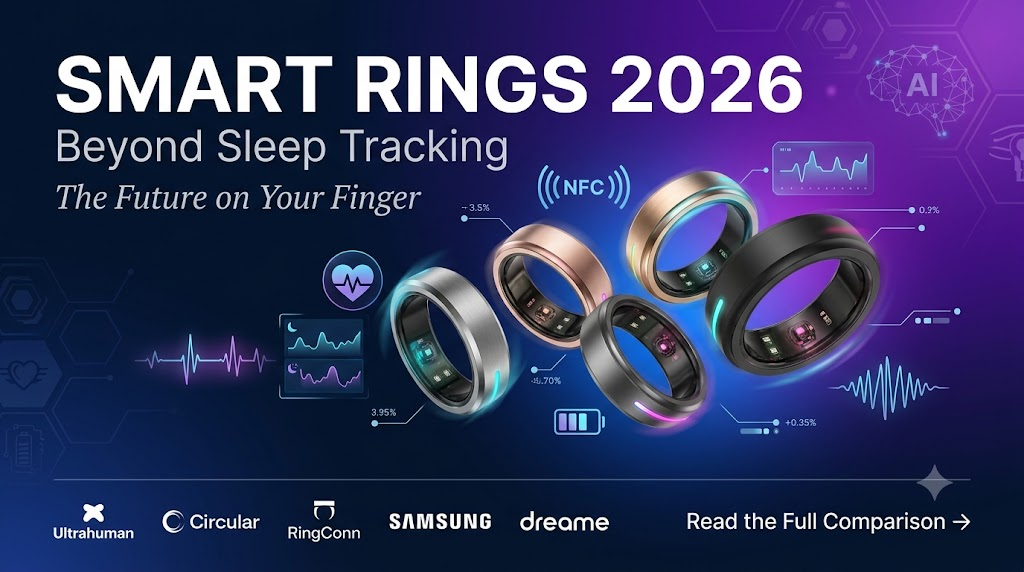
Why Are Smart Rings Getting More Advanced in 2026?
A ring has an obvious limitation: there is very little space for electronics.
Unlike a smartwatch, it has no large display, relatively little battery capacity and almost no room for physical controls. That limitation has traditionally pushed smart rings toward passive monitoring , collecting information quietly and sending it to a smartphone for analysis.
But smart rings 2026 are increasingly challenging that assumption.
Companies are putting more sensors and processing power directly inside the ring. They are also exploring ways for the device to communicate information back to the wearer without needing a screen.
Definition , Smart ring: A smart ring is a wearable electronic device worn on the finger that uses sensors, wireless connectivity and software to monitor health, activity or other information.
The important change is that manufacturers are no longer treating the ring simply as a miniature fitness tracker. The latest products are becoming more like tiny computing platforms.
What is changing?
Several trends stand out:
- Better health sensors for heart rate, blood oxygen, temperature and sleep.
- More advanced health insights, including blood-pressure trends and ECG-based features on some models.
- Longer battery life, reducing the need to remove the ring frequently.
- Haptic feedback, allowing rings to communicate through vibrations.
- NFC payments, turning a ring into a contactless payment device.
- On-device processing, reducing dependence on smartphones and cloud services.
- AI-powered software, using collected biometric information to generate personalized insights.
- More jewelry-like designs, making the devices easier to wear continuously.
This combination is pushing the smart ring category into a much more competitive phase.
Which Smart Rings Are Leading the Market in 2026?
Question → Which companies are driving the smart ring market in 2026?
The most interesting competition currently includes Oura, Ultrahuman, RingConn, Samsung, Circular and newer entrants such as Dreame. Each company is approaching the category differently, which makes choosing a ring more complicated than simply comparing specifications.
Oura remains a major reference point for the category, while Samsung brings the resources of a global electronics company. RingConn and Ultrahuman compete aggressively on health tracking and subscription-free experiences, while Circular and Dreame are experimenting with interaction features such as haptics and touch controls.
Market research estimates also point toward continued growth. Grand View Research estimates the global smart-ring market could grow from $502.4 million in 2026 to about $2.08 billion by 2033, representing a projected 22.5% compound annual growth rate.
That does not mean every smart ring will succeed. Instead, it suggests the category is becoming large enough to attract companies with very different product strategies.
Ultrahuman Ring Pro: Can a Smart Ring Become a Computer?
Ultrahuman’s Ring Pro is one of the most interesting examples of how the category is changing.
The company introduced the third-generation ring in 2026 with a redesigned sensing architecture and a new dual-core processor. According to TechCrunch, the new architecture is intended to improve heart-rate signal quality during sleep, while the processor enables greater on-device computing and data processing.
The redesigned hardware also matters for another reason: Ultrahuman’s U.S. business was disrupted following its patent dispute with Oura.
Question → Why did Ultrahuman redesign the Ring Pro?
The company redesigned the ring’s physical architecture as part of its effort to return to the U.S. market after the patent dispute affected imports of its previous hardware. TechCrunch reported that the redesigned unibody structure helped Ultrahuman secure U.S. clearance.
But the more interesting story may be what comes next.
In September 2026, TechCrunch reported that Ultrahuman raised $70 million, with Qualcomm Ventures participating, as the company works toward making smart rings more like computers rather than passive health trackers.
That vision could eventually include:
- AI interactions
- Game controls
- Pointer or mouse functionality
- Car-key applications
- Third-party applications
- More processing directly on the ring
This is a significant conceptual shift.
Instead of asking, “How accurately can this ring measure my sleep?”, the company is beginning to ask, “What can a computer on your finger actually do?”
Why Ultrahuman matters for India
Ultrahuman is especially relevant to Indian consumers because it is a Bengaluru-based company competing directly with global wearable brands.
The company’s strategy also highlights a broader trend: Indian hardware startups are no longer limiting themselves to domestic markets. Ultrahuman is competing in premium international wearable markets where established companies such as Samsung and Oura already have strong recognition.
Circular Ring 3: The Smart Ring That Wants to Vibrate and Pay
Circular is taking a different route.
The company’s upcoming Ring 3 series consists of the Ring 3 Pro and Ring 3 Slim. Both models introduce two features that could make smart rings more useful in everyday life: NFC-based contactless payments and on-finger vibration alerts.
Definition , NFC: NFC, or Near Field Communication, is a short-range wireless technology that allows compatible devices to communicate when they are brought very close together.
For a smart ring, NFC can turn the device into a payment tool. Instead of taking out a phone or card, a user could potentially tap the ring against a compatible payment terminal.
The Ring 3 Pro goes further with health-focused capabilities, including FDA-cleared ECG for AFib detection, blood-pressure trend tracking, glucose tracking, advanced sleep analysis and broader biometric monitoring. Circular says the Pro can deliver up to 12 days of battery life, while the Slim can reach up to 10 days.
What makes Circular different?
The answer is communication.
Most health trackers collect data quietly and make users open an app to see the result. Circular wants the ring itself to tell you something happened.
Its vibration system can be used for:
- Silent wake-up alarms
- Medication reminders
- Health alerts
- Guided breathing exercises
- Other notifications
The company expects the Ring 3 series to become available in early 2027, with pricing and preorder information still to be announced.
That makes Circular one of the clearest examples of a smart ring moving from passive tracking toward active interaction.
RingConn Gen 3: A Health Tracker Without the Subscription Focus
RingConn is competing from another angle: comprehensive health tracking without making a recurring subscription the center of the product.
The RingConn Gen 3 starts at $349 and introduces vascular health insights alongside more familiar measurements such as heart rate, blood oxygen, sleep, activity and stress. TechCrunch’s review also highlighted the ring’s slim design and claimed battery life of up to 14 days.
Question → What is special about RingConn Gen 3?
Its standout feature is vascular health monitoring, which uses sensor data to assess changes in vascular strain over time after calibration with externally measured blood-pressure values.
That does not mean the ring replaces a medical blood-pressure cuff. Instead, the concept is about observing trends relative to a person’s baseline.
RingConn also uses vibration alerts for certain health changes, sedentary reminders and battery notifications.
The company’s approach illustrates an important choice facing consumers: Do you want the cheapest device, the most features, or the best long-term value without recurring fees?
For buyers who dislike subscriptions, that distinction can be more important than a small difference in sensor specifications.
Samsung Galaxy Ring: Best for the Samsung Ecosystem?
Samsung entered the smart-ring market in 2024 with the Galaxy Ring, priced at $399 at launch.
Samsung’s biggest advantage is not necessarily the ring itself. It is the ecosystem around it.
The Galaxy Ring works alongside Samsung’s broader health platform and Galaxy devices, making it particularly appealing to people who already use Samsung phones and watches.
The ring focuses heavily on passive health and sleep monitoring. Samsung says the device can provide sleep-related measurements based on factors including movement, heart rate and respiratory rate, while its software combines information from multiple signals to generate broader health insights.
Samsung’s official product information lists three primary sensor types , an accelerometer, optical bio-signal sensor and skin-temperature sensor , and states that the ring can provide up to seven days of battery life.
Question → Who should consider the Galaxy Ring?
Samsung Galaxy users are the most obvious audience because the ring makes the most sense when combined with Samsung’s broader device ecosystem.
It may be less compelling for someone who wants the widest range of experimental health features or who uses an iPhone.
This is an important lesson for smart rings 2026: the best product is not necessarily the one with the longest feature list. Ecosystem compatibility can matter just as much.
Dreame AI Haptic Ring: What If Your Ring Became a Remote Control?
Dreame is perhaps the most unconventional entrant in this comparison.
Known primarily for smart-home products, the company introduced its AI Haptic Ring at CES 2026. Rather than treating the ring purely as a health monitor, Dreame positioned it as a discreet interface for interacting with technology.
The ring uses haptic feedback for alerts and an “AI Touch Zone” that can be used for actions such as skipping music, taking photos or controlling presentations.
Question → Why is Dreame’s approach important?
Because it demonstrates that the future of smart rings may not be limited to wellness.
Dreame says its ring has a 2.5 mm profile and can provide up to 100 days of battery life with its charging case.
Its concept is closer to a tiny remote control worn on your finger.
Imagine giving a presentation and advancing slides with a subtle tap. Or taking a smartphone photo without reaching for the phone. Or receiving a private vibration rather than a loud notification.
These are small interactions, but they could become meaningful if smart rings eventually become standardized input devices.
Smart Ring Comparison: How Do the Major Models Differ?
Here is a simplified look at the main approaches.
| Smart ring | Main strength | Standout direction | Subscription approach | Battery claim |
| Ultrahuman Ring Pro | Health + computing | On-device processing and future AI interactions | Core experience designed around no mandatory subscription | Up to 15 days claimed |
| Circular Ring 3 Pro | Health + interaction | ECG, haptics and NFC payments | Core features positioned without mandatory subscription | Up to 12 days |
| Circular Ring 3 Slim | Slim design | Essential tracking + NFC + haptics | Core features positioned without mandatory subscription | Up to 10 days |
| RingConn Gen 3 | Health tracking/value | Vascular insights and long battery life | No subscription for core experience | Up to 14 days |
| Samsung Galaxy Ring | Ecosystem | Samsung Health integration | No subscription for core features at launch | Up to 7 days |
| Dreame AI Haptic Ring | Interaction | Haptic controls and touch interface | Not positioned primarily as a subscription health platform | Up to 100 days with charging case claimed |
Battery figures are manufacturer claims and can vary with usage and configuration.
There is also an important caveat: these products are not directly interchangeable. A ring optimized for sleep tracking may not be the best choice for contactless payments, while a ring designed around haptics may not offer the deepest health analytics.
What Should You Look for When Buying a Smart Ring?
Choosing among smart rings 2026 requires more than comparing prices.
A smart ring is something you are expected to wear for long periods, often including overnight. Comfort, sizing, battery life and software quality can therefore be more important than having one extra sensor.
1. Start with your ecosystem
If you already use Samsung devices, the Galaxy Ring deserves serious consideration.
If you want a subscription-free health tracker, RingConn or Ultrahuman may be more attractive.
If contactless payments are important, Circular’s Ring 3 models are particularly interesting.
2. Decide whether you need advanced health features
Ask yourself what information you actually intend to use.
Do you care about:
- Sleep tracking?
- Heart rate?
- HRV?
- Blood oxygen?
- Skin temperature?
- ECG?
- Blood-pressure trends?
- Activity?
- Stress?
- Recovery?
More features are not automatically better. A measurement is only useful if the underlying technology can provide reliable information and you know how to interpret it.
3. Check subscription costs
The purchase price is only part of the cost.
A $399 ring with a recurring subscription can become more expensive over several years than a slightly more expensive device without one.
Oura, for example, combines its hardware with a membership model, while companies such as RingConn and Ultrahuman emphasize subscription-free access to their core experiences. Oura’s Ring 5 starts at $399, while its membership remains part of the overall proposition.
4. Pay attention to battery life
A ring that needs frequent charging can interfere with the very thing you bought it to measure.
If sleep tracking is your priority, being able to wear the device for several days without charging is especially valuable.
5. Do not ignore the app
The physical ring is only half of the product.
The smartphone application turns raw sensor readings into charts, trends, explanations and recommendations. A technically impressive sensor is much less useful if the software makes its data difficult to understand.
Are Smart Rings Better Than Smartwatches?
Question → Should you buy a smart ring instead of a smartwatch?
Not necessarily. The two form factors solve different problems.
A smartwatch is better when you need a display, GPS, calls, apps, workout controls and real-time information.
A smart ring is better when you want something small, discreet and comfortable enough to wear continuously, especially during sleep.
Think of a smartwatch as a visible computer on your wrist and a smart ring as a passive or ambient computer on your finger.
That distinction explains why the two products can coexist.
A person could use a smartwatch during workouts and a smart ring for overnight recovery tracking. In fact, some manufacturers are designing their products specifically to complement other wearables rather than replace them.
The Bigger Shift: Smart Rings Are Becoming Interfaces
The most exciting development in smart rings 2026 may not be another health metric.
It could be the transition from measurement to interaction.
The first generation of smart rings largely answered questions such as:
How did I sleep?
How active was I today?
What happened to my heart rate?
The next generation could answer a completely different set of questions:
Can I pay with my ring?
Can my ring wake me without waking my partner?
Can I control my phone without touching it?
Can my ring interact with an AI assistant?
Can it become a game controller?
Can it recognize physical gestures?
Ultrahuman’s current push toward on-device computing illustrates this direction particularly clearly. The company says future rings could support AI interaction, gaming, pointer functions and other applications, while software updates could bring some capabilities to existing devices.
That could turn the ring into something much more interesting than a miniature fitness tracker.
What Does the Future of Smart Rings Look Like?
The future will probably not be defined by one “killer feature.”
Instead, smart rings are likely to converge around several capabilities:
Health sensing + AI + payments + haptics + computing.
The challenge will be fitting all of these into a device that remains small, comfortable and energy-efficient.
There is also a trust problem.
The more information a ring collects, the more important privacy and data security become. Heart rate, sleep patterns, activity and other biometric signals can reveal intimate details about someone’s life.
That means consumers should not evaluate smart rings only by their sensor count.
They should also ask:
- Where is my data stored?
- How is it processed?
- Is data shared with third parties?
- What features require cloud processing?
- What happens if I stop paying?
- Can I export my health data?
- How transparent is the company about accuracy?
These questions will become increasingly important as AI turns wearable data into personalized recommendations.
Are Smart Rings Worth Buying in 2026?
Question → Are smart rings worth buying in 2026?
Yes , if you value passive health tracking, long battery life and a discreet wearable. But the right model depends heavily on what you want the ring to do.
For health-focused users, RingConn, Ultrahuman and Oura offer strong reasons to consider the category. Samsung makes the most sense for people already invested in Galaxy devices. Circular is particularly interesting if haptic alerts and contactless payments appeal to you, while Dreame represents a more experimental vision of the ring as a control interface.
The biggest mistake is buying a smart ring because its specification sheet looks impressive.
Instead, choose the device that fits your daily routine.
If you will wear it every night, comfort matters.
If you hate subscriptions, pricing matters beyond the initial purchase.
If you use Samsung devices, ecosystem integration matters.
And if you want the ring to become more than a health tracker, emerging features such as NFC, haptics and on-device computing may matter most.
The smart-ring market is moving quickly, and that is good news for consumers. More competition means companies have to make their hardware thinner, their sensors better and their software more useful.
For smart rings 2026, the bigger story is not simply that more companies are making rings.
It is that they are trying to turn the smallest wearable on your body into one of the smartest.
FAQ: Smart Rings 2026
What is the best smart ring in 2026?
There is no single best smart ring for everyone. RingConn Gen 3 is attractive for buyers prioritizing health tracking, long battery life and a subscription-free experience; Ultrahuman Ring Pro is compelling for users interested in health tracking and the company’s broader on-device computing ambitions; Samsung Galaxy Ring is especially suitable for Galaxy users; and Circular’s upcoming Ring 3 models stand out for NFC payments and haptic alerts.
Which smart ring has the longest battery life?
Battery claims vary by model and usage. RingConn Gen 3 claims up to 14 days, while Ultrahuman has claimed up to 15 days for the Ring Pro. Circular says the Ring 3 Pro can reach up to 12 days and the Ring 3 Slim up to 10 days. Dreame has claimed up to 100 days when its AI Haptic Ring is used with its charging case, making its approach quite different from conventional health-tracking rings.
Which smart rings do not require a subscription?
RingConn and Ultrahuman emphasize subscription-free access to their core experiences. Samsung also offered core Galaxy Ring features without a paid subscription at launch. Circular has positioned its Ring 3 models around subscription-free core functionality, although some advanced features may follow different access models. Always check the latest terms before purchasing because software plans can change.
Can smart rings measure blood pressure?
Some newer smart rings are developing blood-pressure trend features, but consumers should distinguish between trend monitoring and medical blood-pressure measurement. Circular Ring 3 Pro and RingConn Gen 3 both include blood-pressure-related capabilities, but users should not assume a ring can replace a clinically validated blood-pressure cuff.
Can smart rings make contactless payments?
Yes, some newer models are being designed for this purpose. Circular’s Ring 3 series includes an integrated NFC chip intended for contactless payments. NFC enables short-range communication between the ring and compatible payment terminals.
Are smart rings better than smartwatches?
Smart rings are not universally better than smartwatches. Rings are generally more discreet and convenient for passive, continuous tracking, particularly during sleep, while smartwatches offer displays, GPS, apps, calls and more active interaction. For many users, the two devices can complement each other rather than compete directly.
Final Takeaway
The most important development in smart rings 2026 is that the category is expanding beyond sleep and fitness tracking. Health sensors remain the foundation, but NFC payments, haptic notifications, AI and on-device computing are opening the door to a new kind of wearable interface.
For students, professionals and tech enthusiasts watching the wearable market from India, the next few years could be especially interesting: an Indian startup is pushing toward computer-like rings, global electronics brands are building ecosystem products, and newcomers are experimenting with ways to make technology almost invisible.
The ring may be small. The ambitions behind it are getting much bigger. explore more kalinga.ai