CD Sales Are Rising Again , But Why?
Remember when CDs seemed destined to disappear completely?
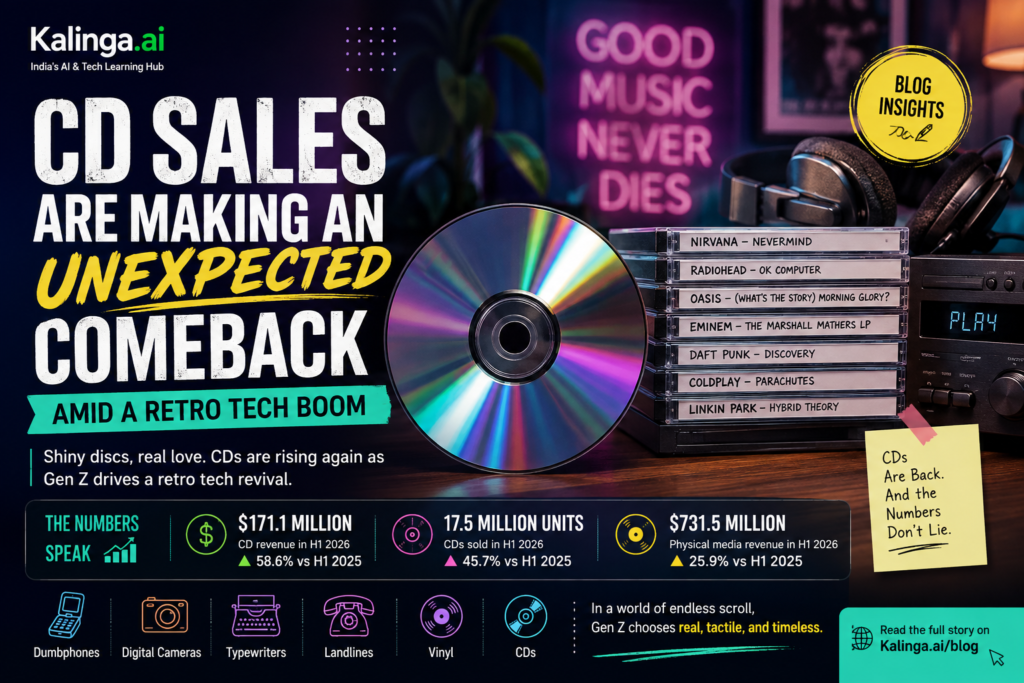
Streaming services made carrying physical music around feel unnecessary, but CD sales are unexpectedly rising again in 2026, with U.S. CD revenue jumping 58.6% in the first half of the year. The comeback is happening alongside renewed interest in older, simpler technology such as dumbphones, digital cameras, typewriters, landlines and vinyl records.
According to data from the Recording Industry Association of America (RIAA), CDs generated $171.1 million in U.S. revenue during the first half of 2026, compared with roughly $107.9 million during the same period in 2025.
Even more striking, the number of CDs sold increased 45.7%, reaching 17.5 million units compared with approximately 12 million units during the first half of 2025.
So, is the CD actually making a comeback?
The short answer is yes , at least for now. But this isn’t simply about people suddenly deciding that CDs sound better than Spotify. It is part of a broader cultural shift toward physical media, offline experiences and technology that gives people more control over how they interact with their devices.
What Do the Latest CD Sales Numbers Actually Show?
The strongest evidence for the revival comes from the RIAA’s latest mid-year recorded-music report.
Question → Direct Answer: How much did CD sales grow in the first half of 2026?
U.S. CD revenue reached $171.1 million in the first half of 2026, a 58.6% increase from approximately $107.9 million during the same period in 2025. Unit sales rose 45.7%, from about 12 million CDs to 17.5 million.
That is significant because CDs weren’t experiencing a steady upward trajectory before this year.
In fact, 2025 was another difficult year for the format. The RIAA’s full-year 2025 report showed that CD revenue fell 7.8%, from $338.9 million in 2024 to $312.4 million in 2025.
The number of units sold also declined 11.6%, dropping from 33.3 million CDs in 2024 to 29.5 million in 2025.
That makes the 2026 rebound particularly interesting.
2024 vs. 2025 vs. 2026
| Period | CD revenue | CD units sold | Trend |
| First half 2025 | ~$107.9 million | ~12 million | Declining |
| First half 2026 | $171.1 million | 17.5 million | Strong rebound |
| Full-year 2024 | $338.9 million | 33.3 million | Higher than 2025 |
| Full-year 2025 | $312.4 million | 29.5 million | Decline |
The numbers tell an important story: the CD isn’t simply continuing a gradual revival that started years ago. Instead, 2026 represents a surprisingly sharp reversal after another decline in 2025.
There Is an Important Catch With the Revenue Numbers
Before declaring a massive CD renaissance, there is an important measurement issue to understand.
Question → Direct Answer: Can we directly compare CD revenue from 2024 and 2025?
Not perfectly. The RIAA changed its methodology in 2025, switching from estimated retail value to wholesale value when calculating dollar figures. That means the 2024 and 2025 revenue figures aren’t directly comparable.
Fortunately, unit sales aren’t affected by that particular accounting change.
And those numbers tell the same basic story: 29.5 million CDs were sold in 2025, down from 33.3 million in 2024.
So the evidence for a 2026 rebound isn’t entirely dependent on revenue calculations.
The increase in physical units is substantial, too.
That distinction matters because it prevents an easy but potentially misleading conclusion: that the entire CD revival is simply the result of the RIAA changing how it measures money.
It isn’t.
The methodology change complicates historical revenue comparisons, but the 45.7% increase in first-half unit sales in 2026 is still a major signal of renewed demand.
Why Is Gen Z Interested in Old Technology?
Here’s where the story gets more interesting.
The CD revival isn’t happening in isolation. It’s appearing alongside a broader retro tech boom involving products and technologies that were once considered obsolete.
Definition + Expansion: Retro tech refers to older or deliberately old-fashioned technology that has regained cultural or consumer interest after newer alternatives became dominant.
Think about the devices that have suddenly become interesting again: flip phones, digital cameras, typewriters, landline phones, portable music players and physical media.
To someone who grew up before smartphones, these products might simply look familiar.
To someone who grew up with smartphones, they can feel almost exotic.
Question → Direct Answer: Why does Gen Z like retro technology?
One explanation is that younger consumers are attracted to technology that provides fewer distractions and more control. Older devices generally don’t bombard users with endless notifications, recommendation algorithms, social-media feeds and apps competing for attention.
A CD is an especially simple example.
You choose an album.
You put the disc into a player.
You press play.
That’s basically it.
There is no algorithm deciding what comes next. There isn’t an infinite music library waiting behind a search box. And there’s no requirement to maintain another subscription simply to access something you already purchased.
That simplicity can be surprisingly attractive in an era of technological overload.
CDs Offer Something Streaming Can’t
Streaming is extraordinarily convenient.
For a monthly subscription, listeners can access enormous music libraries without purchasing individual albums or storing physical objects.
But convenience isn’t the only thing people value.
Question → Direct Answer: Why would someone buy a CD when they can stream the same album?
A physical album offers ownership, collectability and a more deliberate listening experience. A CD can also become part of a personal collection, complete with artwork, packaging and a tangible connection to the music.
That’s particularly relevant for younger consumers who never experienced the original CD era.
For someone who grew up surrounded by smartphones and streaming services, purchasing an album on a disc can feel less like returning to an old habit and more like discovering a new one.
The physical object becomes part of the experience.
And that’s something a streaming interface doesn’t completely replicate.
The CD Comeback Is Part of a Bigger Physical Media Revival
CDs aren’t the only physical format experiencing renewed interest.
The RIAA reported that U.S. physical media revenue reached $731.5 million in the first half of 2026, up 25.9%.
Vinyl continued to grow as well, with revenue increasing 17.7% during the same period.
That gives us a much broader picture.
The trend isn’t necessarily “everyone is abandoning streaming.”
Instead, consumers appear increasingly willing to combine streaming with physical formats.
Someone might use Spotify for discovering new artists while buying a CD from a favorite musician.
Another person might stream an album every day but purchase its vinyl edition as a collectible.
This hybrid behavior makes more sense than treating physical and digital music as mutually exclusive.
CD Sales vs. Vinyl Sales: What’s Driving the Physical Music Boom?
Both formats belong to the physical-media category, but they occupy slightly different cultural spaces.
| Factor | CDs | Vinyl |
| Portability | High | Low |
| Physical ownership | Yes | Yes |
| Collectibility | High | Very high |
| Equipment required | Relatively simple | Turntable and accessories |
| Storage | Compact | Bulky |
| Current growth | 58.6% revenue growth in H1 2026 | 17.7% revenue growth in H1 2026 |
| Cultural appeal | Nostalgia + affordability + convenience | Nostalgia + collecting + listening ritual |
The numbers supplied by the RIAA make one thing particularly clear: CDs are currently experiencing a faster revenue rebound than vinyl.
That doesn’t necessarily mean CDs will permanently overtake vinyl as the preferred physical format.
Vinyl has developed a strong collector culture over the past several years, while CDs have the advantage of being smaller, cheaper to manufacture and easier to store.
For consumers interested in physical music without wanting to maintain shelves of large records, CDs offer a practical middle ground.
Why CDs May Be Especially Attractive to Younger Buyers
There’s an interesting contradiction at the heart of the CD revival.
The people most responsible for the original decline of CDs were not necessarily the same people buying them today.
Many Gen Z consumers didn’t experience the transition from CDs to MP3s to streaming in the same way older generations did.
They largely grew up after streaming had already transformed music consumption.
That means a CD isn’t necessarily associated with technological inconvenience.
Instead, it can represent:
- A physical connection to music
- A break from algorithm-driven recommendations
- A collectible object
- Album artwork and packaging
- Offline listening
- A personal music library
- A nostalgic experience they never personally had
This is an important distinction.
Nostalgia normally means remembering something from your own past.
But retro technology can create something closer to borrowed nostalgia , an attraction to an era experienced through parents, older siblings, movies, photographs, social media and popular culture.
A Gen Z consumer doesn’t have to remember buying CDs in the 1990s to find them interesting.
The “Dumb Tech” Movement Helps Explain the CD Revival
The renewed interest in CDs makes more sense when viewed alongside the rise of deliberately limited technology.
Consider the modern smartphone.
It can be a camera, music player, television, gaming device, navigation system, payment terminal, social network, messaging platform and work computer , all inside one pocket-sized device.
That’s useful.
But it’s also exhausting.
Question → Direct Answer: What does the retro tech boom have to do with digital fatigue?
Retro technology can remove many of the distractions built into modern connected devices. A simple phone can make calls without social media, while a digital camera can take photographs without displaying notifications or encouraging immediate posting.
The same philosophy applies to physical music.
A CD player has one obvious purpose: play the disc.
This doesn’t make the technology objectively better.
It makes it more limited.
And that limitation can itself become a feature.
Physical Ownership Is Becoming Valuable Again
For years, the direction of consumer technology seemed obvious: move everything into the cloud.
Photos went from albums to online galleries.
Movies went from DVDs to streaming.
Music went from CDs to subscriptions.
Documents moved from hard drives to cloud storage.
But the cloud model comes with trade-offs.
You don’t necessarily control the underlying service.
Catalogs can change.
Licensing agreements can expire.
Subscriptions can become more expensive.
A title can disappear from a platform.
Physical media works differently.
If you own a CD, you have a physical copy of that album.
You don’t need an internet connection to play it, and you’re not depending on a streaming catalog remaining available.
That doesn’t mean physical ownership is always more convenient.
It simply offers a different form of control.
Could the CD Comeback Be Bigger Than the RIAA Numbers Suggest?
Possibly , and there’s an important reason.
The RIAA figures primarily capture the formal recorded-music market represented by its reporting system.
They don’t capture every used CD changing hands.
Think about the CDs sitting in:
- Thrift stores
- Garage sales
- Flea markets
- Secondhand music stores
- Family collections
- Personal libraries
- Online resale marketplaces
Those transactions can happen without appearing in the same way as new CD sales reported through the formal music industry.
There’s another overlooked source of physical media: hand-me-downs.
A parent who purchased CDs years ago might give an old collection to their child.
No new CD gets manufactured.
No new CD gets counted as a unit sale.
But the music has still found a new listener.
That means the cultural popularity of CDs could potentially be larger than new-sales statistics alone suggest.
The CD Comeback Is Also About the Album as an Object
Streaming transformed the album into something closer to a digital container.
You can skip songs instantly.
Shuffle them.
Create playlists.
Jump between artists.
Download individual tracks.
That’s incredibly powerful.
But physical albums encourage a different relationship with music.
You see the cover.
You hold the booklet.
You read the credits.
You arrange the collection on a shelf.
You remember where you bought it.
For collectors, the album becomes more than an audio file.
It becomes an object associated with a particular moment, artist or period of life.
That’s one reason the physical-media revival shouldn’t be reduced to “young people like old things.”
They’re often buying experiences and objects, not simply outdated technology.
What Startups Are Doing With the Retro Tech Boom
The interest in simpler technology has also created opportunities for new companies.
Some startups are deliberately building products that resemble older technologies while incorporating modern manufacturing and connectivity.
The broader market now includes companies working on simpler phones, retro-inspired devices and landline-style products.
The examples mentioned in the source material include Tin Can, Ooma, Pinwheel, Light, Dumb Co. and Minimal, alongside products such as Clicks’ BlackBerry-inspired hardware.
Meanwhile, consumers are also looking backward rather than buying newly manufactured retro products.
Vintage technology is increasingly appearing in thrift stores and online marketplaces such as eBay and Retrospekt.
This creates an interesting two-sided market:
New companies are rebuilding old ideas, while consumers are rediscovering the original products.
CDs fit neatly into that ecosystem.
You don’t necessarily need a company to reinvent the CD.
Millions of the original discs already exist.
Is This Really the End of Streaming?
Probably not.
And that distinction is important.
The rise in CD sales doesn’t mean streaming is suddenly disappearing.
Streaming remains one of the most convenient ways to discover and consume music. Its huge catalogs and accessibility are difficult for physical formats to match.
The more interesting possibility is that consumers are becoming comfortable with both models at once.
Streaming can be the discovery tool.
Physical media can be the ownership and collection layer.
That could produce a music ecosystem where people don’t have to choose between digital convenience and physical ownership.
For example, someone might discover an artist through streaming, listen to the album repeatedly and eventually buy the CD because they want something tangible.
The physical purchase becomes a deliberate choice rather than the default method of accessing music.
What the CD Revival Says About the Future of Technology
The biggest lesson isn’t actually about CDs.
It’s about choice.
For years, technological progress was often presented as a one-way journey:
physical → digital
offline → online
dedicated device → smartphone
ownership → subscription
local storage → cloud
But consumers don’t always follow that path permanently.
Technology can move forward while people selectively bring older ideas back.
That doesn’t mean the past was better.
It means different technologies solve different problems.
A smartphone is better than a flip phone for many tasks.
Streaming is easier than maintaining a CD collection.
Cloud storage is more convenient than carrying a stack of hard drives.
But “better” doesn’t always mean “more satisfying.”
Sometimes consumers value limits.
Sometimes they value ownership.
Sometimes they want a device that does one thing extremely well.
And sometimes they simply want to switch off.
Why This Trend Matters Beyond Music
The CD revival is a useful case study for anyone interested in technology and consumer behavior.
It demonstrates that innovation isn’t always about replacing old products permanently.
Instead, technologies can move through cycles.
A product can go from:
New → mainstream → outdated → nostalgic → collectible → commercially relevant again.
That doesn’t mean every obsolete technology will return.
Nobody should assume fax machines or floppy disks are about to dominate the market again.
But certain technologies have characteristics that make them particularly suitable for revival.
CDs are relatively inexpensive, durable, compact and easy to use. They also carry cultural value because they’re directly connected to albums, artists and memories.
Those qualities make them much more likely to experience a second life than many genuinely obsolete technologies.
What Should We Watch Next?
The first question is whether the 2026 growth continues.
One strong six-month period doesn’t automatically establish a permanent market reversal.
The industry will need to see whether unit sales remain elevated throughout the year and into 2027.
The second question is who is buying the CDs.
If younger consumers are driving a meaningful portion of the growth, the revival could represent a genuine generational shift rather than a temporary nostalgia cycle.
The third question concerns artists.
If musicians see growing demand for physical albums, they have an incentive to create more attractive physical editions, special packaging and collector-focused releases.
That could reinforce the cycle.
Finally, the biggest question may be whether this behavior spreads beyond music.
If consumers continue embracing simple cameras, basic phones, physical media and other deliberately limited technologies, the retro tech boom could become a lasting countertrend to the always-connected digital lifestyle.
Frequently Asked Questions About CD Sales
Are CD sales increasing in 2026?
Yes. According to the RIAA’s first-half 2026 data, U.S. CD revenue reached $171.1 million, up 58.6% from approximately $107.9 million during the first half of 2025. Unit sales rose 45.7% to 17.5 million.
Why are CD sales increasing again?
The rise appears connected to a broader renewed interest in physical media and retro technology. Younger consumers, including Gen Z, may be attracted to physical ownership, offline listening, collecting and technology with fewer digital distractions.
Why does Gen Z like CDs?
Gen Z may view CDs as a form of retro technology that offers a more tangible and deliberate music experience. CDs can also provide album artwork, physical ownership and offline listening without the constant notifications and algorithmic recommendations associated with smartphones.
Are CDs becoming more popular than vinyl?
Not necessarily. Both formats are growing, but the RIAA reported that CD revenue increased 58.6% in the first half of 2026, while vinyl revenue increased 17.7%. That shows a particularly strong rebound for CDs, but it does not establish that CDs have overtaken vinyl culturally or commercially.
Is streaming music declining because of the CD comeback?
The available information does not establish that streaming is being replaced by CDs. Streaming remains a highly convenient way to access music, while the physical-media revival may represent an additional way consumers engage with music rather than a complete shift away from digital services.
Could CD sales continue growing?
They could, but one strong period isn’t enough to guarantee a permanent comeback. Continued growth through the rest of 2026 and into subsequent years would provide stronger evidence that CDs have entered a sustained revival rather than experiencing a temporary rebound.
The Bigger Picture: Sometimes Less Technology Is More
The surprising rise in CD sales isn’t really a story about people suddenly deciding that 1990s technology is superior.
It’s a story about consumers reconsidering what they want from technology.
After years of moving toward increasingly connected, automated and algorithm-driven experiences, some people are deliberately choosing products that do less.
A CD doesn’t recommend another song.
A typewriter doesn’t send notifications.
A basic phone doesn’t endlessly scroll.
A digital camera doesn’t necessarily push you to post every picture immediately.
That limitation can feel refreshing.
The 58.6% increase in CD revenue during the first half of 2026 is therefore worth watching,not because it means streaming is dead, but because it suggests consumers may want something that modern technology sometimes overlooks: control, ownership and a little less noise.
And if that desire continues, the humble compact disc may turn out to be only one part of a much larger retro-tech revival.explore more kalinga.ai