What Happened at Tesla’s Private Cybercab Launch Event?
Tesla held a private event to launch the Cybercab, and it looked nothing like the company’s usual big, loud, livestreamed product reveals. According to TechCrunch’s reporting, the keynote reportedly lasted only around 15 minutes, and it doesn’t appear that CEO Elon Musk even spoke at the event.
Question → Direct Answer: How is Tesla sharing Cybercab details if the event wasn’t livestreamed? Tesla released some information through PDFs published on the same day, along with updated terms of service in its “Robotaxi” app , while other details have simply been shared online by a small group of dedicated fans who attended.
A quick definition: A robotaxi is a self-driving vehicle designed to operate as an autonomous taxi service, picking up and transporting passengers without a human driver. Tesla’s pitch for the Cybercab centers on it being a fully autonomous vehicle relying only on cameras and AI , no radar or lidar , offered at a price point well below rivals like Waymo.
Why Doesn’t Tesla Allow Kids Under 13 in the Cybercab Yet?
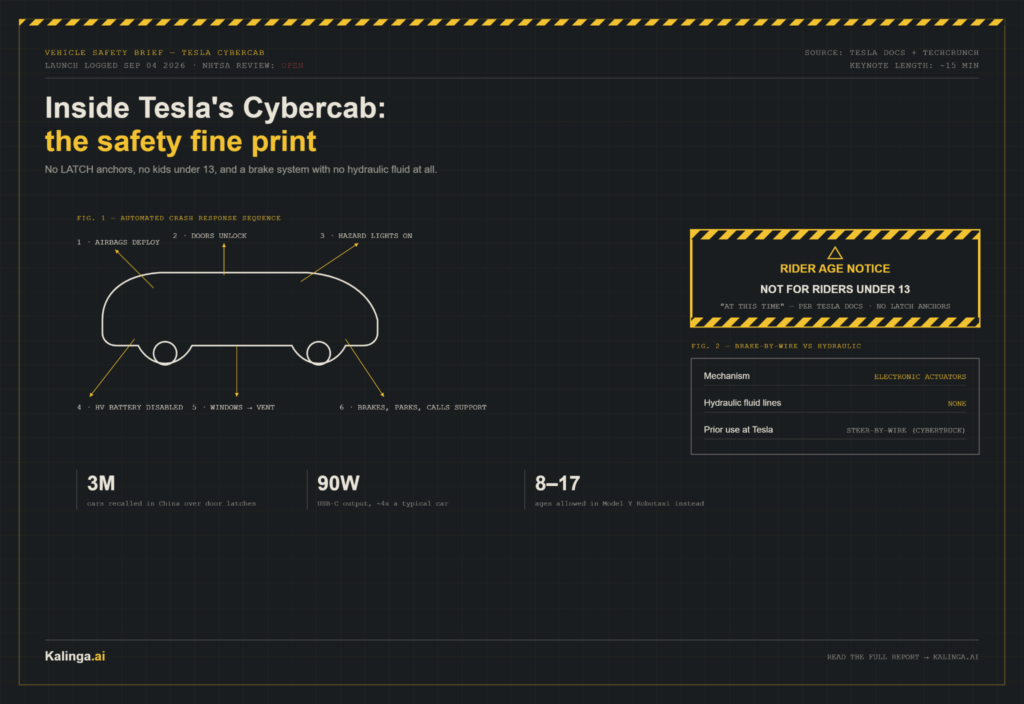
Question → Direct Answer: What’s the minimum age to ride in a Tesla Cybercab? Tesla’s fine print states that minors under the age of 13 are not allowed to ride in the Cybercab “at this time” , a notably stricter rule than Tesla applies to its other robotaxi vehicle.
By comparison, minors between the ages of 8 and 17 are permitted to ride in Tesla’s “Robotaxi” Model Y SUVs, provided they’re accompanied by an adult, which is required for all riders under 18 in both vehicles.
Definition: What Are LATCH Anchors, and Why Does Their Absence Matter?
LATCH anchors are standardized built-in attachment points in a vehicle’s seats that let parents secure a child car seat without using the seatbelt itself. The Cybercab notably lacks these standard anchors , child seats can only be attached using the seat belt instead, a design choice that appears connected to Tesla’s broader push to remove components and cut costs, and one that may help explain why younger children aren’t yet permitted on board.
What Happens When a Tesla Cybercab Gets in a Crash?
Even highly capable autonomous vehicles on the road today still get into collisions, and Tesla has detailed a specific sequence of automated responses for when this happens in a Cybercab:
- Airbags inflate to protect occupants on impact.
- Doors automatically unlock, allowing occupants or first responders to get in or out.
- Hazard warning lights and interior lights turn on to signal the vehicle’s status.
- The high-voltage battery is disabled as a safety precaution.
- Windows move to a “vent” position.
- The Cybercab applies its brakes to come to a stop and park itself.
- The infotainment system starts a two-way connection with Tesla’s rider support team.
Why does the door-unlocking detail matter so much? Because Tesla has faced real scrutiny over its electronic door latches , just last month, Tesla agreed to recall 3 million cars in China, alongside several other automakers, following an investigation into electronic door latches that could trap occupants after a crash.
Manual Door Releases: A Response to Past Criticism
Tesla has also faced criticism that its interior manual door releases are too difficult to locate during an emergency, since electronic latches are the primary way to open doors in its vehicles , activated by a button or a smartphone under normal conditions. In the Cybercab, Tesla says the manual release is placed in a clearly visible spot on each door’s armrest, alongside a small exterior button riders can use as well.
Tesla Cybercab vs. Tesla Robotaxi (Model Y): Key Differences
| Feature | Cybercab | Robotaxi (Model Y) |
| Minimum rider age | 13+ (for now) | 8–17 allowed with adult |
| Adult supervision for minors | Required under 18 | Required under 18 |
| Child seat anchors | No LATCH; seat belt only | Standard child seat guidelines provided |
| Door mechanism | Electronic latches, exterior button | Electronic latches |
| Braking system | Brake-by-wire (electronic actuators) | Not specified in this reporting |
Why compare these two vehicles at all? Because it shows the age and safety-equipment restrictions aren’t a Tesla-wide robotaxi policy , they’re specific to the brand-new Cybercab, suggesting Tesla itself may still be working through unresolved safety questions unique to this vehicle.
Brake-by-Wire and Other Notable Cybercab Design Choices
What is brake-by-wire, and why is Tesla using it in the Cybercab? Brake-by-wire is a braking system that uses electronic actuators to control the brake calipers directly, instead of a traditional hydraulic system that pumps fluid through lines to apply pressure. Musk described the reasoning in a post, noting that “having electric brakes avoids the complexity of a hydraulic system” , eliminating the need to route hydraulic plumbing throughout the vehicle.
This isn’t Tesla’s first move away from traditional mechanical systems: the company was already the first major automaker to use steer-by-wire in its Cybertruck, severing the physical connection between the steering wheel and the front wheels entirely.
A few other notable, less-explained Cybercab details:
- Windows “cannot be fully opened at this time,” according to Tesla’s released documentation, with no explanation given for the limitation.
- USB-C outlets reportedly deliver 90 watts of power , roughly four times the output typically found in a standard vehicle , according to influencer Jeremy Judkins.
What This Means for the Future of Robotaxis and Regulation
- Regulatory scrutiny is already underway , the National Highway Traffic Safety Administration (NHTSA) has opened an investigation into Tesla’s Cybercab rollout, meaning the vehicle’s safety claims will face formal review.
- Cost-cutting decisions carry real safety trade-offs , removing LATCH anchors and relying on brake-by-wire and steer-by-wire systems reflect a broader Tesla pattern of stripping components, which invites extra safety questions for a vehicle carrying passengers autonomously.
- Public trust depends on transparency, and Tesla’s decision to release key details through PDFs and app terms of service rather than a full public presentation stands out as an unusually quiet approach for a flagship product.
- Door latch safety remains a live issue for Tesla globally, given the recent 3-million-vehicle recall in China tied to electronic door latch concerns.
- Autonomous vehicle policies are still evolving in real time , the fact that Tesla explicitly frames its under-13 restriction as being in place “at this time” suggests this rule itself may change as the company gathers more data.
Frequently Asked Questions About Tesla’s Cybercab
Can children ride in a Tesla Cybercab? Not yet if they’re under 13 , Tesla’s released fine print states that minors under age 13 are not allowed to ride in the Cybercab “at this time.”
What’s different about child seat safety in the Cybercab compared to Tesla’s other robotaxi? The Cybercab lacks standard LATCH anchors for child seats, meaning seats can only be secured using the seat belt, unlike Tesla’s Model Y Robotaxi, which follows more standard child seat guidelines.
What happens automatically if a Tesla Cybercab is in a crash? The airbags inflate, doors unlock, hazard and interior lights turn on, the high-voltage battery is disabled, windows move to a vent position, the vehicle brakes to a stop, and the infotainment system opens a two-way connection with Tesla’s rider support team.
Is Tesla’s Cybercab being investigated by regulators? Yes. The National Highway Traffic Safety Administration has already opened an investigation into Tesla’s Cybercab rollout.
What is brake-by-wire technology in the Cybercab? Brake-by-wire uses electronic actuators to control the brake calipers instead of a traditional hydraulic fluid system, a design choice Tesla says reduces mechanical complexity.
Why can’t Cybercab windows be fully opened? Tesla has not explained why, stating only in its released documentation that Cybercab windows “cannot be fully opened at this time.”
Want to keep track of how autonomous vehicle safety standards and regulations evolve? Explore more explainers on AI and emerging tech over on Kalinga.ai.