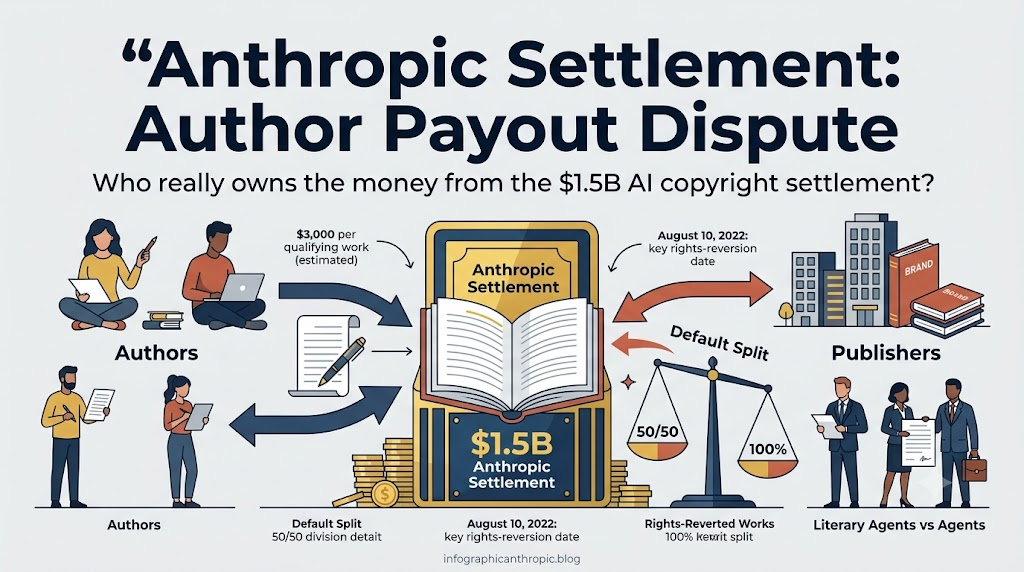
What is happening with the Anthropic settlement?
Imagine discovering that a book you wrote is eligible for thousands of dollars from a major AI copyright settlement,only to receive a notice saying your publisher, or even your literary agent, is claiming part of the money.
That is now happening to some authors involved in Anthropic’s $1.5 billion copyright settlement. The settlement was finally approved in July 2026, but the payment process has triggered a new dispute over who actually owns the right to receive each payout.
The controversy is not primarily about whether Anthropic owes money. That question was addressed through the settlement. The new fight is about allocation: how much of the settlement payment should go to an author, a publisher, or another claimant for a particular book?
The issue has become especially visible because authors began receiving claim notices in early September. The Authors Guild says the settlement administrator sent notices summarizing each claimant’s works, other claims filed against those works, and the percentages being requested.
Definition: What is the Anthropic settlement?
The Anthropic settlement is a $1.5 billion class-action agreement resolving claims over Anthropic’s acquisition and copying of copyrighted books used in developing its AI systems. A U.S. federal court granted final approval on July 20, 2026, allowing the distribution process to proceed.
The settlement covers the “input” side of the dispute,Anthropic’s past acquisition and copying of qualifying works. Importantly, the court’s final judgment did not release future misconduct claims or AI-output claims, according to the Authors Guild.
That distinction matters. The settlement does not mean every future use of copyrighted material by Anthropic is automatically legal. It resolves a particular set of past claims.
How is the Anthropic settlement supposed to divide payments?
The headline number is $1.5 billion, but individual authors are not simply receiving an equal slice of that amount.
Under the settlement structure described by TechCrunch and the Authors Guild, qualifying works generally have an estimated allocation of $3,000 per pirated work, with the amount divided among eligible rights holders according to the applicable allocation rules.
For many traditionally published books, the default allocation is straightforward: the author and publisher generally split the payment 50/50.
But that is not the rule for every book.
Question → Direct Answer: Who gets the settlement money?
The person or organization that legally holds the relevant rights at the time specified by the settlement can be entitled to the payment. For many trade-published books, the default is a 50/50 author-publisher split, while authors whose rights had reverted before the settlement’s relevant August 10, 2022 download date may be entitled to 100%, depending on the circumstances.
That is why old publishing contracts and rights-reversion letters have suddenly become extremely important.
The basic 50/50 rule
For a conventional trade-published book, the settlement generally provides a default split between the author and publisher.
The reasoning is connected to publishing agreements and provisions concerning recovery from copyright infringement. The Authors Guild says standard trade publishing arrangements generally reserve some rights to authors while granting publishers specific exclusive rights, and many contracts contain provisions addressing recovery from infringement.
For an author with a qualifying book that remained under the publisher’s rights, a 50/50 allocation can therefore be appropriate.
The problem begins when a publisher claims a percentage despite no longer holding the relevant rights.
When authors can claim 100%
One of the most important facts in the Anthropic settlement dispute is the concept of rights reversion.
Rights reversion means that contractual publishing rights previously granted to a publisher return to the author. This can happen when a contract terminates, when a book goes out of print under applicable contractual conditions, or through another mechanism specified by the publishing agreement.
If an author’s rights reverted before August 10, 2022, the Authors Guild says the author may be entitled to 100% of the settlement allocation, depending on the contract and circumstances.
That date is crucial because the settlement uses August 10, 2022 as the relevant “download date” for determining certain rights.
So an author who regained rights to a novel years ago could reasonably be surprised to see the old publisher claiming half,or even all,of the settlement allocation.
Why are authors disputing publisher claims?
The current dispute became public after authors started receiving claim-reconciliation notices.
Some authors reportedly discovered that publishers were claiming money from books for which the authors say their rights had already reverted. Others found that publishers appeared to be requesting 100% of a payment even where the default allocation should be 50/50.
Writer Beware, which has been tracking the settlement, reported numerous complaints involving publishers making claims that authors considered incorrect. Victoria Strauss identified two major categories: claims on rights-reverted works and claims for the entire allocation on books where a publisher would ordinarily receive only half.
The reports involve numerous publishers and imprints, although the existence of a reported claim does not by itself establish intentional wrongdoing by any particular publisher.
Question → Direct Answer: Are publishers deliberately taking authors’ money?
There is currently no basis to conclude that all disputed publisher claims are deliberate attempts to take authors’ money. Several publishers reportedly told authors that incorrect claims were mistakes and that Anthropic or the settlement administrator was aware of the problem. At the same time, the repeated nature of similar errors has raised legitimate concerns about how the claims process is being administered.
That distinction is important.
A broken database, outdated rights records, bulk claims, or administrative mistakes could create many of the same symptoms as intentional overclaiming.
But from an author’s perspective, the immediate consequence is identical: money can be placed into dispute until the allocation is corrected.
Rights reversion is at the center of many disputes
Publishing rights can be surprisingly complicated.
A book might have been published by one company, acquired by another, moved between imprints, licensed in different territories, or returned to the author years ago. Audio rights may have been handled separately. A publisher might also have historical records that do not perfectly reflect the author’s current contractual position.
The Anthropic settlement has effectively turned those historical records into financial evidence.
That creates a difficult question:
Who owned the relevant rights when Anthropic downloaded the work?
For authors, the answer may depend on documents that are decades old.
Question → Direct Answer: Why does the August 10, 2022 date matter?
August 10, 2022 is the settlement’s relevant download date, and rights reversion before that date can be important when determining whether an author is entitled to the entire allocation. A later rights reversion does not necessarily eliminate a publisher’s claim because the publisher may have held the relevant rights when the infringement occurred.
This is why authors should not assume that simply owning a book’s rights today automatically means they receive 100% of its settlement payment.
The historical timeline matters.
Are these publisher mistakes or a systemic problem?
This is where the story becomes more complicated.
Writer Beware’s Victoria Strauss has cautioned against immediately assuming malicious intent. Poor recordkeeping, outdated databases, overworked staff, or mistakes in processing large batches of claims could explain at least some incorrect allocations.
Some publishers have also reportedly acknowledged incorrect 100% claims and said corrections were being made.
Yet Strauss has also argued that the unusually high number of similar complaints deserves attention. Authors were reporting comparable errors across different publishers and books, suggesting that the problem may extend beyond isolated administrative glitches.
The Authors Guild has taken a similarly cautious approach.
Its September 4 guidance notes that some publishers informed the settlement administrator they had mistakenly selected 100% rather than the default allocation.
So the most defensible conclusion right now is neither “publishers are stealing the money” nor “everything is fine.”
It is this:
The settlement’s allocation process is generating enough conflicting claims that authors need to independently verify what is being claimed on their books.
Why are literary agents also appearing in settlement claims?
Publishers are not the only organizations attracting attention.
Writer Beware reported complaints from authors whose literary agencies had submitted claims seeking percentages of settlement allocations. The agencies mentioned in those reports allegedly sought percentages ranging from 15% to 25% on certain books.
That has generated particularly strong criticism because literary agents generally represent authors in negotiating and selling publishing rights but are not themselves the copyright owners of the books.
Question → Direct Answer: Should literary agents automatically receive part of the settlement?
No. A literary agent does not automatically become a rights holder simply because the agent represented or sold a book. Whether an agent has any legitimate contractual entitlement would depend on the specific agency agreement and the legal basis for the claim; the settlement itself is focused on eligible rights holders.
This is one reason authors and industry observers are scrutinizing agent claims so closely.
A commission agreement between an author and agent is not necessarily the same thing as ownership of copyright or entitlement to proceeds from a particular infringement claim.
Authors should therefore examine the contract rather than assuming that an agency’s claim is automatically valid,or automatically invalid.
What should authors do if their Anthropic settlement payout is disputed?
If you are an author participating in the Anthropic settlement, the most important step is simple: read the claim notice carefully before accepting the proposed allocation.
The Authors Guild says claimants received notices containing a claim number and PIN, along with information about other claims made for the same works. If there is an allocation disagreement, authors can review and update the percentage they believe is correct and upload supporting documents.
A practical checklist
- Check every title listed in your settlement notice.
- Compare the claimant percentages against your publishing records.
- Check whether your rights had reverted before August 10, 2022.
- Find your rights-reversion letter if you have one.
- Review your publishing contract for relevant allocation or infringement language.
- Check whether another publisher, co-author, or claimant appears on the record.
- Challenge an incorrect allocation through the settlement portal.
- Upload supporting documentation when requested.
- Contact the publisher if its claim appears to be based on outdated information.
- Watch the deadline for resolving allocation disagreements.
The Authors Guild says disputed co-claimants have a 30-day window to attempt to resolve allocation differences. If they cannot reach agreement, the settlement administrator can facilitate the dispute, with unresolved matters eventually going to a court-appointed Special Master.
What documents could help?
The strongest evidence will depend on the dispute, but useful records may include:
| Situation | Potentially useful evidence | Why it matters |
| Rights reverted | Rights-reversion letter | Shows when rights returned |
| Publisher claims 100% | Publishing contract | Can establish allocation rights |
| Author claims 100% | Contract + reversion documents | Supports sole-rights argument |
| Conflicting publisher claims | Assignment/license records | Helps identify the actual rights holder |
| Educational book dispute | Publishing agreement | Educational contracts can use different allocation structures |
| Agent claim | Agency agreement | Determines whether the agent has any contractual entitlement |
The Authors Guild specifically recommends supporting disputed allocations with documentation such as a reversion letter or contract.
Be especially careful with scam emails
There is another problem authors need to consider: scammers can exploit high-profile settlements.
The Authors Guild says legitimate settlement notices were sent as part of the claims-reconciliation process, but it has also warned that scammers have used the Anthropic settlement as bait with look-alike or misspelled domains. The Guild advises checking the sender and destination before clicking links.
That means authors should not treat every email mentioning an Anthropic payment as legitimate.
Why this dispute matters beyond one $1.5 billion settlement
The Anthropic settlement is important because it turns an abstract AI copyright debate into a concrete question about money.
For years, discussions around AI training often sounded like this:
Can an AI company legally train on copyrighted books?
The Anthropic case showed that the answer can depend heavily on how the material was obtained and used.
The court approved a settlement covering claims concerning Anthropic’s past acquisition and copying of works, while preserving future and output-related claims.
Now the industry is confronting another question:
If AI companies compensate creators, who actually gets paid?
That question could become increasingly important as more AI companies negotiate settlements, licensing deals, or face copyright litigation.
The settlement exposes the hidden complexity of copyright ownership
To a reader, a book has one obvious creator: the author.
Legally, however, the rights surrounding that book can be fragmented.
There may be:
- authors and co-authors;
- publishers;
- licensors;
- territorial rights holders;
- audiobook companies;
- educational publishers;
- heirs or estates;
- agencies;
- distributors;
- rights that reverted to authors;
- and contracts governing infringement recoveries.
A settlement administrator therefore has to reconstruct a complicated chain of ownership and contractual rights.
That is much harder than simply identifying the name on a book cover.
What does the dispute mean for AI copyright?
The Anthropic settlement is unlikely to end the broader AI copyright debate.
In fact, the legal landscape is becoming more complicated. Anthropic is facing additional copyright litigation, including a lawsuit filed by major music publishers in August 2026 over alleged use of copyrighted song lyrics and sheet music in AI training. Anthropic has said it disagrees with those claims and plans to defend itself.
At the same time, other AI copyright cases continue to test whether training models on copyrighted material can qualify as fair use.
That means the Anthropic settlement should not be interpreted as a universal legal ruling that AI training is either legal or illegal.
It is a negotiated resolution of specific claims.
Definition: What is fair use?
Fair use is a U.S. copyright-law doctrine that can allow certain uses of copyrighted material without permission, depending on factors such as purpose, nature of the work, amount used, and market effects.
In the Anthropic litigation, the distinction between lawful training-related use and the acquisition of pirated copies became particularly important. The resulting $1.5 billion settlement resolved claims connected to Anthropic’s past conduct without establishing a blanket rule for every AI-training scenario.
For students, creators, startups, and technology professionals in India, there is an additional lesson: U.S. fair use rules should not simply be assumed to apply in India.
Indian copyright law has its own framework, including fair-dealing provisions and specific exceptions.
So when evaluating AI and copyright, always ask:
- Which country’s law applies?
- How was the copyrighted material obtained?
- How was it used?
- What rights did the parties actually hold?
- Was the dispute settled, litigated, or still unresolved?
Those questions are more useful than asking whether “AI training is legal” as if there were one universal answer.
Why the Anthropic settlement could become a lesson for future AI deals
There is another important takeaway here for the AI industry.
A settlement does not eliminate the importance of rights management.
If anything, it demonstrates why companies building AI systems may need increasingly sophisticated systems for tracking where training material came from, what permissions apply, and who owns the relevant rights.
For publishers and authors, the lesson is similar.
Copyright records are not just administrative paperwork. They can become financially significant when an AI company, platform, or other technology business is accused of using copyrighted material.
The Authors Guild reported in August that some authors had discovered publishers failed to register copyrights for books despite contractual obligations, potentially making those works ineligible for settlement payments.
That adds another layer to the controversy.
A creator can potentially lose money not because an AI company rejected a claim, but because the underlying rights documentation was incomplete or incorrect.
What should creators learn from the Anthropic settlement?
For writers and other creators, the biggest lesson is surprisingly old-fashioned: keep your paperwork.
AI may be changing how books, music, images, and software are created, but copyright disputes still depend heavily on contracts, ownership records, dates, licenses, and evidence.
For creators, that means maintaining a digital archive of:
- publishing contracts;
- rights-reversion notices;
- copyright registration information;
- licensing agreements;
- amendments;
- agency agreements;
- royalty statements;
- correspondence about rights;
- and records showing when rights changed hands.
The current Anthropic settlement dispute demonstrates why these documents can matter years after a book was published.
Question → Direct Answer: What is the biggest lesson for authors?
Do not assume that a settlement administrator’s proposed allocation is automatically correct. Review the claim against your own contracts and rights history, especially if another claimant appears to be requesting part of your payment.
This is not about automatically distrusting publishers or agents.
It is about verifying ownership.
The bigger picture: AI copyright is moving from theory to accounting
The first phase of the AI copyright debate was largely philosophical.
Should AI companies be allowed to learn from copyrighted material?
The second phase is becoming much more practical:
Who pays whom, how much, and based on which rights?
The Anthropic settlement provides a striking example because a headline figure of $1.5 billion sounds simple until thousands of individual books, contracts, publishers, authors, and competing claims enter the calculation.
The Authors Guild reported that 440,490 of 482,460 eligible works,91.3%,had been claimed by the March 2026 deadline, an unusually high participation rate for a class action.
That scale helps explain why even relatively small administrative mistakes can affect a large number of people.
But it also explains why the current allocation fight deserves attention.
When hundreds of thousands of works are involved, the quality of the rights data becomes almost as important as the size of the settlement itself.
FAQ: Anthropic settlement and author payouts
What is the Anthropic settlement worth?
The settlement is worth $1.5 billion and resolves a class-action copyright dispute involving Anthropic’s past acquisition and copying of qualifying copyrighted works. A federal judge granted final approval on July 20, 2026.
How much can an author receive from the Anthropic settlement?
The settlement generally uses an estimated $3,000 allocation per qualifying pirated work, subject to the settlement’s rules and the applicable rights split. For many traditionally published books, the default allocation is 50% to the author and 50% to the publisher.
Can an author receive 100% of an Anthropic settlement payment?
Yes, potentially. If an author’s publishing rights reverted before August 10, 2022, the author may be entitled to the full allocation, depending on the contract and circumstances. The Authors Guild recommends submitting evidence such as a rights-reversion letter when disputing a publisher’s claim.
Why would a publisher claim money from an author’s book?
A publisher may have a legitimate claim under the settlement’s allocation rules, particularly when it held relevant rights at the applicable time. However, the Authors Guild says some publishers have reported mistakenly selecting 100% allocations, while authors have also reported claims on works whose rights had already reverted.
Can a literary agent claim part of an Anthropic settlement payment?
A literary agent does not automatically become a copyright rights holder simply by representing an author. Any claim by an agent would need to be evaluated against the relevant agency agreement and the settlement’s eligibility rules. Writer Beware has reported authors challenging claims made by several literary agencies.
What should an author do if the settlement allocation is wrong?
Review the claim notice, compare the requested allocation with your contracts and rights history, and use the settlement portal to update the allocation and upload supporting documentation. The Authors Guild says disputed claimants have a 30-day period to attempt to resolve allocation differences before further dispute-resolution procedures may begin.
The bottom line
The Anthropic settlement was supposed to mark a major step toward compensating authors whose works were caught up in a landmark AI copyright dispute. Instead, the distribution process is revealing just how complicated ownership can become when books, contracts, publishers, agents, and AI systems intersect.
For authors, the immediate lesson is practical: check your allocation, verify your rights history, keep your documentation, and challenge mistakes promptly.
For the broader AI industry, the lesson is even bigger: as AI companies increasingly negotiate with creators, the next battleground may not simply be whether copyrighted material can be used,it may be who owns the rights, who receives compensation, and how that ownership can be proven.keep exploring kalinga.ai .