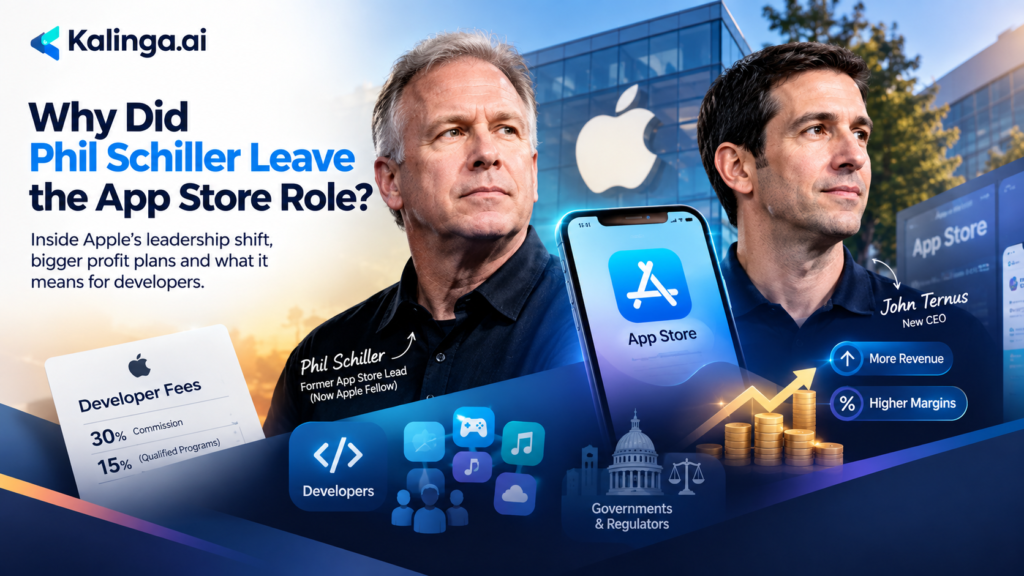
Why Did Phil Schiller Leave the App Store Role at Apple?
Imagine spending years managing one of the world’s most important app marketplaces, only to watch the company enter a new phase where making that marketplace more profitable could also make it more controversial. That appears to be the tension behind the Phil Schiller App Store exit.
According to Bloomberg’s Mark Gurman, as reported by TechCrunch, Schiller stepped away from his role partly because Apple’s new leadership wants to increase App Store margins and generate more recurring revenue. Schiller reportedly believed that pushing harder on profitability could further frustrate developers and governments, although the reports do not describe a major internal fight between him and Apple’s leadership. (kalinga.ai/)
The Phil Schiller App Store exit is therefore more than a routine executive transition. Schiller is not completely leaving Apple: he will remain an Apple Fellow and continue working on unspecified projects. But his departure from day-to-day App Store responsibilities arrives at an unusually important moment, just as John Ternus has taken over as Apple’s CEO and services chief Eddy Cue is reportedly looking for ways to make the App Store financially stronger.
For developers, students learning app development, and anyone building a digital business, the story raises a bigger question: What happens when the company operating the world’s most valuable mobile distribution platform decides it needs to extract even more value from that platform?
Why Is Phil Schiller Leaving the App Store Role?
Question → Why did Phil Schiller step down from running the App Store?
The immediate answer is a combination of personal priorities and disagreement over the direction of the App Store business.
Bloomberg’s reporting says Schiller wanted to spend more time with his family and on philanthropy. At the same time, Gurman reported that new CEO John Ternus and services chief Eddy Cue want to find ways to improve App Store margins and increase recurring revenue. Schiller reportedly believed those efforts could create even more friction with developers and regulators.
That distinction matters.
The Phil Schiller App Store exit should not be interpreted as evidence that Schiller was fired, forced out, or engaged in a dramatic confrontation with Ternus or Cue. The reporting specifically indicates that there was no major internal blowup over the strategy. Instead, Schiller apparently decided that he did not want to participate in a direction he believed could intensify existing tensions
Who Is Phil Schiller?
Phil Schiller is a longtime Apple executive who joined the company in 1987, with a four-year break, and later became one of the most recognizable leaders associated with Apple’s product launches and marketing. He became responsible for the App Store in 2015 after previously serving as Apple’s senior vice president of worldwide marketing. (kalinga.ai/)
Schiller played a particularly important role because the App Store is not simply an online shop.
Definition + Expansion: App Store ecosystem , The App Store ecosystem is the larger network connecting Apple’s devices, developers, users, payments, distribution systems and digital businesses.
That ecosystem has become enormous. Apple says the global App Store ecosystem facilitated more than $1.4 trillion in developer billings and sales in 2025, including physical goods and services, digital goods and services, and advertising. Apple also says the ecosystem had more than 850 million average weekly users across 175 countries and regions during 2025.
That scale explains why changing the economics of the App Store is not a minor accounting exercise. A seemingly small change in fees, payment rules or developer requirements can affect millions of businesses.
What Changed Under New CEO John Ternus?
The Phil Schiller App Store exit is happening alongside one of Apple’s biggest leadership transitions in years.
On September 1, 2026, John Ternus officially became Apple’s CEO, succeeding Tim Cook, who moved into the role of executive chairman. Ternus previously led Apple’s hardware engineering organization and is known primarily as a product and hardware executive.
That makes the timing especially interesting.
Question → Does Schiller’s departure mean Apple is abandoning the App Store?
No. The available reporting points in the opposite direction. Apple appears to be treating the App Store as an increasingly important business that could potentially generate more revenue and stronger margins under its new leadership structure.
The App Store has also moved into Apple’s Services organization under Eddy Cue rather than remaining under the marketing organization. Day-to-day App Store operations are expected to be handled by Carson Oliver, a longtime Apple employee who has worked in the App Store division for more than 14 years.
That organizational change is significant because it changes the way Apple may think about the marketplace.
Instead of viewing the App Store primarily as a product ecosystem that helps make the iPhone more attractive, Apple can increasingly view it as a mature services business that should continually improve its financial performance.
And that is where the debate begins.
Why Is App Store Profitability Becoming a Bigger Issue?
Apple already makes substantial money from services, and the App Store sits at the center of a complicated economic system.
When you download an app for free, Apple may earn nothing from that particular download. But when an app sells digital goods or subscriptions through Apple’s payment system, Apple can receive a commission.
Definition + Expansion: App Store commission , An App Store commission is the percentage of eligible digital transactions that Apple keeps when developers sell apps or digital products through Apple’s marketplace and payment infrastructure.
The exact rate depends on the transaction and the developer’s program. Apple’s standard developer information currently lists a 30% commission on sales of digital goods and services, with 15% rates applying to qualifying programs and subscriptions. Apple’s Small Business Program, for example, offers a 15% commission to qualifying developers.
That means Apple’s challenge isn’t necessarily finding a completely new way to monetize the App Store.
It could instead involve changing how much Apple earns, how often it earns it, or which transactions are subject to fees.
Apple Has a Huge Economic Base to Work With
Apple’s own 2026 ecosystem report provides some useful context.
The company says that in 2025:
- The App Store ecosystem facilitated more than $1.4 trillion in developer billings and sales.
- Physical goods and services accounted for about $1.1 trillion.
- Digital goods and services generated $149 billion.
- In-app advertising generated $151 billion.
- More than 90% of the billings and sales facilitated by the ecosystem did not result in a commission paid to Apple, according to Apple’s methodology.
The last point is particularly important.
The $1.4 trillion figure is not Apple’s App Store revenue. It represents the broader economic activity facilitated by the ecosystem. Most of that money belongs to businesses selling physical goods, services, apps, subscriptions and advertising.
So when discussing the Phil Schiller App Store exit, it is important not to confuse the total size of the ecosystem with the money Apple itself collects.
Why Are Developers and Regulators So Important?
The App Store’s business model has spent years attracting criticism because Apple controls both the marketplace and many of the rules governing access to it.
That creates an unusual relationship.
Apple provides the operating system, distribution platform, payment infrastructure, security processes and customer reach. Developers, meanwhile, create the apps that make Apple’s devices more useful.
Both sides need each other.
Question → Why are developers unhappy with Apple’s App Store policies?
The core complaint is that Apple has significant control over how developers distribute and monetize apps on iOS, including payment rules and commissions. Critics argue that Apple’s control can make it difficult for developers to avoid fees or offer alternative payment options.
The conflict has produced major lawsuits and regulatory interventions.
The long-running Epic Games v. Apple dispute is one of the best-known examples. Epic challenged Apple’s App Store practices, particularly its payment rules and commission structure. Apple’s monopoly claims were largely upheld in the original litigation, but Apple was also ordered to allow developers to link to external payment options under the resulting injunction. The dispute has continued through additional legal proceedings.
And the pressure is not limited to the United States.
In July 2026, Apple’s legal challenge to the European Union’s classification of its App Store and iOS as gatekeeper services under the Digital Markets Act was rejected by the EU’s General Court. The DMA is designed to impose additional obligations on dominant digital platforms and promote competition and user choice.
Apple has also recently announced significant changes to its EU App Store business terms following discussions with the European Commission.
Beginning October 1, 2026, Apple’s new EU terms include different commission structures depending on how an app is distributed and how payments are processed. Apple says App Store apps using Apple In-App Purchase will generally face a 26% commission, while certain qualifying developers and subscriptions have lower rates. Other arrangements, including alternative payments and links to external purchasing, have different rates.
So the regulatory environment is already moving.
That makes the reported concern behind the Phil Schiller App Store exit easier to understand: if Apple tries to increase monetization aggressively, it may have to do so while navigating developers, courts and regulators simultaneously.
What Could Apple Change About the App Store?
Nobody outside Apple knows exactly what changes Ternus and Cue are considering.
That uncertainty is important. The available reporting says Apple wants to improve margins and increase recurring revenue, but it does not establish a final list of App Store changes.
Still, the business model provides several possible directions.
| Possible approach | How it could work | Potential benefit to Apple | Potential concern |
| Higher developer fees | Increase certain developer-related charges | More predictable revenue | Could hurt smaller developers |
| Changes to commissions | Adjust Apple’s percentage of eligible transactions | Directly increases monetization | Developers may push back |
| More recurring fees | Introduce or expand recurring platform charges | Creates predictable revenue | Could increase developer costs |
| Infrastructure-based charges | Charge based on usage or scale | Better links costs to heavy users | Could be complicated to administer |
| Greater external-payment monetization | Take a smaller fee from transactions completed outside Apple payment systems | Preserves some revenue while allowing alternatives | Could remain controversial with regulators |
Some of these possibilities have been discussed by commentators following Gurman’s report, but they should not be treated as confirmed Apple plans. The specific changes Apple ultimately chooses remain unknown.
Recurring Revenue Is the Key Phrase
The phrase recurring revenue deserves attention.
Definition + Expansion: Recurring revenue , Revenue that a company expects to receive repeatedly over time, often through subscriptions, memberships, recurring fees or ongoing usage.
For a platform operator, recurring revenue can be attractive because it is more predictable than relying entirely on one-time transactions.
That is one reason subscriptions have become such an important part of modern software businesses.
For Apple, however, the challenge is finding recurring revenue opportunities that do not make developers feel as though the platform is becoming increasingly expensive to use.
And that is exactly the tension reportedly associated with Schiller’s position.
What Does the Phil Schiller App Store Exit Mean for Developers?
For developers, the Phil Schiller App Store exit could eventually matter more than it does for ordinary iPhone users.
If Apple changes its App Store economics, developers may need to rethink pricing, subscriptions, payment processing and customer acquisition.
For a large company such as a major streaming service or global game publisher, a few percentage points can represent a huge amount of money.
For a small startup in Bhubaneswar, Bengaluru or Hyderabad, the calculation can look very different.
A young developer might spend months building an app, pay for cloud infrastructure and AI coding tools, invest in marketing, and then discover that platform fees significantly affect the economics of every paying customer.
What Should Indian Developers Watch?
If you’re an aspiring app developer in India, you don’t need to predict Apple’s next move. You should instead understand the variables that determine whether an app business works.
Watch these areas:
- Commission rates: How much of each eligible digital transaction goes to the platform?
- Subscription economics: How much recurring revenue remains after platform fees?
- Alternative payments: Can users pay outside the platform, and under what conditions?
- Developer membership costs: Are there annual or recurring costs simply to distribute software?
- Distribution: Can the app reach users through other channels?
- Regulation: Could regional rules change the economics of distribution?
- Customer acquisition: How much does it cost to turn an App Store visitor into a paying customer?
Apple’s developer membership is currently $99 per year, while commission rates vary by program and transaction type.
That doesn’t mean a $99 membership is the main financial burden for most businesses. The much larger question is what happens as an app scales and generates significant digital transaction volume.
Could the App Store Become More Like a Traditional Subscription Business?
Potentially, but this is where speculation needs to be separated from reporting.
The Phil Schiller App Store exit does not prove Apple will introduce a new developer subscription or radically restructure App Store fees.
What the reporting does establish is that Apple leadership is interested in finding ways to increase margins and recurring revenue.
That could lead to a broader philosophical shift.
For years, Apple’s ecosystem strategy has emphasized the idea that developers benefit because the iPhone gives them access to a massive global audience. Apple’s own research says the App Store had more than 850 million average weekly users across 175 countries and regions in 2025.
From Apple’s perspective, that reach has enormous value.
From a developer’s perspective, however, the question is different:
“How much of the value I create do I get to keep?”
That is the economic question sitting underneath almost every App Store dispute.
Why Schiller’s History With Apple Makes This Story More Interesting
The Phil Schiller App Store exit is particularly notable because Schiller has been associated with Apple for decades.
He joined the company in 1987 and became one of its most recognizable executives during the company’s transformation into a consumer technology powerhouse. He was deeply involved in Apple’s marketing and major product launches before eventually taking responsibility for the App Store in 2015.
His continued position as an Apple Fellow also suggests that this is not a complete break.
Apple Fellow is a prestigious role reserved for individuals who have made significant technical or leadership contributions to the company. TechCrunch reported that Schiller will continue working on unspecified projects after stepping away from App Store leadership.
That makes the move less like a conventional executive resignation and more like a strategic withdrawal from one particular responsibility.
Did Schiller Leave Because He Disagreed With Ternus?
Question → Was there a major dispute between Schiller and Apple’s new leadership?
The available reporting does not indicate a dramatic confrontation. Instead, Gurman’s account describes a difference in perspective: Ternus and Cue reportedly want greater App Store monetization, while Schiller reportedly believed that additional pressure on developers and governments could make an already difficult situation worse.
That distinction is important.
Executives can disagree about strategy without engaging in an organizational war.
Schiller could also have multiple reasons for stepping back. Bloomberg’s reporting included his desire to spend more time with family and philanthropy, while his age and long tenure at Apple naturally make a gradual transition unsurprising.
So the safest interpretation is not “Schiller quit because Apple is in trouble.”
It is that Apple is entering a new phase, and Schiller did not want to be the executive responsible for a more aggressive App Store monetization strategy.
What Happens to the App Store Now?
Apple’s App Store responsibilities are shifting toward the Services organization led by Eddy Cue, while Carson Oliver is expected to handle day-to-day operations.
That structure could make the marketplace more tightly connected to Apple’s broader services strategy.
The company already operates a large collection of recurring businesses, including subscriptions and digital services. The App Store itself can be viewed as both the distribution channel for those services and a business that collects revenue from third-party digital transactions.
This creates an interesting strategic loop.
Apple wants developers to build compelling apps because those apps increase the value of Apple’s devices. But Apple also wants to capture economic value from the transactions taking place inside that ecosystem.
The challenge is maintaining enough balance that developers continue to see the platform as worth building for.
Why the Balance Matters
If platform fees become too high, developers may have incentives to:
- Raise prices.
- Reduce investment in iOS-specific features.
- Push users toward web-based services.
- Lobby regulators.
- Challenge platform rules in court.
- Explore alternative distribution channels where available.
None of those outcomes is automatically catastrophic for Apple.
But collectively, they could make the ecosystem more difficult to manage.
That is why the Phil Schiller App Store exit matters beyond one executive’s career decision.
It highlights the increasingly difficult balancing act between platform control, developer economics, regulatory compliance and shareholder returns.
What This Means for Apple’s New Era Under John Ternus
John Ternus inherited an Apple that is enormously successful but also facing a different set of strategic pressures than it did when Tim Cook became CEO in 2011.
Reuters reported that Apple’s annual sales grew from $108 billion to $416 billion during Cook’s tenure, while the company’s valuation expanded dramatically. At the same time, the company faces pressure around artificial intelligence and future product innovation. ()
That context matters because Ternus does not have the luxury of managing only one part of Apple’s business.
He needs to think about hardware, AI, services, developer relationships, regulation and profitability at the same time.
The App Store is attractive precisely because it sits at the intersection of many of these areas.
It is a software platform attached to Apple’s hardware ecosystem, a distribution network for developers, a payment channel, a services business and a major source of regulatory scrutiny.
A more profitable App Store could therefore help Apple’s financial performance.
But an overly aggressive strategy could also increase friction with the very developers whose apps make Apple’s hardware ecosystem valuable.
The Bigger Signal Behind the Phil Schiller App Store Exit
The most important lesson from the Phil Schiller App Store exit may not be about Schiller at all.
It may be about what Apple believes the App Store should become.
For years, the central argument surrounding Apple’s marketplace was about control: Who decides how apps are distributed? Who controls payments? Who sets the rules? Who decides which business models are allowed?
Now another question is becoming increasingly important:
How much more money can Apple make from a platform it already dominates?
The answer will have consequences far beyond Apple’s finance department.
It could affect developers’ pricing decisions, subscription models, app-store discovery, alternative payments and even the future design of mobile software businesses.
For students learning app development, this is a useful reminder that writing code is only one part of building a software company.
The platform underneath your app matters just as much.
If Apple changes its economics, the best developers will not simply complain about the change. They will calculate how the new rules affect margins, distribution, customer acquisition and long-term product strategy.
And that is perhaps the most useful way to read the Phil Schiller App Store exit: not as a simple Apple personnel story, but as an early signal that the economics of mobile software could be entering another major transition.
FAQ: Phil Schiller, Apple and the App Store
Why did Phil Schiller leave the App Store leadership role?
Phil Schiller reportedly stepped down partly because he wanted to spend more time with his family and philanthropy and partly because he was wary of Apple’s reported plans to increase App Store margins and recurring revenue. Bloomberg’s reporting, cited by TechCrunch, says Schiller believed a more aggressive monetization strategy could increase friction with developers and governments.
Is Phil Schiller leaving Apple completely?
No. Schiller is remaining at Apple as an Apple Fellow, where he will work on unspecified projects. His departure is therefore from day-to-day App Store and related responsibilities rather than a complete exit from the company.
Who is taking over the App Store after Phil Schiller?
The App Store is transitioning from Apple’s marketing organization to the Services division led by Eddy Cue. Carson Oliver is expected to manage day-to-day App Store operations.
Does Apple plan to increase App Store fees?
Apple has not publicly announced a comprehensive new global App Store fee structure based on the reporting discussed here. Bloomberg’s Mark Gurman has reported that CEO John Ternus and services chief Eddy Cue are looking for ways to improve margins and increase recurring revenue, but the exact changes remain unclear. (TechCrunch)
How much does Apple charge developers on the App Store?
Apple’s current developer information says the standard commission on eligible digital goods and services is 30%, while qualifying developers and certain subscriptions can receive 15% rates. The App Store Small Business Program, for example, offers a 15% commission to eligible developers.
Why is the App Store facing pressure from governments?
Apple’s control over iOS app distribution and payments has become the subject of lawsuits and regulatory scrutiny. In the European Union, Apple’s App Store and iOS have been treated as gatekeeper services under the Digital Markets Act, while Apple has also recently announced new EU business terms involving alternative payments and distribution.
What should app developers watch next?
Developers should watch Apple’s future commission structure, recurring fees, alternative payment policies, distribution rules and regulatory changes. These factors can directly affect the economics of building and monetizing an iOS app.
Key Takeaways
Phil Schiller stepped down from App Store leadership but remains an Apple Fellow.
Bloomberg’s Mark Gurman reports that Schiller was wary of plans by John Ternus and Eddy Cue to improve App Store margins and increase recurring revenue.
The reported disagreement was not described as a major internal fight.
Apple says its global App Store ecosystem facilitated more than $1.4 trillion in developer billings and sales in 2025.
The App Store is moving under Apple’s Services organization, led by Eddy Cue
Apple faces continuing pressure from developers, lawsuits and regulators over its App Store rules.
Apple’s new EU business terms, taking effect October 1, 2026, demonstrate how quickly App Store economics can change in response to regulation.
For developers, the biggest issue is not simply Apple’s commission percentage but the broader economics of distribution, payments, subscriptions and customer acquisition.
For students and young developers building the next generation of apps, the practical lesson is simple: learn the platform economics alongside the code. Keep following Kalinga.ai for explainers that turn major technology shifts into practical knowledge for India’s next generation of builders.