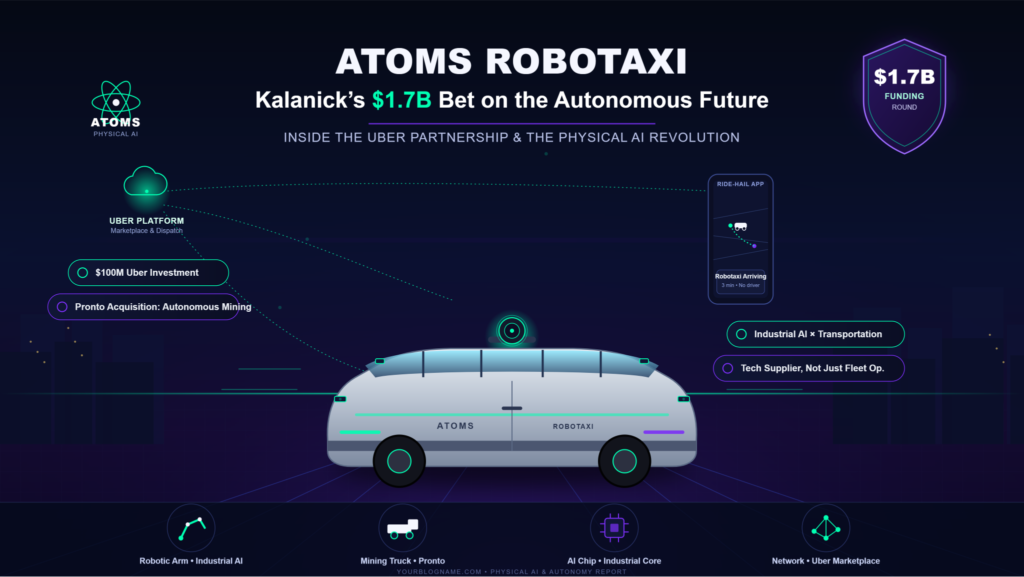
Is Atoms Building a Robotaxi Business With Uber?
What happens when the person who helped build Uber returns with $1.7 billion in fresh funding and starts assembling an autonomous-vehicle team?
That is the question surrounding Atoms robotaxi ambitions. Travis Kalanick’s Atoms is reportedly exploring robotaxi technology and has discussed with Uber how its autonomous-driving technology could potentially be used on Uber’s ride-hailing network, according to the Financial Times. However, Atoms has not publicly said that robotaxis are its only,or even its primary,business. (Financial Times)
The bigger story is that Kalanick appears to be rebuilding around a familiar combination: software, automation, transportation and physical-world infrastructure.
Atoms has already raised $1.7 billion, acquired autonomous-mining company Pronto, brought in former Uber executives and attracted $100 million of investment from Uber, according to TechCrunch. (TechCrunch)
That does not prove Atoms is about to launch a fleet of robotaxis.
But it does suggest something potentially more interesting: Atoms may be positioning itself as an autonomous-technology supplier that could help companies such as Uber operate driverless transportation at scale.
What Is Atoms, and Why Is Travis Kalanick Betting Big on It?
To understand the Atoms robotaxi story, it helps to first understand what Atoms actually is.
Atoms is Travis Kalanick’s robotics and industrial-AI company. Its roots go back to CloudKitchens, Kalanick’s post-Uber venture, but the company has evolved into a broader effort focused on applying AI and robotics to physical industries. (TechCrunch)
Kalanick has described the strategy in broad terms rather than announcing one narrowly defined product.
His goal is essentially to use AI and robotics to make physical-world businesses more productive.
Definition: What is industrial AI?
Industrial AI is the use of artificial intelligence, robotics, sensors and software to automate or improve physical-world operations such as transportation, mining, manufacturing and food production.
Unlike a chatbot that operates entirely on a computer screen, industrial AI has to interact with the real world. That means dealing with vehicles, machinery, roads, warehouses, workers, weather, physical obstacles and unpredictable environments.
That makes the technology considerably more difficult to deploy than conventional software.
Atoms’ strategy appears to reflect this broader view. The company has discussed applications involving mining, food and transportation, rather than limiting itself to passenger vehicles. (TechCrunch)
Question → Direct Answer: What is Atoms trying to build?
Atoms appears to be building a broader industrial-AI and robotics platform rather than simply launching a robotaxi company. Robotaxis may become one application of its technology, but reporting indicates that transportation is only one part of its ambitions. (Financial Times)
That distinction matters.
A company that builds autonomous-driving technology can potentially sell or license that technology to multiple transportation businesses instead of operating its own passenger fleet.
Is Atoms Actually Entering the Robotaxi Market?
This is where the latest reporting gets interesting.
According to the Financial Times, Atoms is preparing for significant hiring and potential acquisitions as it expands its autonomous-vehicle capabilities. The company has also reportedly discussed with Uber how Uber could use Atoms’ robotaxi technology. (Financial Times)
But there is an important caveat.
Sources cited by the Financial Times emphasized that robotaxis are not the entirety of Atoms’ plans. So describing Atoms as a dedicated robotaxi startup would be premature.
Question → Direct Answer: Is Atoms launching its own robotaxi service?
There is no confirmed announcement that Atoms is launching a standalone robotaxi service. Current reporting instead points toward Atoms developing autonomous technology that could potentially be used by partners such as Uber. (Financial Times)
That could actually be a strategically powerful position.
Running robotaxis requires much more than autonomous-driving software. A company needs vehicles, maintenance, insurance, charging or fueling infrastructure, fleet management, regulatory approvals, customer support and a way to attract riders.
A technology supplier can potentially avoid some of those operational burdens.
Why Uber is an important potential partner
Uber already has something many autonomous-driving startups want: millions of riders and a large transportation marketplace.
The company has also been building relationships with multiple autonomous-vehicle companies rather than betting entirely on one technology provider. TechCrunch has reported that Uber has partnered with a long list of autonomous-driving companies. (TechCrunch)
That creates an interesting opportunity for Atoms.
Instead of competing directly with Uber, Atoms could potentially provide technology that Uber integrates into its network.
In simplified terms:
Atoms → autonomous technology
Uber → riders, app, marketplace and transportation network
Robotaxi operator → vehicles and fleet operations
That model would resemble the way technology suppliers and platforms can divide responsibilities in other industries.
What Does Atoms’ $1.7 Billion Funding Mean?
The most obvious signal is scale.
In July 2026, Atoms announced a $1.7 billion investment round led by Andreessen Horowitz, with Ben Horowitz joining the company’s board. Uber also participated in the financing. (TechCrunch)
For a company whose plans are still relatively broad publicly, that is an enormous amount of capital.
Question → Direct Answer: Why does the $1.7 billion matter?
The funding gives Atoms the financial capacity to hire specialized talent, acquire companies and pursue multiple industrial-AI projects simultaneously. Reporting specifically points to hiring and acquisitions as part of the company’s next phase. (Financial Times)
Kalanick himself described the funding round as “unfinished business”, linking it to a longer arc that began with his work at Uber and continued through CloudKitchens. (A16Z)
The money therefore appears to be about more than one product.
It gives Atoms room to experiment.
Where could the money go?
Based on the company’s stated focus and current reporting, possible areas include:
- Autonomous-vehicle engineering
- Robotics research
- Industrial automation
- Mining autonomy
- Transportation technology
- Acquisitions
- Recruitment of experienced engineers and executives
- Commercial partnerships
- Fleet or autonomous-system development
The important word is possible.
Atoms has not publicly committed the entire $1.7 billion to robotaxis.
How Does Atoms Fit Into the Autonomous Vehicle Race?
The autonomous-vehicle market is already crowded.
Companies such as Waymo, Tesla, Zoox, Wayve and others are developing different approaches to driverless transportation. Uber, meanwhile, is positioning itself as a marketplace that can connect riders with autonomous fleets operated by technology partners.
This creates several possible business models.
| Strategy | Example | Basic Approach | Main Advantage |
| Full-stack robotaxi | Waymo | Develop technology and operate robotaxi service | Greater control |
| Platform + partners | Uber | Connect riders with multiple autonomous fleets | Large existing marketplace |
| Autonomous technology supplier | Potential Atoms model | Develop technology for transportation partners | Can scale through partners |
| Vehicle-focused autonomy | Tesla | Combine vehicle production with autonomous software | Hardware/software integration |
| AI driving platform | Wayve | Develop learned autonomous-driving systems | Potentially broad vehicle compatibility |
The Atoms robotaxi opportunity becomes more interesting when viewed through this comparison.
Atoms does not necessarily need to beat Waymo at running a robotaxi fleet.
It could instead try to become the company whose technology powers fleets operated by other businesses.
Question → Direct Answer: Could Atoms compete with Waymo without becoming another Waymo?
Yes, potentially. If Atoms focuses on supplying autonomous-driving technology rather than operating a consumer-facing robotaxi network itself, it could compete at a different layer of the market.
That distinction could be strategically important.
Waymo has spent years building an integrated autonomous-driving system and commercial service. Atoms is entering the market later, but with a huge amount of capital and a founder who already understands transportation marketplaces.
The challenge is proving that its technology can work safely and commercially.
Why Does the Pronto Acquisition Matter?
One of the strongest clues about Atoms’ autonomous ambitions is its acquisition of Pronto, an autonomous-mining company led by Anthony Levandowski.
Levandowski previously worked on Uber’s self-driving efforts and was later involved in a high-profile legal dispute with Google over trade secrets. He was sentenced to 18 months in prison after being convicted of stealing trade secrets and was subsequently pardoned by President Donald Trump. (TechCrunch)
For Atoms, the acquisition provides more than a corporate asset.
It brings autonomous-vehicle expertise into a company attempting to expand across physical industries.
Definition: What is autonomous mining?
Autonomous mining uses sensors, AI and automated control systems to allow mining vehicles and equipment to perform tasks with reduced or no direct human control.
The underlying engineering challenges overlap with autonomous transportation.
Vehicles need to perceive their surroundings, understand where they are, make decisions and move safely through environments that can change.
A mine and a city street are obviously very different.
But autonomy developed for one physical environment can potentially provide valuable engineering experience for another.
The former Uber connection
The Pronto acquisition is also significant because Levandowski is a former Uber self-driving executive.
And he is not the only former Uber employee now associated with Atoms.
In August, Atoms hired Gautam Gupta, a former Uber finance chief who worked at the ride-hailing company during Kalanick’s tenure. TechCrunch described the move as part of Kalanick’s broader effort to bring former Uber colleagues into Atoms. (TechCrunch)
That creates a striking pattern.
Kalanick → Uber → autonomous-driving ambitions → former Uber talent → Atoms
The company is increasingly connected to the people and expertise surrounding Uber’s earlier autonomy push.
What Could an Atoms-Uber Robotaxi Partnership Look Like?
The most interesting scenario is not necessarily Uber buying Atoms.
It could be a technology partnership.
Imagine a future in which:
- Atoms develops an autonomous-driving system.
- A vehicle manufacturer supplies compatible cars.
- Atoms’ software handles autonomous driving.
- Uber provides access to riders through its app.
- A fleet operator handles maintenance and operations.
- The autonomous vehicles complete trips through Uber’s marketplace.
This is only a conceptual example, not an announced Atoms business model.
But it illustrates why an Atoms robotaxi partnership could make sense.
Question → Direct Answer: Why would Uber want Atoms technology?
Uber could potentially benefit from adding another autonomous-vehicle technology partner as it expands its robotaxi marketplace. Uber has already pursued partnerships across the autonomous-vehicle industry, making a technology relationship with Atoms plausible, although no final commercial arrangement has been announced. (TechCrunch)
Uber’s investment makes the relationship even more noteworthy.
TechCrunch has confirmed reporting that Uber invested $100 million in Atoms. (TechCrunch)
That does not guarantee a future robotaxi deal.
But it gives Uber a financial connection to a company that could potentially become relevant to autonomous transportation.
Why the Timing Is Important for Uber
The autonomous-vehicle market is moving quickly.
Uber is simultaneously working with multiple autonomous-driving partners while facing growing pressure from companies such as Waymo and Tesla.
Recent reporting indicates that Uber plans to invest more than $10 billion in autonomous-vehicle technology and is restructuring its business partly in response to the competitive threat posed by robotaxis. (Reuters)
That makes Atoms’ timing particularly interesting.
Uber does not necessarily need to own every autonomous-driving system.
Its potential advantage is the marketplace.
If autonomous vehicles become widely available, the company could try to become the platform through which customers discover and book those vehicles.
Question → Direct Answer: Is Uber betting against human drivers?
Uber is pursuing autonomous vehicles while still operating a large human-driver network. Its current strategy involves working with multiple autonomous-vehicle partners rather than immediately replacing its entire driver network with robotaxis. (Reuters)
That hybrid model could allow Uber to introduce autonomous vehicles gradually.
And that is exactly where companies such as Atoms could become relevant.
What Are the Biggest Challenges for Atoms?
Money can accelerate development.
It cannot automatically solve the hardest problems in autonomous driving.
The first challenge is safety.
A robotaxi has to operate around pedestrians, cyclists, motorcycles, emergency vehicles, construction zones and unpredictable human drivers. The system must work not only in ideal conditions but across a huge range of edge cases.
The second challenge is regulation.
Autonomous vehicles operate under different rules across cities, states and countries. A technology that works technically may still take years to deploy commercially.
The third challenge is commercial reliability.
A robotaxi company must make the economics work.
The system needs to deliver enough rides at an acceptable cost while keeping vehicles available, maintained and safe.
Key challenges for Atoms
- Autonomous-driving safety
- Regulatory approval
- Vehicle integration
- Software reliability
- Fleet economics
- Competition
- Hiring specialized engineers
- Commercial partnerships
- Scaling beyond pilot programs
Question → Direct Answer: Does $1.7 billion guarantee Atoms will succeed?
No. The funding gives Atoms substantial resources, but autonomous transportation remains technically, commercially and regulatorily difficult. The company’s eventual success will depend on whether it can turn capital and talent into reliable technology and commercially viable deployments.
This is particularly important because the autonomous-driving sector has already seen companies spend billions without achieving widespread commercial deployment.
What Makes Travis Kalanick’s Return Different This Time?
Kalanick’s return to transportation is arguably the most fascinating part of the story.
He left Uber as CEO in 2017, nearly a decade before Atoms’ latest funding round. Now he is once again working around transportation, autonomous systems and large-scale physical infrastructure. (TechCrunch)
But Atoms is not simply Uber 2.0.
Kalanick’s current company is broader.
He has described the ambition as applying AI and robotics to the physical world rather than building another ride-hailing app.
That could eventually make transportation only one part of a much larger industrial-AI company.
Definition: What does “physical AI” mean?
Physical AI refers to AI systems that perceive and act in the real world through robots, vehicles, machines and other physical systems.
A chatbot generates text.
A physical-AI system might control a vehicle, guide a robot or operate industrial equipment.
This is an important shift in the technology industry because it moves AI from purely digital environments into factories, warehouses, roads, mines and other physical spaces.
Atoms is betting that this transition could create enormous economic value.
What Could Atoms Do Beyond Robotaxis?
The robotaxi story may actually be only the most recognizable part of Atoms’ larger strategy.
The company has identified areas including mining, food and transportation, while its broader positioning centers on industrial AI and robotics. (TechCrunch)
That opens several potential applications.
Mining
Autonomous mining vehicles could transport materials or perform repetitive tasks with less direct human intervention.
Food production
Robotics could potentially automate repetitive physical operations in food facilities and commercial kitchens.
Transportation
Autonomous vehicles could move people or goods without requiring a human driver for every trip.
Industrial logistics
Robots and AI systems could coordinate movement of materials across warehouses, factories and other facilities.
The common thread is not the specific industry.
It is automation of physical work.
Why This Story Matters for Students and Young Tech Professionals
If you are studying AI, robotics, software engineering or transportation technology, Atoms is an interesting case study because it demonstrates where the industry may be heading.
The next major AI opportunity may not be another chatbot.
It could be AI that interacts with machines.
That means demand may increasingly grow for people who understand combinations of disciplines:
- AI and machine learning
- Robotics
- Computer vision
- Embedded systems
- Autonomous navigation
- Mechanical engineering
- Sensor fusion
- Cloud infrastructure
- Data engineering
- Safety engineering
- Transportation systems
Question → Direct Answer: What skills could matter in the physical-AI economy?
The strongest opportunities are likely to sit at the intersection of software, AI and physical systems. Engineers who understand how AI models interact with sensors, machines, vehicles and real-world constraints can contribute to emerging robotics and autonomous-vehicle systems.
For students in India, this is especially relevant.
The global AI race is increasingly expanding beyond large language models into robotics, autonomous systems and industrial automation.
That means the career opportunity is broader than simply becoming an AI chatbot developer.
Atoms Robotaxi: What Should We Watch Next?
The next few months should reveal whether the robotaxi angle becomes a central part of Atoms’ strategy or remains one component of a much broader industrial-AI plan.
Several signals will be worth watching.
1. Hiring
A major increase in autonomous-driving engineers would strengthen the case that transportation is becoming a significant focus.
2. Acquisitions
Additional acquisitions could reveal which technical capabilities Atoms believes it needs.
3. Uber partnership announcements
A formal agreement involving Uber would provide much stronger evidence of Atoms’ robotaxi ambitions than current reports.
4. Vehicle testing
Public-road testing or regulatory filings could offer clues about whether Atoms is moving from research toward deployment.
5. Commercial customers
The most important signal may ultimately be customers willing to pay for Atoms’ technology.
A billion-dollar funding round attracts attention.
A working commercial autonomous system creates a business.
FAQ: Atoms, Travis Kalanick, Uber and Robotaxis
What is Atoms?
Atoms is Travis Kalanick’s robotics and industrial-AI company. It is focused on applying AI and automation to physical industries including transportation, mining and food production. (TechCrunch)
Is Atoms building robotaxis?
Atoms appears to be exploring autonomous transportation and has reportedly discussed robotaxi technology with Uber. However, current reporting indicates that robotaxis are only one part of its broader industrial-AI strategy, and Atoms has not announced a standalone robotaxi service. (Financial Times)
How much money has Atoms raised?
Atoms announced a $1.7 billion investment round in July 2026, led by Andreessen Horowitz. Uber also participated in the financing. (TechCrunch)
How much did Uber invest in Atoms?
TechCrunch reported that Uber invested $100 million in Atoms, confirming a figure previously reported elsewhere. (TechCrunch)
Why did Atoms acquire Pronto?
Atoms acquired Pronto, an autonomous-mining company led by former Uber self-driving executive Anthony Levandowski. The acquisition gives Atoms additional expertise in autonomous systems and physical-world automation. (TechCrunch)
Could Atoms become an Uber robotaxi technology supplier?
Potentially. The Financial Times reported that Atoms has discussed with Uber how its robotaxi technology could be used by Uber. However, there is no confirmed announcement of a final commercial arrangement, so the partnership should currently be viewed as an emerging possibility rather than a completed deal. (Financial Times)
The Bottom Line
The Atoms robotaxi story is bigger than a possible comeback to ride-hailing for Travis Kalanick.
Atoms has raised $1.7 billion, acquired autonomous-technology expertise through Pronto, recruited former Uber talent and attracted a $100 million investment from Uber. At the same time, reporting suggests the company is exploring how its autonomous technology could fit into Uber’s growing robotaxi strategy. (TechCrunch)
But the key detail is that Atoms is not publicly defining itself as a robotaxi-only company.
Its larger bet appears to be on physical AI: using software, robotics and autonomous systems to transform industries where computers have historically had limited control over the physical world.
If that strategy works, robotaxis could be just one piece of a much bigger story.
For more explainers on AI, robotics, autonomous vehicles and the technologies reshaping work, keep exploring Kalinga.ai.