Tesla Cybercab Launch: What Actually Happened?
What happens when a car designed to have no steering wheel or pedals suddenly starts carrying passengers on public roads? That is the question surrounding Tesla’s Cybercab after its Austin rollout, and the answer is bigger than a flashy product launch: Tesla has moved its robotaxi ambitions from demonstration to real-world commercial deployment, but regulators are already examining whether the vehicle’s certification process complies with federal safety rules.
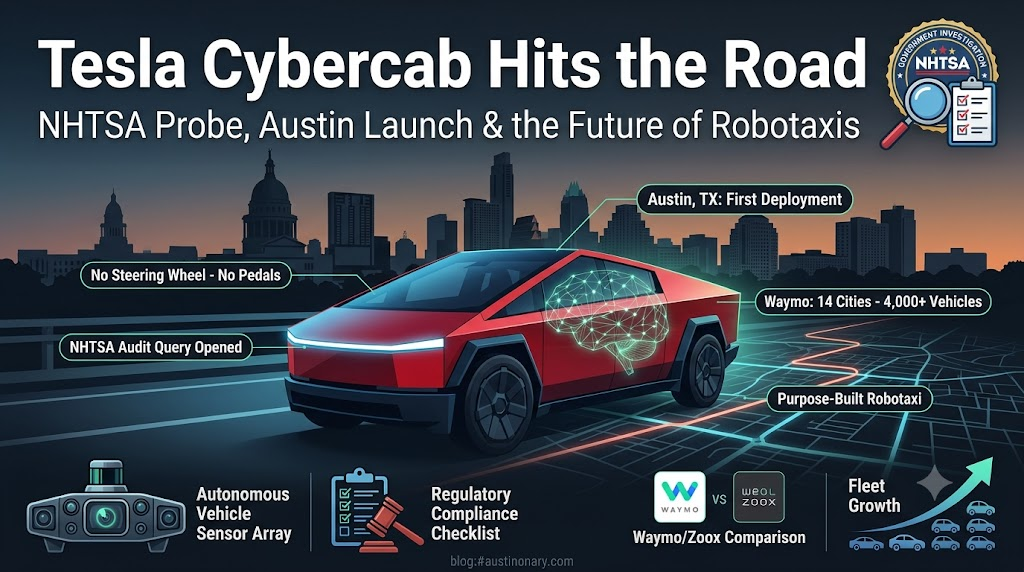
Tesla began deploying its Cybercab in Austin, Texas, in early September 2026. The two-seat autonomous vehicle is designed around the idea that a human driver should not need to take control at all. But only hours after the first vehicles appeared on Austin streets, the U.S. National Highway Traffic Safety Administration (NHTSA) opened an investigation into Tesla’s self-certification of the vehicle.
That makes the Tesla Cybercab an unusually important test case for the autonomous-vehicle industry. Tesla is not simply testing whether its artificial intelligence can drive a car. It is testing whether a vehicle designed entirely around autonomy can fit into a regulatory system largely written for cars controlled by humans.
The timing is especially significant because competitors are already operating autonomous ride-hailing services at commercial scale. Waymo, for example, expanded public robotaxi operations to Denver, San Diego and Tampa in September, bringing its commercial footprint to 14 U.S. cities and a fleet of more than 4,000 vehicles.
So the central question is no longer simply whether Tesla can build a self-driving car.
It is whether Tesla can safely, legally and repeatedly operate thousands of them.
Why the Tesla Cybercab Has No Steering Wheel or Pedals
The most striking feature of the Tesla Cybercab is also the feature creating one of its biggest regulatory questions: there is no conventional steering wheel or pedal setup for a human driver.
That is not an accident or a cost-cutting decision. It reflects Tesla’s fundamental vision for autonomous transportation.
Definition + Expansion: What is an autonomous vehicle?
An autonomous vehicle is a vehicle that uses sensors, computing systems and software to perform some or all driving tasks without continuous human control.
In a conventional vehicle, the human is ultimately responsible for steering, braking and accelerating. In a fully autonomous robotaxi, those functions are handled by the vehicle’s automated driving system.
The Cybercab takes that concept to an extreme. Instead of building a normal car and allowing software to drive it, Tesla has designed the vehicle around a future in which there may be no human driver at all.
Question: Why remove the steering wheel and pedals?
Direct answer: Because Tesla’s Cybercab is intended to operate as a driverless vehicle rather than as a conventional car that can also be driven by a person.
That distinction matters. A traditional vehicle with autonomous features can potentially hand control back to a human. A purpose-built robotaxi assumes that the automated system is responsible for the journey.
This could eventually simplify the vehicle’s interior, change how passengers interact with transportation and potentially reduce some hardware associated with human driving.
But it also creates a difficult question: What happens when existing safety regulations assume that every vehicle has a human driver who can intervene?
That is precisely where Tesla’s current challenge begins.
What Is the NHTSA Investigating?
The NHTSA investigation is not simply a declaration that the Cybercab is unsafe.
Instead, regulators are examining how Tesla determined that the vehicle complied with applicable Federal Motor Vehicle Safety Standards, or FMVSS.
According to NHTSA, Tesla told the agency that it had self-certified the Cybercab as compliant with all applicable standards. The agency then opened an Audit Query to examine the process and technical information behind that certification.
What is self-certification?
In the United States, automakers generally certify that their vehicles meet applicable federal safety standards rather than waiting for the government to approve every vehicle model before sale.
That system works relatively straightforwardly for conventional cars. A manufacturer builds a vehicle with familiar components such as steering wheels, pedals, mirrors, airbags and other equipment, then demonstrates that it meets the relevant standards.
The Tesla Cybercab is different because some of those conventional components simply do not exist.
NHTSA says its investigation will examine the extent to which Tesla’s certification relied on determining that certain safety standards were not applicable to the Cybercab.
Question: Does the NHTSA investigation automatically mean the Cybercab is illegal or unsafe?
Direct answer: No. The investigation is examining Tesla’s certification process and technical justification; it is not itself a final finding that the Cybercab is unsafe or noncompliant.
That distinction is important for understanding the story.
The real issue is whether regulations written around human-operated vehicles can be applied appropriately to a vehicle designed not to have a human operator.
NHTSA has also acknowledged that federal vehicle standards are being reconsidered as autonomous technology develops. However, the agency said existing standards remain in force until changes are completed.
Why the Zoox precedent matters
Tesla is not the first autonomous-vehicle company to encounter this regulatory problem.
Amazon-owned Zoox previously developed a purpose-built robotaxi without conventional steering controls. NHTSA investigated Zoox’s self-certification approach, and the regulatory process became a significant part of the company’s path toward commercialization. Zoox eventually received a temporary exemption in July 2026 that cleared a major regulatory hurdle for its commercial robotaxi operations.
This precedent does not mean Tesla will face exactly the same timeline.
But it demonstrates an important reality of autonomous transportation: building the technology is only one part of launching a robotaxi business.
Regulatory approval, insurance, fleet management, passenger safety, emergency procedures and public acceptance all matter too.
Cybercab Austin: Why the First Deployment Matters
The Austin deployment is important because it turns an abstract technology demonstration into an operational service.
A prototype driving around a controlled testing environment is one thing. A vehicle transporting paying passengers through normal city traffic is something else entirely.
The difference is scale and unpredictability.
A public robotaxi has to handle pedestrians, cyclists, emergency vehicles, road construction, unusual weather, unexpected driver behavior and countless other edge cases. It also needs to operate repeatedly rather than simply completing a successful demonstration.
Question: What is the real test for Tesla’s robotaxi strategy?
Direct answer: The real test is whether Tesla can operate the Cybercab safely and reliably at scale, not whether a handful of vehicles can complete successful demonstration rides.
That is where Tesla faces an important comparison with Waymo.
Waymo has spent years expanding autonomous ride-hailing operations city by city. In September 2026, the company began welcoming public riders in Denver, San Diego and Tampa, bringing its service to 14 cities.
Tesla, meanwhile, is still building out its robotaxi footprint.
According to the Texas automated-vehicle registration data cited in the TechCrunch report, Tesla had 45 Cybercabs registered in Texas around the launch period. That is a tiny number compared with the fleet scale of established autonomous-ride-hailing competitors.
The comparison illustrates an important point: robotaxi leadership is not determined only by the most futuristic vehicle.
It is also determined by how many vehicles can operate safely, how many passengers can use them, how many cities they serve and how consistently the system performs.
Tesla Cybercab vs. Waymo vs. Zoox
The autonomous-vehicle market is increasingly becoming a competition between different philosophies rather than a simple race to build the first driverless car.
| Company | Core approach | Current position | Key challenge |
| Tesla | Purpose-built Cybercab plus autonomous driving software | Beginning Cybercab deployment in Austin | Regulatory approval, safety validation and scaling |
| Waymo | Dedicated autonomous driving system deployed across multiple vehicle platforms | Commercial operations in 14 U.S. cities | Expanding efficiently while maintaining safety |
| Zoox | Purpose-built autonomous robotaxi | Commercial service launched in Las Vegas | Scaling fleet and expanding to more markets |
Waymo’s September expansion demonstrates the importance of operational scale. The company says its fully autonomous service is now available in 14 cities, with access being rolled out gradually in its newest markets.
Zoox represents another important model: rather than primarily modifying conventional cars, it developed a purpose-built vehicle specifically for autonomous transportation. Its regulatory experience also demonstrates how difficult it can be to move from an experimental robotaxi to a commercial one.
Tesla’s approach is distinctive because it combines a purpose-built vehicle with the company’s broader software and AI strategy.
The question is whether that combination can move quickly enough while satisfying regulators and demonstrating safety.
Why Scale Could Be Tesla’s Biggest Challenge
There is a temptation to judge robotaxi companies by the appearance of their vehicles.
That can be misleading.
A robotaxi business is ultimately an enormous software-and-operations system. The vehicle is only the most visible part.
To operate thousands of autonomous vehicles, Tesla would need to coordinate:
- Autonomous driving software
- Vehicle maintenance
- Charging infrastructure
- Remote assistance
- Passenger support
- Fleet monitoring
- Insurance
- Cleaning and servicing
- Regulatory compliance
- Incident investigation
- Mapping and software updates
- Emergency response procedures
Every one of these systems has to work together.
Question: Why is scale so difficult for robotaxis?
Direct answer: Because autonomous driving has to work reliably across thousands of vehicles, passengers and unpredictable real-world situations, not merely during controlled demonstrations.
This is one reason Waymo’s existing footprint matters.
Waymo has already accumulated experience operating autonomous vehicles as a commercial transportation service. Its latest expansion to Denver, San Diego and Tampa shows the company’s strategy of gradually opening service in additional markets.
Tesla now has to demonstrate that the Cybercab can progress through the same stages without compromising safety or becoming trapped by regulatory uncertainty.
AI Is the Real Engine Behind the Cybercab
It is easy to think of the Cybercab as simply another electric vehicle.
That misses the bigger story.
The Tesla Cybercab represents Tesla’s attempt to make artificial intelligence the primary decision-maker inside a vehicle.
An autonomous driving system needs to perceive the environment, predict what other road users may do, plan a route and execute driving actions. These tasks require a combination of cameras, computing hardware, machine-learning models and control software.
For students and early-career professionals interested in AI, this is where the Cybercab story becomes especially relevant.
Autonomous vehicles are one of the clearest examples of AI moving from software into the physical world.
A chatbot can generate an incorrect answer and frustrate a user. A driving system making an incorrect decision can create a physical safety risk.
That makes robotaxi technology a much harder engineering problem than many consumer AI applications.
Perception is not enough
A self-driving system does not simply need to recognize a pedestrian.
It needs to understand the pedestrian’s position, estimate movement, predict possible actions and decide what the vehicle should do.
The same applies to cyclists, cars, buses, road workers and emergency vehicles.
This is why autonomous driving is often described as a physical AI problem: artificial intelligence has to interact directly with the physical environment.
Tesla’s Cybercab therefore represents more than a new car design. It is part of a broader attempt to turn AI into an operational transportation system.
The Cybercab’s Regulatory Problem Could Become an Industry Test
The most interesting consequence of the NHTSA investigation may extend beyond Tesla.
If autonomous vehicles increasingly abandon traditional controls, regulators will need to decide how existing safety rules should evolve.
Question: Why does Cybercab’s regulatory case matter beyond Tesla?
Direct answer: Because purpose-built driverless vehicles challenge safety regulations designed around human-operated cars, potentially forcing governments to update rules for autonomous transportation.
This creates a difficult balancing act.
Regulators need to protect passengers and other road users. At the same time, regulations that assume every vehicle has a steering wheel and pedals may not make sense for vehicles that are genuinely designed to operate without human drivers.
NHTSA has indicated that it is working on changes to standards involving manual controls, but existing rules remain applicable until those changes are completed.
The Cybercab therefore sits directly at the intersection of AI innovation and public policy.
That is one reason this story deserves attention even if you have no plans to ride a robotaxi.
The rules created today could influence what autonomous vehicles look like for years.
What Does the Cybercab Mean for the Future of Transportation?
If Tesla succeeds, the long-term implications could be substantial.
A purpose-built robotaxi could be optimized around passengers rather than drivers. That could mean different interior layouts, more efficient use of space and potentially new transportation business models.
Tesla has also explored whether autonomous vehicles could eventually be sold to fleet operators, according to the TechCrunch report.
That raises an interesting possibility: Tesla may not necessarily need to own every robotaxi operating on the road.
Instead, it could potentially become a supplier of autonomous vehicles and technology to fleet businesses.
The broader industry is already moving toward multiple business models.
Waymo operates autonomous ride-hailing services. Zoox is building its own robotaxi ecosystem. Tesla could pursue a combination of company-operated service, vehicle sales and autonomous software.
Question: Could robotaxis eventually replace traditional taxis?
Direct answer: They could take a significant share of urban ride-hailing if autonomous vehicles become demonstrably safe, affordable and widely available, but the timing and scale of that transition remain uncertain.
The technology still has substantial hurdles.
Regulation is one.
Safety validation is another.
And then there is economics.
A robotaxi needs to generate enough revenue to justify the cost of its vehicle, computing hardware, maintenance, charging, insurance and operational infrastructure. Removing the human driver could eventually reduce one major cost, but autonomous systems themselves are not free.
What Tesla’s Cybercab Launch Says About the Robotaxi Race
The most useful way to understand the Tesla Cybercab launch is not as a victory or failure.
It is a milestone.
Tesla has demonstrated that its purpose-built driverless vehicle can move into real-world deployment. But the NHTSA investigation shows that technological readiness and regulatory readiness are separate problems.
At the same time, competitors are moving quickly.
Waymo has expanded to additional U.S. cities, while Zoox has begun commercial operations after navigating its own regulatory process.
That means Tesla is entering a market where simply having a futuristic vehicle is no longer enough.
The competitive advantage will increasingly come from safe autonomous miles, reliable service, fleet scale, regulatory clearance and passenger trust.
For Tesla, the Cybercab may ultimately become one of the company’s most important products.
But right now, it is also one of its biggest tests.
Other Mobility Developments Worth Watching
The Cybercab story is part of a much broader transformation in transportation.
Several developments highlighted in the latest mobility landscape show how quickly the sector is changing.
Waymo expands its autonomous footprint
Waymo began welcoming public riders in Denver, San Diego and Tampa in September 2026, extending its commercial autonomous service to 14 cities.
This is significant because the autonomous-vehicle competition is increasingly about deployment rather than demonstrations.
Zoox expands commercial robotaxi operations
Amazon’s Zoox has expanded its commercial robotaxi service in Las Vegas, including trips to and from Harry Reid International Airport. Reuters also reported that Zoox was expanding testing into additional U.S. markets.
Uber continues restructuring
Uber is also adjusting its strategy as autonomous vehicles reshape ride-hailing. The company announced plans to cut about 3,300 jobs, or roughly 10% of its global workforce, while restructuring management and combining parts of its engineering, science and delivery organizations.
For the traditional ride-hailing industry, autonomous vehicles could eventually change the economics of transportation dramatically.
Autonomous transportation is moving beyond cars
The mobility industry is also experimenting with autonomous aircraft, drones, electric battery swapping and hydrogen technologies.
That broader trend matters because AI-driven transportation is not limited to robotaxis.
It is becoming part of a much larger shift toward machines that can sense, decide and operate in the physical world.
What Should Students and Young Professionals Learn From the Cybercab Story?
For anyone studying AI, engineering, business or technology, the Tesla Cybercab story offers a useful lesson.
The future of AI will not be determined only by better models.
It will also depend on how those models interact with hardware, regulation, infrastructure and human behavior.
If you’re interested in this space, pay attention to five areas:
- AI and machine learning — The algorithms behind perception, prediction and decision-making.
- Robotics — How software controls physical machines.
- Edge computing — How AI processing happens inside devices rather than entirely in the cloud.
- Autonomous systems safety — How engineers test systems that can affect the physical world.
- Technology regulation — How governments adapt existing rules to emerging technologies.
This combination of skills is likely to become increasingly valuable.
The most important jobs in autonomous transportation will not all be labelled “AI engineer.” Companies also need safety specialists, product managers, policy experts, data scientists, robotics engineers, cybersecurity professionals and operations teams.
Tesla Cybercab FAQ
What is the Tesla Cybercab?
The Tesla Cybercab is a purpose-built autonomous vehicle designed to operate as a driverless robotaxi. Unlike conventional cars, it is designed without a permanently attached steering wheel and traditional driving pedals.
Where did Tesla launch the Cybercab?
Tesla began deploying Cybercabs commercially in Austin, Texas, in September 2026. The rollout marked a transition from demonstrations toward real-world robotaxi operations.
Why is the NHTSA investigating the Tesla Cybercab?
NHTSA opened an Audit Query to examine Tesla’s self-certification process and the technical information used to determine that the Cybercab complied with applicable Federal Motor Vehicle Safety Standards. The investigation focuses partly on how Tesla determined which standards apply to a vehicle without conventional manual controls.
Does the NHTSA investigation mean the Cybercab is unsafe?
Not necessarily. The investigation does not by itself constitute a final finding that the vehicle is unsafe. It is an examination of Tesla’s certification process and technical justification.
How does Tesla compare with Waymo in robotaxis?
Tesla is beginning to scale its purpose-built Cybercab, while Waymo already operates commercial autonomous services across 14 U.S. cities and has a fleet of more than 4,000 vehicles, according to TechCrunch’s September 2026 report.
Why is the Cybercab important for the future of AI?
The Cybercab is an example of physical AI, where artificial intelligence must make decisions in the real world. Its development highlights how AI, robotics, transportation infrastructure and regulation are becoming increasingly interconnected.
The Bottom Line
The Tesla Cybercab has finally moved from futuristic promise to real-world deployment, but its biggest challenge may not be the road itself. Tesla now has to demonstrate that its driverless technology can operate safely at scale while convincing regulators that a vehicle without traditional controls can comply with existing safety rules.
That makes the Cybercab launch less of a finish line and more of a starting point.
For the autonomous-vehicle industry, the next few months could reveal whether purpose-built robotaxis can move from impressive demonstrations to dependable everyday transportation. keep exploring kaling.ai for more.