Why Is Retro Tech Making a Comeback?
What if the next big technology trend is not something futuristic, but something you remember from your childhood?
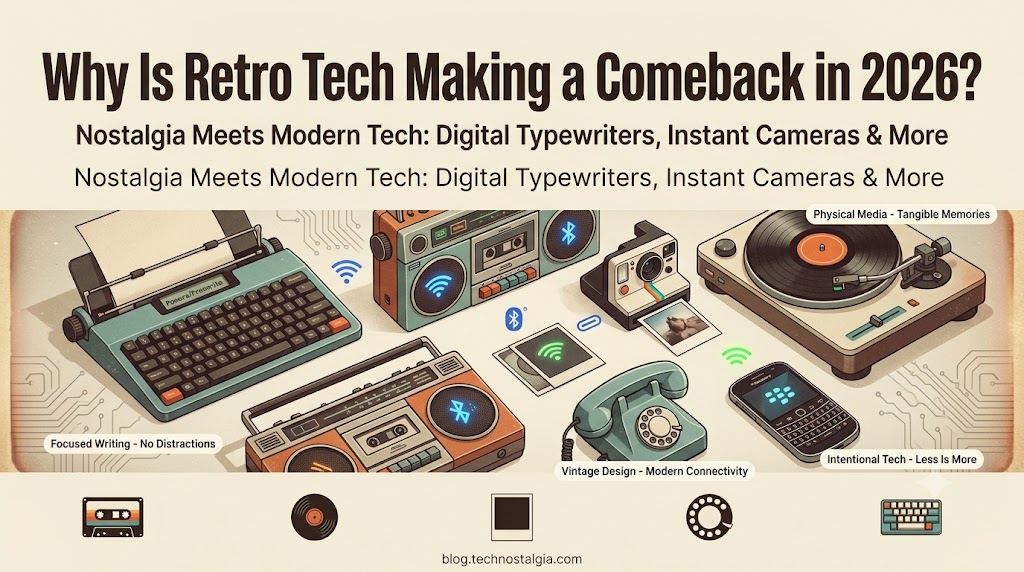
Retro tech is making a comeback because people are increasingly attracted to tactile experiences, simpler devices, nostalgic design, and technology that does one thing without demanding constant attention. Companies are responding by taking familiar products such as typewriters, boom boxes, cassette players, instant cameras, and landline phones and combining their old-school appeal with modern features such as Bluetooth, Wi-Fi, USB-C, cloud syncing, and smartphone connectivity.
The result is not exactly a return to the past. Instead, it is a new category of products that borrows the personality of older technology while removing some of its limitations.
That distinction matters. A modern cassette player can have USB-C charging. A digital typewriter can sync documents to the cloud. A landline-style phone can work entirely over Wi-Fi.
In other words, the retro technology comeback is less about abandoning modern technology and more about choosing which parts of modern technology people actually want.
What is retro tech?
Retro tech is modern technology designed around the appearance, interaction, or experience of older technological products. It can recreate the physical design of a classic device while adding contemporary features that make it easier to use today.
Think of a typewriter-inspired writing device with cloud synchronization, a cassette player with Bluetooth, or an old-fashioned landline phone that operates through Wi-Fi.
The appeal is partly visual, but it is also about interaction. Older devices often required users to perform physical actions: press mechanical keys, turn a dial, insert a cassette, wait for a photograph to develop, or physically handle a record.
Those interactions create friction. And surprisingly, that friction can be enjoyable.
Question: Why do people want technology that feels less convenient?
Because convenience is not always the same as satisfaction. When everything can be done instantly, a slower and more physical experience can feel more intentional.
For someone overwhelmed by notifications, social media feeds, browser tabs, and constant digital communication, a device that deliberately limits what they can do may feel refreshing.
That is one reason retro-inspired products are attracting attention across several categories at once.
Why Are Digital Typewriters Popular Again?
Imagine sitting down to write and discovering that your device has no social media, no endless browser tabs, and almost nothing to distract you.
That is the basic idea behind digital typewriters.
What is a digital typewriter?
A digital typewriter is a dedicated electronic writing device that combines the focused experience of a traditional typewriter with selected digital features. Unlike a conventional laptop, it is designed primarily for writing rather than multitasking.
This makes the category particularly interesting for students, writers, researchers, and professionals who struggle to concentrate when their main computer is full of distractions.
The modern versions do not necessarily force you to give up digital workflows. Instead, they separate writing from editing, browsing, and communication.
For example, a writer might compose a draft on a distraction-free device and later transfer the document to a laptop for editing.
Freewrite: a typewriter-inspired writing machine
The Freewrite Smart Typewriter costs $699 according to the supplied TechCrunch report. Its design takes inspiration from classic typewriters, including a physical keyboard and a small display.
The key idea is simplicity. Instead of giving users a large screen filled with applications, the device focuses attention on the words being written.
At the same time, drafts can be synchronized to the cloud and exported to other software, meaning the device does not completely isolate users from modern workflows.
Question: Why use a digital typewriter instead of a laptop?
The main advantage is reduced distraction. A laptop can be a writing tool, entertainment device, communication platform, research browser, and gaming machine at the same time; a digital typewriter intentionally narrows that experience.
Pomera: another approach to focused writing
Pomera takes a slightly different approach. The device resembles a compact laptop and includes features such as spell checking, document management, word counts, multiple transfer options, and up to 20 hours of battery life, according to the supplied article.
At around $549, it sits in a similar premium niche.
The interesting point is that these devices are not competing only on specifications. They are selling an experience: focused computing.
For a student writing an assignment, for example, removing the temptation to check social media every few minutes may be more valuable than having the fastest processor.
Why Are Boom Boxes, Cassette Players, and Record Players Returning?
The boom box once represented portable music technology. Today, its oversized speakers, chunky controls, cassette decks, and unmistakable shape are being rediscovered as both functional devices and design objects.
Modern versions demonstrate exactly how the retro technology comeback works.
They keep the recognizable appearance and physical interaction while adding features that older products never had.
What makes modern boom boxes different?
Modern retro audio devices combine vintage-inspired hardware with features such as Bluetooth, rechargeable batteries, USB recording, and improved speakers.
That means someone can enjoy the visual and physical experience of a classic boom box without giving up wireless connectivity.
The supplied article highlights several examples.
We Are Rewind’s GB-001 costs about $525 and includes woofers, tweeters, a cassette player and recorder, Bluetooth, and a rechargeable battery. Its speakers are rated at 104 watts.
Meanwhile, Bumpboxx’s BB-777 brings an especially strong 1980s aesthetic to a modern portable device. The product includes a three-way speaker system, dual cassette decks, recording and high-speed dubbing, a CD player, USB recording, and AM/FM radio.
The idea is almost deliberately excessive.
Instead of hiding the technology inside a tiny smartphone, these products make the hardware part of the experience.
Cassette players are becoming lifestyle products
Retrospekt offers a more minimalist alternative at around $99. Its Walkman-style portable cassette player includes basic functions such as play, rewind, fast-forward, and record, while also supporting battery power and USB-C.
This illustrates an important shift.
A cassette player is no longer necessarily purchased because it is the most practical way to listen to music. It can be purchased because the physical format makes listening feel different.
You have to choose a cassette. You handle it. You press a button. You see the physical object.
Question: Why listen to cassettes or vinyl when streaming is easier?
Because physical media can turn passive listening into a more deliberate activity. Streaming prioritizes convenience and access, while physical formats add ownership, collecting, tactile interaction, and visual appeal.
Record players are part of the same trend
The retro technology comeback also extends to record players.
Kickback World’s DEKO record player, priced at about $500, uses orange acrylic and a design inspired by Swedish modernism. According to the supplied article, it began shipping in January 2025.
Here, the product is not simply an audio machine. It is also a piece of interior design.
That is another reason vintage technology is interesting in 2026: the device itself can become part of the user’s identity and environment.
Why Are Instant Cameras Having Another Moment?
Smartphones made photography almost effortless. Yet instant cameras continue to offer something smartphones cannot perfectly reproduce: a physical photograph that appears in your hands.
That waiting period changes the experience.
With a smartphone, you can take dozens of pictures and immediately delete the ones you dislike. With instant film, every shot feels more deliberate.
Why are instant photos different?
Instant cameras create physical photographs shortly after the picture is taken, combining photography with a tangible object that can be held, displayed, or shared immediately.
The imperfections of instant photography can actually become part of the appeal.
A slightly unusual exposure, unexpected framing, or distinctive film texture can make a photograph feel personal rather than perfectly optimized.
Polaroid brings modern features to a classic format
Polaroid remains one of the strongest names in this category.
The Polaroid Flip, referenced in the supplied article at around $249, combines a retro-inspired appearance with modern features including autofocus and app connectivity for remote control.
The important combination is familiar design plus contemporary convenience.
You get the physical photograph, but the camera does not necessarily behave like an old camera in every respect.
Fujifilm Instax combines digital and physical photography
The Fujifilm Instax Mini Evo takes the hybrid approach even further.
Priced around $225 in the supplied article, it can capture images digitally and print them as instant photographs. It also includes USB-C connectivity.
Fujifilm introduced the Instax Mini Evo Cinema in January 2026, with a three-in-one hybrid design that can also print images from a smartphone. The supplied article lists the price at approximately $412.
This is an important example of how retro technology evolves.
The goal is not necessarily to recreate the limitations of old equipment. Instead, manufacturers are keeping the enjoyable parts and updating the inconvenient ones.
Kodak keeps disposable cameras alive
There is also a simpler option: the disposable camera.
The supplied article lists a Kodak single-use camera at around $30. It requires little technical knowledge and preserves the distinctive experience of shooting on film.
Kodak has also introduced the Charmera, a miniature keychain digital camera that can save and transfer photographs and videos through USB-C.
Question: Why would anyone want a tiny camera when every phone has a better camera?
Because image quality is only one part of photography. A dedicated camera can change how you approach taking pictures, and a tiny novelty camera can make the activity itself more playful.
Why Are Landline-Style Phones Coming Back?
The landline seemed destined to disappear as smartphones became universal.
Instead, a modern version is finding a new audience.
The new products are not trying to recreate every limitation of traditional telephone networks. Many use Wi-Fi while preserving the familiar idea of a dedicated home phone.
What is a modern landline-style phone?
A modern landline-style phone is a dedicated home communication device that recreates the simplicity of traditional phones while using technologies such as Wi-Fi and companion apps.
This can be especially useful for families who want children to communicate without giving them unrestricted access to smartphones, social media, browsers, or mobile games.
It also appeals to adults who like the appearance and simplicity of traditional phones.
Tin Can puts communication before apps
Tin Can, listed at about $100, is designed for children and works through Wi-Fi rather than requiring a traditional phone jack.
Only approved people can call, and parents can manage contacts through a companion application.
The service includes free calling between Tin Can users, while a $9.99-per-month plan supports calls to approved contacts.
The concept is straightforward: provide communication without turning communication into a gateway to an entire smartphone ecosystem.
Clicks brings back the physical keyboard
Clicks announced its smartphone at CES 2026, bringing a BlackBerry-inspired physical keyboard into a modern smartphone experience.
The device, listed at about $499 in the supplied article, supports services such as messaging, Gmail, and Slack but does not provide access to mobile games and social media.
That makes Clicks an interesting hybrid.
It looks backward aesthetically while addressing a very modern problem: digital distraction.
Question: Is the return of physical keyboards really about nostalgia?
Partly, but not entirely. Physical keyboards can also provide a different typing experience and may appeal to people who prefer tactile feedback over touchscreen typing.
Pinwheel Home focuses on families
In July 2026, Pinwheel launched Pinwheel Home, a Wi-Fi-based landline-style device aimed at children.
It allows parents to approve contacts through the company’s Caregiver Portal. Calls between Pinwheel Home devices are free, while plans for calls to regular phone numbers start at $6.99 per month for up to five approved contacts or $9.99 per month for unlimited calling, according to the supplied article.
The product demonstrates how old technology can be reinterpreted for modern family needs.
Ooma MyPhone removes the smartphone layer
Ooma MyPhone, listed at about $100, is another child-focused home phone.
It supports approved contacts, Quiet Hours, emergency alerts, and parental call-log monitoring. It does not provide apps, internet access, texting, or social media.
This is perhaps the clearest expression of the trend.
Instead of asking, “How can we put more features into one device?” these products ask, “What if the device did less?”
Retro Tech vs. Modern Tech: Which Is Better?
There is no universal winner. The better choice depends on what you want technology to do.
| Feature | Retro-inspired technology | Mainstream modern technology |
| Primary appeal | Nostalgia and focused experiences | Convenience and versatility |
| User interaction | Often physical and tactile | Mostly touchscreen or software-based |
| Distractions | Usually limited | Often numerous |
| Connectivity | Selective or focused | Usually extensive |
| Design | Vintage-inspired | Contemporary |
| Portability | Depends on product | Generally strong |
| Customization | Often limited | Usually extensive |
| Best for | Focus, hobbies, collecting, intentional use | Multitasking and productivity |
| Main drawback | Can be expensive for limited features | Can encourage distraction |
Question: Should you replace your smartphone with retro tech?
Probably not. For most people, the most useful approach is selective rather than extreme.
You can use a smartphone for communication and work while choosing a dedicated camera for photography, a digital typewriter for writing, or a record player for music.
That gives you the best of both worlds.
What Does the Retro Tech Comeback Say About the Future?
The most interesting thing about the retro technology comeback is that it does not necessarily represent rejection of innovation.
Instead, it may show that people are becoming more selective about which innovations deserve their attention.
For years, consumer technology often followed a simple formula: smaller, faster, smarter, more connected.
Now another question is becoming important:
Does more technology actually create a better experience?
A device can have dozens of features and still be frustrating to use. Conversely, a product with one primary purpose can feel satisfying precisely because it refuses to do everything.
That is why the current trend includes such different products.
A digital typewriter reduces distractions.
A cassette player makes music physical.
An instant camera creates a tangible memory.
A landline-style phone limits communication.
They appear unrelated, but they share one principle: intentional technology.
Retro does not mean obsolete
It is also important to distinguish nostalgia from technological regression.
Modern retro-inspired products often depend on technologies that did not exist when their designs first became popular.
Bluetooth, USB-C, cloud synchronization, Wi-Fi, smartphone apps, digital storage, and modern batteries can all exist inside products that visually resemble decades-old devices.
So the future may not be a choice between old technology and new technology.
It could be a combination of both.
Question: What is the biggest lesson from the retro tech trend?
The biggest lesson is that technology does not have to maximize features to maximize value. Sometimes the most valuable feature is a limitation that helps people focus.
What Can Students and Young Professionals Learn From Retro Tech?
For students and young professionals, the trend offers an interesting lesson about productivity.
Modern devices are incredibly powerful, but their power can work against concentration. A laptop can simultaneously display a lecture, email inbox, social media, entertainment, messaging apps, and dozens of browser tabs.
That flexibility is useful until it becomes noise.
You do not necessarily need to buy an expensive retro-inspired device to benefit from the idea.
Instead, you can borrow the philosophy.
Try an intentional-tech approach
Here are a few practical ideas:
- Create distraction-free writing sessions: Close unnecessary tabs and notifications when working on assignments or reports.
- Use single-purpose tools: Consider a basic notebook, timer, e-reader, or focused writing application when a full computer creates too many distractions.
- Make entertainment deliberate: Instead of endlessly scrolling through music recommendations, choose an album and listen from beginning to end.
- Print meaningful photographs: Physical photos can turn digital memories into something tangible.
- Create phone-free periods: Keep your smartphone away during study sessions, meals, or creative work.
- Separate communication from entertainment: If possible, use dedicated tools or settings that make messaging easier without opening social feeds.
The goal is not to reject smartphones or modern computers.
It is to stop assuming that maximum connectivity is always the best experience.
Why this matters for India’s young technology users
For students and young professionals in India, digital tools are deeply integrated into education and work. Smartphones are used for payments, classes, navigation, messaging, entertainment, job searches, and professional communication.
That makes digital boundaries especially valuable.
A retro-inspired mindset can therefore be useful even without buying a retro gadget.
The question becomes: What technology helps me accomplish this task, and what technology distracts me from it?
That is a much more useful question than simply asking whether a product is old or new.
Is Retro Tech Just a Passing Trend?
It could be partly driven by nostalgia, but the underlying motivations are broader.
People are not buying these products solely because they remember them from childhood. Some are attracted to physical interaction, others to distinctive design, and others to devices that reduce digital distractions.
The products also demonstrate that nostalgia can be commercially useful when combined with modern functionality.
A purely vintage product might be inconvenient because its original technology has limitations. A modern product with vintage-inspired design can preserve the emotional appeal while improving usability.
That gives manufacturers a powerful formula:
familiar design + physical interaction + modern connectivity + selective functionality.
Whether every category remains popular is difficult to predict. But the broader demand for more intentional digital experiences is likely to remain relevant as people spend increasing amounts of time surrounded by connected devices.
Retro Tech Comeback FAQ
Why is retro tech becoming popular again?
Retro tech is becoming popular because it combines nostalgia, tactile interaction, distinctive design, and simpler experiences with modern functionality. Products such as digital typewriters, instant cameras, cassette players, and landline-style phones offer alternatives to highly connected devices.
What are examples of retro tech in 2026?
Examples include digital typewriters, cassette players, boom boxes, record players, instant cameras, disposable cameras, physical-keyboard smartphones, and Wi-Fi landline-style phones. Many combine vintage-inspired designs with Bluetooth, USB-C, Wi-Fi, cloud syncing, or smartphone connectivity.
Why are digital typewriters better for focused writing?
Digital typewriters are designed to minimize distractions by concentrating on writing rather than multitasking. Unlike a general-purpose laptop, they typically provide fewer applications and interruptions, making them appealing for focused writing sessions.
Are instant cameras still useful when smartphones have better cameras?
Yes. Instant cameras provide an experience that smartphones do not fully reproduce: a physical photograph that can be held immediately after taking it. The slower, more deliberate process can make photography feel more meaningful and social.
Why are landline-style phones returning?
Modern landline-style phones can provide simple communication without giving users unrestricted access to apps, social media, games, or internet browsing. This makes them particularly appealing for families looking for more controlled communication options for children.
Is retro technology better than modern technology?
Neither is universally better. Modern technology is generally more versatile and connected, while retro-inspired technology can provide more focused, tactile, or intentional experiences. The best choice depends on the task and the user’s priorities.
The Future of Retro Tech Is Probably Not Retro at All
The biggest irony of the trend is that today’s retro products are often highly modern underneath.
A typewriter can use cloud synchronization. A cassette player can use USB-C. A landline can run through Wi-Fi. An instant camera can combine physical film with digital storage and smartphone connectivity.
That suggests the real trend is not a return to the past.
It is a search for better relationships with technology.
As devices become increasingly capable of doing everything, some people are discovering the value of products that intentionally do less.
For students, creators, professionals, and anyone tired of endless notifications, that idea is worth paying attention to.
The next generation of technology may not always be about adding another feature. Sometimes, innovation can mean bringing back the right limitation.
If you’re exploring smarter ways to use technology for study, work, and creativity, keep exploring Kalinga.ai for more practical AI and tech insights.