What Does the OpenAI Malaysia Data Centre Deal Mean for AI Infrastructure?
What happens when the biggest AI companies need more computing power than their existing data centres can provide? They start locking in infrastructure years in advance , and OpenAI’s new deal with Australia’s Firmus shows exactly how important that race has become.
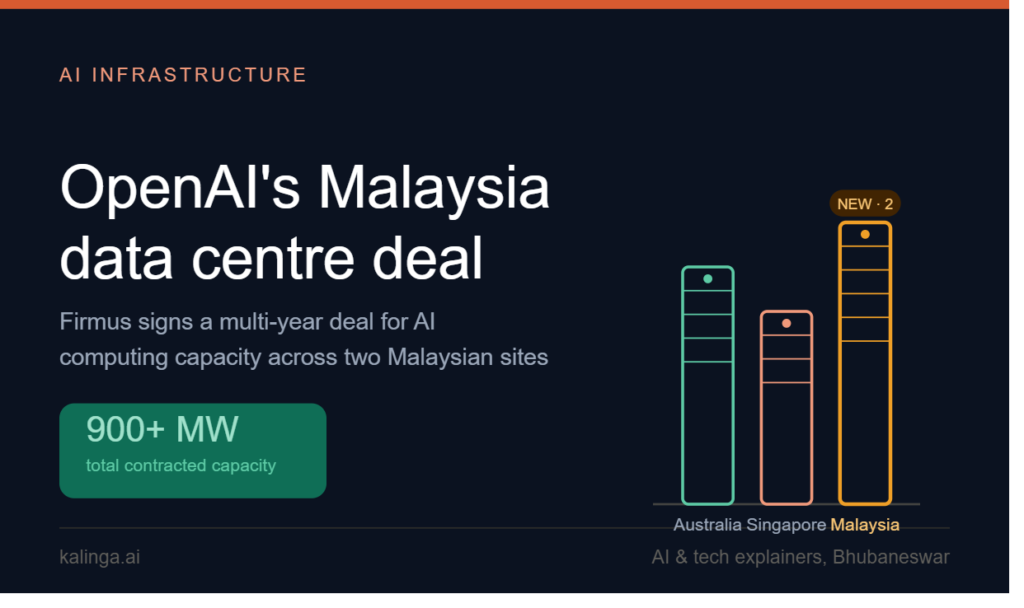
On September 8, 2026, Firmus said it had signed a multi-year agreement with OpenAI to supply computing capacity from two Malaysian data centres. The agreement makes OpenAI an anchor customer for Firmus in Malaysia as demand for infrastructure capable of running advanced AI models continues to grow.
The deal is bigger than simply adding another customer to a data centre. It reflects a fundamental shift in the AI industry: access to electricity, high-performance chips, cooling systems and data-centre space is becoming just as strategically important as developing better AI models.
For Malaysia, the agreement strengthens its position as a rapidly growing data-centre market in Southeast Asia. For Firmus, it adds a major global AI company to its customer base. And for OpenAI, it provides additional infrastructure capacity as competition for AI computing resources intensifies.
What Is the OpenAI Malaysia Data Centre Deal?
The OpenAI Malaysia data centre deal is a multi-year agreement under which Firmus will provide computing capacity to OpenAI from two Malaysian data centres.
In practical terms, OpenAI is not simply renting a conventional office server room. The capacity is intended to support the enormous computational requirements associated with advanced AI models.
According to Reuters, the agreement raises Firmus’ contracted customer capacity to more than 900 megawatts (MW).
That figure gives a sense of the scale of the infrastructure race surrounding artificial intelligence.
Question: What exactly is OpenAI buying from Firmus?
OpenAI is securing computing capacity from Firmus’ Malaysian data-centre infrastructure. The contract value was not disclosed, but the agreement provides OpenAI with access to infrastructure needed to run increasingly demanding AI workloads.
The arrangement also makes OpenAI an anchor customer, meaning a major customer whose long-term commitment can provide an important foundation for a data-centre project.
Why an anchor customer matters
Building an AI-focused data centre is an expensive, infrastructure-heavy undertaking.
Developers need to secure land, electricity, networking, cooling equipment, computing hardware and other systems before customers can use the facility.
Having a large customer committed to capacity can make the economics of such projects more predictable.
For Firmus, signing OpenAI therefore represents more than a headline customer win. It potentially strengthens the commercial foundation of its expanding Asia-Pacific infrastructure portfolio.
The key numbers
Several figures from the Reuters report illustrate the scale of the development:
- Multi-year: The OpenAI-Firmus agreement is not described as a short-term capacity purchase.
- 2 Malaysian data centres: The contracted computing capacity will come from two facilities in Malaysia.
- 900+ MW: Firmus’ total contracted capacity across customers rises above this level.
- $10.5 billion+: Firmus was valued above this level in its most recent fundraising.
- 5 data centres: Firmus has five additional facilities under development across Asia-Pacific.
- 2 operational AI data centres: Firmus already has operational AI data centres in Australia and Singapore.
Together, these numbers show why AI infrastructure has become a major investment category.
Why OpenAI Is Securing Data Centre Capacity
Building a powerful AI model is only part of the challenge.
Once a model exists, companies need enormous amounts of computing infrastructure to train, test, update and serve it to users.
This is where the concept of AI infrastructure becomes important.
Definition + Expansion: AI infrastructure
AI infrastructure is the physical and digital technology required to develop and operate artificial intelligence systems.
It includes specialised processors, servers, networking equipment, data centres, electricity, cooling systems and software infrastructure. For large AI companies, these resources must operate at massive scale because millions of users and increasingly complex models can create enormous computing demand.
Why AI models require huge amounts of computing
Traditional software can often run on relatively ordinary computing systems.
Advanced AI models are different.
Training a large model can involve processing enormous datasets through specialised processors. Once the model is deployed, every user interaction requires additional computation.
A simple chatbot request might seem small from the user’s perspective, but millions of simultaneous requests can translate into substantial infrastructure requirements.
And AI models are becoming more computationally demanding.
Models designed for reasoning, multimodal interactions, coding, autonomous agents and other advanced tasks can require significantly more computing resources than simpler systems.
Question: Why can’t OpenAI simply build all its own data centres?
It could develop its own infrastructure, but partnering with specialised data-centre operators can provide additional capacity and geographic flexibility more quickly.
The AI industry is expanding across multiple regions, and companies need infrastructure close to major power sources, networks and markets.
Using specialist infrastructure providers can also allow AI companies to focus more of their resources on model development and products while relying on partners for parts of the physical infrastructure stack.
Capacity is becoming a strategic resource
The traditional technology race focused heavily on chips.
Today, the equation is broader.
An AI company needs:
AI model → chips → data centre → electricity → cooling → networking → users
If one link is missing, the entire system can become constrained.
A company may have access to advanced processors but still struggle to deploy them if it cannot obtain enough electricity or suitable data-centre capacity.
That is why agreements such as the OpenAI Malaysia data centre deal are strategically significant.
Why Firmus Matters in the AI Infrastructure Race
Firmus is an Australian AI infrastructure company that has been expanding across the Asia-Pacific region.
The company has attracted backing from major investors and technology players, including Nvidia, Jane Street, Blackstone funds and Coatue Management.
Reuters reported that Firmus was valued at more than $10.5 billion during its latest fundraising round.
That valuation makes the company an important participant in the increasingly competitive AI infrastructure market.
Firmus’ growing regional footprint
Firmus currently has:
- Two operational AI data centres in Australia and Singapore
- Five data centres under development across Asia-Pacific
- More than 900 MW of contracted capacity across customers following the OpenAI agreement
The geographic expansion matters because AI infrastructure is becoming increasingly distributed.
Rather than concentrating every facility in one country, companies can develop networks across regions with different power markets, connectivity options and regulatory environments.
Question: Why is Firmus expanding across Asia-Pacific?
The region is becoming a major destination for AI and cloud infrastructure, creating demand for large-scale computing capacity.
Malaysia, Singapore and Australia each have different strengths, while other Asian markets are also investing heavily in data-centre infrastructure.
For an infrastructure company, operating across multiple markets can create opportunities to serve international AI customers.
Nvidia’s connection
Nvidia’s role adds another important dimension.
Nvidia is one of the world’s most important suppliers of AI accelerators , specialised processors designed to handle the mathematical workloads used in modern AI systems.
Firmus has said it will deploy Nvidia’s next-generation Vera Rubin processors at scale across Asia-Pacific.
That means Firmus is positioning its infrastructure around increasingly advanced generations of AI computing hardware.
The combination is important:
Nvidia supplies the computing technology. Firmus develops the infrastructure around it. OpenAI becomes a major customer for that capacity.
That illustrates how today’s AI economy is becoming an interconnected ecosystem rather than a competition between model developers alone.
Why Malaysia Is Becoming an AI Data Centre Hub
The OpenAI Malaysia data centre deal also highlights a larger trend: Malaysia is becoming one of Southeast Asia’s fastest-growing data-centre markets.
The country’s appeal comes from several factors, including its location within Asia, infrastructure development and growing demand for cloud and AI services.
For AI companies, geographic location matters because data centres need reliable electricity, high-speed connectivity and access to suitable physical infrastructure.
Malaysia’s strategic location
Malaysia sits within an important part of Southeast Asia’s digital economy.
It is close to major technology and business markets, while also having room for continued infrastructure development.
That makes Malaysia attractive for companies looking to expand computing capacity in the region.
The country is increasingly competing for data-centre investment as demand for cloud computing and AI accelerates.
Question: Why do AI companies need data centres in different countries?
Geographically distributed data centres can provide additional computing capacity, improve network connectivity and help companies serve users across different markets.
They can also help companies manage infrastructure constraints in individual locations.
For example, if demand for data-centre capacity rises sharply in one market, companies may look elsewhere for additional electricity, land or development opportunities.
The hidden cost: electricity and water
But the data-centre boom has a major challenge.
Large computing facilities consume significant amounts of electricity, and many use substantial quantities of water for cooling.
Reuters noted that Malaysia’s rapid data-centre expansion has attracted scrutiny over electricity and water use.
This creates a difficult policy balancing act.
Governments want to attract investment, technology companies and high-skilled jobs. At the same time, they must make sure infrastructure growth does not put unsustainable pressure on local resources.
What the OpenAI-Firmus Deal Means for AI Infrastructure
The significance of the OpenAI Malaysia data centre agreement goes beyond Malaysia itself.
It demonstrates that the AI industry’s next phase will depend heavily on infrastructure availability.
For years, discussions about artificial intelligence focused on algorithms, datasets and model benchmarks.
Now another question is becoming increasingly important:
Where will all these AI models actually run?
The AI infrastructure bottleneck
Suppose an AI company wants to deploy a new model globally.
It needs enough:
- Processors to perform calculations
- Data-centre capacity to house those processors
- Electricity to power them
- Cooling to prevent overheating
- Networking to connect systems and users
- Construction capacity to build additional facilities
A shortage in any one category can slow expansion.
That makes infrastructure a potential bottleneck for AI growth.
Question: Is computing capacity becoming as important as AI models?
Increasingly, yes. Better models require computing resources to train and operate, while popular AI products can generate enormous demand for inference , the process of running a trained model to produce an answer.
This is why major AI companies are making long-term infrastructure commitments.
OpenAI’s position
The Reuters report places the Firmus agreement within a broader race among U.S. and Chinese AI groups to secure power and data-centre capacity.
OpenAI has also been developing increasingly capable AI models, making access to large-scale computing infrastructure strategically important.
The company’s demand is therefore part of a much larger industry trend.
As models become more sophisticated, infrastructure requirements can rise alongside them.
How Nvidia’s Vera Rubin Chips Fit Into the Strategy
The Nvidia Vera Rubin platform is another important part of the story.
Nvidia’s processors are designed specifically for high-performance computing workloads, including artificial intelligence.
Firmus plans to deploy next-generation Vera Rubin processors at scale across the Asia-Pacific region.
That means data-centre infrastructure is increasingly being designed around specialised AI hardware rather than traditional general-purpose servers alone.
What makes AI processors different?
AI workloads involve enormous numbers of mathematical operations.
Specialised accelerators can perform these calculations efficiently and in parallel.
That makes them particularly useful for:
- Training large AI models
- Running generative AI systems
- Processing multimodal workloads
- Supporting reasoning systems
- Serving large numbers of AI requests
But powerful processors create another infrastructure challenge.
They generate substantial heat and require sophisticated cooling.
So a next-generation AI chip is not useful in isolation.
It needs the right data-centre environment around it.
Question: Why does a chip announcement matter to a data-centre story?
Because the type of processors being deployed influences the power, cooling, networking and physical infrastructure a data centre needs.
The move toward increasingly powerful AI accelerators is therefore directly connected to the expansion of AI data centres.
This is one reason the Nvidia-Firmus relationship matters.
OpenAI, Firmus and the Race for AI Capacity
The AI infrastructure race is becoming increasingly competitive.
According to Reuters, the Firmus deal comes amid a wider contest between U.S. and Chinese AI groups to secure the electricity and data-centre capacity required for advanced models.
That competition is happening alongside the race to develop better algorithms and AI products.
The new AI stack
A useful way to understand the industry is to break it into layers:
| Layer | Examples | Why it matters |
| AI models | Large language and reasoning models | Provides intelligence and capabilities |
| AI chips | Nvidia accelerators | Performs computational workloads |
| Data centres | Large computing facilities | Houses AI hardware |
| Energy | Electricity generation and transmission | Powers computation |
| Cooling | Air and liquid cooling systems | Keeps hardware operating safely |
| Networking | High-speed data connections | Connects processors and users |
| Applications | Chatbots, coding tools, agents | Delivers AI to users |
This makes one thing clear:
The AI race is also an infrastructure race.
Why capacity contracts are important
Long-term capacity agreements can help AI companies secure access to infrastructure before demand becomes even tighter.
For infrastructure providers, contracts with major AI companies can provide predictable demand.
For AI companies, securing capacity can reduce the risk of being unable to deploy future systems because suitable infrastructure is unavailable.
That creates a mutually beneficial relationship.
Question: Does this mean every AI company needs its own data centre?
No. AI companies can use a mixture of owned facilities, cloud providers, specialised infrastructure companies and other hosting arrangements.
The important issue is having sufficient reliable computing capacity, not necessarily owning every physical facility.
What Could the Deal Mean for Malaysia and Asia-Pacific?
The OpenAI Malaysia data centre agreement could reinforce Malaysia’s position as an important destination for AI infrastructure investment.
Having a major AI company commit to local data-centre capacity can also increase the visibility of the country’s infrastructure market.
But investment brings both opportunities and responsibilities.
Potential opportunities
Malaysia could benefit from:
- Increased data-centre investment
- Construction and infrastructure activity
- Demand for technical talent
- Growth in supporting technology services
- Greater participation in the regional AI economy
- Potential development of specialised AI infrastructure expertise
The wider impact depends on how governments, infrastructure providers and technology companies manage that growth.
Resource constraints remain important
The biggest challenge is sustainability.
Data centres require electricity, and AI-focused facilities can have particularly high power requirements.
Cooling can also require significant resources.
This means governments increasingly need to consider questions such as:
- Where should new data centres be built?
- How much electricity will they consume?
- What energy sources will power them?
- How will water use be managed?
- Can local grids handle increasing demand?
- What economic benefits will communities receive?
Question: Could Malaysia’s data-centre boom create problems?
Yes, if infrastructure growth outpaces sustainable power, water and grid planning. Reuters specifically noted scrutiny surrounding electricity and water use as Malaysia’s data-centre market expands rapidly.
The challenge is therefore not simply attracting more facilities.
It is building an infrastructure ecosystem that can support them sustainably.
What Should Students and Tech Professionals Learn From This?
If you’re a student or early-career professional interested in AI, the Firmus-OpenAI agreement offers a useful lesson.
The future of artificial intelligence will not be built entirely inside software.
It will also depend on physical infrastructure.
The AI career opportunity is broader than coding
AI-related careers increasingly extend beyond model development.
The expanding infrastructure ecosystem creates opportunities in areas such as:
- Data-centre engineering
- Cloud computing
- Semiconductor technology
- Electrical engineering
- Power systems
- Cooling and thermal engineering
- Networking
- Cybersecurity
- AI operations
- Infrastructure finance
- Sustainability
- Data governance
A computer science student might focus on machine learning, while an electrical engineering student might work on the power systems that keep AI facilities running.
Both are contributing to the AI economy.
Question: Why should Indian students care about a Malaysian data-centre deal?
Because AI infrastructure is becoming a regional technology industry, and developments across Asia-Pacific can influence investment, jobs, skills and opportunities in India.
India is also expanding its own digital infrastructure and AI capabilities.
Understanding how AI infrastructure works can therefore help students see opportunities beyond building AI applications alone.
A simple learning roadmap
If AI infrastructure interests you, start with these concepts:
- Learn cloud computing fundamentals.
- Understand GPUs and AI accelerators.
- Study how data centres work.
- Learn basic networking concepts.
- Understand electricity and cooling requirements.
- Explore AI inference and model serving.
- Follow semiconductor and data-centre developments.
- Learn about AI sustainability and energy consumption.
You do not need to master every area immediately.
The goal is to understand how the pieces connect.
Why This Deal Matters Beyond OpenAI
At first glance, the headline is simple: Firmus has signed OpenAI as a customer in Malaysia.
But the deeper story is about how the economics of artificial intelligence are changing.
AI companies increasingly need enormous physical resources to deliver digital products.
That changes the competitive landscape.
A company with a strong model but insufficient computing capacity may struggle to serve users at scale. A company with access to chips but no electricity or data-centre space faces the same problem.
This makes infrastructure partnerships strategically important.
Three trends to watch
1. AI companies will continue securing computing capacity.
As demand grows, long-term infrastructure agreements could become increasingly common.
2. Data-centre locations will become strategic decisions.
Companies will evaluate electricity availability, connectivity, land, regulations, cooling and sustainability alongside traditional business considerations.
3. AI hardware and infrastructure will increasingly evolve together.
New generations of processors will influence data-centre design, power requirements and cooling technology.
The OpenAI Malaysia data centre deal sits directly at the intersection of all three trends.
FAQ: OpenAI, Firmus and Malaysia Data Centres
What is the OpenAI Malaysia data centre deal?
The OpenAI Malaysia data centre deal is a multi-year agreement between OpenAI and Australian AI infrastructure company Firmus to supply computing capacity from two Malaysian data centres. The agreement makes OpenAI an anchor customer for Firmus in Malaysia.
Who is Firmus?
Firmus is an Australian AI infrastructure company developing and operating data centres for high-performance computing workloads. Reuters reported that Firmus was valued above $10.5 billion in its latest fundraising and has operational facilities in Australia and Singapore, with additional sites under development across Asia-Pacific.
How much contracted capacity does Firmus have?
Following the OpenAI agreement, Firmus said its contracted capacity across customers had risen to more than 900 MW. The figure represents the scale of computing infrastructure the company has contracted with customers.
Why is Malaysia important for AI data centres?
Malaysia has become one of Southeast Asia’s fastest-growing data-centre markets. Its regional location and expanding digital infrastructure have attracted investment, although the rapid buildout has also raised concerns about electricity and water consumption.
What are Nvidia Vera Rubin processors?
Vera Rubin refers to Nvidia’s next-generation AI computing platform and processors. Firmus plans to deploy Nvidia’s Vera Rubin processors at scale across Asia-Pacific, including as part of its expanding regional AI infrastructure footprint.
Why does OpenAI need so much data-centre capacity?
Advanced AI models require large amounts of computing power for training and inference. As AI products serve more users and models become more capable, companies need additional processors, electricity, networking, cooling and data-centre capacity to operate them at scale.
Final Takeaway
The OpenAI Malaysia data centre agreement with Firmus is a sign that the AI industry’s next competitive frontier is not just smarter models , it is access to the physical infrastructure required to run them.
With Firmus expanding across Asia-Pacific, Nvidia deploying next-generation AI processors and Malaysia attracting major data-centre investment, the region is becoming an increasingly important part of the global AI infrastructure map. For students and professionals, that means the AI opportunity extends far beyond chatbots and software: the people who build, power, cool and connect AI systems will be just as important to the industry’s future. keep exploring KALINGA.AI for more.