Why Oil Prices Haven’t Crossed $100 Yet
At first glance, the oil market looks like it should be experiencing a dramatic price shock.
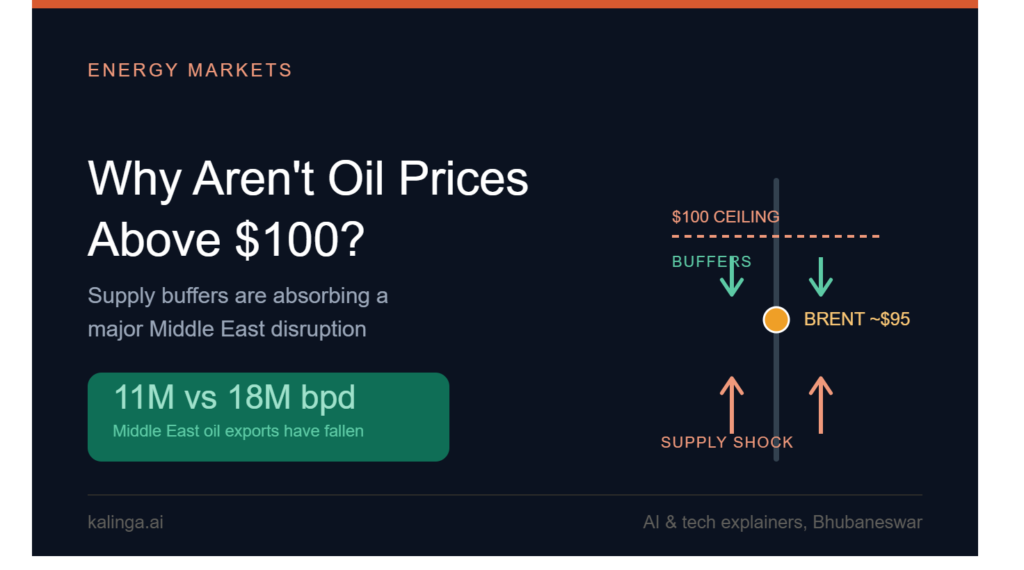
Middle Eastern crude shipments are reportedly down from 18 million bpd to about 11 million bpd since the beginning of the Iran war. Shipping through the Strait of Hormuz has slowed, Red Sea routes remain under pressure and the conflict has created serious uncertainty around future energy supplies.
Yet oil prices have not consistently crossed $100 a barrel.
Question: Why aren’t oil prices above $100 despite such large supply disruptions?
Because the global market has several buffers. Some oil is still moving through Hormuz, Gulf producers are using alternative routes and ship-to-ship transfers, non-OPEC producers are increasing output, demand has weakened significantly and China has substantial reserves.
These factors do not eliminate the supply shock. Instead, they prevent the shock from becoming even larger.
Definition + Expansion
Supply disruption means a reduction or interruption in the amount of a commodity that can reach the market. In oil markets, a disruption can happen because of damaged infrastructure, blocked shipping routes, military conflict, sanctions or production problems.
The crucial point is that a reduction in one supply route does not necessarily equal an identical reduction in global oil availability. Producers, traders and refiners can sometimes find alternative routes, draw on inventories or reduce consumption.
That is exactly what is happening in the current market.
The Oil Market Has More Flexibility Than It Appears
Oil is a globally traded commodity, which means buyers and sellers can respond to regional disruptions in multiple ways.
If a tanker cannot use one route, another route may be available. If one producer exports less, another producer may increase output. If prices rise sharply, consumers and industries may reduce consumption.
The result is a complicated balancing act.
| Factor | Effect on Oil Market | Impact on Prices |
| Lower Middle East exports | Reduces available supply | Pushes prices higher |
| Continued Hormuz flows | Preserves some supply | Limits price gains |
| Alternative export routes | Keeps barrels moving | Limits disruption |
| Higher U.S., Canadian and Guyanese output | Adds supply | Moderates prices |
| Weaker global demand | Reduces consumption | Pushes prices lower |
| Chinese oil reserves | Provides supply cushion | Reduces shortage fears |
| Tight physical market | Indicates scarce nearby barrels | Supports higher prices |
This explains why the direction of oil prices cannot be determined by one headline statistic.
How Much Oil Is Still Moving Through the Strait of Hormuz?
The Strait of Hormuz is at the center of the current energy-market story.
Before the latest escalation, significant volumes of oil were still moving through the waterway. Rystad Energy Chief Economist Claudio Galimberti told Reuters that 8 million to 9 million bpd flowed through Hormuz during the week before fighting erupted again on August 30.
That was roughly double the volume of the previous week.
Since then, flows have fallen to below 2 million bpd, but the moving average has remained around 4 million to 5 million bpd, according to Galimberti.
His estimate placed the “fair” Brent price around $95 a barrel based on those moving-average flows.
Question: Does the continued movement of oil through Hormuz explain why oil prices remain below $100?
Yes, at least partly. As long as meaningful volumes continue moving through the strait, the market can avoid the extreme supply shock that would occur if the waterway were effectively closed.
Industry estimates put daily exports through Hormuz at around 6 million to 8 million barrels.
That is still a huge amount of energy moving through one strategic chokepoint.
Hormuz Is a Chokepoint, Not a Switch
It is tempting to think of the Strait of Hormuz as either “open” or “closed.”
The reality is more complicated.
Even when traffic falls sharply, some shipments may continue. Different vessels may face different risks, and exporters can adjust their logistics.
The result is a partial disruption rather than a complete shutdown.
Reuters also reported that there had been no visible very large crude carrier exiting the strait since September 2, based on Kpler data cited in the report.
That suggests the market remains under considerable pressure, even though oil has not yet moved permanently above $100.
How Alternative Routes Are Protecting Global Supply
Another reason oil prices have not exploded is that Gulf producers are finding ways to move some crude without relying entirely on the most disrupted routes.
Producers can use alternative ports, pipelines and logistical arrangements. They can also arrange ship-to-ship transfers, in which oil is moved between vessels at sea rather than traveling through a conventional export route from the original port.
These methods are not necessarily perfect substitutes, but they can reduce the size of the supply shortfall.
Question: Can alternative routes completely replace Hormuz?
Not necessarily. They can mitigate some disruption, but the capacity, geography and operational constraints of alternative routes limit how much additional oil they can handle.
That is why the market remains tight even while some supply continues to reach buyers.
Saudi Arabia Shows How Export Routes Matter
Saudi Aramco resumed loadings from its Ras Tanura port inside the Gulf in August, according to Reuters.
At the same time, Saudi exports from Yanbu, located on the Red Sea, remained under pressure because of a naval blockade by Iran-aligned Yemeni Houthis.
Yanbu exports fell to a six-month low of 1.429 million bpd in August, compared with an average of 3.9 million bpd during the previous three months, according to provisional Kpler data.
That is a substantial decline.
But other routes are helping compensate for some of the lost supply.
Exports from Egypt’s Sidi Kerir port reached 2.139 million bpd in August, more than double June volumes.
Iraq also increased exports to about 2.34 million bpd in August, while shipments from the United Arab Emirates were around 2.9 million bpd during July and August.
Kuwaiti crude exports also recovered to approximately 1 million bpd during July and August.
The lesson is straightforward: oil markets are global networks, not isolated pipelines.
Why Other Oil Producers Are Filling Part of the Gap
The Middle East is central to global oil supply, but it is not the only source of crude.
Other producers are increasing output, helping reduce the impact of the Middle Eastern disruption.
According to Rystad Energy founder Jarand Rystad, non-OPEC producers including the United States, Canada and Guyana are expected to increase combined production by 1.4 million bpd this year.
That is significant because additional production elsewhere can partly compensate for barrels that become unavailable from the Middle East.
Question: Can production growth outside the Middle East completely replace lost Gulf exports?
No. The additional output does not fully replace the scale of the Middle Eastern shortfall. But it can reduce the amount of supply that the global market actually needs to find elsewhere.
That difference is crucial.
Russia Is Also Still Exporting Large Volumes
Russian crude exports remained around 5.5 million bpd in July and August, according to Kpler data cited by Reuters.
That is lower than the 6.4 million bpd peak recorded in June but still 23% higher than February.
Russia’s exports have remained relatively resilient even as the country has faced military and economic pressures.
However, Russia has lowered its 2026 oil output forecast to a 17-year low, according to Reuters, which could eventually reduce its export capacity.
This creates another tension in the market.
Russia is helping maintain global supply today, but lower future production could make the market tighter later.
How Weaker Demand Is Holding Prices Down
Supply is only half of the oil-price equation.
The other half is demand.
If oil supplies fall but consumers simultaneously use less oil, the resulting shortage can be much smaller than expected.
That is one of the biggest reasons oil prices have not risen as far as some might expect.
Rystad estimates that demand destruction in petrochemicals and transportation fuels remains significant, at about 3.5 million bpd in the third quarter, compared with 4.5 million bpd in the second quarter.
Definition + Expansion
Demand destruction occurs when consumers and businesses reduce their use of a commodity, often because prices rise, economic activity slows or alternative technologies become more attractive. In the oil market, this can mean fewer barrels being consumed by transportation, manufacturing and petrochemical industries.
China is responsible for more than half of the current demand reduction cited by Rystad.
The country’s transportation electrification and use of coal-based chemicals have reduced its demand for some oil products.
That means the global market does not need to replace every lost barrel with another barrel.
Some of the adjustment happens on the demand side.
China Has Become a Major Variable
China is the world’s top oil importer and has been described as the “new demand OPEC” because of its influence on global consumption.
Its seaborne crude shipments fell to around 7 million bpd in July and August, compared with more than 11 million bpd in February.
That is a major reduction.
When one of the world’s biggest oil buyers imports less crude, it can significantly change the global supply-demand balance.
Question: Why does weaker Chinese demand matter so much to oil prices?
Because China is large enough to influence global oil consumption. When Chinese purchases decline, some of the barrels that might otherwise be needed by Chinese refiners remain available to other buyers.
That can reduce upward pressure on prices.
Why China’s Oil Reserves Matter
China has another advantage: large petroleum reserves.
Kpler estimates China’s oil reserves at around 1.17 billion barrels.
Strategic and commercial inventories can act as a cushion during periods of supply disruption.
If imports temporarily fall or international shipments become more difficult, stored crude can help meet some domestic requirements.
Question: Can China’s reserves prevent a global oil-price spike?
No. China’s inventories are not a permanent replacement for international production or shipping. But large reserves can reduce the urgency of buying additional barrels from an already tight spot market.
That helps explain why oil prices can remain below extreme levels even during a serious geopolitical disruption.
Inventories Change the Market’s Psychology
Oil markets respond to expectations.
If traders believe that a country has enough inventory to absorb a temporary disruption, they may be less concerned about an immediate shortage.
That can reduce panic buying.
In contrast, if inventories are low and supply suddenly falls, buyers may compete aggressively for available crude, pushing prices higher.
This is why inventory data is one of the most important indicators to watch during a geopolitical crisis.
Why Physical Oil Markets Look Tighter Than Brent
Here is where the current market becomes particularly interesting.
The headline Brent price does not tell the entire story.
Reuters reported that spot premiums have rebounded to April levels, with Dubai and Oman trading around $19 to $20 a barrel above Dubai quotes for November cargoes.
Oman futures were at $104.54 a barrel on Monday, while cash Dubai traded at $105.10.
That means some physical parts of the market are already behaving as though oil is above $100.
Question: Why can physical oil trade above $100 while Brent remains below $100?
Because benchmark futures prices reflect broader expectations about future supply and demand, while physical prices can respond much more sharply to immediate shortages of particular grades or cargoes.
This is sometimes described as a difference between the paper market and the physical market.
What Physical Tightness Tells Us
Argus Chief Economist David Fyfe told Reuters that the physical market is “incredibly tight.”
He also pointed to a particularly important warning sign: diesel shortages.
That matters because refiners may need to increase production of diesel and other refined fuels even while crude supply remains constrained.
A shortage of refined products can create additional pressure throughout the energy market.
In other words, the current market may not look like a straightforward crude-oil shortage.
It may be a more complicated shortage involving specific crude grades, refined products, shipping capacity and regional inventories.
What Higher Diesel Prices Tell Us About the Market
Crude oil gets most of the attention, but consumers often experience energy-market stress through refined products.
Diesel is especially important because it powers trucks, industrial equipment, agriculture and many commercial vehicles.
Reuters reported that U.S. diesel prices reached a record high in early September.
Question: Why can diesel become extremely expensive even when Brent is below $100?
Because crude oil is only one component of the final diesel price. Refining capacity, product inventories, shipping constraints and regional demand can all affect diesel prices.
The current Middle East conflict is expected to curb Gulf exports while refiners increase diesel production, creating additional pressure on the diesel market.
That suggests that watching only Brent can give an incomplete picture of energy-market stress.
Crude Oil and Fuel Prices Are Connected—but Not Identical
Think of crude oil as a raw material.
It must be transported, refined and distributed before becoming gasoline, diesel or jet fuel.
A disruption anywhere along that chain can affect the final product.
This is particularly important for countries such as India, where changes in international energy markets can eventually influence transportation costs, inflation and household expenses.
Will Oil Prices Eventually Break Above $100?
The possibility remains.
Several banks have already raised their forecasts for Brent.
Morgan Stanley expects Brent to average $100 a barrel in the fourth quarter, according to Reuters.
Goldman Sachs raised its Brent and West Texas Intermediate forecasts by $5 a barrel for December 2026 and 2027, citing expectations that Middle East shipping disruptions could continue into next year.
Its December 2026 forecasts were $85 for Brent and $80 for WTI, while its 2027 forecasts were $80 and $75, respectively.
These forecasts demonstrate that analysts are not treating the current disruption as irrelevant.
But they also show that analysts do not necessarily expect Brent to remain dramatically above $100.
Question: What would make oil prices break sustainably above $100?
A much larger or longer-lasting physical supply disruption would increase that possibility. In particular, a severe and sustained reduction in shipments through the Strait of Hormuz, combined with stronger demand or insufficient alternative supply, could create the conditions for a larger price spike.
Three Things Could Change the Equation
Watch these three variables:
- Hormuz flows: A further sustained decline in shipments would remove one of the market’s biggest supply cushions.
- Global demand: If China and other major economies begin consuming more oil, the existing supply buffers could shrink.
- Alternative production: If output growth from the U.S., Canada, Guyana or other producers slows, the market would have fewer replacement barrels.
If all three move in the wrong direction at once, the current price ceiling could disappear quickly.
What This Means for India and Consumers
For Indian consumers, the question is not simply whether Brent crosses $100.
Even below $100, a tight global market can influence fuel and transportation costs.
India is a major oil importer, so international crude prices, freight costs and the rupee-dollar exchange rate can all affect the economics of imported energy.
Question: Should Indian consumers assume that Brent below $100 means fuel prices will remain stable?
Not necessarily. Domestic fuel prices depend on several factors beyond the headline international crude benchmark, including taxes, refining margins, currency movements and local pricing decisions.
A prolonged energy shock could also affect businesses indirectly.
Higher diesel costs can increase transportation expenses. Higher aviation fuel costs can affect airlines. More expensive energy can increase operating costs for manufacturers and logistics companies.
Those pressures can eventually filter into the prices consumers pay for goods and services.
Why India’s Energy Security Matters
The current crisis also highlights the importance of energy diversification.
For an oil-importing country, energy security is not only about finding enough crude. It is also about maintaining diverse suppliers, reliable shipping routes, adequate reserves and alternative energy sources.
That makes the global oil market an important topic even for people who never trade commodities.
What Investors Should Watch Next
The most useful way to understand oil prices over the coming weeks is to watch physical indicators rather than relying only on dramatic headlines.
Here are the signals that matter most:
- Strait of Hormuz traffic: Is oil movement recovering or falling further?
- Very large crude carrier activity: Are major tankers returning to the route?
- Saudi exports: Are alternative ports successfully maintaining shipments?
- Chinese imports: Is China buying more or less crude?
- Global inventories: Are countries drawing down reserves?
- Non-OPEC production: Is the U.S., Canada and Guyana output increase continuing?
- Diesel prices: Are refined-product shortages getting worse?
- Shipping costs: Are insurance and freight rates rising sharply?
- Conflict developments: Are military tensions escalating or easing?
Question: What is the single most important indicator?
There is no single perfect indicator. But sustained physical shipping disruption through Hormuz would be particularly important because of the enormous volume of energy that normally passes through the waterway.
The Difference Between Fear and Physical Shortage
This is perhaps the most important lesson from the current market.
Markets can become nervous before a physical shortage occurs.
Traders may anticipate disruption and push prices higher. But if alternative supplies appear, demand falls and inventories remain available, the initial price spike can fade.
The opposite is also true.
A market can look relatively calm while physical supplies become increasingly tight. The divergence between benchmark prices and physical premiums can provide an early warning that conditions are worsening.
That appears to be part of what the current market is showing.
Why Oil Prices Could Stay Volatile
The current situation is unlikely to produce a simple upward or downward trend.
Instead, oil prices may remain highly sensitive to every major development in the Middle East.
An announcement about a ceasefire could cause prices to fall. A new attack on infrastructure could send them higher. Evidence of stronger Chinese demand could add upward pressure, while weaker economic activity could pull prices down.
That makes volatility almost as important as the absolute price level.
For businesses, this creates planning difficulties.
An airline, trucking company, manufacturer or logistics provider may have trouble forecasting fuel expenses when geopolitical developments can change market expectations rapidly.
For investors, it creates opportunities but also risks.
FAQ: Oil Prices, Hormuz and Supply Disruptions
Why aren’t oil prices above $100 despite Middle East supply disruptions?
Oil prices have remained below $100 because several factors are offsetting the supply disruption. Some oil continues to flow through the Strait of Hormuz, Gulf exporters are using alternative routes, non-OPEC production is increasing, oil demand has weakened and China has large reserves.
How much Middle Eastern oil is currently being shipped?
According to the Reuters report, crude shipments from Middle Eastern producers are currently around 11 million barrels per day, compared with approximately 18 million bpd before the Iran war began seven months ago.
How much oil is still moving through the Strait of Hormuz?
Recent flows have fallen below 2 million bpd, but the daily moving average remains around 4 million to 5 million bpd, according to Rystad Energy’s Claudio Galimberti. Industry estimates put daily exports through the strait at roughly 6 million to 8 million bpd.
Why is the physical oil market tighter than Brent suggests?
Physical markets can experience shortages of particular crude grades or cargoes even when a global benchmark remains below $100. Reuters reported that Dubai and Oman spot premiums had returned to April levels, while Oman futures and cash Dubai were already above $100.
Is China helping keep oil prices lower?
Yes. China’s seaborne crude imports fell to around 7 million bpd in July and August, from more than 11 million bpd in February. Its estimated 1.17 billion barrels of reserves also provide a significant supply cushion.
Could oil prices still rise above $100?
Yes. A sustained worsening of shipping disruptions, especially through the Strait of Hormuz, could push prices higher. Stronger global demand or slower production growth outside the Middle East could further tighten the market.
Final Takeaway
The answer to why oil prices are not above $100 despite supply disruptions is more complicated than simply saying the market is ignoring the conflict.
The market is adjusting.
Some Middle Eastern oil is still moving through the Strait of Hormuz. Gulf producers are finding alternative export routes. The United States, Canada and Guyana are adding production. China is importing less crude and holds substantial reserves. At the same time, weaker demand is reducing the number of barrels the world needs.
Yet the physical market is sending a warning.
Dubai and Oman prices are already above $100, diesel markets are showing severe tightness, and analysts are raising some of their forecasts. Brent remaining below $100 therefore should not be interpreted as proof that the energy market is comfortable.
Instead, it suggests that the global oil system still has enough buffers to absorb part of the shock—for now.
The biggest question is what happens if those buffers begin to disappear.
If Hormuz flows fall further, alternative routes reach their limits, demand recovers and inventories decline, the forces currently keeping oil prices below $100 could weaken rapidly.
For readers trying to understand the global economy, this is the key lesson: commodity prices are determined not just by how much supply is lost, but by how quickly the rest of the market can adapt.
Keep following Kalinga.ai for more explainers on global energy markets, geopolitics, technology and the economic forces shaping India.