What Happened in Saudi Arabia?
The latest Houthi attacks targeted Saudi cities and energy facilities on Tuesday, according to Reuters. Fires broke out at some energy facilities as firefighters and emergency crews responded.
Saudi Arabia’s Energy Ministry confirmed that fires had occurred at some energy facilities, while Colonel Turki al-Malki, spokesperson for the Saudi-led coalition in Yemen, said at least 73 people were wounded in attacks across four cities in southern Saudi Arabia.
The incidents came at a particularly sensitive moment for global energy markets.
Question: Why are these attacks receiving so much attention?
Because Saudi Arabia is a major global energy producer, while the broader region contains critical infrastructure and shipping routes used to transport oil and gas to international markets. Any sustained threat to those systems can increase fears of supply shortages and cause traders to price in additional risk.
The latest Houthi attacks also represent a wider escalation. The Houthis, who control Yemen’s most populous areas and much of the country’s north, have been targeting Saudi Arabia since declaring a naval blockade against Riyadh in July, according to Reuters.
Their actions are occurring alongside growing tensions involving Iran and the United States.
From Local Attacks to a Regional Risk
A key feature of the current situation is that multiple pressure points are developing simultaneously.
There are concerns involving:
- Saudi energy infrastructure
- Shipping in the Red Sea
- Tanker traffic through the Strait of Hormuz
- U.S. military assets in the Gulf
- Iranian missile and drone capabilities
- Regional energy exports
Each issue is significant by itself. Together, they create a much larger risk for the global economy.
Why Houthi Attacks Are Pushing Oil Prices Higher
Oil markets react not only to actual shortages but also to the possibility of future shortages.
That is why the Houthi attacks have affected oil prices even before they necessarily create a large, measurable reduction in global production.
Definition + Expansion
Geopolitical risk premium is the additional amount investors may effectively price into commodities because political or military events could disrupt future supply. In oil markets, traders can push prices higher when they believe conflict could threaten production, pipelines, ports or shipping routes.
The logic is relatively simple. If fewer barrels of oil can reach international buyers, prices may rise because available supply becomes tighter. Even when supply has not yet fallen significantly, the risk of disruption can influence buying and selling decisions.
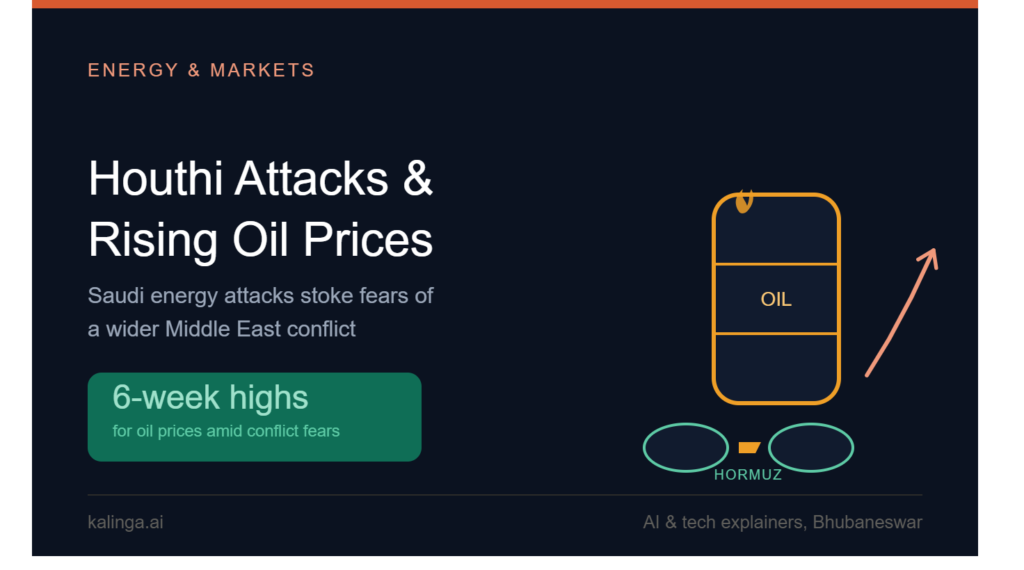
Reuters reported that the latest attacks pushed oil prices to more than six-week highs as concerns about a prolonged Middle East conflict increased.
Question: Does a higher oil price automatically mean there is already an oil shortage?
No. Oil prices can rise because markets anticipate a potential shortage or disruption. Expectations about future supply can move prices before physical supplies are actually reduced.
That distinction is important when interpreting headlines about oil.
Why Energy Infrastructure Is So Sensitive
Oil and gas systems are interconnected networks.
A disruption at one location can affect transportation schedules, refinery operations, export capacity, insurance costs and shipping decisions. If traders believe attacks could spread to additional facilities, they may assign a higher risk to future supplies.
That is one reason energy markets can react quickly to geopolitical events.
Why the Strait of Hormuz Matters to Global Energy
The Strait of Hormuz is one of the world’s most important energy chokepoints.
A chokepoint is a narrow geographical route through which large amounts of goods must pass. In energy markets, a disruption at such a location can have consequences far beyond the countries immediately surrounding it.
Before the current war, about one-fifth of global oil and liquefied natural gas shipments passed through the Strait of Hormuz, according to the Reuters report.
That figure explains why investors are watching the waterway so closely.
Question: What happens if shipping through the Strait of Hormuz slows significantly?
Oil and gas exporters may struggle to move their products to international buyers, while importers could face tighter supplies and higher transportation costs. The resulting uncertainty can place upward pressure on global energy prices.
Reuters reported that Iran continued to limit shipping through the strait, with commodity vessel traffic slowing again during the week.
Red Sea Disruptions Add Another Layer
Hormuz is not the only concern.
The Red Sea is another important shipping corridor, and Houthi attacks have already affected perceptions of maritime security in the area.
The combination of Red Sea disruption and slower traffic through Hormuz creates a difficult scenario for global trade.
A tanker or cargo ship does not simply need oil available at the production site. It also needs a safe and economically viable route to reach its destination.
That means shipping security is effectively part of the global energy supply chain.
What Is a Maritime Exclusion Zone?
Iran has threatened to establish a new restricted zone in the Gulf, adding another potential source of uncertainty.
Definition + Expansion
Maritime exclusion zone refers to a designated area of water where access or movement is restricted. Depending on how such a zone is enforced, it can affect commercial vessels, military ships and other maritime traffic.
Iran’s Supreme National Security Council secretary, Mohsen Rezaei, said the country planned to announce a new restricted zone in the Gulf and provide maps for a new shipping corridor through the Strait of Hormuz.
He said the zone would begin where the U.S. blockade of Iran begins and extend into parts of the Gulf. He also warned that vessels entering the area could be placed on an Iranian sanctions list.
Question: Why would a proposed exclusion zone affect oil prices?
Because markets depend heavily on predictable shipping routes. If vessels face restrictions, threats or uncertainty about whether they can safely pass through a route, transportation can slow and the cost of moving energy can rise.
That uncertainty can then be reflected in commodity prices.
Iran’s Missile Threats Add to the Risk
Rezaei also issued military and economic warnings, saying Iran’s new missiles represented a warning to Washington.
Reuters reported that he was likely referring to the Qassem Basir ballistic missile, which Iranian media said had been fired toward U.S. warships near the Strait of Hormuz. The U.S. military said its warships had evaded missile attacks.
The exchange illustrates why energy traders are paying attention to military developments even when an individual incident does not directly damage oil production.
The more difficult the region becomes for commercial shipping, the greater the possibility of a sustained energy risk premium.
How the Iran Conflict Is Spreading Across the Region
The Houthi attacks cannot be viewed in isolation from the broader Iran conflict.
According to Reuters, the six-month-old conflict has experienced periods of pauses followed by renewed flare-ups since the United States and Israel launched attacks on Iran on February 28, 2026.
Those attacks were aimed at ending Iran’s nuclear program, limiting its ability to attack neighboring countries and reducing its support for regional proxy groups.
The conflict has now created several overlapping risks.
Question: Why does the Iran conflict matter to Saudi Arabia?
Saudi Arabia is a U.S. ally and a major energy producer located close to several of the region’s active military and maritime flashpoints. Attacks against Saudi infrastructure therefore create both a direct security concern and a potential global energy-market problem.
Iran has also demonstrated that, despite attacks that have degraded parts of its conventional military capabilities, it retains missile and drone capabilities that can threaten shipping and regional targets.
The Proxy Dimension
The Houthis are an important part of the regional security picture because they operate from Yemen while receiving backing from Iran.
That creates a complicated geopolitical environment.
A conflict involving two or more states can be relatively straightforward to map. A conflict involving governments, proxy groups, military forces and shipping routes is harder to contain.
This is why another round of Houthi attacks can generate concern about escalation even when the immediate target is geographically limited.
What Could Happen to Global Oil and Gas Supplies?
There are several possible outcomes, and they depend heavily on how long the current escalation lasts.
The most important variable is duration.
A single attack that is quickly contained may have a temporary effect on markets. Repeated attacks against energy infrastructure or shipping routes could create a much more persistent supply concern.
Scenario 1: Short-Lived Disruption
If attacks remain limited and shipping continues operating, oil prices could eventually give up some of their geopolitical risk premium.
Markets would likely focus again on production levels, inventories, demand and other conventional energy-market factors.
Scenario 2: Prolonged Regional Escalation
If attacks continue against energy facilities and shipping, the risk becomes more serious.
Exporters could face higher insurance and security costs, vessels could be rerouted, and buyers could compete more aggressively for available supplies.
That could keep energy prices elevated for longer.
Scenario 3: Major Shipping Disruption
The most disruptive scenario would involve a substantial reduction in energy traffic through critical maritime routes.
That could produce a much larger shock because the problem would no longer be limited to individual facilities. The movement of large volumes of energy itself would be affected.
| Risk Scenario | Main Trigger | Likely Market Concern | Potential Impact |
| Limited disruption | Isolated attacks | Temporary uncertainty | Short-term price volatility |
| Prolonged escalation | Repeated attacks | Supply security | Sustained oil-price pressure |
| Shipping disruption | Hormuz/Red Sea traffic falls sharply | Physical delivery constraints | Major global energy shock |
| De-escalation | Military tensions ease | Risk premium declines | Potential oil-price relief |
The table highlights an important point: the severity of the market reaction depends not only on what is attacked, but on whether energy can continue moving.
Why This Matters for India and Indian Consumers
For people in India, a conflict thousands of kilometers away can still affect household budgets.
India imports a substantial portion of the crude oil it uses, so international oil prices can influence domestic fuel costs, transportation expenses and inflation.
When crude becomes more expensive internationally, the effects can spread through the economy.
Question: How can a Middle East conflict affect an Indian household?
Higher global energy costs can increase the cost of transportation and logistics, while businesses that depend heavily on fuel or energy may face higher operating expenses. Those costs can eventually influence prices for goods and services.
The impact is not always immediate or one-to-one because domestic fuel prices also depend on taxes, refining costs, currency movements and other factors.
But sustained global oil-price increases generally create an additional economic challenge for oil-importing economies.
The Supply Chain Connection
Consider a simple example.
A manufacturer needs raw materials delivered by truck. The truck uses diesel. The logistics company pays for fuel. If fuel becomes significantly more expensive, transportation costs can rise.
That does not mean every product price immediately increases by the same amount. But higher energy costs can add pressure throughout the supply chain.
The same principle applies to airlines, shipping companies, agriculture and many other sectors.
What Investors and Businesses Should Watch
The latest Houthi attacks create a situation where headlines alone can produce confusion.
For investors and businesses, the more useful approach is to watch measurable indicators.
These include:
- Oil prices: Sustained increases can indicate that markets expect longer-lasting supply risks.
- Strait of Hormuz traffic: Changes in vessel movement can reveal whether the threat is affecting physical energy flows.
- Red Sea shipping: Continued disruption could increase transportation times and costs.
- Saudi energy infrastructure: Further damage could create direct production or export concerns.
- Iranian military actions: New missile or drone attacks could increase escalation risks.
- U.S. responses: Additional military action could alter the conflict’s trajectory.
- European and Asian energy demand: Major importing regions may compete for alternative supplies.
- Currency movements: A stronger or weaker dollar can influence how international energy prices affect individual economies.
Question: What should investors avoid doing during a geopolitical oil shock?
They should avoid assuming that every initial price move will continue indefinitely. Oil markets can react dramatically to headlines, but prices can also reverse if supply disruptions fail to materialize or tensions ease.
The distinction between market fear and physical supply disruption is especially important.
Why the Saudi Attacks Matter Beyond Oil
It would be easy to reduce this story to a simple headline: attacks happened, therefore oil prices rose.
The reality is more complicated.
The significance of the Houthi attacks lies in their interaction with other regional risks. Saudi energy infrastructure, Red Sea shipping and Strait of Hormuz traffic are all connected to the same broader concern: whether Middle Eastern instability can interfere with the global energy system.
That is why the attacks matter even to countries that are not directly involved in the conflict.
Question: Is the biggest risk the damage to one facility?
Not necessarily. The larger concern is escalation that causes multiple disruptions at the same time or makes commercial shipping through critical routes increasingly difficult.
Markets can absorb many individual disruptions when alternative supplies and routes remain available. A simultaneous threat to production and transportation is much harder to manage.
The Global Economy Is Watching the Same Chokepoints
Energy security is ultimately about three things:
- Production – Can oil and gas be extracted?
- Transportation – Can energy safely reach export terminals and shipping routes?
- Delivery – Can tankers and pipelines move supplies to consumers?
A conflict can affect any one of these stages.
The current situation raises concerns about all three, which explains the market sensitivity.
What Happens Next?
The immediate question is whether the latest escalation remains contained.
Saudi authorities have said the coalition will take necessary operational measures against the Houthis. Iran, meanwhile, has continued issuing warnings involving Gulf shipping and military forces.
The next major developments could therefore come from several directions.
More attacks on Saudi infrastructure would increase concerns about energy supplies. Further restrictions on shipping through the Strait of Hormuz could have an even broader impact.
On the other hand, a meaningful reduction in military tensions could ease the risk premium that has pushed oil prices higher.
For consumers, businesses and investors, the key issue is therefore not simply whether another attack happens, but whether the conflict begins to systematically disrupt the global energy supply chain.
FAQ: Houthi Attacks, Oil Prices and the Iran Conflict
Why did oil prices rise after the Houthi attacks?
Oil prices rose because the attacks increased fears that the broader Middle East conflict could disrupt energy production and shipping. Reuters reported that oil prices reached more than six-week highs as supply concerns intensified.
How many people were wounded in the Saudi attacks?
A spokesperson for the Saudi-led coalition in Yemen said at least 73 people were wounded in attacks on four southern Saudi cities. Saudi authorities also reported fires at some energy facilities.
What is the Strait of Hormuz?
The Strait of Hormuz is a critical maritime chokepoint between the Persian Gulf and the Gulf of Oman. Before the war, approximately one-fifth of global oil and liquefied natural gas shipments passed through it, according to Reuters.
What is a maritime exclusion zone?
A maritime exclusion zone is an area of water where access or movement is restricted. Iran has threatened to establish a new restricted zone in parts of the Gulf and has discussed a new shipping corridor through the Strait of Hormuz.
Could the Houthi attacks cause a global oil shortage?
The attacks do not automatically create a global oil shortage. However, prolonged attacks on energy infrastructure or major disruptions to shipping could reduce available supplies and increase global oil prices.
How could higher oil prices affect India?
Higher international crude prices can increase costs for transportation, logistics and energy-intensive businesses in India. The final effect on Indian consumers also depends on factors such as taxes, refining costs and currency movements.
Final Takeaway
The latest Houthi attacks on Saudi Arabia have added another layer of risk to an already fragile Middle Eastern energy landscape. With at least 73 people wounded, fires reported at energy facilities and shipping through the Strait of Hormuz slowing, the market is reacting to the possibility that regional conflict could become a broader global energy problem.
The most important thing to watch now is whether these attacks remain isolated or become part of a sustained disruption to oil production, shipping and energy exports.
For readers in India, that distinction matters because a prolonged oil shock can eventually reach fuel costs, transportation and everyday prices.
Follow Kalinga.ai for more explainers on how geopolitical events, energy markets and emerging technology affect India’s economy and everyday life.