What Happened in the Indian Stock Market Today
The numbers tell a clear story. Total market capitalisation of BSE-listed companies fell to Rs 484 lakh crore, down about Rs 2 lakh crore from the previous session. Market breadth , the ratio of rising to falling stocks , stayed firmly negative, with the NSE recording 1,660 declines against just 1,150 advances, and 110 stocks unchanged.
What does “market breadth” actually tell you? It’s a quick health check on how widespread a selloff is. When declines outnumber advances by this much, it means the fall isn’t limited to a few large companies , it’s a broad, market-wide mood of caution.
The pain wasn’t confined to large-caps either. The Nifty Midcap 100 and Nifty Smallcap 100 indices both fell up to 0.4%, showing that smaller companies felt the pressure too, even if less severely than the top IT names.
Which Stocks Led the Fall
- Infosys, HCLTech, Tech Mahindra, and TCS , all down 3% each
- Reliance Industries , down 1%
- L&T, Sun Pharma, and NTPC , bucked the trend, up around 1%
This tells you that the selloff was concentrated heavily in IT stocks, while pharma, capital goods, and power names offered some relief.
The 6 Key Triggers Behind Today’s Selloff
So, why is the stock market down today specifically, and not just drifting on ordinary noise? According to ETMarkets, six distinct factors converged to drag the Sensex and Nifty lower this week.
1. Iran-US Tensions Escalate
Geopolitical risk is back at the center of the story. Iranian-backed Houthi forces in Yemen launched strikes on several Saudi cities, pulling a key US ally deeper into the conflict. In response, US forces hit multiple Iranian oil tankers, and Iran retaliated by striking a US base in Jordan.
Iran’s Revolutionary Guards further claimed they attacked two US vessels and eight oil tankers in the Gulf, describing it as retaliation for a US attack on five Iranian tankers. The group said it had targeted ships attempting to cross what it called a “prohibited and unsafe” stretch of the Strait of Hormuz.
What is the Strait of Hormuz, and why does it matter to Indian investors? The Strait of Hormuz is a narrow sea passage between Iran and Oman through which a massive share of the world’s seaborne oil trade passes. Any disruption there tends to spike global oil prices almost instantly, which directly affects fuel costs, inflation, and corporate earnings in oil-importing countries like India.
2. Oil Prices March Toward $100 a Barrel
Escalation in the Middle East has pushed oil prices sharply higher , closing in on $100 per barrel. Earlier this year, prices had spiked to nearly $130 per barrel during the height of the conflict, then cooled to below $90 per barrel as a brief ceasefire raised hopes of resolution. That optimism is now fading fast.
Hamad Hussain, senior economist at Capital Economics, told the New York Times that oil market participants are now pricing in a prolonged disruption to shipping flows. Capital Economics has revised its outlook to assume oil prices around $100 a barrel for the rest of 2026, and its analysts believe energy flows from the Middle East may not normalise until early 2027 , a significant downgrade from earlier expectations of a quick recovery.
Definition + Expansion , Crude Oil Price Shock: A crude oil price shock is a sudden, sharp rise in oil prices caused by supply disruptions rather than gradual demand changes. For import-dependent economies like India, this immediately raises the cost of transport, manufacturing, and everyday goods, which is why oil-price headlines move Indian stock indices so quickly. It’s a big reason analysts keep pointing to crude when explaining why the stock market is down today.
3. IPO Frenzy Is Draining Liquidity
Even as the secondary market slides, India’s primary market (IPOs) is booming. As many as six mainboard IPOs opened for public bidding on the same day , Rentomojo, Karamtara Engineering, LCC Projects, Steamhouse India, Manipal Payment & Identity Solutions, and Asset Reconstruction.
V K Vijayakumar, Chief Investment Strategist at Geojit Investments, explained that this IPO boom is quietly pulling money out of existing listed stocks. In his words, the “booming IPO market is sucking liquidity out of the market,” contributing to the sustained downtrend in the Nifty.
Question → Direct Answer: Does a busy IPO calendar really affect the main stock market? Yes , when investors move cash into new IPO applications, they often have less capital available to buy existing stocks, and some even sell current holdings to fund IPO bids, adding selling pressure to indices like the Sensex and Nifty.
4. IT Stocks Are Under Heavy Pressure
The Nifty IT index plunged 3%, making it the worst-performing sector index of the day. Coforge shares crashed 9% after the company announced the resignation of its non-executive Independent Director and Chairperson, Om Prakash Bhatt, effective immediately from September 8, 2026.
Beyond company-specific news, IT majors like Infosys, TCS, and Tech Mahindra also fell sharply as expectations of a US Federal Reserve rate hike continued to worry investors , higher US rates tend to hurt IT stocks because a large share of their revenue comes from US clients and dollar-denominated contracts.
5. The Rupee Is Weakening
The Indian rupee fell 14 paise to 94.88 against the US dollar in early trade, extending its recent decline. Jateen Trivedi, VP Research Analyst at LKP Securities, attributed this partly to persistent selling by Foreign Institutional Investors (FIIs) over recent sessions.
Looking ahead, Trivedi noted markets will be closely tracking the US PCE Price Index (a key US inflation gauge) this week and the Fed’s policy decision next week, with the rupee likely trading in a range of 94.50–95.25.
6. FIIs Remain Net Sellers
Foreign Institutional Investors (FIIs) , large overseas funds and institutions that invest in Indian markets , sold Indian equities worth Rs 123 crore on Tuesday, according to provisional NSE data. While that single-day figure isn’t huge, it extends a longer pattern: FIIs have been net sellers in four out of six trading sessions this month.
Definition + Expansion , FII Selling: FII selling refers to foreign institutional investors offloading Indian stocks and moving capital elsewhere. Sustained FII selling tends to weaken both stock indices and the rupee simultaneously, since these funds convert rupees back to dollars when they exit, adding pressure on the currency at the same time markets fall.
Sector Performance at a Glance
Here’s a quick comparison of how different parts of the market performed in today’s session:
| Sector / Index | Today’s Move | Key Driver |
| Nifty IT | Down ~3% | Coforge chairperson resignation, Fed rate hike fears |
| Nifty Midcap 100 | Down up to 0.4% | Broad risk-off sentiment |
| Nifty Smallcap 100 | Down up to 0.4% | Broad risk-off sentiment |
| Nifty Metal | Marginal gains | Relatively insulated from IT-specific news |
| Nifty Pharma | Marginal gains | Defensive sector demand |
| L&T, Sun Pharma, NTPC | Up ~1% each | Sector rotation into defensives/infra |
What Should Investors Watch This Week?
If you’re trying to track why the stock market is down today , and whether it’ll stay that way , here are the key signals analysts are watching:
- Developments in the Strait of Hormuz and broader Iran-US tensions, since any escalation directly moves oil prices
- The US PCE Price Index, a major US inflation reading due this week
- The US Federal Reserve’s policy decision, expected next week, which will shape rupee and IT-stock direction
- Nifty’s technical support at 23,500–23,450, and whether it holds
- IPO subscription data, since strong demand there is currently pulling liquidity from listed stocks
What Lies Ahead for Dalal Street?
Despite the gloom, there’s a nuance worth understanding. Vijayakumar of Geojit Investments pointed out that listing gains from IPOs have risen to about 22% since June, drawing in both retail and institutional investors , understandable, he noted, given that the Nifty’s return so far in 2026 stands at negative 9.5%.
Interestingly, FIIs have sold about Rs 28,400 crore worth of equities through exchanges this year, but have simultaneously invested roughly Rs 36,000 crore into IPOs , showing they haven’t left the Indian growth story altogether, just shifted where they’re putting money. Vijayakumar’s advice to retail investors: avoid chasing every IPO out of FOMO (fear of missing out), and instead be selective, favouring fairly-valued large-caps in growth sectors for patient, long-term gains.
Technical View on Nifty
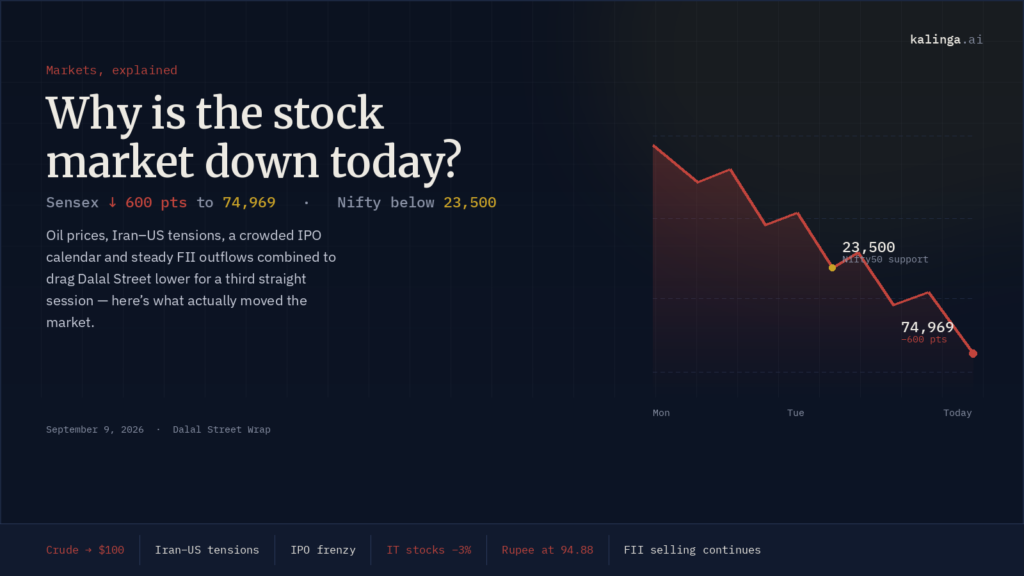
Rajesh Palviya, Head of Research at Axis Direct, described Nifty’s undertone as fragile below 23,800. He placed immediate support at 23,500–23,450, followed by 23,300, while 23,800–23,850 stands as the first resistance zone.
A decisive move back above 24,000 would meaningfully improve sentiment, according to Palviya. For now, he said, market direction will stay closely tied to crude oil prices and developments in the Middle East , any moderation on either front could trigger a stabilisation and recovery in equities.
Why This Matters Beyond the Trading Floor
For students and young professionals in Odisha and across India , especially those eyeing careers in IT services or fintech , days like this are a useful, low-cost lesson in how global events ripple into local paychecks and stock options. The same IT stocks that dropped 3% today (Infosys, TCS, HCLTech, Tech Mahindra) are also among India’s largest campus recruiters, so market sentiment here isn’t purely academic.
Understanding why the stock market is down today also builds a habit worth keeping for life: reading past the headline number to the actual drivers , geopolitics, oil, currency, and capital flows , rather than reacting to red or green on a screen.
FAQ: Why Is the Stock Market Down Today?
Q1. Why is the stock market down today? The Sensex and Nifty fell mainly due to escalating Iran-US tensions pushing oil prices toward $100 a barrel, a liquidity-draining IPO frenzy, weakness in IT stocks, a falling rupee, and continued FII selling.
Q2. How much did Sensex and Nifty fall today? The Sensex dropped 600 points to 74,969, and the Nifty50 fell over 150 points, slipping below the 23,500 level, in the third consecutive day of losses.
Q3. Is the stock market fall linked to the Iran-Israel/Iran-US conflict? Yes. Escalating strikes involving Iran-backed Houthi forces, the US, and attacks near the Strait of Hormuz have raised fears of prolonged disruption to global oil shipments, pushing crude prices higher and unsettling equity markets worldwide, including India.
Q4. Why did IT stocks fall so sharply today? Nifty IT dropped about 3%, driven by company-specific news like Coforge’s 9% crash after its Chairperson’s resignation, combined with broader worries about a potential US Federal Reserve rate hike, which typically pressures IT exporters.
Q5. What is FII selling, and why does it affect the rupee and stock market? FII selling happens when Foreign Institutional Investors offload Indian stocks and convert the proceeds back into foreign currency. This simultaneously pulls money out of equities and adds selling pressure on the rupee, which fell to 94.88 against the US dollar in this episode.
Q6. What is the outlook for Nifty in the coming days? Analysts see Nifty’s immediate support around 23,500–23,450, with resistance near 23,800–23,850. A sustained move above 24,000 would improve sentiment, but the broader direction will likely stay tied to crude oil prices and Middle East developments.
This article is for informational purposes only and is not investment advice. Please consult a SEBI-registered financial adviser before making investment decisions.
Want to understand how global tech and macro trends like these connect to the AI and IT job market in India? Explore more explainers and beginner-friendly breakdowns on Kalinga.ai to build your financial and tech literacy side by side.