File Name: uk-sanctions-israeli-west-bank-settlements-2026.jpg
Title: UK Sanctions Israeli West Bank Settlements
What Are the UK Sanctions on Israeli West Bank Settlements?
Question → Direct Answer: What is Britain announcing?
Britain is preparing a trade ban on goods made in Israeli settlements in the occupied West Bank, according to Reuters. UK Foreign Minister Ed Miliband is expected to announce the measure on September 8, 2026.
The policy is part of a broader British effort to respond to continued settlement activity and reinforce support for a two-state solution, meaning the creation of separate Israeli and Palestinian states living alongside each other.
The announcement does not represent a general UK trade embargo on Israel. Britain has also stressed that Israel will remain an important trading partner.
Definition + Expansion: What is a settlement trade ban?
A settlement trade ban is a restriction on importing goods produced in Israeli settlements located in the West Bank. It differs from a blanket ban on Israeli products because it specifically targets goods originating from settlements.
That distinction matters because settlement-produced goods represent only a small share of Britain’s overall trade with Israel. Reuters reports that settlement products are mainly agricultural goods, including fresh produce and wine.
The practical challenge is determining where a product was actually made. Foreign diplomats cited by Reuters said enforcement could be difficult if Israeli products contain materials originating from settlements without clearly identifying that source.
Key takeaway: The UK’s proposed policy is designed to target settlement-linked trade rather than end economic relations with Israel.
Why Is Britain Targeting Israeli Settlement Goods Now?
Question → Direct Answer: Why has the UK moved toward sanctions?
Britain says the pace of settlement activity has made action increasingly urgent. The government is linking the sanctions to its stated commitment to preserving the possibility of a two-state solution.
The issue has become particularly sensitive because of plans for settlement development in the E1 area, located east of Jerusalem.
The UK and several other European governments criticized the E1 plans in August. Their concern is that development in this area could affect the territorial continuity Palestinians would need for a future independent state.
Settlement expansion and diplomacy
The Israeli-Palestinian conflict is not only about individual settlements. It is also about territory, borders, infrastructure and political control.
For supporters of a Palestinian state, continued settlement expansion can make it harder to establish a geographically viable and independent country. For Israel’s government and settlement supporters, however, the West Bank is viewed differently.
Israel disputes the characterization of the West Bank as occupied territory and argues that the land is disputed. It also points to Jewish historical claims to the area.
This difference in terminology is important because it explains why the same settlement project can be viewed as either a security, historical or territorial issue depending on the political perspective.
Question → Direct Answer: Why does Britain connect settlements to Palestinian statehood?
The British position is that continued settlement expansion could make a negotiated two-state arrangement more difficult to achieve. The UK therefore sees pressure over settlements as part of a broader effort to preserve the possibility of Palestinian statehood.
What Is the E1 Settlement Project and Why Does It Matter?
Question → Direct Answer: Why is E1 at the center of international concern?
The E1 area is strategically important because it lies between Jerusalem and existing Israeli settlement areas in the West Bank. Britain and other governments fear that development there could divide Palestinian-populated areas and complicate plans for a future contiguous Palestinian state.
The issue is therefore larger than the construction of individual homes.
Imagine trying to design a country where roads, towns and infrastructure need to connect different population centers. If major developments create physical barriers between those areas, building an independent state becomes more complicated.
That is why the E1 project has become a major diplomatic flashpoint.
E1 and the two-state solution
The two-state solution is a proposed political framework in which Israel and an independent Palestinian state coexist, generally based on negotiated borders and security arrangements.
Britain has repeatedly presented this framework as the preferred route toward resolving the Israeli-Palestinian conflict.
The problem is that the political geography of the West Bank has changed substantially over decades of settlement growth. Every new settlement, road or infrastructure project can potentially affect future negotiations over borders and land.
Key takeaway: Britain’s concern over E1 is fundamentally about whether the geography of the West Bank will remain compatible with a future Palestinian state.
How Could the UK Settlement Goods Ban Affect Trade?
Question → Direct Answer: Will the ban significantly damage UK-Israel trade?
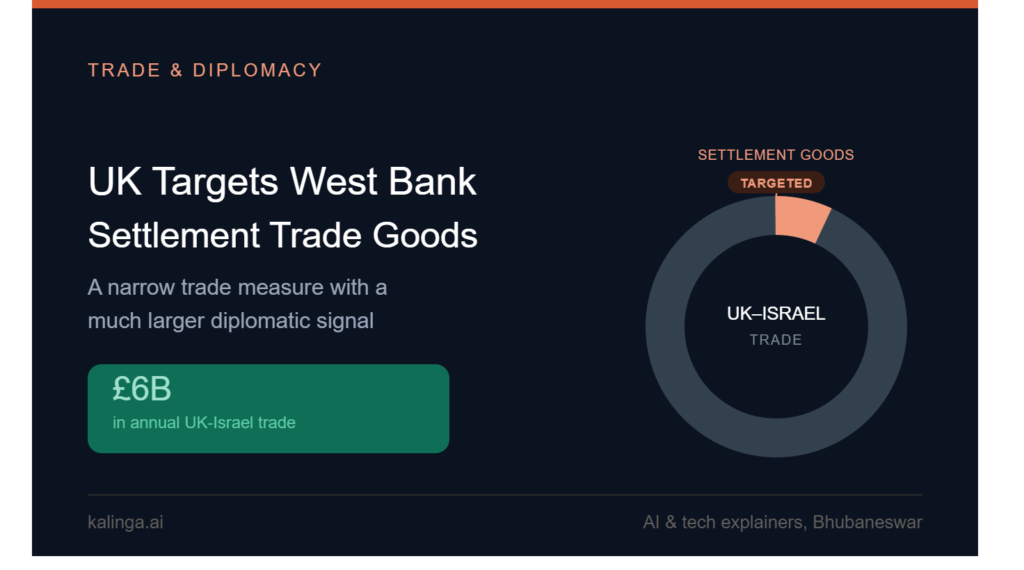
Probably not at the overall trade level, based on the information in the Reuters report. The UK and Israel have approximately £6 billion ($8.12 billion) in annual bilateral trade, while goods originating from settlements account for only a tiny portion of Israel’s total trade flows.
That means the immediate economic impact could be limited even if the diplomatic impact is much larger.
The distinction between economic impact and political impact is essential here.
| Area | Likely effect of UK settlement sanctions |
| Overall UK-Israel trade | Limited direct effect expected |
| Settlement-produced goods | Directly targeted |
| Agricultural exports | Potentially affected |
| Fresh produce and wine | Among the products most exposed |
| Diplomatic relations | Likely to face additional strain |
| Two-state diplomacy | Britain says the measure reinforces this goal |
| Enforcement | Could be complicated by supply-chain tracing |
Why enforcement could be difficult
Modern supply chains rarely follow simple geographic boundaries.
A product might be grown in one location, processed somewhere else and packaged in another facility. If components from a settlement enter a wider Israeli production chain, determining the exact origin could become difficult.
This creates an administrative problem for customs authorities.
Britain will need a practical system for identifying settlement-produced goods without unintentionally blocking ordinary Israeli products that do not fall under the policy.
Question → Direct Answer: What is the biggest practical challenge?
The biggest challenge could be identifying and verifying settlement-origin goods. Reuters reports that diplomats have warned that some Israeli products may contain settlement inputs without clearly declaring their origin.
How Has Israel Reacted to the UK’s Move?
The announcement has triggered strong criticism from Israeli officials.
Israeli President Isaac Herzog described the sanctions as a “grave miscalculation” and argued that Britain would be on the “wrong side of history.”
Finance Minister Bezalel Smotrich went further, calling for the British ambassador in Tel Aviv to be expelled.
These reactions reflect the broader political sensitivity of settlement policy inside Israel.
Why the timing is politically sensitive
Israel is scheduled to hold elections in late October 2026. Herzog accused Britain of interfering in Israel’s electoral process by announcing the sanctions at this time.
Britain rejects that framing and presents the policy as part of its foreign-policy position on settlement expansion and Palestinian statehood.
This creates a diplomatic dilemma.
The UK wants to signal opposition to settlement expansion without completely damaging its relationship with Israel. At the same time, Israeli political leaders can portray foreign sanctions as external pressure on Israeli sovereignty.
Question → Direct Answer: Why is the UK trying to avoid a broader trade confrontation?
Britain has emphasized that Israel will remain an important trading partner. This suggests the government wants to distinguish opposition to settlement activity from opposition to economic relations with Israel as a whole.
How Does the Policy Fit Britain’s Two-State Solution Strategy?
The proposed sanctions did not appear in isolation.
Under former Prime Minister Keir Starmer, Britain joined other countries in 2025 to recognize a Palestinian state, according to Reuters. In June 2026, Britain also sanctioned Israeli networks accused of financing, enabling or carrying out violence in the West Bank.
Prime Minister Andy Burnham has continued that policy direction.
In a call with U.S. President Donald Trump on Monday, Burnham emphasized the importance of the two-state solution, according to his office.
From recognition to economic pressure
There is a noticeable progression in Britain’s approach:
- Diplomatic recognition — supporting Palestinian statehood.
- Targeted sanctions — acting against networks accused of settler violence.
- Trade restrictions — targeting goods produced in settlements.
- Diplomatic pressure — opposing settlement projects viewed as threats to Palestinian territorial continuity.
These measures are different tools, but they are connected by a common political objective: maintaining pressure for a negotiated two-state outcome.
Question → Direct Answer: Does Britain say it is imposing sanctions on Israel itself?
The current measure is more narrowly focused on goods produced in Israeli settlements, rather than a comprehensive ban on Israeli trade. Britain has explicitly said Israel will remain an important trading partner.
Why Are Israeli Settlements So Controversial Internationally?
Israeli West Bank settlements have been at the center of the Israeli-Palestinian conflict for decades.
Britain, the United Nations and many other governments consider the settlements illegal under international law and regard the West Bank as territory under military occupation.
Israel rejects that characterization, describing the territory as disputed and emphasizing Jewish historical claims to the land.
These competing legal and political positions are central to understanding the controversy.
Three major areas of disagreement
1. International law
Many governments argue that settlement construction violates international law governing occupied territories.
2. Palestinian statehood
Critics argue that settlement expansion can fragment territory intended for a Palestinian state.
3. Israeli security and historical claims
Israel and settlement supporters argue that Jewish historical connections to the West Bank and security considerations must be taken into account.
A useful analysis therefore needs to distinguish between what governments claim, what international bodies conclude and what remains politically disputed.
What Are Other Countries Doing About Israeli Settlements?
Britain is not acting alone.
Reuters reports that Spain, Ireland and the Netherlands have moved toward banning imports originating from Israeli settlements in the West Bank, although not all of those measures have taken effect.
Other governments have chosen sanctions targeting individuals, organizations or settlement-related networks.
International pressure is becoming broader
Countries including France, Canada and Norway have imposed sanctions this year targeting settlement-related activity, according to Reuters.
The UK itself sanctioned Israeli networks in June 2026 over allegations involving financing, enabling and carrying out violence in the West Bank.
Some Israeli officials have also been personally targeted by foreign sanctions. Reuters reports that Finance Minister Bezalel Smotrich and National Security Minister Itamar Ben-Gvir have been sanctioned by some countries, including Britain.
Question → Direct Answer: Is the UK the first country to restrict settlement imports?
No. Other European countries have already moved toward restrictions on settlement-origin goods, while several governments have separately imposed sanctions on individuals and organizations associated with settlement activity.
How Could the Sanctions Affect UK-Israel Relations?
The sanctions arrive at a time when relations between London and Tel Aviv are already under pressure.
Britain has criticized Israel’s conduct in Gaza, settlement expansion in the West Bank and rising settler attacks against Palestinians.
The new trade measure adds an economic dimension to those disagreements.
A diplomatic balancing act
Britain has to manage several competing interests:
- Support for Israel as a trading partner.
- Support for Palestinian statehood.
- Opposition to settlement expansion.
- Concern over violence against Palestinians.
- Relations with the United States.
- Britain’s wider role in Middle East diplomacy.
- Domestic political disagreements over Israel policy.
This makes the settlement goods ban more significant than its direct trade value might suggest.
Question → Direct Answer: Could the measure affect Britain’s relationship with the United States?
Potentially. U.S. Ambassador to Israel Mike Huckabee criticized the British move and described it as discrimination against Jewish people. He also warned that the policy could create complications for British companies operating in U.S. states that restrict government contracts or investments involving companies that boycott Israel.
That warning adds another layer to the issue because the UK must balance its Middle East policy with its important relationship with Washington.
Why Does Britain Say the Economic Impact Will Be Limited?
The UK’s own messaging emphasizes that the settlement trade restriction is narrowly targeted.
Settlement goods represent only a small share of the broader UK-Israel economic relationship. The estimated £6 billion annual bilateral trade therefore provides important context.
This means the measure is better understood as a political signal with a targeted economic component rather than a sweeping trade embargo.
Economic pressure versus diplomatic signaling
Economic sanctions can have different objectives.
Sometimes governments impose them to cause direct financial damage. In other cases, the goal is to raise the political cost of a particular policy, demonstrate international disapproval or influence future decisions.
The UK settlement goods ban appears to contain elements of the second approach.
Key takeaway: The direct financial effect may be modest, but the diplomatic message is substantial because Britain is explicitly linking trade restrictions to settlement policy and the two-state solution.
What Does This Mean for the Future of the Two-State Solution?
The central question is whether diplomatic pressure can slow settlement expansion enough to preserve the possibility of a negotiated political settlement.
Britain believes stronger international pressure is necessary because continued settlement activity could make a two-state arrangement harder to implement.
Israel’s government and settlement supporters take a different view of the territory and its future.
That disagreement is unlikely to be resolved through one trade ban.
Three possible outcomes
Scenario 1: Limited economic impact, continued diplomatic pressure
The UK ban could remain narrowly focused while Britain continues trading with Israel and uses additional diplomatic measures to oppose settlement expansion.
Scenario 2: Wider international coordination
If more countries introduce comparable restrictions, Israeli settlement-related businesses could face a broader network of import controls and sanctions.
Scenario 3: Increased diplomatic confrontation
If Israel responds with retaliatory diplomatic measures, relations with Britain and other European governments could become more strained.
None of these scenarios guarantees a change in settlement policy. But they show why the announcement matters beyond the value of the goods affected.
What Should Students and Young Professionals Watch Next?
For anyone following international affairs, the story offers a useful example of how trade policy, diplomacy and geopolitics overlap.
A trade restriction does not always have to be economically enormous to matter politically.
When analyzing future developments, watch these indicators:
- The exact rules for identifying settlement-origin goods.
- Whether the UK introduces additional sanctions.
- Whether Israel retaliates diplomatically.
- Whether other European governments coordinate their policies.
- How Washington responds.
- Whether settlement construction continues around sensitive areas such as E1.
- Whether the issue becomes more prominent during Israel’s October election campaign.
- Whether Britain’s policy changes the wider international debate over Palestinian statehood.
These developments will help show whether the measure is primarily symbolic or becomes part of a larger coordinated pressure campaign.
Key Takeaways
- Britain is preparing a ban on goods made in Israeli settlements in the occupied West Bank.
- The UK says the measure supports the two-state solution.
- The policy is not a general trade embargo on Israel.
- Britain and other governments are particularly concerned about the E1 settlement project.
- Settlement goods represent only a small portion of the approximately £6 billion annual UK-Israel trade relationship.
- Enforcement could be difficult when supply chains do not clearly identify settlement-origin inputs.
- Israel has strongly criticized the move, while the U.S. ambassador to Israel has also opposed it.
- Britain has already taken other steps, including recognition of a Palestinian state in 2025 and sanctions on settlement-related networks in 2026.
- Other European countries, including Spain, Ireland and the Netherlands, have also moved toward restrictions on settlement goods.
- The larger dispute concerns whether continued settlement expansion could undermine the territorial basis for a future Palestinian state.
FAQ: UK Sanctions and Israeli West Bank Settlements
What are the UK’s new sanctions on Israeli West Bank settlements?
The UK is preparing to ban imports of goods produced in Israeli settlements in the occupied West Bank. The measure is intended to increase pressure over settlement expansion while supporting Britain’s stated commitment to a two-state solution.
Why is Britain banning settlement goods?
Britain says the pace of settlement activity has made sanctions necessary and argues that settlement expansion could undermine the possibility of establishing a viable Palestinian state.
What is the E1 settlement project?
E1 is a strategically important area of the West Bank near Jerusalem. Britain and other governments are concerned that development there could affect the territorial continuity Palestinians would need for a future independent state.
Will the UK ban all Israeli products?
No. The proposed policy specifically targets goods originating from Israeli settlements rather than Israeli goods generally. Britain has emphasized that Israel will remain an important trading partner.
How much trade does Britain conduct with Israel?
According to the Reuters report, annual bilateral trade between Britain and Israel is approximately £6 billion ($8.12 billion). Settlement-produced goods make up only a tiny fraction of Israel’s overall trade flows.
Are other countries also restricting settlement goods?
Yes. Reuters reports that Spain, Ireland and the Netherlands have moved to ban imports originating in Israeli settlements, although not all of those measures have taken effect. France, Canada and Norway have also imposed other settlement-related sanctions.
Conclusion
The UK’s decision to target goods from Israeli West Bank settlements is economically narrow but diplomatically significant. Britain is using trade policy to reinforce its support for a two-state solution while signaling growing opposition to settlement expansion.
Whether the measure changes Israeli policy remains uncertain. Its larger importance may lie in whether Britain can persuade other countries to coordinate similar actions and whether sustained diplomatic pressure can preserve the possibility of a negotiated Israeli-Palestinian settlement.
For more accessible explainers on geopolitics, technology and the global forces shaping today’s world, keep exploring Kalinga.ai.