Why Does Singapore Airlines Want More Control Over Air India Funding?
What happens when a minority investor is asked to put more money into a company that has already reported billions of dollars in losses? Singapore Airlines is reportedly seeking greater management influence and stronger governance protections before agreeing to provide additional funding to Air India.
According to a Reuters report published September 9, 2026, Singapore Airlines is expected to negotiate stronger terms with Air India’s majority owner, Tata Sons, before approving any new capital injection. The reported conditions could include greater board voting power, stronger governance rights and requirements for Air India to narrow its losses.
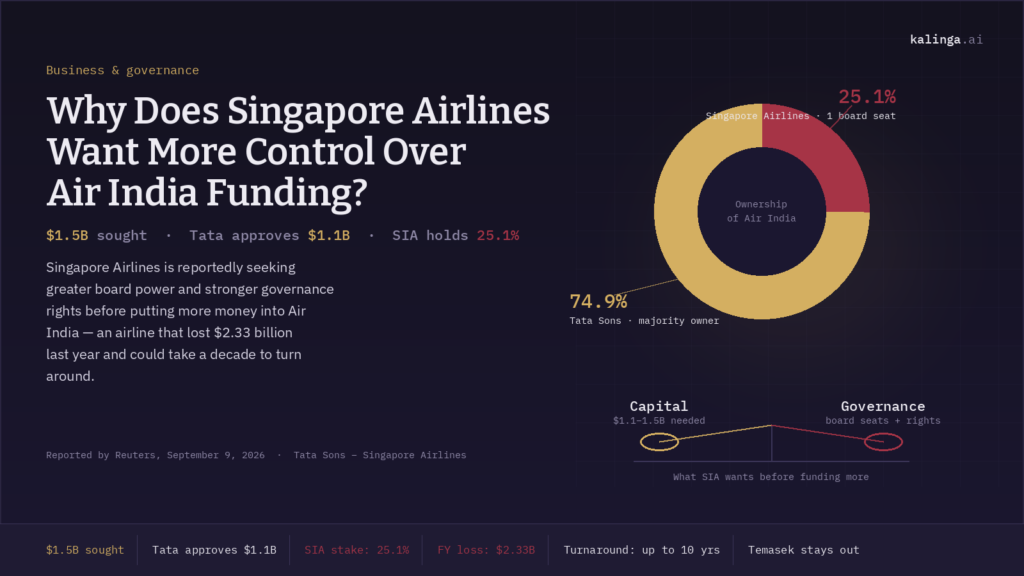
The issue matters because Air India is reportedly seeking about $1.5 billion in fresh equity, while Tata Sons has approved approximately $1.1 billion, representing its pro-rata share. Singapore Airlines owns the remaining 25.1% stake in Air India.
The debate therefore is not simply about who pays the next cheque. It is about who gets more influence over how Air India is managed and whether the airline can deliver a credible turnaround.
Singapore Airlines Wants Stronger Terms Before Funding Air India
The central development is straightforward: Singapore Airlines is reportedly considering additional investment in Air India, but wants stronger protections before committing more capital.
Reuters reported that the airline is expected to seek greater influence over management and stronger governance rights. The exact terms have not been publicly finalised, and negotiations would take place with Tata Sons, Air India’s majority shareholder.
The proposed conditions could include increased board voting power and expectations that Air India take steps to reduce its losses.
Question: Why does Singapore Airlines want more influence before investing more money?
The reported position reflects a basic investor concern: if an investor commits additional capital to a loss-making company, it may want greater visibility, influence and safeguards around how that money is deployed.
Singapore Airlines already owns a significant minority stake but has relatively limited formal management influence.
That makes the funding discussion particularly important.
What does stronger governance mean?
Governance rights are mechanisms that allow investors to influence or oversee major corporate decisions.
These can include board representation, voting rights and protections relating to significant strategic decisions. In Air India’s case, Reuters reported that Singapore Airlines could seek greater board voting power and stronger governance arrangements as part of negotiations over additional funding.
The distinction between ownership and influence is important.
An investor can own a substantial stake without having day-to-day control of a company. That is broadly the position Singapore Airlines finds itself in with Air India.
Why Is Air India Seeking Fresh Capital?
Air India’s funding requirement comes against the backdrop of significant losses.
Reuters reported that Air India was seeking approximately $1.5 billion in fresh equity from its owners.
Tata Sons has reportedly approved around $1.1 billion, while Singapore Airlines holds the remaining 25.1% stake.
Definition — Capital infusion: A capital infusion is new money invested into a company, typically by existing owners or new investors, to support operations, investment, growth or financial stability.
For an airline undergoing a large-scale turnaround, fresh capital can be used to support the business while it works through operational and financial challenges.
However, raising money does not solve the underlying business problem by itself.
If losses continue, additional capital may eventually be required. That is why Singapore Airlines is reportedly looking for stronger conditions around any further investment.
Why does Air India need so much capital?
Air India is undergoing a major transformation under Tata Group ownership.
The airline has been attempting to rebuild its operations and competitive position, while also dealing with the financial consequences of its existing business.
Reuters reported that Air India posted a $2.33 billion loss for the financial year ended March.
That figure helps explain why another large funding requirement is attracting attention from investors and policymakers.
Question: Does fresh capital automatically mean Air India is financially healthy?
No. Fresh capital provides financial resources, but it does not necessarily indicate that a business has become profitable. In Air India’s case, the funding request comes while the carrier continues to face substantial losses and pursue a long-term turnaround.
What Singapore Airlines Wants From Tata Sons
The reported negotiations could revolve around three broad areas: management influence, governance rights and financial performance.
These are closely connected.
If Singapore Airlines is expected to invest more money, it may want greater involvement in decisions affecting the value of its investment.
Greater management influence
Singapore Airlines reportedly wants more influence over Air India’s management.
This does not necessarily mean taking control of the airline. Rather, it could mean having a stronger voice in strategic decisions or greater oversight of management performance.
That would represent a change from the current arrangement, under which Singapore Airlines has limited formal influence.
Stronger governance rights
Reuters reported that proposed conditions could include greater board voting power.
Board-level influence can matter because major corporate decisions are typically overseen through the company’s governance structure.
For a minority shareholder, stronger governance rights can provide greater visibility into strategy, financial decisions and performance.
Question: Does Singapore Airlines currently control Air India?
No. Tata Sons is the majority owner, while Singapore Airlines holds a 25.1% minority stake. Singapore Airlines has one board seat under the existing arrangement, although its stake gives it important blocking rights for certain special resolutions under Indian company law.
Pressure to narrow losses
The reported conditions could also include requirements for Air India to narrow its losses.
That is significant because Singapore Airlines is not simply considering whether to invest in a growing airline. It is investing in a company undergoing a complex turnaround.
A clearer financial-performance framework could give Singapore Airlines greater assurance that additional capital is linked to measurable progress.
How Much Money Does Air India Need?
Reuters reported last month that Air India was seeking about $1.5 billion in fresh equity from its owners.
Tata Sons has reportedly approved approximately $1.1 billion, representing its pro-rata contribution.
Singapore Airlines owns 25.1% of Air India.
At first glance, the ownership percentages might suggest that the funding split should be straightforward. But the negotiations reported by Reuters show why capital contributions can become more complicated when an investor also wants changes to governance and management arrangements.
| Issue | Tata Sons | Singapore Airlines |
| Ownership position | Majority owner | 25.1% minority stake |
| Reported funding decision | Approved about $1.1 billion | Evaluating any additional capital request |
| Management influence | Majority-owner position | Limited formal influence |
| Board position | Majority-owner representation | One board seat under existing arrangement |
| Key issue | Funding Air India’s turnaround | Funding while seeking stronger safeguards |
Question: Has Singapore Airlines agreed to provide the reported funding?
Not according to the Reuters report. Singapore Airlines said its board would carefully evaluate any request for additional capital, considering Air India’s business strategy, the group’s operating cash flow and other capital requirements.
That means the funding decision should be viewed as under evaluation rather than finalised.
Why Singapore Airlines Has Limited Influence Today
The current ownership structure dates back to the transformation of India’s aviation market involving Vistara and Air India.
Singapore Airlines previously owned 49% of Vistara, its joint venture with Tata Group. Under the 2022 merger agreement that folded Vistara into Air India, Singapore Airlines received a 25.1% stake in Air India.
It also received a single board seat, occupied by Singapore Airlines CEO Goh Choon Phong, according to Reuters.
This arrangement gave Singapore Airlines an important financial interest in Air India without giving it majority management control.
The power of a 25.1% stake
There is an important distinction between management control and blocking power.
Reuters reported that Singapore Airlines’ stake of more than 25% gives it the ability under Indian company law to block certain special resolutions involving major corporate matters.
These can include matters such as:
- Mergers
- Share buybacks
- Voluntary winding up
- Other decisions requiring special resolutions
That means Singapore Airlines is not a passive shareholder.
However, having the ability to block certain major decisions is different from having control over the airline’s everyday management.
Question: Why would Singapore Airlines want more rights if it already has blocking power?
The reported negotiations suggest that Singapore Airlines may want more direct influence over management and governance in exchange for committing additional capital. Blocking certain resolutions does not provide the same level of ongoing oversight as stronger board or management rights.
Air India’s Losses Put Pressure on the Investment
The financial performance of Air India is central to the latest funding debate.
Reuters reported a $2.33 billion loss for the financial year ended March.
That is a substantial loss for any airline and increases the pressure on shareholders to assess how quickly the turnaround can realistically happen.
The situation is particularly relevant for Singapore Airlines because Air India’s performance affects Singapore Airlines’ own investment results.
Why does Air India’s loss matter to Singapore Airlines?
Singapore Airlines has to justify the use of its capital to its own shareholders and stakeholders.
If Air India requires repeated capital injections while remaining deeply loss-making, the Singaporean carrier has to assess whether the long-term potential of the investment justifies the additional financial commitment.
Reuters noted that Singapore Airlines has lost money in several past overseas investments.
That history makes governance and financial discipline particularly relevant to the current discussion.
Air India’s turnaround may take years
Tata said in July 2026 that Air India’s turnaround could take up to a decade, according to Reuters.
That is an important signal.
Air India’s transformation is not being presented as a quick fix. It could require years of investment, operational improvements and strategic execution.
For Singapore Airlines, that creates a fundamental investment question:
How much additional capital should be committed now, and what protections should accompany it?
What the Tata–Singapore Airlines Partnership Looks Like
The relationship between Tata and Singapore Airlines is unusual because it combines a major Indian corporate group with one of Asia’s best-known airlines.
The partnership initially centred on Vistara.
After the merger with Air India, Singapore Airlines became a significant minority shareholder in the enlarged Air India group.
That means the Singaporean carrier has a direct financial interest in the success of Tata’s aviation strategy.
Why did Singapore Airlines invest in Air India?
The strategic logic is linked to India’s long-term aviation growth.
Reuters reported that Singapore Airlines’ strategy is to benefit from India’s long-term aviation growth while managing the risks associated with a major airline turnaround.
That is an important distinction.
Singapore Airlines is not necessarily making a short-term bet on Air India’s immediate profitability. The investment can be viewed as a longer-term attempt to participate in India’s expanding aviation market.
Question: Is Singapore Airlines abandoning its Air India investment?
There is no indication in the reported information that Singapore Airlines is seeking to exit the investment. Instead, the issue is whether it will provide additional capital and under what conditions.
That difference matters.
The reported strategy is about managing investment risk, not necessarily walking away from Air India.
Why Temasek Is Staying Out of the Funding Decision
Temasek is another major name in the story because it is Singapore Airlines’ majority shareholder.
But Reuters reported that Temasek would neither provide the capital itself nor intervene in Air India’s decisions.
Instead, the decision rests with Singapore Airlines.
Temasek has publicly supported the broader investment, taking a long-term view of Singapore Airlines’ Air India stake.
Singapore’s Senior Minister K. Shanmugam also said that any decision to invest in Air India rests with Singapore Airlines and that Temasek expects the airline to make investment decisions responsibly.
Singapore Airlines has its own financial resources
Singapore Airlines said its investments in India have been and will continue to be funded through internal resources.
It reported S$10.48 billion ($8.29 billion) in cash reserves and S$3.24 billion in undrawn credit lines as of the end of June.
These figures indicate that Singapore Airlines has financial capacity, but capacity does not mean every investment should automatically be funded.
Question: Why wouldn’t Temasek simply fund Air India directly?
According to the Reuters report, the investment decision belongs to Singapore Airlines. Temasek is the airline’s majority shareholder but does not intend to directly provide the capital for this Air India funding request.
What This Means for Air India’s Turnaround
The funding debate highlights a bigger challenge facing Air India: turnaround speed versus investment patience.
Air India has ambitious long-term goals, but transforming a large airline takes time.
It involves fleet decisions, network planning, operational reliability, customer experience, technology, employee processes and financial discipline.
Each of these areas can require significant investment.
At the same time, shareholders cannot ignore losses indefinitely.
The key balancing act
Air India’s owners need to balance:
- Investment in long-term growth
- Reduction of ongoing losses
- Fleet and infrastructure requirements
- Operational improvements
- Cash-flow management
- Governance expectations
- Competitive pressure in India’s aviation market
Singapore Airlines’ reported push for stronger governance can therefore be understood as part of this broader balancing act.
Question: What does Singapore Airlines want to see before investing more?
Based on the Reuters report, the airline is expected to seek stronger management influence, tighter governance provisions and measures aimed at narrowing Air India’s losses before approving additional funding.
The exact conditions remain subject to negotiations.
What Could Happen Next?
The immediate next step is likely to be discussions between Singapore Airlines and Tata Sons over the terms of any additional investment.
Several outcomes are possible, although the final arrangement cannot be known until the parties reach an agreement.
Singapore Airlines could approve additional funding with revised governance conditions. It could seek further assurances before committing capital. Or negotiations could result in an arrangement that preserves much of the existing ownership structure while adding new safeguards.
The central question will be whether Tata and Singapore Airlines can agree on a structure that supports Air India’s long-term transformation while protecting the interests of both shareholders.
What should observers watch?
The most important developments include:
- Singapore Airlines’ funding decision
- Any new governance agreement with Tata Sons
- Air India’s progress in reducing losses
- The final size and structure of the capital infusion
- Changes to board representation or voting rights
- Air India’s broader turnaround strategy
The outcome could shape the relationship between Tata Sons and Singapore Airlines for years.
Why the Air India Funding Debate Matters
The latest Singapore Airlines Air India funding discussion is ultimately a story about corporate governance, investment risk and India’s aviation ambitions.
Singapore Airlines owns a significant minority stake in Air India and wants to benefit from India’s long-term aviation growth. But the airline is also being asked to consider additional investment while Air India remains deeply loss-making.
That creates a natural tension.
Tata Sons has reportedly approved $1.1 billion, while Air India is seeking around $1.5 billion from its owners. Singapore Airlines is considering its position and reportedly wants stronger influence and safeguards before putting in more money.
The key takeaway is simple: the next phase of Air India’s turnaround may depend not only on how much capital shareholders provide, but also on how they structure accountability around that capital.
For readers following Indian business and technology, this is a useful case study in how ownership, governance, capital allocation and long-term strategy interact inside a major company.
FAQ: Singapore Airlines and Air India Funding
Why does Singapore Airlines want greater influence over Air India?
Singapore Airlines is reportedly seeking greater management influence and stronger governance rights before approving additional funding for Air India. The objective is to provide stronger oversight and safeguards around its investment.
How much funding is Air India seeking?
Reuters reported that Air India is seeking about $1.5 billion in fresh equity from its owners. Tata Sons has reportedly approved approximately $1.1 billion, while Singapore Airlines holds the remaining 25.1% stake.
What percentage of Air India does Singapore Airlines own?
Singapore Airlines owns 25.1% of Air India. It received the stake following the merger of Vistara, in which Singapore Airlines had been a 49% shareholder, into Air India.
How much did Air India lose in the latest financial year?
According to Reuters, Air India reported a $2.33 billion loss for the financial year ended March. The loss is an important factor behind the scrutiny surrounding the airline’s latest funding requirement.
Does Singapore Airlines control Air India?
No. Tata Sons is the majority owner of Air India, while Singapore Airlines holds a 25.1% minority stake. Singapore Airlines has one board seat and certain blocking rights over special resolutions, but it does not control Air India’s day-to-day management.
Will Temasek fund Air India’s capital requirement?
According to Reuters, Temasek will not directly provide the capital for Air India’s funding request. Singapore Airlines is expected to make the investment decision using its own resources and after evaluating Air India’s strategy, cash flow and its other capital requirements. keep exploring kalinga.ai for more.