What Does L&T’s ONGC Offshore Order Mean for India’s West Coast?
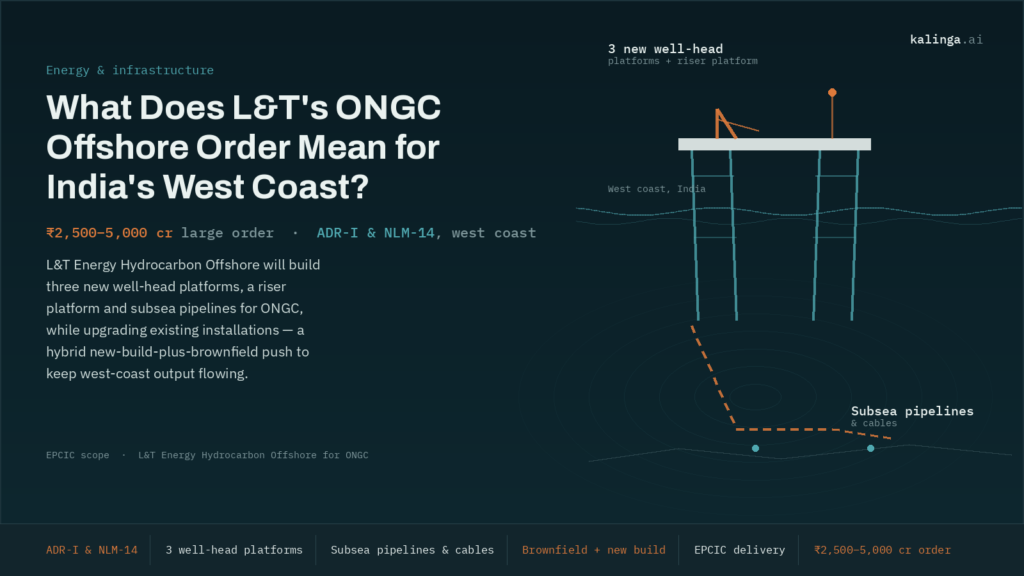
What does a ₹5,000-crore offshore order actually mean when most of the infrastructure involved will sit far from India’s shoreline? Larsen & Toubro’s Energy Hydrocarbon Offshore business has secured a large order from state-run Oil and Natural Gas Corporation (ONGC) for additional development projects off India’s west coast. The L&T ONGC offshore order covers new platforms, subsea pipelines, cables and modifications to existing offshore installations.
The order is officially classified by L&T as a “large” order, meaning its value falls between ₹2,500 crore and ₹5,000 crore. The projects are the Additional Development of Ratna-I (ADR-I) and NLM-14 developments and are intended to enhance production from ONGC’s established offshore assets.
For India, the story is bigger than one corporate contract. It highlights continued investment in domestic offshore energy infrastructure at a time when maintaining output from existing oil and gas fields remains strategically important.
L&T Bags a ₹5,000-Crore Offshore Order From ONGC
The latest L&T ONGC offshore order has been awarded to L&T Energy Hydrocarbon Offshore (LTEH Offshore), the company’s business serving the offshore oil and gas industry.
According to the Economic Times, the contract covers engineering, procurement, construction, installation and commissioning of new offshore infrastructure for ONGC’s west coast projects.
L&T’s classification puts the contract in the ₹2,500 crore–₹5,000 crore “large order” category. The company has not described the announcement as a fixed ₹5,000-crore contract; therefore, the upper end of that range should not be treated as the confirmed order value.
Question: How large is the L&T ONGC offshore order?
L&T classifies the contract as a large order valued between ₹2,500 crore and ₹5,000 crore. The exact value within that range was not specified in the announcement provided by the company.
The order comes as ONGC continues developing its offshore assets on India’s western coast.
For L&T, it adds another major project to its offshore engineering portfolio. For ONGC, the work supports continued development of existing offshore fields and infrastructure.
What Exactly Will L&T Build Offshore?
The L&T ONGC offshore order involves a mixture of completely new facilities and modifications to infrastructure that is already operating.
That combination makes the project technically demanding. Engineers need to build new assets while also integrating them with existing offshore installations.
The scope includes:
- Three new well-head platforms
- One riser platform
- Multiple segments of subsea pipelines
- Subsea cables
- Brownfield modifications to existing offshore installations
- Engineering, procurement, construction, installation and commissioning
Each component plays a different role in the offshore production system.
Three new well-head platforms
A well-head platform is an offshore structure associated with wells and the equipment needed to control and manage production from them.
The three new platforms form a central part of the development programme.
Their construction requires coordination across structural engineering, offshore fabrication, installation, pipelines, equipment and safety systems.
Riser platform, subsea pipelines and cables
The order also covers a riser platform and several sections of subsea pipelines and cables.
Definition — Subsea pipeline: A pipeline installed on or beneath the seabed to transport fluids or support connections between offshore facilities and other parts of an energy system.
Subsea infrastructure is essential because offshore production facilities cannot operate as isolated structures. They need connections that allow produced hydrocarbons and other systems to move between platforms and associated infrastructure.
What are brownfield modifications?
Brownfield modifications are upgrades or changes made to an existing operating facility rather than constructing an entirely new facility.
This is particularly challenging offshore because engineers have to work around existing equipment and operating systems. New infrastructure must be integrated without compromising the safety and functioning of the established installation.
Question: Why are brownfield modifications important in the ONGC project?
They allow ONGC to enhance existing offshore assets rather than relying exclusively on completely new developments. The L&T project therefore combines new infrastructure with upgrades to existing installations.
What Is an Offshore Development Project?
An offshore development project involves building or upgrading infrastructure used to explore, produce, process or transport oil and gas from fields located beneath the seabed.
Unlike an ordinary construction project on land, offshore work must account for marine conditions, limited working space, specialised vessels and demanding safety requirements.
The L&T ONGC offshore order illustrates this complexity because its scope covers the complete project cycle, from engineering and procurement through construction, installation and commissioning.
Why is offshore construction difficult?
The physical environment is one major reason.
Engineers and construction teams have to account for factors such as:
- Marine weather conditions
- Waves and currents
- Offshore transportation
- Limited access to facilities
- Heavy-lift requirements
- Subsea installation
- Integration with operating assets
- Strict safety procedures
The result is a highly coordinated engineering exercise.
Question: Is offshore oil and gas infrastructure just about drilling wells?
No. Drilling is only one component of a much larger system. Offshore production requires platforms, pipelines, cables, processing and control equipment, transportation infrastructure and connections to existing facilities.
That is why contracts such as the L&T ONGC offshore order can involve thousands of engineering and construction activities even when the headline simply says “offshore development.”
Why ONGC Is Investing in India’s West Coast Assets
ONGC is India’s state-run oil and gas producer and has extensive offshore operations.
The latest projects involve the ADR-I and NLM-14 developments, both associated with offshore assets on India’s western coast.
According to L&T’s announcement, the projects are designed to enhance production and support continued development of ONGC’s offshore assets.
This is important because existing oil and gas fields require ongoing investment.
Production from a field is not necessarily static throughout its operating life. Infrastructure may need to be expanded, modified or upgraded to maintain or improve output.
Developing existing assets
The latest project illustrates a practical approach to energy infrastructure: improving established offshore assets rather than treating energy production as a series of entirely new greenfield projects.
Definition — Greenfield vs brownfield: A greenfield project is developed from a relatively new or undeveloped site, while a brownfield project involves modifying or expanding existing infrastructure.
The ONGC developments include elements of both approaches.
New platforms and subsea infrastructure represent new construction, while modifications to existing offshore installations represent brownfield work.
Question: Why develop an existing offshore field instead of building an entirely new one?
Existing assets already have infrastructure, operational experience and established connections. Additional development can therefore help extend or improve the use of those assets, although the commercial and technical feasibility varies from field to field.
What Does the L&T Order Mean for Oil and Gas Production?
The immediate objective of the projects is clear: support and enhance production from ONGC’s offshore assets.
However, it is important not to confuse infrastructure investment with a guaranteed production increase of a specific amount. The announcement does not provide a quantified production figure attributable to the L&T contract.
What it does establish is that ONGC is continuing to invest in infrastructure connected to its western offshore operations.
That matters because India’s domestic energy supply depends on a combination of domestic production, imports, refining and other energy sources.
Infrastructure is the hidden layer of energy security
When people think about oil and gas, they often focus on wells, crude prices or petrol and diesel.
But behind those headlines is a huge physical infrastructure network.
Platforms extract resources. Pipelines transport them. Processing systems prepare them. Ports, vessels and onshore facilities connect the offshore system to the wider energy economy.
The L&T ONGC offshore order sits within that infrastructure layer.
Question: Will this order immediately increase India’s oil production?
Not necessarily. The project is intended to enhance production and develop offshore assets, but the announcement does not specify a precise production increase or an immediate timeline for additional output.
That distinction is important when interpreting large infrastructure announcements.
EPCIC Explained: How L&T Will Execute the Project
One of the most important technical terms in the announcement is EPCIC.
Definition — EPCIC: Engineering, Procurement, Construction, Installation and Commissioning is an integrated project-delivery model covering the major stages required to turn an offshore engineering design into an operational facility.
For a project like this, the five stages broadly mean:
- Engineering: Designing the platforms, pipelines, cables and associated systems.
- Procurement: Sourcing equipment, materials and components.
- Construction: Fabricating and assembling the required infrastructure.
- Installation: Transporting and installing structures and subsea systems offshore.
- Commissioning: Testing systems and preparing them for operational use.
This integrated approach is especially valuable for complex offshore developments because multiple engineering disciplines have to work together.
Why integration matters
Imagine building a platform without knowing how its pipelines will connect to existing infrastructure. The project could encounter serious problems during installation.
EPCIC reduces that disconnect by bringing different stages of the project into a coordinated delivery framework.
Question: Why did ONGC award the project to L&T Energy Hydrocarbon Offshore?
The available announcement confirms that LTEH Offshore received the order, but it does not provide a detailed comparative explanation of the commercial evaluation or tender process. L&T says its offshore business has executed projects involving fixed platforms, subsea pipelines, structures, brownfield upgrades and decommissioning over the past four decades.
L&T vs ONGC: Who Does What?
Understanding the roles of the two companies makes the L&T ONGC offshore order easier to understand.
| Organisation | Role in the project |
| ONGC | State-run oil and gas producer and project owner/client |
| L&T Energy Hydrocarbon Offshore | Engineering and offshore project execution |
| L&T | Parent company of the engineering and infrastructure business |
| Offshore contractors and suppliers | Support specialised equipment, fabrication, installation and services |
ONGC is responsible for developing its offshore energy assets, while L&T’s offshore business provides the engineering and project-execution capability required to build and modify infrastructure.
This relationship is common in large energy projects: the asset owner contracts specialised engineering companies to execute complex infrastructure.
L&T’s offshore experience
L&T says its Energy Hydrocarbon Offshore business has worked on offshore projects for more than four decades.
Its stated experience covers fixed platforms, subsea pipelines and structures, brownfield upgrades and decommissioning assignments.
That range is relevant to the latest contract because the ONGC project combines several of these capabilities.
Why This Order Matters for India’s Energy Infrastructure
The L&T ONGC offshore order is significant because it combines infrastructure development with continued investment in domestic energy production.
India remains a major energy-consuming economy, and domestic oil and gas production forms one part of its overall energy system.
Offshore resources can be particularly important because India’s western offshore basin has established oil and gas infrastructure and producing assets.
The latest order shows that investment continues not only in discovering resources but also in developing and sustaining established offshore fields.
What could the project mean for India’s engineering sector?
Large offshore projects create demand for specialised engineering and construction capabilities.
The work can involve:
- Structural engineering
- Marine engineering
- Pipeline engineering
- Subsea technology
- Project management
- Fabrication
- Heavy-lift operations
- Electrical and instrumentation systems
- Safety engineering
- Digital project monitoring
For young engineers, that makes offshore energy more relevant than it may initially appear.
The industry increasingly combines traditional mechanical and civil engineering with digital tools, automation, data analysis and sophisticated project-management systems.
What Investors Should Know About the L&T Order
L&T’s share price was reported at ₹3,997.25 around 10:10 a.m. on September 9, 2026, up ₹37.25 or 0.94% on the BSE at that time, according to the Economic Times.
However, a single intraday share-price movement should not be interpreted as proof that the contract alone caused the change.
For investors, the more useful takeaway is the potential contribution of large orders to L&T’s project pipeline.
What should investors watch next?
The key factors include:
- Execution of the offshore contract
- Progress on new platforms
- Subsea pipeline and cable installation
- Brownfield integration
- Project timelines
- Further order inflows
- Broader energy-sector investment
- L&T’s overall financial performance
Question: Is the L&T ONGC offshore order automatically positive for L&T shareholders?
A large order can strengthen a company’s order book and future revenue visibility, but it does not by itself determine shareholder returns. Investors also need to consider execution, margins, costs, cash flows, other orders and overall market conditions.
What the ONGC Project Says About India’s Offshore Future
The latest L&T ONGC offshore order provides a useful snapshot of where India’s energy infrastructure stands.
The country is not simply building new energy facilities. It is also investing in existing assets to maintain production and improve infrastructure.
That distinction becomes increasingly important as mature fields require upgrades and additional development.
The ADR-I and NLM-14 projects demonstrate this hybrid approach: new offshore platforms are being combined with modifications to existing installations.
For L&T, the project reinforces its position in complex offshore engineering.
For ONGC, it supports the continued development of assets along India’s western coast.
For India, it represents another investment in the physical infrastructure behind domestic oil and gas production.
The Bottom Line
The L&T ONGC offshore order is a large engineering and infrastructure contract covering the development of ONGC’s ADR-I and NLM-14 offshore projects on India’s west coast.
L&T Energy Hydrocarbon Offshore will execute work involving three new well-head platforms, a riser platform, subsea pipelines and cables, and modifications to existing offshore installations.
The contract is classified by L&T as a ₹2,500-crore to ₹5,000-crore large order.
More importantly, the project shows how India’s offshore energy infrastructure is evolving. New facilities are being combined with upgrades to existing assets, while specialised engineering companies such as L&T take on increasingly integrated roles.
For students and young professionals, the project also offers a reminder that India’s energy sector is deeply connected to engineering, manufacturing, marine technology, project management and digital systems.
FAQ: L&T, ONGC and the Offshore Order
What is the L&T ONGC offshore order?
The L&T ONGC offshore order is a large contract awarded to L&T Energy Hydrocarbon Offshore by ONGC for additional development projects off India’s west coast. It covers new offshore infrastructure and modifications to existing installations.
How much is L&T’s offshore order from ONGC worth?
L&T classifies the order as a large order valued between ₹2,500 crore and ₹5,000 crore. The specific contract value within that range was not disclosed in the announcement.
What will L&T build for ONGC?
The project includes three new well-head platforms, a riser platform, multiple sections of subsea pipelines and cables, along with brownfield modifications to existing offshore installations.
What are the ADR-I and NLM-14 projects?
ADR-I refers to the Additional Development of Ratna-I, while NLM-14 is another offshore development covered by the contract. L&T says both projects are intended to support enhanced production and continued development of ONGC’s offshore assets.
What does EPCIC mean in the L&T project?
EPCIC stands for Engineering, Procurement, Construction, Installation and Commissioning. It covers the major stages required to design, build, install and prepare offshore infrastructure for operation.
Why is the ONGC west coast project important?
The project supports continued investment in India’s western offshore energy infrastructure. It combines new facilities with modifications to existing assets, helping ONGC continue developing established offshore fields. keep exploring kalinga.ai for more.