What is the Raghav Chadha voter registration controversy?
When a politician’s name appears in an electoral roll after an earlier draft showed a different voter count, even a routine administrative process can quickly become a political controversy.
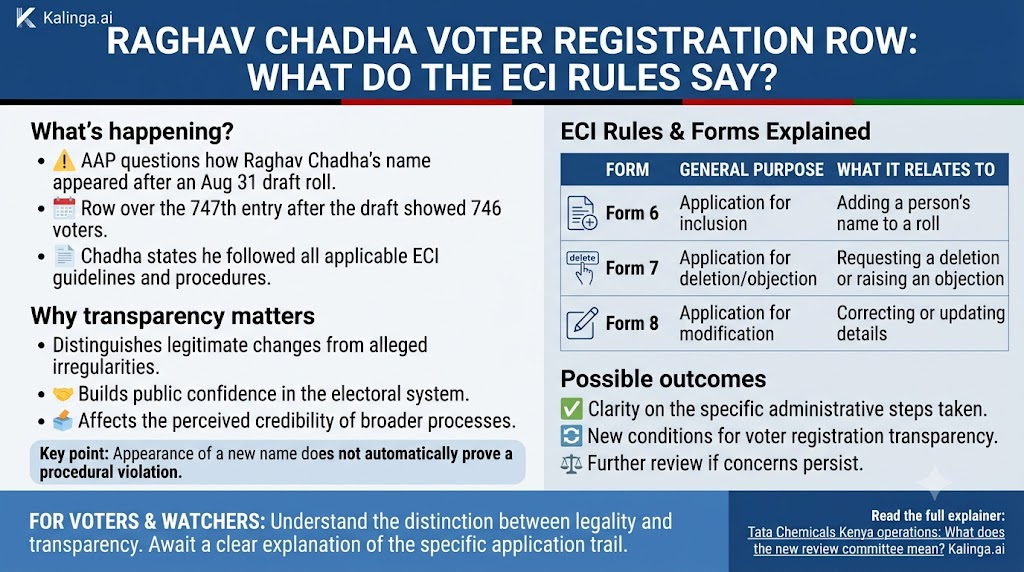
The Raghav Chadha voter registration dispute centres on allegations by the Aam Aadmi Party (AAP) about how BJP MP Raghav Chadha’s name appeared in the electoral roll of Assembly Constituency 39, Rajinder Nagar. Chadha has rejected the allegations, saying he followed all applicable Election Commission of India (ECI) guidelines and procedures.
The Delhi Chief Electoral Officer’s office, meanwhile, has explained that additions, deletions and modifications to electoral rolls are carried out through prescribed forms and processed by Electoral Registration Officers (EROs).
The disagreement is therefore not simply about whether Chadha is registered as a voter. It is about how his name was added, what procedure was followed and whether that process was transparent enough for political parties and voters to understand.
AAP has questioned how Chadha’s name appeared after an August 31 draft roll reportedly showed 746 voters, while Chadha’s name subsequently appeared as the 747th entry.
Chadha has described the allegations as baseless and accused AAP of confusing electoral rolls with its party membership register.
What did Raghav Chadha say about the allegations?
Raghav Chadha has strongly rejected AAP’s claims regarding his voter registration.
In his response, Chadha said he had followed all applicable ECI guidelines and procedures and had used the prescribed remedies available under the electoral system.
He also accused AAP and its leadership of repeatedly targeting him since he left the party.
Chadha argued that AAP was confusing two completely different records: the electoral roll and the party’s membership register.
He further alleged that AAP had created a dedicated effort to target him following his departure from the party.
Question: What is Chadha’s central defence?
Chadha’s central defence is that his voter registration was carried out according to the procedures prescribed by the Election Commission. He says the allegations against him are baseless and that he used the remedies available under the established electoral process.
That distinction matters because voter registration is governed by electoral laws and administrative procedures, rather than by a political party’s internal membership system.
What did the Election Commission say about voter roll changes?
The Delhi Chief Electoral Officer’s office issued a clarification after AAP questioned how Chadha’s name was included in the Rajinder Nagar electoral roll.
According to the clarification, names can be added, deleted or modified in electoral rolls through specific statutory forms.
The process involves Electoral Registration Officers, or EROs, who handle applications according to the Representation of the People Act, 1950, the Registration of Electors Rules, 1960, and instructions issued by the Election Commission of India.
Form 6, Form 7 and Form 8 explained
Understanding these forms is useful because they are central to the dispute.
Definition: Electoral roll forms are prescribed applications used to request specific changes to voter records.
The ECI framework uses different forms for different types of electoral-roll actions:
| Form | General purpose | What it relates to |
| Form 6 | Application for inclusion | Adding a person’s name to an electoral roll |
| Form 7 | Application for deletion/objection | Requesting deletion of a name or raising an objection |
| Form 8 | Application for modification | Correcting or updating details in an electoral roll |
The Delhi CEO’s clarification specifically cited these forms when explaining how names are added, deleted or modified.
Question: Does the appearance of a new name automatically prove that the procedure was violated?
No. A name appearing after a draft roll does not by itself establish that the legal procedure was bypassed. The relevant question is whether the appropriate application was submitted, processed and approved through the prescribed mechanism.
That is why the specific administrative record behind Chadha’s entry is central to the controversy.
Why is the August 31 draft electoral roll important?
The August 31 draft electoral roll has become one of the most important points in AAP’s argument.
According to AAP’s National Media In-charge Anurag Dhanda, the draft roll contained 746 voters. AAP then questioned how Chadha’s name appeared as the 747th entry in the electoral roll.
The party argued that the Election Commission had not adequately explained how the additional entry was created.
Dhanda described the development as evidence of what AAP called a “backdoor” addition and said it raised questions about the transparency of the Special Intensive Revision, or SIR, process.
It is important to distinguish between an allegation and an established finding. AAP has made the allegation, while Chadha has rejected it and the Delhi CEO has explained the standard legal framework for changes to electoral rolls.
What is a draft electoral roll?
A draft electoral roll is a provisional version of the voter list published for a defined process of verification, claims, objections or revisions.
The purpose of a draft is not necessarily to freeze the voter list permanently. Electoral records can undergo lawful additions, deletions and corrections through the prescribed mechanisms.
This is why the timeline between a draft roll and a later version needs to be examined alongside the relevant applications and decisions.
What is AAP alleging about Chadha’s voter registration?
AAP’s objection focuses primarily on how Chadha’s name appeared in the Delhi electoral roll.
The party says the Election Commission’s response did not adequately explain the specific circumstances through which the name was added.
Anurag Dhanda argued that the fact that Chadha’s name appeared after the August 31 draft containing 746 voters raised questions about the transparency of the process.
AAP also questioned whether the prescribed legal and procedural requirements had been followed before the additional entry appeared.
The party has therefore shifted attention from the identity of the voter to the administrative trail behind the voter entry.
Question: What exactly does AAP want explained?
AAP wants the Election Commission to explain how Chadha’s name became the 747th entry after the August 31 draft listed 746 voters. The party says a clear explanation of the specific process would address its concerns about transparency.
That demand is different from proving that the registration itself was unlawful. The available report describes AAP’s allegations and the ECI’s procedural clarification but does not establish a final finding that Chadha’s registration violated electoral law.
What is the dispute over the 747th voter entry?
The number 747 has become a central talking point because it represents the apparent sequence of Chadha’s name in the electoral roll after the earlier draft reportedly contained 746 voters.
From AAP’s perspective, the question is straightforward: if the draft contained 746 names, how did the next version contain Chadha as the 747th entry?
But electoral rolls are administrative records that can change during revision processes.
A later addition is not inherently unusual if an eligible voter has submitted the appropriate application and the competent electoral authority has processed it.
The important issue is whether the addition can be connected to a valid application and an authorised decision.
Why the paperwork matters
Electoral systems rely on documentation because voter eligibility and registration need to be independently verifiable.
In this case, the relevant questions include:
- Was an appropriate application submitted?
- Which statutory form was used?
- Was the application processed by the appropriate ERO?
- Were applicable ECI instructions followed?
- Was the name included through the authorised electoral-roll process?
- What records explain the change between the draft and subsequent roll?
These questions are more important than simply looking at the numerical sequence of voters.
Question: Does being the 747th entry prove that Chadha was added improperly?
No. The sequence number alone cannot establish whether a voter was lawfully added. The underlying application, verification and ERO decision are what determine whether the prescribed procedure was followed.
How does the electoral roll modification process work?
The electoral roll system is designed to allow eligible citizens to be added while also allowing incorrect or outdated information to be removed or corrected.
The Delhi CEO’s clarification stated that additions, deletions and modifications are handled through Forms 6, 7 and 8, respectively.
The applications are processed by Electoral Registration Officers under India’s electoral laws and ECI instructions.
This provides an important distinction between a voter-list change and an arbitrary change.
A voter list can legitimately change between different publication stages because people move, become eligible, correct details, object to entries or otherwise interact with the registration system.
The basic process
At a simplified level, the process can be understood as:
Application → Electoral authority processing → Verification under applicable rules → Decision → Electoral roll update
The exact administrative procedure can vary depending on the nature of the application and the relevant election or revision process.
The key principle is that electoral-roll changes should be traceable to the applicable legal and administrative framework.
Why transparency matters in electoral rolls
The Raghav Chadha voter registration dispute illustrates why transparency is almost as important as the underlying decision in electoral administration.
Even when an electoral authority follows the correct procedure, a lack of clear explanation can create confusion if political parties or voters cannot understand why a name appeared, disappeared or changed.
This is especially relevant when the individual involved is a prominent political figure.
Electoral rolls affect who can participate in elections. Consequently, questions about additions and deletions can quickly become questions about the credibility of the broader electoral process.
Transparency versus legality
These two concepts should not be treated as identical.
Legality asks whether the applicable law and rules were followed.
Transparency asks whether the process and its reasoning are sufficiently clear and traceable for relevant stakeholders to understand what happened.
A process can therefore face transparency questions without there already being a proven finding of illegality.
In the Chadha case, that distinction is particularly important because AAP is questioning the explanation for the entry, while Chadha maintains that he followed ECI procedures.
What does the dispute reveal about India’s electoral system?
The controversy offers a useful example of how India’s voter-registration infrastructure works.
For citizens, electoral rolls can appear to be simple lists of names. Behind those lists, however, are laws, rules, forms, electoral officials and administrative decisions.
The use of designated forms creates a documented pathway for making changes.
That system serves several purposes:
- Adding eligible voters to the electoral roll.
- Removing entries where deletion is legally justified.
- Correcting voter information when details need to be changed.
- Providing an administrative record for electoral authorities.
- Creating a process for claims and objections during electoral-roll revision.
The Raghav Chadha voter registration controversy demonstrates why understanding this system matters before drawing conclusions from a change in the published voter list.
Could the controversy affect public trust?
Political disputes over electoral rolls can have an impact beyond the individual involved.
If voters believe names are being added or removed without clear procedures, confidence in elections can suffer.
Conversely, when electoral authorities clearly explain the legal basis and administrative trail behind a disputed change, it becomes easier for citizens and political parties to evaluate the claim.
The current controversy therefore raises a broader question about how electoral authorities communicate procedural decisions.
Question: Why does clear communication matter when electoral rolls are revised?
Clear communication helps distinguish legitimate administrative changes from alleged irregularities. When authorities explain the applicable forms, legal framework and processing mechanism, the public has more information with which to assess competing political claims.
That does not automatically resolve every dispute, but it creates a stronger basis for accountability.
What could happen next in the Raghav Chadha voter registration row?
The immediate focus is likely to remain on the specific administrative record associated with Chadha’s electoral-roll entry.
AAP has demanded a clearer explanation of how his name appeared after the August 31 draft roll.
Chadha has rejected the allegations and said he followed the applicable ECI procedures and used the prescribed remedies.
The Election Commission’s procedural clarification provides the general framework, but the political controversy centres on whether that framework was followed in this particular case.
For the dispute to move beyond political claims, the most useful information would be a clear explanation of the specific application and administrative steps that resulted in Chadha’s inclusion.
Until then, it is important to separate three different things:
- What AAP alleges
- What Chadha says
- What the electoral authorities have officially explained
These are not necessarily the same.
Raghav Chadha voter registration: Key takeaways
The controversy can be understood through a few central points:
- Raghav Chadha has denied AAP’s allegations concerning his voter registration.
- Chadha says he followed all applicable ECI guidelines and procedures.
- The Delhi CEO has said electoral-roll additions, deletions and modifications are made through Forms 6, 7 and 8.
- Such applications are processed by Electoral Registration Officers under the Representation of the People Act, 1950, the Registration of Electors Rules, 1960 and ECI instructions.
- AAP has questioned how Chadha’s name appeared after an August 31 draft roll reportedly listed 746 voters.
- AAP says Chadha appeared as the 747th entry and has demanded an explanation of the process.
- The available information describes competing claims and the ECI’s general procedural clarification; it does not establish a final finding that Chadha’s registration was unlawful.
The most important question, therefore, is not simply why a new name appeared. It is what documented process led to that change.
FAQ: Raghav Chadha voter registration
Why is Raghav Chadha’s voter registration being questioned?
AAP is questioning how Raghav Chadha’s name appeared in the electoral roll of Rajinder Nagar after an August 31 draft reportedly showed 746 voters. The party has asked the Election Commission to explain how his name became the 747th entry.
What has Raghav Chadha said about the voter roll allegations?
Raghav Chadha has called the allegations baseless and said he followed all applicable Election Commission of India guidelines and procedures. He has also accused AAP of targeting him after his departure from the party.
What did the Delhi Chief Electoral Officer say about voter-list changes?
The Delhi CEO said additions, deletions and modifications to electoral rolls are made through Forms 6, 7 and 8, respectively. Applications are processed by Electoral Registration Officers under applicable electoral laws, rules and Election Commission instructions.
What are Forms 6, 7 and 8 used for?
Form 6 is used for applications for inclusion in an electoral roll, Form 7 concerns deletion or objections to entries, and Form 8 is used for modifications or corrections to electoral-roll details.
What is AAP’s main objection in the Chadha voter roll controversy?
AAP’s main objection is that the Election Commission has not, in the party’s view, adequately explained the specific process through which Chadha’s name appeared after the August 31 draft roll. AAP says this raises transparency concerns.
Does the 747th entry prove that Chadha’s voter registration was illegal?
No. The fact that Chadha appeared as the 747th entry does not by itself establish an illegal registration. Determining whether the process was lawful requires examining the relevant application, verification and decision under the applicable electoral rules.
Conclusion
The Raghav Chadha voter registration row is ultimately a dispute about procedure, documentation and transparency as much as it is about politics. Chadha says he followed ECI rules, AAP wants a clearer explanation of how his name appeared, and the Delhi CEO has outlined the standard framework governing electoral-roll changes.
For more explainers on Indian politics, governance, technology and major current affairs, follow Kalinga.ai for clear, context-first coverage.