Why Has Bageshwar Baba Faced a Police Complaint in Kolkata?
When a religious figure comments on what an entire community should eat during a major festival, the debate can quickly move beyond personal belief and into questions of identity, culture and social harmony.
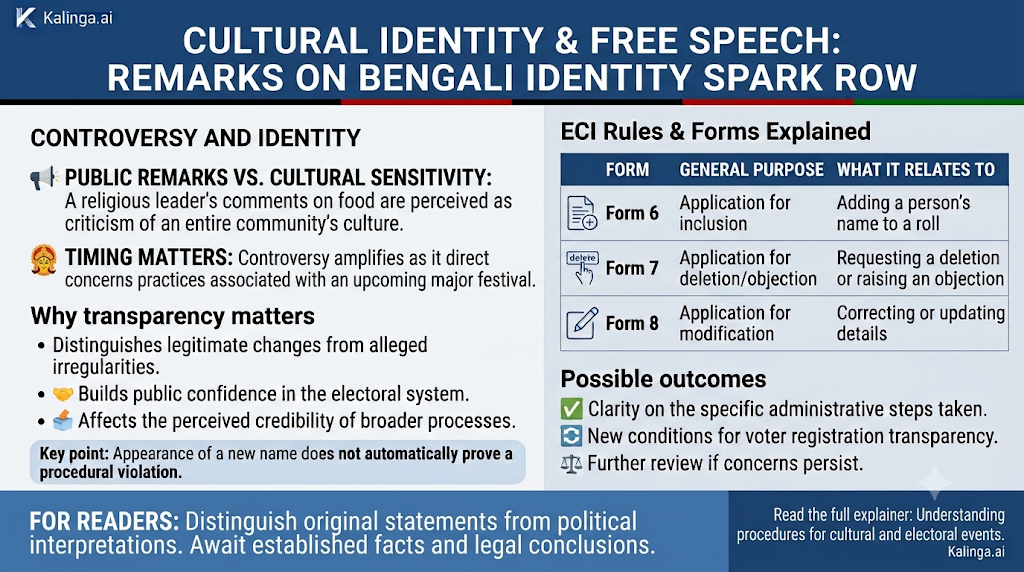
The Bageshwar Baba Kolkata police complaint concerns remarks attributed to Dhirendra Shastri about Bengali identity, religious practices and non-vegetarian food during Durga Puja. Congress leader Manash Sarkar filed the complaint at Kolkata’s Bhawanipore Police Station, alleging that the remarks hurt sentiments and could create social disharmony.
The controversy has also drawn responses from West Bengal BJP leaders, who have pushed back against any suggestion that eating fish or meat is incompatible with Bengali culture. The issue therefore involves several overlapping questions: what Shastri said, whether his comments were offensive, how Bengali food traditions relate to Durga Puja, and where personal religious advice ends and community identity begins.
What is the central issue?
The central issue is a dispute over remarks attributed to Dhirendra Shastri concerning Bengali identity and non-vegetarian food during Durga Puja. A Congress leader has sought police action and an apology, while BJP leaders have said that food choices are part of personal freedom and that fish and meat have long been associated with Bengali customs.
The complaint does not itself establish that any offence has been committed. It represents an allegation and a request for authorities to examine the matter.
What Did Dhirendra Shastri Say About Bengali Identity and Food?
The controversy centres on comments attributed to Dhirendra Shastri, popularly known as Bageshwar Baba. According to the report, his remarks questioned the consumption of non-vegetarian food during Durga Puja and criticised aspects of Bengali behaviour and identity.
Congress leader Manash Sarkar said Shastri had called Bengalis hypocrites and questioned why people eat fish, mutton and chicken. Sarkar argued that an outside figure should not dictate what Bengalis should eat.
Question: Why did the comments become politically sensitive?
Because the remarks were perceived not simply as an argument about vegetarianism, but as comments about an entire regional community and its cultural practices. Once questions of Bengali identity and religious observance became part of the discussion, the issue attracted political reactions from both Congress and BJP leaders.
The distinction matters. A person expressing a personal preference for vegetarian food is different from making a broader statement about what a community should or should not consume.
Bengali identity: Bengali identity refers to the cultural, linguistic, historical and social traditions associated with Bengali-speaking communities.
Food is one part of that identity, alongside language, literature, music, festivals, family traditions and regional customs. Bengali cuisine itself includes a wide range of vegetarian and non-vegetarian dishes, making food habits an especially visible part of cultural identity.
The current controversy emerged because remarks about food were interpreted by critics as comments about Bengali culture more broadly.
Why Has Non-Vegetarian Food During Durga Puja Become Controversial?
The immediate flashpoint is the question of whether Bengalis should eat non-vegetarian food during Durga Puja.
The festival has deep religious significance, but its observance differs across families, communities and regions. Dietary practices can vary depending on household traditions, specific days of the festival, religious beliefs and individual preferences.
West Bengal BJP President Samik Bhattacharya directly pushed back against the criticism of Bengali non-vegetarian food traditions. He said meat and fish are part of West Bengal customs and referred to traditional food practices during the festival.
He specifically mentioned that Bengalis may eat luchi on Ashtami and kochi patha, or young goat meat, on Navami.
Question: Is Bengali food traditionally only vegetarian during Durga Puja?
No. Bengali food culture includes both vegetarian and non-vegetarian traditions, and practices can vary from household to household. The political response in West Bengal has emphasised that fish and meat are traditionally consumed by many Bengalis, including around festive occasions.
That does not mean every Bengali family eats non-vegetarian food during Durga Puja. It means there is no single dietary practice that represents every Bengali household.
Personal belief versus community tradition
This distinction is important for understanding the Bageshwar Baba Kolkata police complaint.
A religious leader can advocate vegetarianism as part of a personal or religious philosophy. At the same time, individuals and communities may follow different dietary traditions.
The controversy becomes sharper when a recommendation is perceived as a judgment about the cultural legitimacy of another community’s established practices.
How Have West Bengal BJP Leaders Responded?
One of the most notable aspects of the controversy is that criticism has not come only from opposition parties.
West Bengal BJP President Samik Bhattacharya said eating fish and meat is part of Bengali culture. His response effectively separated the religious figure’s personal views from the established food practices followed by many people in the state.
Bhattacharya also questioned why comments made by a religious figure should automatically become a political matter.
West Bengal Minister Dilip Ghosh similarly argued that individuals have the freedom to follow their own dietary preferences. He noted that many people across India are vegetarian while many people in West Bengal have traditionally followed non-vegetarian diets.
Question: Do BJP leaders agree with Dhirendra Shastri’s position?
The responses cited in the report indicate that West Bengal BJP leaders did not endorse restricting Bengali non-vegetarian food traditions. Instead, they stressed personal choice and the place of fish and meat in Bengali customs.
This makes the controversy politically unusual because reactions do not fall neatly along a simple government-versus-opposition line.
What Does the Kolkata Police Complaint Allege?
Congress leader Manash Sarkar filed the complaint at Bhawanipore Police Station in Kolkata. According to the report, he alleged that Shastri’s remarks about Bengali identity, food practices and Durga Puja could hurt sentiments and create social disharmony.
Sarkar demanded both an apology and police action.
He also warned that if an apology was not offered and no action was taken under the law, his side would consider further steps. He even raised the possibility of opposing Shastri’s entry into West Bengal.
Question: Does filing a police complaint mean Dhirendra Shastri has been found guilty?
No. A police complaint is an allegation and a request for investigation or action; it is not by itself a finding of guilt. Any legal determination would depend on the applicable law, the facts established by authorities and the subsequent legal process.
This distinction is essential when following politically sensitive stories. A complaint, an investigation, an allegation and a court finding are separate stages and should not be treated as interchangeable.
Why Is the Controversy About More Than Food?
At first glance, the Bageshwar Baba Kolkata police complaint may look like a disagreement over dietary preferences. But the deeper issue is how cultural identity intersects with religion and politics.
Bengali identity is not defined by one food choice. However, food is closely connected to family traditions, celebrations and regional culture. For many people, questioning a familiar food practice can therefore be interpreted as questioning part of their cultural identity.
Three overlapping debates
The controversy can be understood through three connected questions:
- Religion: What dietary practices does an individual believe are appropriate during a religious festival?
- Culture: What foods have historically been part of Bengali social and culinary traditions?
- Politics: Should public figures be held accountable when their comments are perceived as insulting or divisive?
Each question has a different answer depending on the perspective being applied.
Question: Why does food become such a sensitive political issue?
Because food is both personal and cultural. People may view dietary choices as matters of individual freedom while simultaneously seeing traditional dishes as symbols of family, regional and community identity.
That combination makes food-related statements particularly capable of triggering public debate.
Bengali Identity and Religious Practice Are Not the Same Thing
Another important distinction is between Bengali identity and religious observance.
Not every Bengali follows the same religion, and not every person observing Durga Puja follows identical dietary rules. Even among Hindu families, customs can differ substantially.
Similarly, Bengali cuisine contains extensive vegetarian traditions alongside fish, meat and other non-vegetarian foods.
This means that a single rule about what Bengalis should eat cannot automatically describe the practices of an entire population.
Question: Can religious dietary beliefs and Bengali food traditions coexist?
Yes. Different people can follow different dietary practices while participating in the same broader cultural or religious environment. A vegetarian devotee can observe a festival according to their beliefs, while another family may follow a different traditional food practice.
The disagreement arises when one practice is presented as the only legitimate choice for everyone.
How Does Durga Puja Fit Into the Debate?
Durga Puja is one of the most prominent festivals associated with Bengal and Bengali cultural life. Its observance includes religious rituals, community celebrations, food, art, music and social gatherings.
The festival’s cultural expression can differ between households and locations. Food traditions are therefore not necessarily uniform across all celebrations.
The comments attributed to Shastri focused attention on whether non-vegetarian food should be consumed during the festival. Political responses, however, shifted the discussion toward the broader question of whether such dietary choices are compatible with Bengali customs.
Why the timing matters
The controversy comes as Durga Puja approaches, making the issue especially relevant in West Bengal.
A comment about festival food made shortly before a major celebration can attract significantly more public attention than the same statement made at another time of year.
Question: Why did the Durga Puja timing intensify the debate?
Because the remarks directly concerned food practices associated with an approaching festival that has major cultural importance in West Bengal. The timing brought the issue into an active public conversation about how the festival should be observed.
Bageshwar Baba Kolkata Police Complaint: What Are the Main Positions?
The dispute involves several clearly different positions. Understanding them separately helps avoid reducing the story to a simple political confrontation.
| Stakeholder | Position described in the report | Main concern |
| Manash Sarkar, Congress | Sought an apology and police action | Bengali identity, sentiments and social harmony |
| Dhirendra Shastri | His remarks triggered the controversy | Views on Bengali identity and food practices |
| Samik Bhattacharya, West Bengal BJP | Defended Bengali food customs | Fish and meat as part of Bengali culture |
| Dilip Ghosh, West Bengal minister | Emphasised personal dietary choice | Freedom to follow individual preferences |
| Kolkata Police | Received the complaint | Examination of the allegations and applicable law |
The table also shows why the issue cannot be accurately described simply as “vegetarian versus non-vegetarian.” The dispute includes questions about cultural representation, public speech and political accountability.
What Are the Broader Political Implications?
The Bageshwar Baba Kolkata police complaint comes at the intersection of religion, regional identity and electoral politics.
West Bengal has a strong political culture in which questions of Bengali identity and cultural autonomy can become politically significant. Statements involving food, language, religion or regional customs can therefore receive intense attention.
The reaction from BJP leaders is particularly notable because it shows that defending Bengali food traditions is not necessarily confined to opposition parties.
Question: Could the controversy affect politics in West Bengal?
It could influence public debate, particularly because the comments touch on Bengali identity and religious-cultural practices, but the supplied report does not establish a specific electoral impact. Any claim about consequences for elections or voter behaviour would require evidence beyond the current complaint and reactions.
That distinction is important. Political controversy can generate headlines without necessarily producing measurable changes in public opinion.
Why Public Figures Need to Be Precise About Cultural Claims
Public figures, particularly religious leaders and politicians, often speak to large audiences. Their statements can therefore be interpreted more broadly than a private conversation.
A comment intended as religious advice may be understood by listeners as criticism of a community. Similarly, a political response intended to defend cultural traditions can intensify rather than resolve a dispute.
A useful way to read controversies like this
When encountering a politically charged statement, separate the story into four layers:
- What was actually said?
- Who interpreted it as offensive or harmful?
- What response followed?
- What has been legally established, if anything?
This approach prevents allegations from being mistaken for established facts.
Question: What should readers avoid assuming about the case?
Readers should avoid treating the filing of a police complaint as proof that an offence occurred or that the accused person has been found guilty. They should also distinguish between a person’s reported remarks, political interpretations of those remarks and any eventual findings by authorities or courts.
What Could Happen Next in the Bageshwar Baba Controversy?
The immediate question is how authorities respond to the complaint filed at Bhawanipore Police Station.
The complainant has asked for police action and an apology. Meanwhile, political leaders have continued to debate whether Shastri’s remarks crossed a line and whether they misrepresented Bengali culture.
The report does not provide a final legal determination. Therefore, any discussion of potential charges, investigation outcomes or court proceedings should be treated as conditional unless authorities subsequently confirm them.
Question: What is the most important next development to watch?
The key development will be whether police take further action on the complaint and whether Dhirendra Shastri responds publicly to the criticism or demands for an apology. Further official statements could clarify the legal and political direction of the dispute.
For readers, the safest approach is to track confirmed statements from police, the complainant, Shastri and relevant political leaders rather than relying on social-media interpretations.
What Does This Controversy Tell Us About Food, Religion and Identity?
The debate surrounding the Bageshwar Baba Kolkata police complaint illustrates how ordinary cultural practices can become politically charged when they are connected to religion and identity.
Food is rarely just food in a culturally rich society. Recipes, ingredients and eating habits can carry memories of family, region, festivals and community traditions.
At the same time, religious belief can lead individuals to follow dietary rules that differ from those of their neighbours. A diverse society accommodates both realities.
The bigger lesson
A useful principle is that individual religious preference does not automatically become a universal cultural rule.
One person may choose vegetarian food for religious reasons. Another may regard fish or meat as an important part of family tradition. Neither choice, by itself, necessarily represents the dietary behaviour of an entire community.
The current dispute demonstrates why statements about collective identity need to be made carefully, particularly when they involve politically sensitive regions and major religious festivals.
Key Takeaways From the Kolkata Row
The Bageshwar Baba Kolkata police complaint can be summarised through several important points:
- Congress leader Manash Sarkar filed a complaint at Bhawanipore Police Station in Kolkata against Dhirendra Shastri.
- The complaint concerns remarks about Bengali identity, food practices and Durga Puja.
- Shastri’s comments reportedly questioned the consumption of fish, mutton and chicken during the festival period.
- Sarkar alleged that the remarks hurt sentiments and could contribute to social disharmony.
- He demanded an apology and police action.
- West Bengal BJP President Samik Bhattacharya said fish and meat are part of Bengali customs.
- West Bengal Minister Dilip Ghosh emphasised individual freedom in dietary choices.
- The complaint itself does not establish guilt or prove that an offence occurred.
- The broader debate concerns the relationship between religious beliefs, Bengali cultural traditions and personal choice.
- Any further legal consequences depend on what authorities determine after considering the complaint and applicable law.
FAQ: Bageshwar Baba Kolkata Police Complaint
Why was a police complaint filed against Bageshwar Baba in Kolkata?
A Congress leader, Manash Sarkar, filed a complaint against Dhirendra Shastri, popularly known as Bageshwar Baba, at Kolkata’s Bhawanipore Police Station. The complaint alleges that his remarks about Bengali identity, food practices and Durga Puja hurt sentiments and could create social disharmony.
What did Dhirendra Shastri say about Bengali food?
According to the supplied report, Dhirendra Shastri questioned the consumption of non-vegetarian food during Durga Puja and raised questions about Bengalis eating fish, mutton and chicken. His remarks triggered criticism from political leaders in West Bengal.
Why are Bengali non-vegetarian food traditions part of the controversy?
Fish and meat have historically been part of Bengali cuisine and are described by West Bengal BJP leaders as part of Bengali customs. The controversy arose because Shastri’s remarks were perceived by critics as questioning these food practices during a major Bengali festival.
What did West Bengal BJP leaders say about the controversy?
West Bengal BJP President Samik Bhattacharya said consuming meat and fish is part of Bengali culture and referred to traditional festival food practices. Minister Dilip Ghosh also stressed that people have different dietary preferences and are free to follow them.
Does the Kolkata police complaint prove that Bageshwar Baba committed an offence?
No. A police complaint is an allegation submitted to authorities and does not itself establish guilt. Whether any offence occurred would depend on the applicable law, evidence and any subsequent investigation or judicial proceedings.
Why has the Bageshwar Baba controversy become a Bengali identity issue?
The dispute expanded beyond food because the reported comments also addressed Bengali identity and cultural behaviour. Critics viewed the remarks as an attack on Bengali customs, while political responses defended the region’s food traditions and the individual’s freedom to choose what to eat.
Final Takeaway
The Bageshwar Baba Kolkata police complaint highlights how discussions about food and religion can quickly become debates about cultural identity and social harmony. For now, the central facts are the complaint, the reported remarks and the contrasting political responses; any legal conclusion will depend on what authorities establish next.
For more explainers on major India news, politics, technology and emerging public debates, keep exploring Kalinga.ai for clear, context-first coverage.